
Hazrat Yahya Pasha Sahab Qadri: A Life of Prayer, Service and Spiritual Healing

By Adnan Faizi, New Age Islam
11 June 2026
Hazrat Syed Shah Mohammad Yahya Hussaini Badshah, known poetically as Haziq and popularly as Hazrat Yahya Pasha Sahab Qadri, was a 20th‑century Sufi master whose mausoleum lies in Misri Ganj, Hyderabad, and whose life combined inner knowledge, poetic talent, miraculous healing, and selfless service to the poor of all religions.
Main Points:
· Hazrat Yahya Pasha was born 1303 Hijri in Hyderabad and died 4 Safar 1373 Hijri at age 70.
· He was disciple of his father Hazrat Syed Mohammad Siddiqui Sahab and later custodian after his brother’s death.
· He cured diseases with prayer and amulets, helped poor of all religions, talked less, ate less, woke throughout night.
· He composed poetry under name Haziq, studied Arabic and Urdu at Darul Uloom Hyderabad under Mir Hashim Ali.
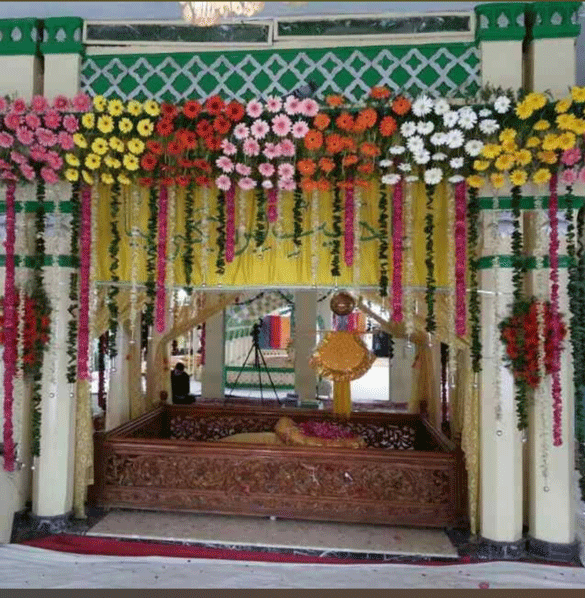
· His shrine in Riyad Jannah, Misri Ganj has Chaukhandi tomb with 12 pillars, Urs 3–5 Safar.
Early Life and Education
Hazrat Yahya Pasha Sahab Qadri, whose real name was Hazrat Syed Shah Mohammad Yahya Hussaini Badshah and whose poetic pen name was Haziq, was born in 1303 Hijri in Hyderabad into a noble Hussaini Syed family. His mother, Hazrat Qamrunnisa Begum, daughter of Hazrat Syed Shah Shaykun Ahmed Shuttari, was a pious, charitable and spiritually devoted woman. His first spiritual guide was his father, Hazrat Syed Mohammad Siddiqui Sahab, from whom he received his early education, spiritual training and khirqa (saintly dress). After his father’s demise during his childhood, he came under the care of his elder brother, Hazrat Hafiz Syed Usman Hussaini Sahab, who completed his spiritual training and later granted him khilafat and the saintly dress. Following his father’s death, his mother migrated to Madina Tayyaba, where he studied for two years at Madrasa-e-Faqria before returning to the Deccan for higher learning. He later studied at Hyderabad’s renowned Darul Uloom and obtained the Maulvi and Alim qualifications from Punjab University. His teachers included his uncle Hazrat Maulana Syed Shah Omer Hussaini, author of Tafsir-e-Qadri, and his cousin Bahr-ul-Uloom Hazrat Allama Maulana Mohammad Abdul Qadir Siddiqui, from whom he acquired advanced knowledge of Tafsir, Hadith and even martial arts.
He also learned Arabic and Urdu calligraphy from Hazrat Mir Hashim Ali and became an accomplished calligrapher, particularly in the Naskh and Nastaliq scripts. In poetry, he studied under Hazrat Fasahat Jung Jalil and Hazrat Thaqib Badayuni, gaining recognition through the pen name Haziq. His surviving poetry was later compiled in Anwar-e-Ghaib, a collection containing praises of Allah, the Prophet Muhammad and the Awliya. In 1332 Hijri, after the death of his elder brother without a male heir or successor, Hazrat Yahya Pasha assumed the custodianship of the ancestral shrine and spiritual lineage, continuing the responsibilities of his forefathers while guiding disciples and serving the community.
Lifestyle, Teachings and Family
Hazrat Yahya Pasha Sahab lived a life of simplicity, self-denial and deep spirituality. He avoided ostentation and rarely associated with wealthy people or high officials, preferring instead to serve the poor, the needy and the sick without any distinction of religion. Known for his mastery of inner spiritual knowledge, he spoke little, ate little, spent much of the night in worship, and performed Hajj and visited Madina twice during his lifetime. He was also widely respected for healing illnesses through prayers, taʿwizat (amulets) and spiritual remedies rooted in the Sufi tradition. His life reflected values of humility, service, spiritual healing, inner purification and indifference to worldly status. His example demonstrated that true spirituality lies in devotion to Allah, compassion for humanity and sincere service beyond religious boundaries.
Hazrat Yahya Pasha Sahab had four sons—Hazrat Syed Mohiuddin, Hazrat Syed Ibrahim, Hazrat Syed Usman and Hazrat Syed Mohammad—and one daughter, Safia Qamarunisa, who was married to Mir Akram Ali Khan Jagirdar, grandson of Nawab Farkhanda Yar Jung. The custodianship of the ancestral shrine and spiritual lineage later passed to Hazrat Syed Shah Mohiuddin Hussaini Qadri, who assumed the seat of teaching and spiritual instruction in accordance with the record preserved in Guldasta Tajalliyat.
Wisaal, Shrine and Urs
Hazrat Yahya Pasha Sahab Qadri passed away at the age of 70 on 4 Safar 1373 Hijri (1953 CE) at his residence in Qazipura, Hyderabad. He was buried at Riyad Jannah in Misri Ganj, outside Fatah Darwaza, on the road leading toward the tomb of Hazrat Shah Raju Qattal. The preserved shrine complex includes a garden, well, buildings and a traditional earth-made Sama Khana. At the centre of the compound stands his Chaukhandi-style mausoleum on a platform measuring 23 feet square and about 8 feet by 5 feet in height. The platform has a sand floor and steps on the eastern, western and southern sides. The roofless stone structure contains twelve yellow-coloured stone pillars, three on each side, with a stone floor inside. His single grave, made of marble and stone, measures 8 feet 6 inches in length, 5 feet 6 inches in width and 1 foot 3 inches in height.
His annual Urs is observed from 3 to 5 Safar on a grand scale, drawing large numbers of devotees, disciples and visitors. The celebrations include a fair, The grave itself has no table structure above it. Even today, the shrine is widely known among devotees for the fulfilment of prayers and wishes associated with Hazrat Yahiah Pasha Sahab’s blessings.
Legacy and Enduring Influence
Hazrat Yahya Pasha Sahab Qadri’s legacy continues through his annual Urs, held from 3 to 5 Safar, which attracts large numbers of devotees, disciples and visitors. His shrine at Riyad Jannah in Misri Ganj—featuring its distinctive Chaukhandi tomb with twelve yellow-coloured stone pillars, sand floor, garden, well, buildings, Sama Khana, remains renowned for the fulfilment of prayers and wishes. His spiritual lineage continues through his four sons Hazrat Syed Mohiuddin, Hazrat Syed Ibrahim, Hazrat Syed Usman and Hazrat Syed Mohammad—and his daughter Safia Qamarunisa, who was married to Mir Akram Ali Khan Jagirdar, grandson of Nawab Farkhanda Yar Jung. The present custodian of the shrine and spiritual seat is Hazrat Syed Shah Mohiuddin Hussaini Qadri, who continues the work of teaching and guidance as recorded in Guldasta Tajalliyat.
Known by his full name Syed Shah Mohammed Yahya Hussaini Badshah and his poetic pen name Haziq, Hazrat Yahya Pasha Sahab was a remarkable 20th-century Sufi saint whose life united inner spiritual knowledge, poetry, healing through prayers and taʿwizat, night-long worship, simplicity, and service to humanity without religious discrimination. Born in Hyderabad in 1303 Hijri, trained by his father Hazrat Syed Mohammad Siddiqui Sahab and later by his elder brother Hazrat Hafiz Syed Usman Hussaini Sahab, he became custodian of the family’s spiritual lineage after his brother’s death in 1332 Hijri. Passing away at the age of seventy on 4 Safar 1373 Hijri (1953 CE), he left behind a legacy that teaches humility, devotion, compassion, spiritual healing, and service beyond barriers of religion, caste or status, reminding people that true sainthood lies in sincere worship of Allah and selfless care for His creation.
___
Adnan Faizi is a Peace and Harmony activist based in Delhi. He is an alumni of CCS University, Meerut.
New Age Islam, Islam Online, Islamic Website, African Muslim News, Arab World News, South Asia News, Indian Muslim News, World Muslim News, Women in Islam, Islamic Feminism, Arab Women, Women In Arab, Islamophobia in America, Muslim Women in West, Islam Women and Feminism