
Hazrat Syed Qutbuddin Munawwar: The Ascetic Qutub Of Hansi And A Pillar of The Chishti Order

By Adnan Faizi, New Age Islam
5 january 2026
Hazrat Syed Qutbuddin Munawwar was a venerated Chishti Sufi saint of medieval India, grandson of Hazrat Qutb Jamaluddin Hansvi and son of Hazrat Burhanuddin Chishti Hansvi. His life exemplified ascetic devotion, moral integrity, and spiritual authority that earned him recognition even among the sultanate's rulers.
Main points:
· He was the grandson of Hazrat Jamaluddin Hansvi and khalifa of Hazrat
· Nizamuddin Auliya.
· Hazrat was born in Hansi in 1300 CE and died 1359 CE, living fifty-nine years.
· He was an ascetic saint who refused sultans’ gifts and maintained independence from politics.
· He was a contemporary of Nasiruddin Chiragh-e-Dehlvi and received khilafat same day.
· His spiritual domain was Hansi, his son Hazrat Nooruddin succeeded fourth, preserved at Char Qutub dargah.
Introduction
In the spiritual history of medieval India, a few saints continue to shine long after their time, guiding generations through their lives and teachings. Hazrat Syed Qutbuddin Munawwar was one such luminous figure of the Chishti tradition, whose character reflected the ideals of Islamic spirituality. He was born in 1300 CE in Hansi, in present-day Haryana, into a family deeply rooted in the Chishti silsila, tracing its spiritual lineage back to Hazrat Baba Fariduddin Ganjshakar.
The name Munawwar, meaning illuminated, truly reflected his inner light. His grandfather, Hazrat Qutb Jamaluddin Hansvi (1187–1261 CE), was a prominent Chishti saint and the devoted khalifa of Hazrat Baba Farid for many decades. His father, Hazrat Burhanuddin Chishti Hansvi (1261–1300 CE), carried forward this legacy as the custodian of the Hansi khanqah, upholding its values of silence, service, and spiritual detachment. Raised in this environment, Hazrat Qutbuddin Munawwar emerged as the third Qutub of his lineage, a title later affirmed by his contemporaries, symbolising his attainment of the highest spiritual rank and his role as a guiding light for the Chishti silsila of his time.
Early Life and Family Background
Hazrat Syed Qutbuddin Munawwar was born in 1300 CE in Hansi, Haryana, into one of the most spiritually distinguished Chishti families of medieval India. His lineage traced back to Hazrat Imam Abu Hanifa, and his upbringing was shaped by an unbroken silsila of Chishti saints, making spirituality not an inheritance of blood alone but of lived discipline and training. His grandfather, Hazrat Qutb Jamaluddin Ahmad Hansvi, was a foremost khalifa of Hazrat Baba Fariduddin Ganjshakar and the spiritual pillar of the Hansi khanqah. His father, Hazrat Burhanuddin Chishti Hansvi, inherited this responsibility and refined the Hansi tradition around silence, service, sincerity, and detachment. Closely connected to Hazrat Nizamuddin Auliya, Hazrat Burhanuddin ensured that his son was nurtured under the highest spiritual guidance of the Chishti order.
Raised in an atmosphere of renunciation, discipline, and inner devotion, Hazrat Qutbuddin Munawwar was prepared from an early age for spiritual leadership. Recognising his readiness for higher stations, his father sent him to Delhi for advanced training under Hazrat Nizamuddin Auliya, whose khanqah shaped his mature spiritual personality. This grounding in both hereditary and experiential spirituality enabled Hazrat Qutbuddin Munawwar to emerge as a leading Chishti saint of his generation and a rightful heir to the Hansi spiritual legacy.
Bay‘ah and Khilafat
Hazrat Qutbuddin Munawwar travelled to Delhi in his youth and entered the khanqah of Hazrat Nizamuddin Auliya, known as Mehboob-e-Ilahi, where he formally took bay‘ah and underwent sustained spiritual training. He spent several years in close companionship with his Murshid, immersing himself in the core Chishti disciplines of Quranic recitation, zikr, muraqaba, and selfless service. Under Hazrat Nizamuddin’s direct supervision, he learned not only spiritual practices but also the Chishti ethic of humility, generosity, reliance on God, and moral firmness. Recognising his spiritual maturity, Hazrat Nizamuddin Auliya granted Hazrat Qutbuddin Munawwar khilafat through a formal Khalifat-nama. Significantly, this authorisation was bestowed on the same day as that of Hazrat Nasiruddin Chiragh-e-Dehli, affirming Hazrat Qutbuddin’s standing among the foremost disciples of the Chishti order. When questioned by Hazrat Nasiruddin about the special instructions he had received, Hazrat Qutbuddin firmly upheld the Chishti principle of confidentiality, stating that spiritual secrets entrusted by the master were not to be disclosed.
Before Hazrat Qutbuddin’s return to Hansi, Hazrat Nizamuddin Auliya gave him a copy of Awariful-Ma‘arif, a foundational Sufi text. This manuscript had originally been given by Hazrat Baba Farid to Hazrat Jamaluddin Hansvi at the time of his khilafat and was now returned to the Hansi line. The gesture symbolised the continuity of spiritual authority within Hazrat Qutbuddin Munawwar’s lineage and confirmed him as the rightful inheritor of the Chishti tradition in Hansi.
Character, Asceticism, and Spiritual Authority
Hazrat Qutbuddin Munawwar was widely respected for his uncompromising asceticism and complete detachment from political power. At a time when many religious figures sought patronage from rulers, he consciously kept himself distant from courts and state authority, preserving the Chishti ideal of spiritual independence. Sultan Muhammad bin Tughlaq once attempted to test this detachment by offering Hazrat Qutbuddin two villages through the Qazi Sadr-e-Jahan Kamaluddin. Hazrat firmly refused, invoking the example of Hazrat Baba Fariduddin Ganjshakar and warning that deviation from the path of one’s spiritual masters deserved censure. The refusal itself served as moral instruction to the Sultan, reinforcing the saint’s authority without confrontation. When Sultan Muhammad bin Tughlaq later visited Hansi and summoned Hazrat Qutbuddin to court, Hazrat went unwillingly, carrying only his prayer mat and staff, accompanied by his young son, Hazrat Nooruddin. Explaining his earlier absence, he stated that he considered himself unworthy of appearing before the ruler and had remained occupied in prayers for the Sultan and the Muslim community. Deeply moved by this humility, the Sultan offered a large monetary gift of 100,000 tankas. Hazrat Qutbuddin accepted only 2,000 tankas and immediately distributed the entire amount among the poor.
During the reign of Sultan Firoz Shah Tughlaq, Hazrat Qutbuddin’s spiritual authority was acknowledged even by his fellow Chishti saints. Hazrat Nasiruddin Chiragh-e-Dehlvi declared that beyond Sarsuti, the spiritual domain belonged to Hazrat Qutbuddin of Hansi and directed the Sultan to seek his counsel. When Firoz Shah visited him, Hazrat Qutbuddin openly admonished the ruler to abandon drinking and excessive hunting, stressing that killing animals was permissible only for genuine need, not pleasure. When the Sultan requested prayers to curb his hunting habit, Hazrat Qutbuddin responded with visible displeasure, signalling that true reform required sincere intention, not mere supplication. He further rejected an expensive robe offered by the Sultan, reinforcing his lifelong message that spiritual authority rests in moral integrity, not royal favour.
Sama and Succession
Hazrat Qutbuddin Munawwar maintained deep spiritual ties with his fellow Chishti masters, most notably Hazrat Nasiruddin Chiragh-e-Dehli despite residing in Hansi while the latter remained in Delhi. Their bond was rooted in shared spiritual attainment. On a memorable occasion, the two khalifas reunited at a sama mehfil, a Chishti gathering centred on devotional poetry, remembrance of God, and spiritual listening. Overcome by joy at their meeting, both saints entered states of spiritual absorption, marked by wajd and sukr, and Hazrat Qutbuddin Munawwar led the Asr prayer, reflecting his recognised spiritual authority within the gathering. Hazrat Qutbuddin’s most significant successor was his son, Hazrat Nooruddin, also known as Noor-e-Jahan, born around 1325 CE. From an early age, he accompanied his father and absorbed the Chishti ethic through lived experience.
During a visit to the court of Sultan Muhammad bin Tughlaq, the young Nooruddin was momentarily awed by royal splendour, but Hazrat Qutbuddin quietly reminded him that true power belongs to God alone. This teaching became the foundation of his spiritual outlook and shaped his later path. Hazrat Nooruddin eventually succeeded his father as the fourth Qutub of the family’s spiritual lineage and carried forward the Hansi tradition until his death around 1397 CE. He was laid to rest beside his father at the Char Qutub Dargah complex in Hansi. Beyond his family, Hazrat Qutbuddin Munawwar trained many disciples through his khanqah, extending his spiritual influence across the region. His recognition as Qutub by the wider Chishti community affirmed his role as a central spiritual axis of his time, whose legacy endured through both his successors and his teachings.
Death and Spiritual Legacy
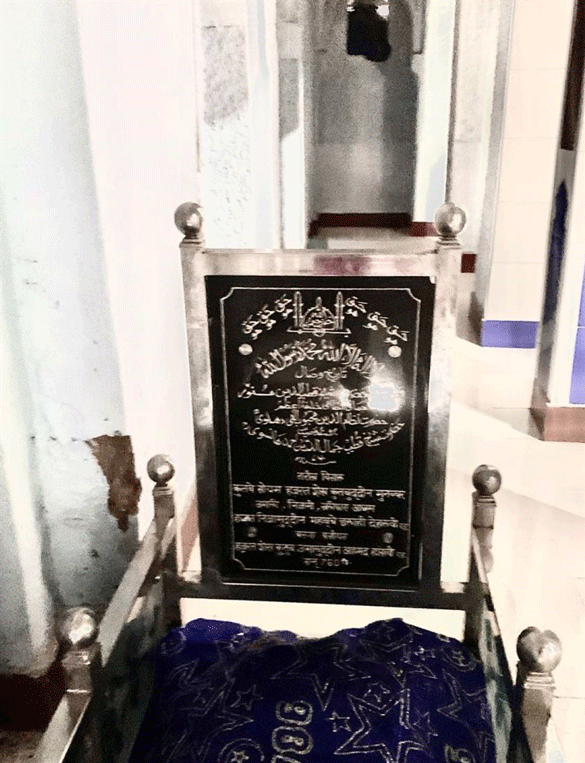
Hazrat Syed Qutbuddin Munawwar passed away at the age of fifty-nine on 7th Muharram 760 AH (1359 CE). Despite a relatively brief lifespan, his life was marked by profound spiritual discipline, moral clarity, and lasting influence within the Chishti order. He was laid to rest in Hansi, Haryana, at the Char Qutub Dargah, a unique shrine complex that houses the tombs of four successive spiritual poles from the same family: Hazrat Qutb Jamaluddin Ahmad Hansvi, Hazrat Burhanuddin Chishti Hansvi, Hazrat Syed Qutbuddin Munawwar, and his son Hazrat Nooruddin. The complex also contains a historic mosque that has survived largely intact from the medieval period and continues to serve as a place of congregational worship.
The Urs of the Four Qutubs is observed annually at the shrine with devotional gatherings, Quranic recitation, spiritual discourse, and langar. Although disrupted after the Partition of Punjab, the Urs tradition was formally revived in 1961 by Shah Waliur Rehman Jamal, and it continues to draw devotees from across India and beyond. Today, Hazrat Qutbuddin Munawwar is remembered for his ascetic integrity, refusal of royal patronage, and unwavering commitment to Chishti principles. His spiritual legacy transcends sectarian boundaries, attracting scholars, seekers, and pilgrims of diverse backgrounds. The Char Qutub Dargah stands as a living symbol of the continuity of Chishti spirituality in India and of a saint whose influence endures through practice, memory, and devotion.
Conclusion
Hazrat Syed Qutbuddin Munawwar was a leading Chishti saint who embodied asceticism, humility, and moral courage. Trained by Hazrat Nizamuddin Auliya, he preserved spiritual independence by refusing royal patronage, earning respect from rulers and disciples alike. His legacy endures through the Char Qutub Dargah in Hansi and his disciples, especially his son Hazrat Nuruddin. His life remains a timeless example that true greatness lies in God-consciousness, inner purification, and selfless service.
_
Adnan Faizi is a Peace and Harmony activist based in Delhi. He is an alumnus of CCS University, Meerut.
URL: https://newageislam.com/islamic-personalities/hazrat-syed-qutbuddin-munawwar-/d/138312
New Age Islam, Islam Online, Islamic Website, African Muslim News, Arab World News, South Asia News, Indian Muslim News, World Muslim News, Women in Islam, Islamic Feminism, Arab Women, Women In Arab, Islamophobia in America, Muslim Women in West, Islam Women and Feminism