
Hazrat Shah Junaid Qadri: Ghazipur's Qadri Beacon of Remembrance and Service

By Adnan Faizi, New Age Islam
16 March 2026
Hazrat Shah Junaid Qadri, revered as the Qadri saint of Ghazipur, is remembered through the city’s oldest and largest tomb, a living centre of spiritual gathering and service. His Urs on 24 Ramadan draws multitudes, reflecting the enduring power of remembrance, humility and love to unite communities.
Main points:
· Hazrat Shah Junaid Qadri’s tomb is Ghazipur’s oldest, largest spiritual landmark today.
· Hazrat followed Ghaus-e-Azam’s Qadri order; lineage continued through son Hazrat Shah Abdullah Qadri.
· Annual Urs on 24th Ramadan gathers thousands, expressing Qadri remembrance and devotion.
· Hazrat’s teachings reflect Qadri emphasis on tawhid, ihsan, love, humble service today.
· Hazrat’s shrine symbolises Eastern Uttar Pradesh’s shared spiritual heritage and inter-communal harmony.
Introduction
Hazrat Shah Junaid Qadri is remembered as one of the foremost Qadri saints of Eastern Uttar Pradesh, closely associated with the city of Ghazipur. His tomb, described by local researchers as the oldest and largest building in Ghazipur, reflects both its architectural antiquity and the deep place his memory holds in the city’s historical and spiritual landscape. Within the religious geography of the region, he is regarded among the prominent awliya of Eastern U.P., a Qadri guide whose presence helped shape devotional life along the Ganga belt.
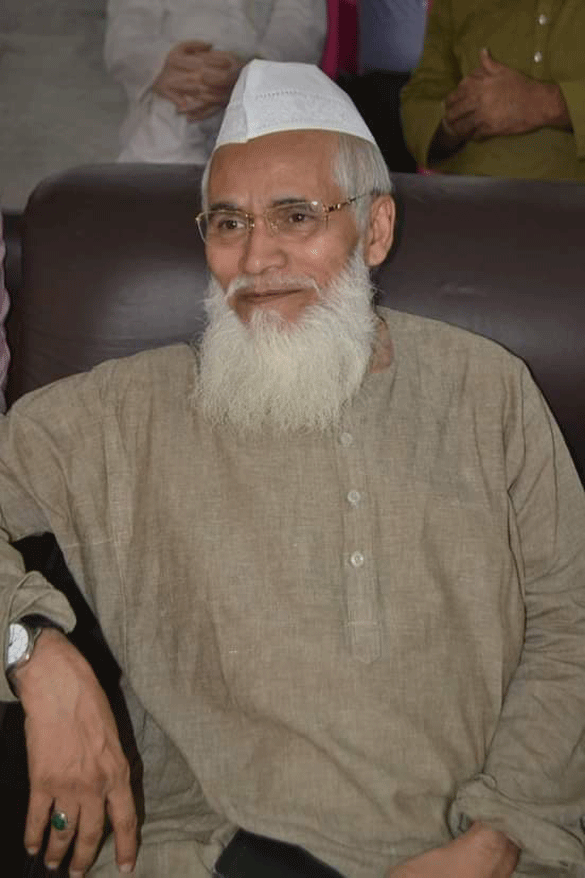
Hazrat belonged to the Qadri silsila, spiritually linked to Hazrat Ghaus-e-Azam whose path of disciplined, Sharia-rooted mysticism spread widely across the Muslim world. In India, the organised growth of the Qadri order is often connected with figures such as Hazrat Shah Niamatullah Qadri and Hazrat Syed Makhdoom Muhammad Gilani , whose work during the fifteenth and sixteenth centuries established Qadri khanqahs in regions like Jaunpur and Ghazipur. Hazrat Shah Junaid Qadri stands within this tradition as a local embodiment of Qadri spirituality, remembered for translating the principles of tawhid, ihsan (spiritual excellence), and compassionate service into everyday life.
Even today, in a region where many young people face unemployment, social tension and religious polarisation, the continuing Urs of Hazrat Shah Junaid Qadri draws thousands from diverse backgrounds. His dargah remains a place of quiet continuity rather than spectacle, where remembrance, humility, and shared meals sustain a sense of community and offer an enduring alternative to the fragmentation of modern life.
Ghazipur Legacy and Qadri Lineage
Hazrat Shah Junaid Qadri is closely associated with the city of Ghazipur, where sources compilation and local histories describe his tomb as the oldest and largest building in the city. This suggests both its architectural antiquity and the central place his memory holds in Ghazipur’s historical and spiritual identity. Located within the city rather than in a rural khanqah, the dargah indicates that his spiritual work remained closely connected with everyday urban life. Over time his burial place evolved into a major public landmark where generations have sought barakah, guidance and continuity with the city’s past. Eastern Uttar Pradesh has long been a fertile region for Sufi activity, with orders such as the Chishti and Qadri establishing shrines along trade routes and administrative centres. Historical notes indicate that the Qadri order spread widely in both Western and Eastern Uttar Pradesh, particularly in Jaunpur and Ghazipur, where Hazrat Shah Junaid Qadri is counted among the notable representatives of this tradition. Hazrat belonged to the Qadri silsila of Hazrat Ghaus-e-Azam, whose path combined strict adherence to Shariat with deep spiritual purification. In India, the organised spread of the Qadri order is often linked with Hazrat Shah Niamatullah Qadri and Hazrat Syed Makhdoom Muhammad Gilani, who helped establish Qadri khanqahs across northern India.
Within this tradition, Hazrat Shah Junaid Qadri is remembered for embodying the Qadri ideals of constant remembrance of Allah, trust in God (tawakkul), simplicity of life and concern for society’s moral wellbeing. Sources also record that he had at least one son, Hazrat Shah Abdullah Qadri, who continued the same spiritual path. Through this familial line as well as the enduring presence of his shrine, the Qadri legacy remained alive in Ghazipur across generations.
Teachings, Devotion and the Culture of Sama
Although no written works or direct sayings of Hazrat Shah Junaid Qadri survive in the available sources, accounts of his life reflect the spiritual ideals of the Qadri path and the Sufi understanding of sainthood. A wali is seen as a sincere friend of Allah whose heart becomes so devoted to the Divine that worldly power and material excess lose their attraction. This friendship rests on tawhid, the inner awareness that no power or refuge exists except Allah, and ihsan, worshipping as though one sees Allah or at least knowing that Allah sees one. The Qadri way therefore emphasises simplicity of life, restraint in consumption and continuous struggle against the lower self (nafs). Sufis are described as people who eat little, sleep little, avoid ostentation and devote themselves to zikr, prayer and service to humanity. In a Qadri khanqah associated with Hazrat Shah Junaid Qadri these values were expressed through lived example, where visitors encountered humility, discipline and compassion. Sufi ethics also stressed tolerance, kindness toward non-Muslims and efforts to bridge divisions of caste and creed, while teachers often used local languages, poetry and music to convey the message of divine unity and human solidarity, shaping the devotional culture of the Bhakti era.
An important part of this spiritual environment was sama, or spiritual listening, often expressed through qawwali gatherings in khanqahs and dargahs. Sama involved attentive listening to Qur’anic verses, hadith, hamd, naat, manqabat, marsiya and mystical poetry, performed collectively by qawwals. Such gatherings aimed not at entertainment but at purifying the heart and deepening remembrance of Allah, while allowing people from different backgrounds to sit together in shared devotion. In Eastern Uttar Pradesh, where strong folk musical traditions already existed, a Qadri khanqah like that associated with Hazrat Shah Junaid Qadri r.a. would have translated theology into a living experience accessible to villagers, artisans, labourers and students alike. Even today, this model suggests that faith flourishes when it speaks to the heart as well as the mind, showing how beauty, remembrance and community can strengthen devotion in an age of confusion and debate.
Urs, Shrine and Continuing Legacy
One of the clearest historical details about Hazrat Shah Junaid Qadri is the annual Urs held on the 24th of Ramadan. Sources from Ghazipur describe how thousands of people gather at the dargah each year for Qur’an recitation, qawwali, food distribution and acts of charity. The timing itself is meaningful: the last ten days of Ramadan are already a period of intense worship, and remembering a Qadri wali during this time links personal fasting with collective gratitude for the spiritual guides who shaped the region’s faith. The shrine’s reputation as the “biggest and oldest building of Ghazipur” shows that the Urs functions not only as a religious commemoration but also as a major cultural gathering. Residents from different professions, neighbourhoods and social backgrounds come together under one canopy of remembrance, devotional music and shared meals. Over generations this pattern has continued despite political and economic changes, suggesting that the memory of Hazrat Shah Junaid Qadri r.a. has become deeply woven into Ghazipur’s shared historical and spiritual identity, extending beyond narrow sectarian boundaries. In contemporary Eastern Uttar Pradesh, where social tensions can sometimes be amplified through modern media, this tradition offers another rhythm of community life—slow, annual and rooted in gratitude rather than conflict. For younger visitors especially, the Urs provides a living example of Islam expressed through remembrance, generosity and respect for those who devoted their lives to Allah. Although the available sources do not preserve detailed anecdotes about Hazrat Shah Junaid Qadri's daily life, family relations or miracles, they consistently describe him as a high-ranking wali of Eastern Uttar Pradesh and an important representative of the Qadri spiritual tradition in Ghazipur.
His legacy therefore appears less through quotations and more through living continuities: a tomb that still shapes the city’s skyline, an Urs that still gathers thousands, and a spiritual affiliation that connects Ghazipur to Hazrat Ghaus-e-Azam Hazrat Syed Abdul Qadir Jilani r.a. in Baghdad through the chain of the Qadriya order. For contemporary readers, especially those reflecting on religion in a rapidly changing society, Hazrat’s example suggests a balanced path. The Qadri tradition associated with his shrine brings together strict tawhid with mercy, dhikr with service, and fidelity to Shariat with openness to local culture. In an age when many people feel spiritually rootless, the continuous flow of visitors to his shrine reminds seekers that faith can still grow through quiet devotion, shared community life and the enduring bond between servant and Lord—a bond that also nurtures friendship and compassion among neighbours.
____
Adnan Faizi is a Peace and Harmony activist based in Delhi. He is an alumnus of CCS University, Meerut.
New Age Islam, Islam Online, Islamic Website, African Muslim News, Arab World News, South Asia News, Indian Muslim News, World Muslim News, Women in Islam, Islamic Feminism, Arab Women, Women In Arab, Islamophobia in America, Muslim Women in West, Islam Women and Feminism