
Hazrat Rajan Shah Wali: The Saint Who Fed Our Souls and Built Our Healing Waters

By Adnan Faizi, New Age Islam
26 June 2026
Hazrat Rajan Shah Wali, popularly known as Bagh Sawar, was a revered Sufi saint from Samarqand who arrived in Adilabad around 700 years ago. Through his spiritual guidance, unwavering devotion to Allah, and the miraculous healing waters associated with him, he left a lasting impact on the region and its people.
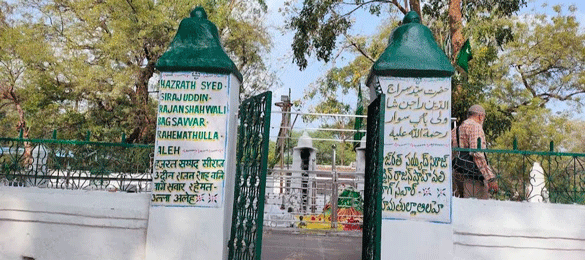
Main Points:
· Hazrat Rajan Shah Wali migrated from Samarqand and settled near Adilabad around 700 years ago.
· His real name was Hazrat Syed SirajUddin Auliya, later famed as Bagh Sawar.
· He defeated a feared magician whose ruined palace remains visible today.
· His 9th Shaban Urs attracts hundreds of thousands from across India annually.
· Hazrat called Bagh Sawar because roaring tiger became gentle cat, served him daily throughout its entire life
Introduction
Hazrat Rajan Shah Wali, popularly known as Bagh Sawar, was one of the most revered Sufi saints of the Deccan. Arriving in Adilabad around seven centuries ago from Samarqand in the Bukhara region, he brought with him a rich spiritual legacy linked to the renowned scholar Faqih Abu Lais Samarqandi. Travelling through Delhi and Hyderabad, he finally settled at Turkal Chanda near Adilabad, where, at the age of twenty-two, he offered his first Asar prayer and laid the foundation of a lasting spiritual centre. Known originally as Syed Siraj Uddin Auliya, he became famous as “Bagh Sawar” after a remarkable encounter in which a roaring tiger submitted to him and served him until its death. Through his prayers and spiritual presence, the region witnessed profound transformation. Water scarcity and other hardships eased, while a blessed stream near the river became renowned for healing illnesses, attracting visitors from distant places.
Remembered as a saint of wisdom, courage and divine connection, Hazrat Rajan Shah Wali embodied the Sufi ideal of the Qutb—the spiritual guide who connects humanity to Allah through complete devotion. His life of fearlessness, service, harmony with nature and unwavering faith continues to inspire people across generations.
Early Life, Lineage and Education
Although detailed genealogical records of Hazrat Rajan Shah Wali have not survived, historical traditions agree that he arrived in Adilabad from the Samarqand region of Bukhara around seven centuries ago. Due to the passage of time, his exact birthplace, ancestry, and the names of his parents remain unknown. What is known is that he reached Chanda Sharif at the age of 22, already possessing deep spiritual knowledge and preparation acquired in the great scholarly tradition of Central Asia. Hazrat's education was rooted in the distinguished lineage of Hazrat Faqih Abu Lais Samarqandi, one of the most renowned authorities of Islamic jurisprudence. Under scholars associated with this tradition, he received training in the Quran, Hadith, Fiqh, Arabic, Persian, and spiritual sciences, enabling him to become an accomplished preacher, teacher, and guide in the Deccan.
Hazrat married Zahra bi Khatoon, a pious woman from Chanda village, reflecting his close integration with the local community. She was remembered for her devotion and noble character, and at the time of her death reportedly recited the kalimah, “La Ilaha Illallah,” twenty-one times, a sign of her deep faith. While no reliable records mention their children, Hazrat's spiritual legacy continued through his numerous disciples and caliphs, whose influence spread across Telangana, Maharashtra, and many other parts of India.
Khilafat and Spread of His Mission
Although the details of his bay‘ah and the name of his spiritual guide have not survived in historical records, his connection to the distinguished lineage of Faqih Abu Lais Samarqandi confirms that he belonged to a well-established Central Asian Sufi tradition. As a spiritual master and khalifa, Hazrat devoted himself to religious discourses, sermons, spiritual training, and the propagation of Islam throughout Adilabad and the wider Deccan region. His teachings emphasized complete submission to Allah, fearlessness except before the Creator, constant remembrance of Allah through prayer and devotion, and strengthening the bond between humanity and its Creator. He lived simply, performed his prayers punctually, spent time in forested areas without fear of wild animals, and remained immersed in worship and spiritual contemplation.
His service to people attracted a large number of disciples, and his circle of mureeds grew rapidly across the Adilabad region. People from places such as Utnoor sought his presence and spiritual guidance, though he chose to remain settled in the Adilabad area. The influence of his teachings spread far beyond his lifetime through his khalifas and disciples, whose spiritual lineage continues across Telangana, Maharashtra, and many other parts of India. Even today, hundreds of thousands of devotees from different religions and backgrounds gather annually at his dargah in Chanda Sharif, reflecting the enduring reach of his spiritual legacy.
Miracles, the Tiger Encounter and Healing Waters
Among the most famous miracles of Hazrat Rajan Shah Wali was his encounter with a tiger while living in a small house surrounded by dense forests inhabited by tigers, cheetahs and other wild animals. One day, a roaring tiger appeared before his dwelling. Fearless, Hazrat addressed the animal as Abul Haris and explained that he had come to Chanda to remember Allah, call people towards Him, and strengthen the bond between humanity and its Creator. He then caught the tiger by its ears, whereupon the ferocious beast became as gentle as a cat and sat obediently before him. The tiger remained in his service until its death, and this extraordinary event earned him the title Bagh Sawar, by which he became famous throughout the Deccan and beyond. The incident came to symbolize the belief that true friends of Allah fear none but Him, and that even the fiercest creatures submit before divine favour. Another well-known tradition relates that an old magician once terrorized the people of Chanda through oppression and fear. A spiritual confrontation took place between Hazrat and the magician, and with Allah’s help Hazrat emerged victorious. The ruins of the magician’s palace are still said to be visible in the Chanda area, preserving the memory of this event.
Hazrat was also associated with a remarkable healing-water miracle. Through his prayers and divine favour, a stream emerged near the riverbank, and its water became renowned for helping cure illnesses. Patients travelled from distant places to drink the water and carried it home in bottles for their loved ones. This blessed stream not only enhanced Hazrat’s reputation for healing, its also became linked to the easing of the water scarcity and hardships that had affected the region before his arrival.
Service to Society, Shrine and Annual Urs
Hazrat Rajan Shah Wali’s impact on the Adilabad region extended far beyond spiritual guidance. Through his service to humanity, religious discourses, sermons, and efforts to spread Islam across the Deccan and surrounding areas, he attracted a large and devoted following. Local traditions maintain that before his arrival, the people of Adilabad faced water scarcity and many other hardships, which eased through his blessed presence and prayers. During his lifetime, he was regarded as an unparalleled Sufi master in the region, with no comparable spiritual figure of his era. His shrine is located at Chanda Sharif in Turkal Chanda village, about ten kilometres from Adilabad, on the bank of a small river. Hazrat’s grave lies at the lower riverbank level, while the village itself stands on higher ground nearby. An old mosque and several monuments associated with him still survive around the dargah, preserving the memory of his life and mission.
His annual Urs is observed every year on 9 Shaban at Chanda Sharif. The occasion draws several hundred thousand devotees from Telangana, Maharashtra, and other parts of India. People from different religions, castes, and communities gather to seek blessings, making the Urs a major spiritual event and also a lasting symbol of Hazrat Rajan Shah Wali’s enduring influence and universal appeal.
Legacy, Spiritual Message and Enduring Relevance
More than seven centuries after his arrival from Samarqand, Hazrat Rajan Shah Wali’s spiritual legacy continues through his disciples spread across Telangana, Maharashtra, and many other parts of India. His shrine at Chanda Sharif remains a living centre of devotion, where the annual Urs, the preserved old mosque, and other historical monuments keep his memory alive. His cultural influence also endures through the famous title Bagh Sawar, the healing stream still visited by patients, and the hundreds of thousands of devotees who gather every year to seek blessings. Hazrat Rajan Shah Wali’s life carries a timeless message of fearing none but Allah, serving humanity, living in harmony with nature, and trusting in divine grace. His example teaches that sincere devotion to Allah brings courage, compassion, and concern for others. In an age marked by religious intolerance, spiritual emptiness, and distance from nature, his life offers a model of peaceful coexistence, selfless service, interfaith inclusivity, and faith-based healing through prayer.
Remembered as one of the greatest Sufi masters of Adilabad and a spiritual Qutb who connected humanity with its Creator through complete submission to Allah, Hazrat Rajan Shah Wali transformed both the material and spiritual life of the region. His life demonstrated that Allah’s chosen servants can inspire even the fiercest creatures to obedience, heal people through divine favour, attract countless followers through service, and leave a legacy that continues to guide generations. The enduring reverence for Bagh Sawar and the continued popularity of his shrine stand as lasting testimony to a saint whose influence has remained alive for more than seven hundred years.
___
Adnan Faizi is a Peace and Harmony activist based in Delhi. He is an alumnus of CCS University, Meerut.
URL: https://newageislam.com/islamic-personalities/hazrat-rajan-shah-wali-saint-fed-souls/d/140551
New Age Islam, Islam Online, Islamic Website, African Muslim News, Arab World News, South Asia News, Indian Muslim News, World Muslim News, Women in Islam, Islamic Feminism, Arab Women, Women In Arab, Islamophobia in America, Muslim Women in West, Islam Women and Feminism