
Hazrat Miskin Shah Sahib: The Sufi Master and Scholar Who Inspired Hyderabad

By Adnan Faizi, New Age Islam
27 June 2026
Hazrat Miskin Shah Sahib, born as Muhammad Nayeem in 1200 AH in Delhi, was a Naqshbandi-Qadri Sufi who settled in Hyderabad, devoted his life to serving his spiritual master and the remembrance of Allah, and whose funeral was personally shouldered by King Mahboob Ali Khan.
Main Points:
· Born in 1200 AH in Delhi, Muhammad Nayeem was the son of Hazrat Muhammad Hafeez.
· He became disciple and khalifa of Hazrat Sadullah Naqshbandi in the Mirza Mazhar lineage.
· He died aged 114 in 1314 AH; King and disciple Mahboob Ali Khan carry his funeral bier.
· His Urdu book Muragabat Sulook teaches meditation; his poetry survives in Hyderabad manuscripts.
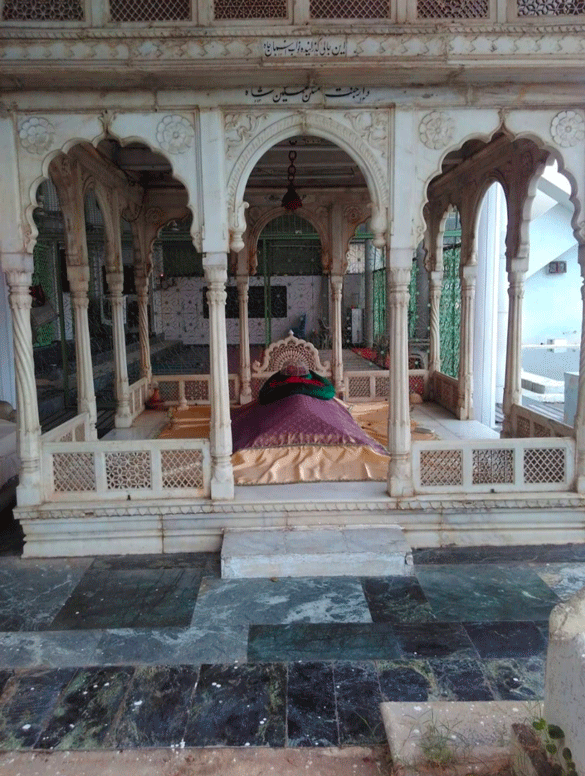
· His marble tomb at Aliabad's Almas Mosque remains a revered shrine gifted by Nawab Asman Jah.
Introduction
Hazrat Miskin Shah Sahib was a distinguished Naqshbandi-Qadri Sufi saint, scholar and author who spent most of his life in Hyderabad after arriving from Delhi during the reign of the Fourth Nizam, Mir Farqunda Ali Khan Bahadur. Born as Muhammad Nayeem in Shahjahanabad (Delhi) in 1200 AH to Hazrat Muhammad Hafeez, he became a disciple and khalifa of Hazrat Sadullah Naqshbandi, whose spiritual lineage traced through Hazrat Ghulam Ali Dehlavi to Hazrat Mirza Mazhar Jan-e-Janan. He devoted decades to the service of his spiritual master, the remembrance of Allah and the guidance of seekers, earning widespread respect for his piety, humility and disciplined life. His fame also rests on his literary contributions, especially Muragabat Sulook, an Urdu work explaining methods of meditation for disciples, while his handwritten poetry is preserved at Idare Adabiyat-e-Urdu, Hyderabad. His sayings were later compiled in the three-volume Lazat Miskin by his disciple Hazrat Abu Taher Muhammad Abdul Qadir Naqshbandi.
His annual Urs is observed every 14 Rabi al-Awwal, while his son and successor, Hazrat Ghulam Muhammad Sahib (Taskin Shah Naqshbandi), continued his spiritual legacy. Remembered for his exemplary character, punctuality and devotion, Hazrat Miskin Shah Sahib remains one of Hyderabad's most respected Sufi saints.
Early Life and Family
Hazrat Miskin Shah Sahib was born as Muhammad Nayeem in Shahjahanabad (Delhi) in 1200 AH (1785 CE) to Hazrat Muhammad Hafeez, during a period when Delhi was a leading centre of Islamic scholarship and Sufism. Raised in this rich spiritual environment, he received the foundation that later shaped his life as a Naqshbandi-Qadri master. Alongside his spiritual excellence, he was widely admired throughout Hyderabad for his humility, refined manners, punctuality and disciplined way of life, qualities he maintained even in his advanced age of 114 years. His spiritual legacy continued through his son and successor, Hazrat Ghulam Muhammad Sahib, popularly known as Taskin Shah Naqshbandi, who became a respected saint in Hyderabad, passed away at the age of 72, and was buried beside his father. Members of Hazrat Miskin Shah Sahib's family continue to reside in Hyderabad today.
Spiritual Training and Sufi Lineage
Hazrat Miskin Shah Sahib entered the Sufi path through bay'ah with Hazrat Sadullah Naqshbandi, under whom he underwent spiritual discipline and was eventually granted both the saintly robe and khilafat, authorising him to guide disciples. His spiritual lineage continued through Hazrat Ghulam Ali Dehlavi to the eminent Naqshbandi master Hazrat Mirza Mazhar Jan-e-Janan, placing him within one of the most respected and authentic Naqshbandi chains of Delhi. This unbroken chain gave his teachings a firm foundation in established Sufi tradition. Alongside his Naqshbandi affiliation, he was also recognised as a leading master of the Qadri order, making him one of the few saints in Hyderabad associated with both the Naqshbandi and Qadri silsilas. Through decades of worship, service and spiritual guidance, Hazrat Miskin Shah Sahib became one of Hyderabad's most respected Sufi masters, with his influence extending to thousands of disciples and devotees.
Arrival in Hyderabad and Spiritual Influence
After spending his early life in Shahjahanabad, Hazrat Miskin Shah Sahib travelled to Hyderabad during the reign of the Fourth Nizam, Mir Farqunda Ali Khan Bahadur, bringing the Naqshbandi spiritual tradition from North India to the Deccan. He settled in Aliabad, then on the outskirts of Hyderabad, where he spent the rest of his life in the service of his spiritual master, the remembrance of Allah, daily recitations and the guidance of seekers. Aliabad remained the centre of his spiritual activities throughout his life and later became the site of his shrine. Blessed with a remarkable lifespan of 114 years (1200–1314 AH / 1785–1895 CE), he devoted decades to worship, spiritual discipline and the training of disciples. His profound knowledge, ascetic way of life, deep fear of Allah and unwavering devotion earned him immense respect across Hyderabad, attracting thousands of disciples and devotees from different walks of life and establishing him as one of the city's most influential Sufi saints.
Literary Contributions
Hazrat Miskin Shah Sahib was a distinguished author whose writings preserved his spiritual teachings for future generations. He wrote in both prose and poetry, reflecting his command of Urdu literary expression. His best-known work, Muragabat Sulook, is an Urdu prose treatise that explains the methods of muraqaba (meditation) and spiritual discipline, offering practical guidance for disciples on the Sufi path. Several handwritten manuscripts of his poetry are still preserved at Idare Adabiyat-e-Urdu, Hyderabad, ensuring that his literary legacy remains available to researchers and seekers. His teachings were also preserved by his devoted disciple, Hazrat Abu Taher Muhammad Abdul Qadir Naqshbandi, who compiled his sayings and discourses into the three-volume Lazat Miskin, published in 1312 AH at Mufid Deccan Press, Hyderabad, during Hazrat's lifetime. Although the work is no longer available, it remains an important testimony to the preservation of his teachings and the lasting influence he had on his disciples.
Royal Patronage and Spiritual Successors
Hazrat Miskin Shah Sahib's spiritual influence extended far beyond his circle of disciples and reached the highest levels of the Hyderabad State. On 9 Rajab 1313 AH, the Sixth Nizam of Hyderabad, Mir Mahboob Ali Khan Bahadur, formally took bay'ah at Hazrat's hands, becoming his disciple. This marked not merely a ceremonial association, it's a genuine spiritual relationship. The Nizam visited Hazrat's residence in Aliabad on numerous occasions, seeking his company, advice and blessings, reflecting the immense reverence he held for the saint.
Hazrat's teachings continued through a strong network of disciples and authorised successors. One of the notable figures connected with this spiritual lineage was Hakim Syed Wazir Ali, father of the Urdu author Talah, who entered the same silsila through bay'ah in 1336 AH, demonstrating the continued influence of Hazrat's spiritual tradition even after his lifetime. Among Hazrat's foremost khalifa was Hazrat Mawlavi Khair Uddin, a resident of Nabi Khana in Pather Gatti, Hyderabad. Widely respected for his scholarship and spiritual standing, he became one of the city's best-known Sufi figures and played a leading role in preserving and spreading Hazrat Miskin Shah Sahib's Naqshbandi-Qadri teachings. Through such devoted disciples and successors, his spiritual lineage remained active and continued guiding seekers in Hyderabad for generations.
Death, Shrine and Continuing Reverence
After spending more than a century in worship, spiritual guidance and service to the people of Hyderabad, Hazrat Miskin Shah Sahib passed away on 14 Rabi al-Awwal 1314 AH (1895 CE) at the age of 114. His death marked the end of a long life devoted to the service of his spiritual master, remembrance of Allah and the guidance of countless disciples. His funeral became one of the most memorable events in Hyderabad's spiritual history. The Sixth Nizam, Mir Mahboob Ali Khan Bahadur, who had earlier become his disciple through bay'ah and frequently visited him, personally carried the saint's bier on his shoulders for part of the funeral procession. Thousands of disciples, devotees and members of the public joined the procession, while the funeral prayer was offered at the historic Makkah Mosque. Hazrat Miskin Shah Sahib was laid to rest in the courtyard of Almas Mosque, inside Aliabad Gate, on the road from Shah Ali Banda towards Aliabad, south of Charminar. The marble jali surrounding the shrine was presented by Nawab Asman Jah, and a Persian chronogram inscribed upon it records his death in 1314 AH with the words: "Rahmatullah Miskin Shah... Dar Jannat Miskin Shah."
His shrine continues to attract devotees throughout the year. Every year, on 14 Rabi al-Awwal, his Urs is observed with large gatherings of disciples, devotees and visitors from different backgrounds. The occasion includes prayers, remembrance of Allah and the traditional serving of food to all guests, preserving the spirit of generosity and devotion that Hazrat Miskin Shah Sahib embodied throughout his life.
Legacy and Modern Relevance
Hazrat Miskin Shah Sahib was remembered throughout Hyderabad for his exemplary character, humility, punctuality and deep fear of Allah. Even at the age of 114, he remained disciplined in worship, regular in his daily routine and widely respected for his refined manners, earning recognition as one of the city's most revered spiritual figures. His life demonstrated that true spiritual excellence is reflected in worship and in conduct, discipline and service to others. His legacy continues through his disciples, his Naqshbandi-Qadri spiritual lineage, and his celebrated work Muragabat Sulook, which offers practical guidance on muraqaba (meditation) and spiritual training for seekers. Nearly a century and a half after his passing, his teachings remain relevant in addressing many contemporary challenges.
His lifelong devotion to his spiritual master and constant remembrance of Allah offer an antidote to modern spiritual emptiness. His punctuality and disciplined way of life remind believers of the importance of fulfilling prayers and responsibilities on time. The respect shown to him by the Sixth Nizam, Mir Mahboob Ali Khan, who personally carried his funeral bier, reflects the honour due to people of knowledge and piety. His practical guidance on meditation provides seekers with a balanced path of inner purification, while his association with both the Naqshbandi and Qadri orders demonstrates that authentic spiritual excellence is rooted in the shared principles of the recognised Sufi traditions rather than sectarian divisions. His life continues to inspire those seeking sincerity, discipline and a deeper relationship with Allah.
____
Adnan Faizi is a Peace and Harmony activist based in Delhi. He is an alumnus of CCS University, Meerut.
URL: https://newageislam.com/islamic-personalities/hazrat-miskin-shah-sahib-sufi-master-scholar/d/140569
New Age Islam, Islam Online, Islamic Website, African Muslim News, Arab World News, South Asia News, Indian Muslim News, World Muslim News, Women in Islam, Islamic Feminism, Arab Women, Women In Arab, Islamophobia in America, Muslim Women in West, Islam Women and Feminism