
Hazrat Baba Shah Palangposh: The Naqshbandi Saint Who Defined Deccan's Spiritual Soul

By Adnan Faizi, New Age Islam
10 December 2025
Hazrat Baba Shah Palangposh was a striking Central Asian Sufi who carried the Naqshbandi path to the Deccan with fierce devotion. His leopard-skin robe, warrior-like grace, and deep bond with Hazrat Baba Shah Musafir still define the soul of Aurangabad’s Panchakki.
Main Points:
1. Hazrat Baba Shah Palangposh brought the Naqshbandi Sufi order to the Deccan.
2. He was the spiritual master of the builder of Panchakki, Hazrat Shah Musafir.
3. He wore a leopard skin, symbolising his majestic and rigorous spiritual state.
4. Hazrat arrived in India from Bukhara with the Mughal army of Feroz Jung.
5. His shrine in Aurangabad symbolises the eternal bond between master and disciple.
----
Introduction
Hazrat Baba Shah Saeed Palangposh stands out in Indian Sufi history as a rare “soldier-saint” a Central Asian master who lived among armies yet remained absorbed in God. His leopard-skin cloak, earned him the title “Palangposh,” symbolising strength, discipline, and mastery over the ego. He arrived in the Deccan during Aurangzeb’s turbulent era and became the spiritual guide for Turani soldiers, offering them inner steadiness amid constant conflict. But his deepest legacy is the bond he shared with his devoted disciple, Hazrat Baba Shah Musafir. Their relationship is remembered as an ideal Pir-Murid companionship one leading with spiritual fire, the other reflecting it with gentle certainty. Together, they laid the spiritual foundation of Aurangabad’s Panchakki complex. While Hazrat Shah Musafir later built and shaped the site, it was Shah Palangposh’s majestic presence and inner power that inspired its creation, becoming the unseen sun that illuminated his disciple’s work.
Early Life and Origins
Hazrat Baba Shah Saeed Palangposh was born in Ghajdavan near Bukhara, the very centre of the Naqshbandi tradition. Though little is known about his family, his spiritual path is clear—he was trained in the Naqshbandi order under the guidance of the elder Hazrat Baba Palangposh, who recognised his remarkable inner strength. In Bukhara he also met the seeker who would become his closest companion, Hazrat Baba Shah Musafir. Their bond formed instantly. Shah Musafir had originally been linked to the Kubrawiyya order, but the moment he encountered Palangposh, he recognised his true master and entered the Naqshbandi path under him. Their travels together are described in Malfuzat-e-Naqshbandi, written by their successor Hazrat Baba Shah Mahmud: Hazrat Shah Musafir serving his teacher with unwavering devotion, and Palangposh shaping him with deep spiritual focus. It was a relationship built on loyalty, sacrifice, and a shared journey toward God.
From Battlefield Wanderers to the Saints of Aurangabad
Hazrat Baba Shah Saeed Palangposh and Hazrat Baba Shah Musafir spent nearly twenty years moving through Afghanistan Karshi, Kabul, Hasan Abdal—before making their way to the Deccan around 1674–75. Their arrival came during a wider movement of Central Asian mystics into the Mughal Empire, where Naqshbandi saints were deeply respected due to the dynasty’s own roots with Khwaja Ahrar and the early Khwajagan. By the time they reached the Mughal camps, they were welcomed as spiritual kin. In the Deccan they lived among the soldiers of Nawab Ghaziuddin Khan Feroz Jung I, guiding the Turani ranks with a rare mix of majesty and spiritual absorption. Shah Palangposh, wrapped in his leopard skin and leaning on his heavy staff, was a commanding presence—speaking Chagatai and Persian, foretelling outcomes of battles, and giving soldiers the inner strength to face war’s turbulence. He embodied the Naqshbandi ideal of living in solitude even while surrounded by crowds.
As the campaigns settled, both saints moved to Aurangabad, choosing a quiet spot by the Kham River near the city’s old gates. There, under the inwardly powerful gaze of Hazrat Shah Palangposh, Hazrat Shah Musafir began shaping a Khanqah and Madrasa. The place soon became a refuge widows, orphans, and displaced families lived within its walls, receiving care, food, and education. The compassion of Shah Musafir and the spiritual radiance of Hazrat Shah Palangposh made it a centre of healing and guidance. Turani nobles, especially Nawab Turktaz Khan, supported them wholeheartedly, seeing these saints as the living link to their Central Asian spiritual heritage.
Death And Legacy
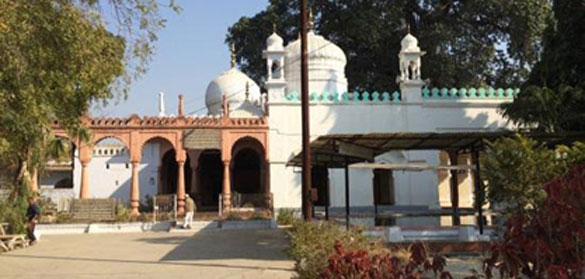
Hazrat Baba Shah Palangposh passed away in 1110 AH, leaving Hazrat Shah Musafir and the Aurangabad community in deep mourning. He was buried inside the khanqah they had built together, marked by a simple red-stone cenotaph. When Hazrat Shah Musafir died in 1126 AH, he was laid to rest beside his master to the west, Hazrat Musafir to the east so that even in death their bond remained unbroken. To this day, visitors at Panchakki instinctively honour both saints together, recognising their shared spiritual legacy.
Although Hazrat Shah Palangposh did not construct the Panchakki himself, his presence is the foundation on which it stands. After his passing, his successors and Turani nobles expanded the complex into a remarkable blend of spirituality, engineering, and service. Water from a spring eight kilometres away flows through underground clay pipes into a vast reservoir, powering the mill that once ground grain for the community kitchen feeding pilgrims and the poor. The complex also became a centre of learning, where Hazrat Baba Shah Mahmud the son and successor of Hazrat Shah Musafir compiled Malfuzat-e-Naqshbandi between 1734 and 1739. This Persian work, later translated into Urdu, preserves their travels, miracles, and teachings, and remains the most authoritative record of the Naqshbandi presence in the Deccan.
Conclusion
Hazrat Baba Shah Palangposh stands as a saint who united the spiritual depth of Central Asia with the rugged realities of the Deccan. He did not withdraw from the world he moved with armies, steadied generals, and nurtured a community in the midst of political turmoil. His life embodied the Naqshbandi belief that true spirituality must remain strong, engaged, and alive in the world. Even today, Panchakki is more than an old monument. Its quiet reservoir, cool breeze, and ancient banyan tree still seem to hold his presence. Hazrat Shah Palangposh rests there beside his beloved disciple, Hazrat Shah Musafir, their paired graves reminding every visitor that the love between a master and his student can outlast time itself.
----
Adnan Faizi is a Peace and Harmony activist based in Delhi. He is an alumni of CCS University, Meerut.
New Age Islam, Islam Online, Islamic Website, African Muslim News, Arab World News, South Asia News, Indian Muslim News, World Muslim News, Women in Islam, Islamic Feminism, Arab Women, Women In Arab, Islamophobia in America, Muslim Women in West, Islam Women and Feminism