
Hazrat Baba Fakhruddin of Penukonda: The Qalandar Saint Who Renounced Kingship for God

By Adnan Faizi, New Age Islam
13 November 2025
Hazrat Baba Fakhruddin al-Hasani al-Hussaini, a 12th-century Qalandar saint, renounced the throne of Sistan to embrace divine servitude. A descendant of both Imam Hassan and Imam Hussain, he spent 23 years under Hazrat Pir Nathar Tabl-e-Aalam Badshah before establishing the Qalandariyya Suhrawardiyya order in Penukonda, Andhra Pradesh, where his sacred legacy still endures.
Main Points:
1. Hazrat Baba Fakhruddin was born in 564 Hijri Sistan, descended from Imam Hasan and Husain.
2. Hazrat renounced his throne and travelled India seeking divine love and perfection.
3. He studied twenty-three years under Hazrat Nathar Badshah and was appointed Khalifa.
4. Hazrat’s Miswak miraculously sprouted in Penukonda and still thrives after centuries.
5. Hazrat passed away in 694 Hijri, and Hazrat Syed Yusuf Qattal continued his sacred legacy.
-----
Introduction
In the spiritual history of Islam, few lives reflect the balance of power and renunciation as deeply as that of Hazrat Syed Baba Fakhruddin. He was born into 12th-century Persian royalty in Sistan and Shahpur, blessed with wealth and power, yet he chose the path of renunciation in pursuit of divine truth and spiritual fulfillment. His journey from a throne to the path of the Qalandars stands as a timeless example of how true sovereignty lies in surrender to the Divine. The Qalandar way that Hazrat Baba Fakhruddin embraced is one of complete detachment from worldly ties and total trust in God. Though known for their wandering lives, he became a guiding light establishing a permanent centre of Qalandariyya and Suhrawardiyya teachings in Penukonda, Andhra Pradesh. Today, his dargah in Penukonda continues to draw seekers from across India. The ancient miswak tree he planted still flourishes, silently bearing witness to his enduring baraka and spiritual presence.
Early Life and Lineage
Hazrat Fakhruddin was born in the year 564 Hijri in the kingdom of Sistan and Shahpur, located in the eastern provinces of Iran. His father was Hazrat Sultan Syed Hussain, the reigning king of Sistan and Shahpur, a ruler renowned for his wisdom, justice, and piety. His mother was Hazrat Syeda Bibi Fatima Sagir, a woman of distinguished royal lineage from the nobility of the region. Both parents traced their ancestry through the Prophet Muhammad. Hazrat Baba Fakhruddin’s lineage united both branches of the Prophet’s family. Through his father, he descended from Hazrat Imam Hasan, and through his mother, from Hazrat Imam Hussain.
This dual descent made him both Hasani and Hussaini Syed, carrying the combined heritage of two noble lines. His grandfather was Hazrat Sultan Abul Khasim, a powerful ruler who had conquered the kingdom of Sistan from the Akhahir dynasty through military prowess and strategic governance. His grand-uncle was Hazrat Sultan Mohammed Hussain, who held the position of Sharief of Makkah and commanded considerable respect throughout the Islamic world. The family was wealthy, cultured, and deeply committed to Islamic learning and practice. The household maintained scholars, theologians, and spiritual teachers who ensured that Hazrat Fakhruddin received the finest education available.
Hazrat Fakhruddin was born into a noble family in Sistan, where he received both religious and royal education. From an early age, he showed strong aptitude for learning and spiritual discipline. He memorised the Qur’an, becoming a Hafiz in childhood, and studied Hadith, Fiqh, and Kalam under prominent scholars. Alongside his religious training, he was taught governance, administration, and military strategy skills expected of a royal heir. He became proficient in horsemanship and was recognised as the heir to the throne of Sistan and Shahpur. After the death of his father, Hazrat Sultan Syed Hussain, Hazrat Fakhruddin ascended the throne and ruled with fairness and generosity.
Records describe him as a capable ruler who maintained peace and prosperity in his dominion. Over time, however, he began to feel detached from worldly authority and comfort. The Qur’anic reminder of life’s transience led him to reassess his role as a ruler. Choosing a path of devotion over power, he distributed his wealth among the poor, renounced his throne, and adopted a life of simplicity. He then left Sistan and journeyed toward India in pursuit of spiritual fulfilment.
Journey, Discipleship, and Mission to Penukonda
After renouncing his throne, Hazrat Baba Fakhruddin travelled to Makkah, Madinah, Afghanistan, and Kashmir in search of a spiritual guide who could lead him toward a deeper understanding of faith and the inner path of Islam. His journey eventually brought him to Tiruchirappalli (Trichy) in Tamil Nadu, where he met Hazrat Pir Nathar Tabl-e-Aalam Badshah, a Sufi saint of the Qalandariyya–Suhrawardiyya Silsila. Hazrat Nathar Badshah, himself a former ruler who had turned to spiritual life, recognised in Hazrat Fakhruddin a sincere seeker and accepted him as his disciple.
Under his guidance, Hazrat Fakhruddin spent twenty-three years in disciplined spiritual training. His life during this period was marked by devotion, restraint, and constant remembrance of God. He observed long fasts, performed night prayers, and engaged in continuous dhikr. The years of service under his Murshid gradually removed the traces of pride and attachment that come with worldly life. His obedience, humility, and dedication earned him deep respect among fellow disciples.
Though several extraordinary events were attributed to him, Hazrat Fakhruddin paid them little attention, focusing instead on inner purification and spiritual maturity. When his training was complete, Hazrat Nathar Badshah granted him khilafat, authorising him to guide others on the path. Along with this, he entrusted Hazrat Fakhruddin with a specific mission to travel to Penukonda in the Deccan region and establish a centre for spiritual teaching and service. Hazrat Nathar Badshah selected three hundred qalandars from among his nine hundred disciples and ordered them to accompany Hazrat Fakhruddin on this journey. Their presence reflected the deep trust the Murshid placed in his disciple’s ability to continue the Divine’s work and spread its principles of devotion, humility, and service in a new land.
Life in Penukonda and Spiritual Ministry
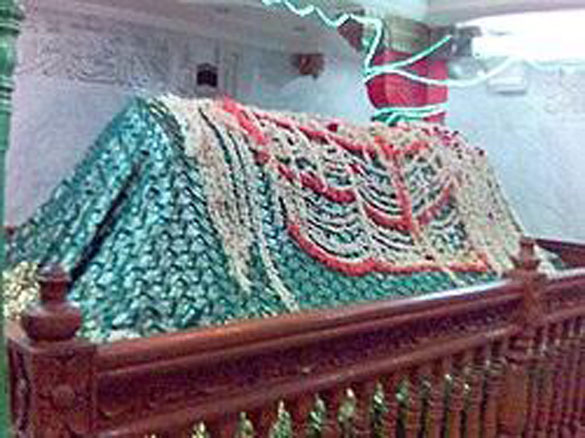
Hazrat Fakhruddin spent the rest of his life in Penukonda, where he established a Khanqah that soon became known as a centre of spiritual learning and healing. Disciples from across the Deccan came to seek guidance, drawn by the saint’s quiet authority and deep compassion. The daily routine at the Khanqah followed the Qalandariyya principles, with regular dhikr gatherings marked by rhythmic recitation and spiritual intensity. Nearby stood Chilla Pahad, the hill where Hazrat Fakhruddin would retreat for long periods of solitude, prayer, and meditation. He observed strict discipline fasting, sleepless nights, and continuous remembrance of Allah. Many believed he received divine inspiration during these retreats. The rock bearing the imprint of his foot on Chilla Pahad remains a site of devotion for visitors seeking blessings.
Despite reports of miraculous healings and spiritual visions, Hazrat Fakhruddin discouraged attention to such wonders, reminding his followers that true power lies only with Allah. He lived a life of celibacy, explaining that he had pledged himself entirely to spiritual service and renounced all distractions, even those permitted in faith. Under his guidance, Penukonda became a leading centre for Qalandars and Fakirs.
The Khanqah welcomed everyone Rifai, Madari, Banava, Malang, and others—who worked in unity rather than rivalry. Every year, on the first of Jamadi-ul-Thani, representatives of these orders gathered at Penukonda to select their leaders for the coming year, a unique blend of spiritual and democratic tradition. It was also agreed that every two years, a faqir from the Shah Banava order would travel across the region, visiting shrines and spreading the teachings of Hazrat Fakhruddin, ensuring the unity and vitality of the Qalandar network across South India.
Death, Succession, and Continuing Legacy
Hazrat Baba Fakhruddin lived for about 126 solar years (130 lunar years), a lifespan that reflected divine blessing and the enduring strength of his spiritual discipline. Even in his final days, his vitality and spiritual radiance remained unchanged. On Thursday, 12 Jamadi-ul-Thani 694 Hijri (5 May 1295 CE), after completing the Zuhr prayer, Hazrat Baba Fakhruddin passed away in Penukonda. His closest disciples were present during his passing and carried out the burial rites. Before his death, Hazrat Fakhruddin appointed his nephew and devoted disciple, Hazrat Syed Yusuf Qattal Hussaini, as his spiritual successor. Hazrat Yusuf Qattal, a learned and spiritually mature figure, continued the mission of his uncle, maintaining the Khanqah and guiding seekers with the same humility and devotion. The line of custodianship (Sajjada Nasheeni) established through him has remained unbroken to this day, with each successor preserving the sanctity and traditions of the shrine.
The annual Urs of Hazrat Fakhruddin, observed on the 12th of Jumada al-Thani, is among the most revered gatherings in South India. It begins with the flag hoisting on the 6th, led by the current Sajjada Nasheen, marking the start of an eight to nine-day celebration. During this period, Penukonda becomes a centre of devotion, drawing vast numbers of pilgrims Muslims, Hindus, Sikhs, Christians, and others united in reverence for the saint. The Urs includes Qur’anic recitations, discussions on his teachings, qawwali, collective prayers, and Langar, embodying the inclusive and compassionate spirit he lived by. Centuries after his passing, the light of Hazrat Fakhruddin’s message continues to guide seekers, his shrine standing as a living symbol of spiritual equality, humility, and divine love.
The Living Miswak and Chilla Pahad
Among the most remarkable features of the Penukonda shrine is the Miswak tree—the plant that sprouted miraculously seven and a half centuries ago when Hazrat Fakhruddin planted the sacred twig given by his Murshid. Despite its antiquity, the tree remains alive and thriving, bearing witness across the centuries to the truth of Hazrat Fakhruddin's spiritual station and the authenticity of his mission.
Pilgrims visiting the shrine often seek out this remarkable tree, touching its trunk reverently, and experiencing a sense of direct connection to the saint and to the miraculous events of Penukonda's spiritual foundation. Equally significant is Chilla Pahad, the small hill where Hazrat Fakhruddin spent years in prayer and meditation. The cave on this hill remains a place of intense spiritual atmosphere. Within the cave, a rock bears the impression of Hazrat Fakhruddin's foot, preserved as a sacred relic. This footprint, worn into the stone by centuries of pilgrims seeking its Baraka, represents a tangible connection to the physical presence of the saint and serves as a focal point for those seeking his intercession and blessing.
Conclusion
Hazrat Fakhruddin remains one of the most enduring figures of Indian Sufism. Born into royalty, he chose the path of renunciation and devoted his life entirely to the remembrance of God. Through years of discipline and devotion under the guidance of Hazrat Nathar Badshah, he attained spiritual perfection and became a guide for seekers across the Deccan. His Khanqah at Penukonda turned into a centre of learning, healing, and compassion that continues to inspire devotion centuries later. His legacy endures through the living Miswak tree, the spiritual gatherings at his shrine, and the unbroken chain of custodians who have preserved his path. The message his life conveys remains timeless that true power lies in humility, that the richest wealth is contentment in God, and that the truest monuments are those built in human hearts.
-----
Adnan Faizi is a Peace and Harmony activist based in Delhi. He is an alumni of CCS University, Meerut.
New Age Islam, Islam Online, Islamic Website, African Muslim News, Arab World News, South Asia News, Indian Muslim News, World Muslim News, Women in Islam, Islamic Feminism, Arab Women, Women In Arab, Islamophobia in America, Muslim Women in West, Islam Women and Feminism