
From Warrior to Wali: How Hazrat Khan Jahan Ali Turned the Sundarbans into a Spiritual Civilization

By Adnan Faizi, New Age Islam
22 December 2025
Hazrat Khan Jahan Ali came to Bengal as both a warrior and a saint, turning the wild Sundarbans into a living land. Through faith, service, and compassion, he built mosques, settled communities, and left a lasting spiritual legacy.
Main Points:
· Hazrat Khan Jahan Ali arrived from Khwarazm, Turkestan after Timur attacked Delhi.
· Disciple of Hazrat Noor Qutub Alam, married to Murshid's daughter for spiritual unity.
· As Chief Commander under Sultan Ibrahim Sharki, defeated Raja Ganesh of Gour.
· Governed Khalifatabad (Bagerhat) for Sultan Nasiruddin Mahmud Shah of Bengal.
· Constructed Sixty Dome Mosque, dug hundreds of tanks, built infrastructure legacy.
Introduction
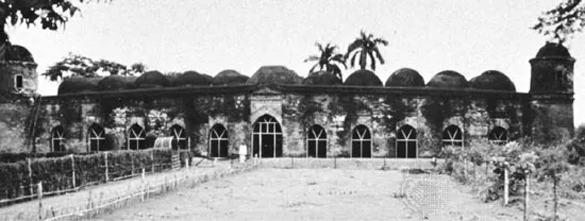
Hazrat Khan Jahan Ali stands out in Bengal’s Islamic history as a rare blend of power and piety. Born in Khwarazm, he was trained in learning and warfare, but the upheavals following Timur’s 1398 invasion of Delhi pushed him eastward in search of purpose rather than conquest. His life changed decisively after meeting Hazrat Noor Qutub Alam, becoming his disciple and marrying his daughter marking his transformation from warrior to saint-administrator. As governor of Khalifatabad (modern Bagerhat), Hazrat Khan Jahan Ali ruled with spiritual conscience. He turned the harsh Sundarbans wilderness into a settled region of farms, learning, and faith, showing how just governance could uplift society. The Sixty Dome Mosque, now a UNESCO World Heritage Site, remains his most visible legacy, but his true contribution lies in proving that spiritual leadership and effective administration can work together to transform both hearts and lands.
Early Life and Family Background
Hazrat Khan Jahan Ali was born in Khwarazm (present-day Khiva, Turkestan), a land known for both fearless warriors and deep-thinking Sufi mystics. He came from a noble Turkish family, but what set him apart even early on was his rare balance of strength and sensitivity. As a young man, he loved books as much as others loved weapons spending long hours reading, reflecting, and learning, while also training in martial skills. This quiet harmony between the sword and the mind made him distinctive among his contemporaries. The turmoil of the late 14th century reshaped his destiny. News of Timur’s brutal invasion of Delhi in 1398 CE signalled the collapse of familiar political orders. Instead of clinging to fading power, Hazrat Khan Jahan Ali sensed a deeper calling. Guided by spiritual instinct rather than ambition, he chose a new direction and joined the army of Sultan Ibrahim Sharki of Jaunpur—a ruler known for vision, learning, and respect for saints. This step marked the beginning of a journey that would eventually turn a warrior into a servant of faith and society.
Military Career and Spiritual Initiation
Hazrat Khan Jahan Ali’s rise in the military was swift and unmistakable. He began as an ordinary soldier in Sultan Ibrahim army, but his discipline, courage, and leadership soon set him apart. In a short span, he was elevated to Chief Commander, a position carrying real authority over campaigns that reshaped regional politics. One of his most significant expeditions was against Gour (Gaur), ruled by Raja Ganesh, whose harsh policies had made religious life extremely difficult for Muslims and other communities, with Islamic practices openly suppressed. Hazrat Khan Jahan Ali led the campaign that defeated Raja Ganesh, yet his response to victory revealed his inner character. When the defeated ruler sought mercy, it was granted. Instead of revenge, he chose justice and restraint, showing that power, in his hands, was guided by conscience rather than cruelty. This ability to conquer without oppression became a defining trait of his life.
At the peak of his worldly authority, a deeper transformation awaited him. Hazrat Khan Jahan Ali encountered with Hazrat Noor Qutub Alam, a revered Sufi master renowned for sacred knowledge and spiritual insight. This meeting, understood in Sufi tradition as divinely ordained, altered the course of his life. By taking Bayat at Hazrat Noor Qutub Alam’s hands, he willingly placed his military rank beneath the discipline of spiritual discipleship. The bond was further sealed through marriage to Hazrat Noor Qutub Alam’s daughter, uniting saint and soldier not only spiritually but as family. This union symbolised the complete harmony of worldly power and inner devotion, through which Hazrat Khan Jahan Ali inherited his master’s blessings and stepped fully onto the path that would define his lasting legacy.
Khalifat, Governance, and the Transformation of Khalifatabad
After receiving Bay'ah from Hazrat Noor Qutub Alam, Hazrat Khan Jahan Ali took a step that astonished his contemporaries: he resigned from his military command at the peak of his power. This renunciation was not an escape from responsibility, it's a conscious turning toward a Spritual Path. He did not retreat from society; instead, he redirected his strength from conquest to service. Around 1437 CE, he entered the service of Sultan Nasiruddin Mahmud Shah of Bengal, who entrusted him with the governance of Khalifatabad (present-day Bagerhat) deep within the hostile wilderness of the Sundarbans, stretching up to Naldi north of Narail. The region was notorious for dense forests, salt marshes, wild animals, and disease, having resisted organised settlement for generations. To support this immense task, the Sultan appointed Hazrat Burhan Bura Khan and his son Hazrat Fateh Khan as deputies, allowing Hazrat Khan Jahan Ali to focus on vision and direction. Over the next two decades, he oversaw a complete transformation of both land and society. He began by clearing the forests to make room for villages and agriculture, mobilising labour and resources on an exceptional scale. Understanding that life and settlement depended first on water, he ordered the excavation of hundreds of tanks (dighis) for drinking, irrigation, and community use. Among them, Khanjali Dighi (1450 CE), near his future resting place, and the vast Ghoradighi 230 by 460 metres west of the Sixty Dome Mosque, stand out as enduring symbols of service.
His vision extended further. Embankments were built to block saltwater intrusion, making rice cultivation possible. A highway linking Bagerhat to Chittagong was constructed, along with roads from Samantasena to Badhkhali and from Shuvabara to Daulatpur, integrating Khalifatabad into wider trade and communication networks. Hazrat Khan Jahan Ali believe that true da‘wah lies in care for human need. Clean water, roads, and protection from floods served everyone Muslim and Hindu alike. This practical compassion spoke louder than sermons, drawing thousands toward Islam through example rather than force. In Khalifatabad, governance itself became an act of spiritual service.
Architectural Legacy and Mosque Construction
Hazrat Khan Jahan Ali’s most lasting contribution unfolded through architecture. Around 1450 CE, as Khalifatabad matured, he commissioned a grand mosque meant to anchor the region’s spiritual life. The result was the Sixty Dome Mosque an iconic structure whose popular name understates its scale: seventy-seven domes resting on sixty pillars, creating an interior marked by both majesty and calm. Built of brick and stone with rich terracotta ornamentation, the mosque exemplifies what scholars call the “Khan Jahan Style,” a distinct Bengali Islamic architectural expression shaped by his vision. Construction spanned roughly 1450–1459 CE (with inscriptions ranging from 1440 to 1459), demanding immense resources. Every detail was functional and symbolic: multiple domes enhanced Qur’anic acoustics, the vast hall held thousands of worshippers, and the terracotta motifs proved that Islamic aesthetics could fully flourish in Bengal.
Under his guidance, this was part of a wider sacred building programme. The Nine Dome Mosque near his shrine, along with the Singar, Bibi Begni, Chunakhola, Ranabijoypur mosques, and structures linked to Zinda Pir and Reza Khoda, emerged during this period. In total, sixteen mosques rose across Khalifatabad, turning the region into a continuous spiritual landscape. These buildings were not displaying of power but acts of devotion. Each mosque functioned as a place of prayer, learning, and refuge, welcoming rich and poor alike. For Hazrat Khan Jahan Ali, beauty itself was a form of remembrance proof that faith could shape both the soul and the world around it.
Spiritual Teachings and Disciples
Although fewer formal discourses of Hazrat Khan Jahan Ali have survived than those of some other Sufi masters, his life itself served as his strongest teaching. He instructed by living Islamic principles openly in governance and everyday conduct. Despite ruling as the supreme authority of Khalifatabad, he chose a life of deep simplicity, residing in a small cave beside his mosque. His needs were met by a single goat that provided milk, butter, an intentional renunciation that showed his disciples that closeness to God. Among his closest disciples, Hazrat Shaykh Muhammad Tahir revered as Hazrat Pir Ali emerged as a leading spiritual heir. Recognised as a khalifa of Hazrat Khan Jahan Ali, Hazrat Pir Ali carried forward his Murshid’s teachings with distinction. His tomb, situated near Hazrat Khan Jahan Ali’s own resting place, reflects a bond of discipleship that endured beyond death and remains a point of reverence for pilgrims.
Hazrat Khan Jahan Ali’s influence also crossed religious boundaries. Many Hindu inhabitants of Khalifatabad were drawn to Islam by witnessing his justice, compassion, and service to humanity. Those who accepted Islam retained elements of their cultural identity, eventually forming the community known as the Pirali Brahmins. From this lineage emerged ancestors of the Tagore family, whose later generations shaped Bengal’s intellectual and cultural life. In this way, Hazrat Khan Jahan Ali’s quiet spirituality continued to shape hearts, communities, and history long after his own time.
Death and Eternal Legacy
Hazrat Khan Jahan Ali departed this world on 25 October 1459 CE, having lived to see Khalifatabad take shape exactly as he had envisioned. His passing felt like a quiet transition, for his presence remained deeply woven into the land and the people he had served. He was laid to rest in Bagerhat, close to the mosques he had built, and his grave soon became a place of prayer, remembrance, and solace. A simple single-domed mosque rose over his tomb, preserving both his dignity and humility. The inscriptions that remember him as Ulugh Khan and Khan-e-Azam recall his worldly authority, but it is his lived compassion that continues to draw hearts. Today, pilgrims from different faiths still visit his shrine, seeking blessings and paying respect to a saint whose mercy knew no boundaries.
The wider landscape bears his imprint even now. The Mosque City of Bagerhat, recognised as a UNESCO World Heritage Site, stands as a living reminder of his vision. The tanks he dug, the roads he laid, and the embankments he built shaped the region’s prosperity and continue to support life in modern form. Bagerhat remains a thriving city, where mosques stand alongside temples in peaceful coexistence an enduring reflection of the harmony Hazrat Khan Jahan Ali nurtured through faith, service, and example.
Conclusion
Hazrat Khan Jahan Ali stands out as a man who held power yet chose humility, who knew the arts of war but lived the life of a saint. He showed, through his own conduct, that spirituality does not require turning away from the world; it can work within it, healing and rebuilding. The Sixty Dome Mosque reflects his vision in brick and stone and his legacy lives in the fertile lands he reclaimed, the communities he nurtured, and the spirit of harmony that still defines Bagerhat. More than five centuries after his passing, his presence is still felt. People come to his shrine seeking comfort and direction, scholars revisit his methods of governance, and architects continue to study the style he helped create. Above all, his life remains a quiet lesson—that faith, service, and responsibility can walk together, shaping both the soul and society.
___
Adnan Faizi is a Peace and Harmony activist based in Delhi. He is an alumnus of CCS University, Meerut.
URL: https://newageislam.com/islamic-personalities/warrior-wali-hazrat-jahan-ali/d/138104
New Age Islam, Islam Online, Islamic Website, African Muslim News, Arab World News, South Asia News, Indian Muslim News, World Muslim News, Women in Islam, Islamic Feminism, Arab Women, Women In Arab, Islamophobia in America, Muslim Women in West, Islam Women and Feminism