
Sir Syed Ahmad Khan: The Man Who Modernized Muslim Education and United India Through Learning
By Abdul Hafiz Farooqui
Translated from Urdu to English
For Sir Syed, unity among people was the greatest strength. He always considered Hindus and Muslims as children of the same soil and saw national harmony as the key to progress. In one of his speeches, he said: “There is no difference between Muslims and Hindus. Just as the Aryans are called Hindus, Muslims too can be called Hindus, meaning, inhabitants of Hindustan. We have often said that India is like a beautiful bride, and Hindus and Muslims are her two eyes. Her beauty can remain only when both eyes exist.”
-----
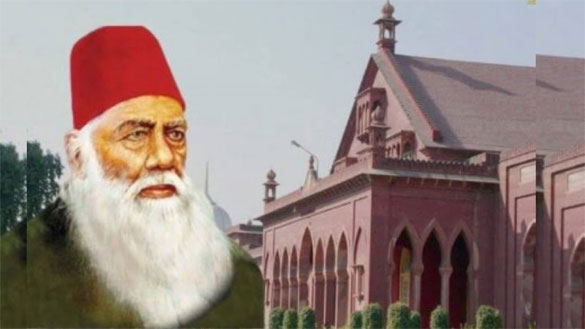
The nineteenth century will always be remembered for efforts toward reform and cultural awakening among Muslims. During this time, reformers across the world launched movements that left lasting effects on human life and society. In India, two names stand out above all others: Raja Ram Mohan Roy and Sir Syed Ahmad Khan.
Sir Syed belonged to an era when the Mughal Empire was in decline and Indian society, especially Muslims, faced deep despair. He saw his people trapped in ignorance, poverty, and intellectual stagnation. In such times, he began an educational movement that became a beacon of hope, not only for the survival of Muslims but for the progress of all Indians.
At the Aligarh Exhibition, he expressed both his helplessness and his passion for service with these words:
“I begged from people but received very little. I tried to make volunteers, but very few came forward, and those who did could not help much. So today I stand here to do whatever I can for the education of our children.”
These words reflect the burning desire in his heart for the upliftment of his community. He believed that education was the only path that could restore dignity and self-respect to Muslims.
The most remarkable aspect of Sir Syed’s life was his intellectual vision. He knew that clinging to the glories of the past was not enough. To survive, the community had to adapt to changing times. This is why the Aligarh Movement was not merely about founding a college; it was about creating a new way of thinking, a philosophy that gave new life to an entire generation.
For Sir Syed, unity among people was the greatest strength. He always considered Hindus and Muslims as children of the same soil and saw national harmony as the key to progress. In one of his speeches, he said:
“There is no difference between Muslims and Hindus. Just as the Aryans are called Hindus, Muslims too can be called Hindus, meaning, inhabitants of Hindustan. We have often said that India is like a beautiful bride, and Hindus and Muslims are her two eyes. Her beauty can remain only when both eyes exist.”
For Sir Syed, the goal of education was not only to lift Muslims out of decline but also to promote the welfare and progress of all of India. He believed that true service to humanity could only come from rising above religious prejudice. On one occasion, he said:
“My friends! I would be deeply saddened if anyone thought that this college was founded to create division between Hindus and Muslims. The real reason for its establishment was that Muslims were becoming increasingly degraded and dependent. Their religious prejudices kept them from taking advantage of the education offered in government schools and colleges. Therefore, it became necessary to make special arrangements for their education.”
This statement clearly shows that, in Sir Syed’s view, the Aligarh College was not merely an institution, it was a centre of learning meant to give the nation new intellectual strength and practical vision. For him, Hindu–Muslim unity was the foundation of national progress.
In 1883, while addressing a gathering of Hindus in Punjab, he said:
“You use the word Hindu only for yourselves. That is not correct, because in my opinion the word Hindu does not refer to a specific religion, but to anyone who lives in India. Therefore, I am saddened that although I live in India, you do not consider me a Hindu.”
This concept of nationality, if both communities had understood it, could have changed the course of the country’s history. Sir Syed saw the betterment of Muslims as part of India’s progress, and India’s advancement as the progress of all Asia. His vision compels us to see how farsighted and realistic a leader he truly was.
Among all the weaknesses of Indian society, the one that Sir Syed felt most deeply was the lack of education. He saw that the Western world, through the advancement of science and knowledge, had unlocked the secrets of the universe, while India, especially the Muslims, had fallen far behind. This realization led him to conclude that for the nation to survive, it must embrace an education system free from sectarian boundaries and rooted in reason and scientific thought.
This very idea later evolved into a well-defined secular educational philosophy that became the foundation of the Aligarh Movement. Sir Syed clearly understood that if education were confined within the narrow limits of religion, society would become even more divided. What was needed instead was a system of learning that opened its doors to all—Hindus, Muslims, Christians, and Sikhs alike.
For him, the goal of education was not merely religious understanding, but the enlightenment of the human mind, so that people could meet the demands of a changing world.
In the educational framework he proposed, science and modern philosophy held a central place. He wanted the youth of India to move beyond blind tradition and to engage with the world through reason and inquiry. It cannot be overlooked that Sir Syed’s educational plan gave preference to no single religion. Rather, it emphasized equal opportunity for every community. That is why the doors of Aligarh College were kept open to all—so its graduates could serve not only their own people but the entire nation as beacons of light. His message was clear: education is not the property of any one faith or sect; it is the shared heritage of all humanity.
The Aligarh Movement was the realization of that dream. It declared that education should not remain limited to religious meanings but should be a broad and inclusive concept, embracing reason, science, philosophy, literature, and law. Through this movement, Sir Syed gave Indian society a new message: that the true purpose of education is to end communal divisions and to promote national unity and enlightenment.
This was the balanced and rational vision that paved the way for secular education in India. Sir Syed believed that if people of all faiths were educated together, they would have the chance to know and understand one another more closely. As a result, mutual hatred would fade, and the country’s progress would accelerate. In his eyes, knowledge was the power that could change not only the fate of Muslims but also lead the entire Indian nation into a new era. He knew that religious prejudice had brought the nation to the brink of ruin, which is why he advocated for an educational system free from all discrimination and devoted solely to the welfare of humanity.
It was this very vision that eventually led to the creation of Aligarh Muslim University. When the institution came into being in 1920, it was not merely a university; it was a centre of learning that turned Sir Syed’s dream into reality. Its walls still bear witness to how the passion of one determined man transformed into a great movement.
Through his sacrifices and tireless efforts, Sir Syed made this institution a shining symbol of secular education in India. If any single figure deserves credit in the history of Indian education for presenting learning through a rational and secular perspective, and for making the nation aware of its true importance, it is undoubtedly Sir Syed Ahmad Khan.
He was not just an individual—he was an era, a movement, and a caravan of progress. The light he kindled became a beacon not only for Muslims but for all of India.
-----
Urdu Article: Sir Syed Ahmed Khan and Secular Education in India سرسید احمد خان او رہندوستان میں سیکولرتعلیم
New Age Islam, Islam Online, Islamic Website, African Muslim News, Arab World News, South Asia News, Indian Muslim News, World Muslim News, Women in Islam, Islamic Feminism, Arab Women, Women In Arab, Islamophobia in America, Muslim Women in West, Islam Women and Feminism