
Thinking About Contingencies in Philosophy, History and Theology: The Case of Madrasa Discourses Project

By Saad Ahmad, New Age Islam
22 December 2025
Abstract:
The essay explores how the concept of contingency, events and ideas shaped by circumstance and context function across intellectual traditions. It problematizes how contingency is central to understanding the unfolding philosophy, historical narratives and theological debates. In an attempt to situate contingency within madrasa discourses especially, and within madrasa-sphere in Indian subcontinent, the essay tries to ponder upon scholastic traditions with question of necessity, possibility and divine will. It sheds light on modern frames of historical and philosophical analysis and peeps into the window of fixity; fixed readings of history, theology and opens gates of plural interpretations, criticality, dialogue between and through classical and contemporary thought.
Keywords: Philosophy, history, theology, Madrasa Discourses, modern, Fiqh, Religion, Islamic pedagogy
…
Taking a bird’s eye-view of intellectual activities of contemporary madaris (pl. madrasa) in the Muslim world — and in India and Pakistan in particular — one finds a nostalgia for so-called ‘Islamic pedagogy.’ This pedagogy emphasizes the idea that invincible knowledge emerges out of reading and adherence to tradition, polemical contestation, and preservationist mobilisation. In this sense, a modern Muslim scholar could be well received for supplying a rational defence to rote-learning culture of the seventeenth- and eighteenth-century Muslim scholarship. He could provide a library full of works of literature making the case for elitism, patriarchy, and feudalism (referred to as zamindar in the Indian subcontinental context), as well as celebrate contributions provided by these works toward maintaining religious authority and his (his/her) claimed idea of worldly-unworldly position of knowledge in society. But the ‘modern Muslim scholar’ could also seek to approach this literature critically.
The modern Muslim scholar might invent a critical tradition to win over historically critical ulama (plural of alim, scholar) by articulating a higher degree of the knowledge seen and practised by mystics. But, for the modern Muslim scholar, science has dwarfed the real degree of knowledge of those mystics. One can explain the treasury of Islamic heritage and its multifaceted relevance for any society, but one’s reflection goes with the modern society as the only ideal and rational society. Despite having developed abilities to identify the problem of the traditional society, the scholar sees that Muslim society of our time has not produced a thing except taking inspiration and considering the past only. This issue leaves the very society relying on an enigmatic narrative of the future and sums the idea that Muslim society whether looks in the past or get caught by unrealized, mysterious future. It is the “looking tradition” most elaborated by modern Muslim scholars which he/she thinks is an offshoot of structural trauma and symptom of the psychological struggle of the very society. Despite this, the modern Muslim scholar cannot see the traditional worlds from inside, nor speak from the perspective of traditional societies.
For a student of traditions and modernities, the most important thing lies not in the baggage of either case but inside; in a deep-seated, multi-layered inside.
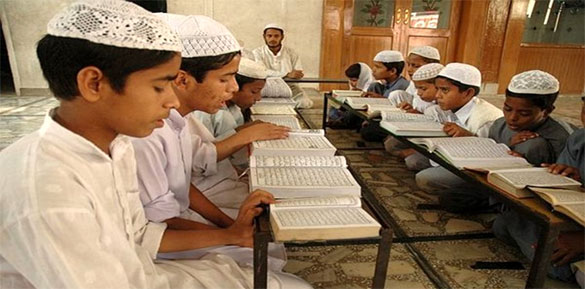
The Madrasa Discourses project is not an illustration of insights happening in the West or in the East; in Christendom or Islamdom (Marshall J H Hodgson (1974) The Venture of Islam, Volume I, Chicago, The University of Chicago Press, p.58); in the modern secular world of European culture or the traditional world of Muslim culture. It is about invigorating the sense of criticality from the deep-seated, multi-layered inside. It never tries to judge the “modernness” of a modern Muslim scholar but showcases/produces the body of traditions upon that entire carrier of one-directional reasoning of modern-ness hitherto relied.
Madrasa Discourses makes one able to see and understand things around oneself. It goes deep inside of the self. It lets you identify whether your intellectual traditions are dynamic or static. Understanding of the inside opens more than one world around you. It shows you the embedded self is never a singular identity, religious or irreligious, but each character belongs to another, and another is entangled with the understanding of self. Madrasa Discourses became another name for looking and defining things in more than one way. Unlike some of the existing dialogues on Islam, Madrasa Discourse hardly seems interested in identifying declension in Islamic thought. It hardly claims that it has the panacea for all problems happening to Islam/Muslims. Rather, it is worried about understanding and interpretation in Islamic thought processes. Engagement with Madrasa Discourses leads one to learn how entire structures of knowledge in the contemporary Muslim world have been seized, seemingly, by the absence of a tiny element of the thinking process: the will to knowledge. In no sense is the Muslim world contemporary, nor does it try to make itself modern. What Muslim cultures had as heritage been becoming part of the one-directional understanding of the knowledge, with a dominant idea of reason and reasoning.
Knowledge of traditional practices prepared Madrasa Discourses students to look at the seventeenth to nineteenth century works of literature taught in contemporary madaris and to consider their responsibility for producing Muslim societies disconnected from thinking process at first stance. One can argue that this disconnection was because of unavoidable historical shift of the circumstances from Godly-defined historicity to a materially experienced reality. But this cannot be an appropriate explanation of the case. Instead, contemporary madaris relied on the preservation of highly sectarian consciousness of Islam (an invention of their own). They believed in their imam-faqih or sheikh-peer as the absolute truth of their versions of Islam. Thus, in the preservationist narrative, the subject-truth of Islam became the subject politics for the facts of Islam. The preserving images remained such a beautiful theme which embraced seeing Islam in danger more ideologically than earlier. One Islam existed nowhere but was multiplied into many Islams and versions of Islam. From this perspective, Thinking and its connection with cultural determinism in madrasas were seen as the only refuge for the interpretative attempts. The literature of the seventeenth to nineteenth century Islam seems an essential example of the preservationist trend. For example, in the current model, madrasa students are taught to stubbornly recommend solutions from seventeenth-nineteenth century literature for twenty-first century social activities. Adherence to certain historical time periods makes one’s culture more anachronistic instead of advancing its attitude. But being part of Madrasa Discourses does not mean rejecting the knowledge of the seventeenth to nineteenth centuries, or the more historically profound knowledge of Islam’s past.
The Curious Case of Possibilities: Theologies and Religions
Knowledge of the past provides context for the present. But the crisis in contemporary Islamic/Muslim scholarship lies in the very understanding that solutions from the seventeenth to nineteenth centuries can solve problems of the twenty-first century. The jurisprudential field in the medieval world of Islam (or pre-modern world) had a different politico-social set up than ours. We do not find a crisis in the medieval world claiming other understandings of the world as more meaningful. We, from our current position in the modern world — despite being trained to observe things in a particular way — hardly see any crisis (from inside) in the realm of the knowledge because of the internal continuity of Islamic thought.
The crisis in our time is a crisis of religion within religion. We have failed to make religion contemporary. Despite this, if we claim a synchronisation of religious knowledge with worldly knowledge, then what we have is nothing but a militant presentation of religion. The idea of religion in our time generates only impositions, exclusionary politics of good and evil, parochial proposals of salvation, and hegemonic conditions for the truth. The crisis is not in performance of the religion but in the understanding of the religion, which presents not as a neutral agency but as a racialised/culturalised/ritualised set of knowledges. While facing confrontation, people interpret cultural conflicts as instances of religion itself in danger instead of saying the culture is fearful and feels itself to be in danger. All this happens as the result of not thinking about possibilities of theologies and religions.
Madrasa Discourses and Its Discursive Realm:
To understand the crisis of religion and Islam, Madrasa Discourses offers many ideas which seemingly posed challenges to the formative elements of Islam in general, and engagement with the spirits of other religions as well. To understand the discursive condition of ideas from Islamic history, theology and philosophy, one needs to open the doors of Islamic dynamism to face contemporary thought. Engaging with reasoning itself is primarily the work of an elite. Hence, working in the field of legal jurisprudence might bring an impression that most of the legal works in Islam are smitten with ideology. But, taking his insight from Terry Eagleton, Prof Moosa suggested that ideology can serve good purposes as well.
To understand the working behaviour of Islamic reasoning, for instance, Madrasa Discourses brought Dr Saadia Yacoob, whose reading of Hina Azam, Maya Shatzmiller, and Kecia Ali added a sensible context to the reification of Islamic law and jurisprudence. Prof Yacoob highlighted the gap between our understanding and treatment of the “female body” in contemporary society as an embodiment of human assertion versus the medieval history of women as property belonging to “the patriarchal body” of the male. In this regard, one seems interested by the existence of sexual violation and ways of treating them by legal experts in the medieval period and possibilities to narrate the contemporary Western concepts of rape cognate to Islamic law.
The idea of gender studies and related problematisations with reference to Islamic law and jurisprudence raises significant fiqhi contemplation known as tamlik (dominion right) and istemta’a (right to seek sexual pleasure). The sense of tamlik suggests the entire non-modern context of social order and justice which, for some, successfully maintained the society in the medieval period of Islam. The very sense explains that the husband acquires ownership of the body of a woman and the right to seek sexual pleasure from his wife whenever he wants. Istemta’a falls under the professional understanding of the social contract. Living in an age of liberations, the biggest question before Islamic jurisprudence comes to whether the concept of tamlik is relevant in today’s life, or whether one should strive to overturn what Prof Yacoob called ‘Islam maintained unique patriarchy’. In thinking of tamlik as the product of jurisprudential/cultural/interpretative contemplation, one could argue to remove the ideational context of tamlik on the ground of various other claims as a source of patriarchy-laden oppression. The critical question comes before the non-Islamic enterprise of the law: are we ready to take the risk of a post-tamlik Islamic jurisprudence to embrace the ethics of a comparatively more mature, rights-led society for the modern world?
The issues raised by Prof Yacoob were continued by Prof Atalia Omer, who examined how one’s fiqhi discursivity from inside the tradition joins outside discourses within a broader gender studies framework. Prof Omer highlighted the importance of inter-religious dialogue and scriptural reasoning. For her, the question and concept of justice were essential, and must be responded to. Prof Omer’s methodological interests in peacebuilding introduced such ideas as how to reimagine Jewishness through feminism and other-centric solidarity. She explained that this issue requires an understanding of the intersectionality and the US civil rights movement. Prof Jason Springs provoked us to think upon Christian theology and mesmerised students by his understanding of narratives of “vulnerable God” (Placher 1994) which, if used for inter-religious scriptural reasoning, could be equated to the attribute of Rahman (compassion, one of the many names of Allah) in Islamic theology. The attribute of Rahman is interpreted as able to swallow the anger of the Allah. Thus, God’s love makes Him vulnerable. Prof Springs also provided contexts regarding how to understand a plural tradition, noting that “a tradition is itself a pluralistic affair.”
Students considered the invitation to see these discourses as inter-jurisprudential and inter-scriptural as one of the vital articulations provided by Madrasa Discourses.
Professor Moosa led students to the work of Abdul Wahhab Sha’raani (d.1566), whose interpretation of knowledge opened a door full of wonders. Sha’rani had a philosophy of the Quran, theology, fiqh and an unexplainable technique that makes his reader speak from the same point of view and same experiences as Sha’rani had wished. Explaining the importance of Siyasah Hukmiyyah (politics of natural edict) and Siyasah al-Sharaiyyah (politics of Shariah) and constitutive elements of adah (human nature), Sha’rani stated that many things in the world are indeed inscrutable, enigmatic, and cannot be understood only using reason. His pontification on the nature of Shariah clarified one of the emerging confusions on whether the idea of Shariah is a problem or solution. Shariah creates a problem for the secular world as well as for Islamic understanding when it is introduced and applied as a policy. In case of adopting Shariah as policy, the primary threat it poses is to the idea of pluralism. As a result, a pluralist idea of society and a policy-centric Shara’i idea of society both battle with each other. Prof Moosa proposed, and in the light of Sha’rani, that Shariah must be meant as a system of governance instead of policy.
On one crucial aspect, participant questioned what one understands by religious thinking. For him, despite the claim that religious thought is meant to guide the people, it cannot establish itself permanently. The immanent-transcendent relationship in religious view works within a temporal framework. Against this, the religious thought always considers itself an associative and meaningful project because its awareness of immanent-transcendent ties stems out of the Quranic knowledge. Thus, religion and religious thought processes remain a laughable topic from outside. Since we avoid linking history and the idea of Shari’a, we hardly understand its purpose according to the contemporary needs. The rationalisation about the givenness of Shariah makes us consume it like a candy. We rarely consider that prophets were expected to contemporise Shariah within the human nature available in specific temporal and regional contexts. Prophet Muhammad’s idea of Shariah is essential and claimed universalism as it shares more with human nature and life in agreement with human nature in essence. The South Asian context of Shariah and its relevance is highly in need to be reworked from an unrepairable-repairable perspective. It seems that the intuition and vision developed in a South Asian context of Shariah are highly in need of a profound engagement without missing the contemporary ideas of reason and needs to be elaborated according to modern conditions of knowledge, ideas and religious thinking.
Opportunity as Freedom:
After the engagement with Madrasa Discourse, I realized that the more we learn, the more we unlearn. The more we understand ideas of Islam, Christianity, Judaism, Hinduism and other beliefs and contemporary contexts, the more we lament that we did not learn them earlier. In most cases, finding systematic-un-systematic opportunities provided by Madrasa discourse, though few, students seemed ready to develop their imagination with useful contexts. Despite, reading a number of censoring agendas of religious-irreligious literature about the literature of the medieval period of Islam and Christianity, we feel the freedom of rereading so-called “dangerous knowledge,” but from a different angle.
Instead of a conclusion of what we have learnt in the Intensive Programme of Madrasa Discourses, I would like to quote Thomas Mann, “A man lives not only his own personal life, but also, consciously or unconsciously, the life of his epoch and his contemporaries.” (The Magic Mountain,1924).
Dr. Saad Ahmad, a JNU PhD graduate, is an accomplished academic who served as Assistant Professor at the Centre for Culture, Media and Governance and as Guest Faculty at the Nelson Mandela Centre for Peace and Conflict Resolution, both at Jamia Millia Islamia, New Delhi. He was also part of the Madrasa Discourses Project under the University of Notre Dame’s Contending Modernities initiative from 2017 to 2020.
URL:https://newageislam.com/islamic-ideology/philosophy-history-theology-madrasa/d/138106
New Age Islam, Islam Online, Islamic Website, African Muslim News, Arab World News, South Asia News, Indian Muslim News, World Muslim News, Women in Islam, Islamic Feminism, Arab Women, Women In Arab, Islamophobia in America, Muslim Women in West, Islam Women and Feminism