
The Moral Pain of Usury

By Moin Qazi, New Age Islam
04 June 2026
The most hated sort [of moneymaking], and with the greatest reason, is usury, which makes a gain out of money itself, and not from the natural use of it. Money was intended to be used in exchange, not to increase by interest. … Wherefore of all modes of making money, this is the most unnatural.
— Aristotle, Politics, Book I, Chapter 10 (1258b)
The Moral Question Of Usury
Men, created in the image of God, possess an inherent dignity and the capacity for moral elevation. The distance between ordinary and extraordinary human beings is not absolute but one of degree—a gradual movement from frailty toward greatness, from moral weakness toward the fuller realisation of human character.
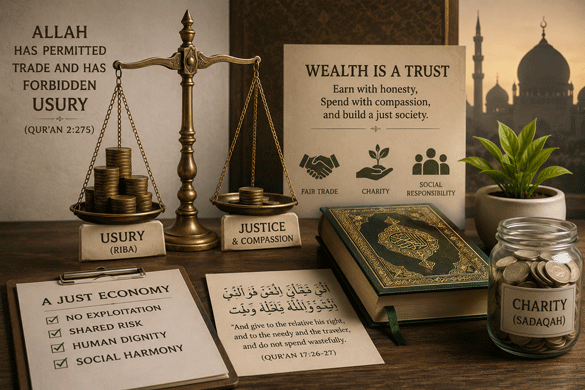
Across civilisations, few practices have provoked deeper moral unease than usury—the extraction of gain from another's vulnerability. It is more than a financial arrangement; it reflects how a society understands justice, obligation, and human worth. When money multiplies without labour, without shared risk, and without accountability, it ceases to serve life and gradually begins to dominate it. What appears economically efficient may conceal a deeper ethical imbalance: gain detached from contribution, accumulation severed from responsibility.
This anxiety surrounding usury is ancient and enduring. Philosophers, theologians, jurists, and moral thinkers repeatedly questioned whether wealth could legitimately reproduce itself without productive effort. Aristotle regarded usury as "unnatural" because money, unlike land or labour, appeared incapable of generating true increase. To him, profit divorced from productive activity represented a distortion of the moral order itself.
Classical hostility toward usury later found powerful expression in Christian thought, where the medieval Church transformed opposition to interest into a theological doctrine that shaped European moral consciousness for centuries. Literature reinforced these anxieties. Shakespeare's Merchant of Venice revealed the violence latent within a world where contractual entitlement eclipses mercy and human relationships are reduced to financial calculation.
Yet the modern world gradually normalised what earlier civilisations viewed with profound suspicion. Today, opposition to usury largely survives only in objections to "excessive" interest rather than to interest itself. Modern economies are deeply organised around debt, credit, and financial speculation, while those most burdened by these systems are often the economically vulnerable themselves.
The question, therefore, transcends economics. It concerns the moral architecture of civilisation itself: whether financial systems exist to serve humanity or whether human beings slowly become subordinate to systems governed solely by profit and accumulation.
Islam And the Ethics Of Wealth
Islam approached the question of usury through a profoundly ethical and juridical vision. The Qurʾānic prohibition of ribā did not emerge from hostility toward trade, enterprise, or lawful profit. Islam arose within a vibrant mercantile civilisation in which commerce was regarded as honourable and socially beneficial. The Prophet Muhammad himself engaged in trade before prophethood, and the Qurʾān repeatedly affirms the lawfulness of commerce while condemning exploitative financial practices.
The prohibition of ribā rests upon a fundamental moral distinction between productive exchange and guaranteed gain detached from reciprocal responsibility. Trade involves labour, enterprise, and exposure to risk; usury secures return without corresponding burden. The Qurʾān, therefore, sharply distinguishes lawful trade from usurious increase, rejecting any attempt to equate the two.
The severity of the Qurʾānic warning reflects the gravity of the issue. Ribā is not presented merely as an individual moral lapse but as a systemic corruption capable of disfiguring the ethical foundations of society itself. Those who persist in it are warned of "war from God and His Messenger," a phrase whose force underscores the profound moral seriousness of economic injustice.
Prophetic traditions deepen this ethical framework by extending responsibility beyond the lender alone to the payer, witness, and scribe, recognising that unjust systems endure through collective participation as much as through direct intention.
Classical Islamic jurisprudence consequently developed an economic ethic that sought to harmonise commercial freedom with moral restraint. Profit derived from labour, trade, partnership, and risk-sharing was considered legitimate, while guaranteed increase without risk exposure remained morally suspect. Islamic commercial law, therefore, encouraged partnerships, profit-sharing arrangements, and asset-backed exchange rather than purely interest-based lending.
Importantly, Islamic civilisation never rejected commerce or finance itself. Medieval Muslim societies developed sophisticated systems of trade, investment, credit, and long-distance commerce extending from Spain to India. Muslim merchants and jurists constructed intricate commercial mechanisms while remaining within the ethical limits prescribed by the Sharīʿah.
The modern revival of Islamic finance reflects an ongoing effort to reconcile participation in global financial systems with these inherited moral concerns. Whether contemporary Islamic banking fully succeeds in this endeavour remains debated. Yet the persistence of these efforts demonstrates that the moral questions surrounding debt, wealth, and distributive justice remain deeply alive within contemporary Islamic thought.
At its heart, the Islamic conception of wealth rests upon the principle of amānah—trust. Wealth ultimately belongs to God, while human beings remain temporary custodians accountable for how wealth is acquired, used, and ultimately transferred. Economic life, therefore, cannot be morally autonomous; it must remain subordinate to justice, moderation, compassion, and accountability before God.
The Moral Ruin of Usury
One of the central objections to usury lies in its tendency to disturb the natural balance of human relations. A person who consumes usury mismanages both personal need and the vulnerability of the debtor, thereby weakening a moral order grounded in reciprocity, compassion, and social equilibrium. Islamic moral thought does not view economic life as an isolated sphere governed solely by profit, but as part of a divinely ordered universe in which justice, proportion, and human dignity must be preserved. Usury, therefore, is regarded as a pathway to exploitation and social injustice.
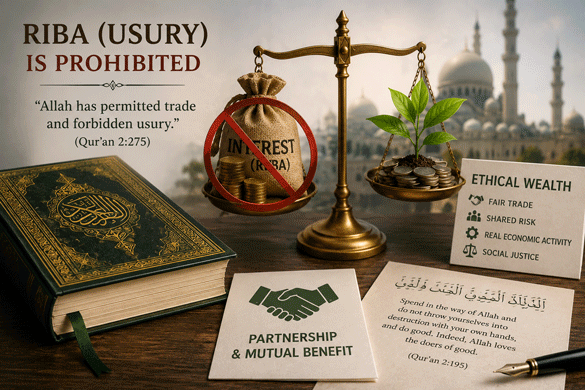
There is also a categorical objection: money should not generate money merely by virtue of itself. Classical Islamic teachings emphasise that wealth must arise from genuine effort, productive activity, risk, or exchange rather than from the passive accumulation of gain through debt. Traditions associated with early Islamic commerce repeatedly caution against transactions in which wealth reproduces itself without labour, responsibility, or tangible economic contribution.
The most famous Qur'anic passage concerning usury appears in the second chapter of the Qur'an. It warns that those who engage in usury will rise afflicted by torment and spiritual disorder, as though struck by Satan. The passage further declares that persistence in usury invites war against the moral law established by God and His Messenger. Alongside this warning comes an exhortation toward mercy and leniency toward debtors:
"If the debtor is in difficulty, then delay things . . . Still, if you were to write it off as an act of charity, that would be better for you, if only you knew."
Usury is thus portrayed not merely as a legal violation, but as a failure of generosity where compassion is morally required. In a faith shaped by a mercantile civilisation and guided by a Prophet deeply familiar with commerce, believers are repeatedly cautioned against confusing lawful economic activity with exploitative financial gain.
Islamic ethical thought consequently places strong emphasis upon shared responsibility and risk-sharing. Profit is considered morally legitimate when accompanied by uncertainty, labour, and accountability. Wealth should circulate within society and contribute to productive human activity rather than remain concentrated through passive accumulation. Hoarding and the pursuit of guaranteed gain without corresponding responsibility are viewed with suspicion because they threaten social balance and weaken communal solidarity.
Closely related to this is the concept of uncertainty and ambiguity in transactions. Islamic moral teachings discourage agreements clouded by excessive speculation, hidden liabilities, or unclear obligations. Commerce should remain transparent, comprehensible, and rooted in tangible realities rather than conjecture detached from genuine economic substance. The concern is not with prudent risk itself, which is inseparable from human enterprise, but with forms of speculation that sever economic activity from moral responsibility and social consequence.
For this reason, Islamic ethical discourse repeatedly emphasises that economic relations are ultimately human relations. Debt, deferred obligations, and financial agreements are never viewed as merely technical matters; they involve trust, vulnerability, conscience, and justice. The moral anxiety surrounding usury arises from the fear that unchecked financial appetite may transform relationships of mutual assistance into structures of domination and exploitation.
At its heart, the prohibition of usury reflects a broader civilisational vision: wealth must serve society rather than enslave it; commerce must preserve justice rather than erode it; and economic life must remain subordinate to moral responsibility. The enduring concern of Islamic tradition is not merely how wealth is accumulated, but whether its accumulation preserves compassion, dignity, and balance within the human order.
"Those who consume usury cannot stand except as one stands who is being beaten by Satan into insanity… Those who repeat (the offence) are companions of the Fire: they will abide therein (for ever). Allah will deprive usury of all blessing, but will give increase for deeds of charity."
— Qur’an 2:275–276
The Qur'anic condemnation of usury is not confined merely to economics; it is fundamentally a moral and spiritual warning against greed, exploitation, and the corrosion of human conscience. The verses portray those who consume usury as rising on the Day of Judgment in a condition of humiliation and inner ruin, an image intended to awaken fear of moral accountability before God.
The reflection further emphasises the grave warning contained in the declaration:
"Those who repeat (the offence) are companions of the Fire."
Classical Islamic commentators understood this as a severe admonition directed at those who knowingly persist in usury despite divine prohibition and ethical awareness."
The Arabic expression mahq signifies gradual erosion, depletion, and the removal of blessing. Thus, even wealth that appears abundant outwardly may inwardly become a source of anxiety, spiritual emptiness, and ultimate loss. In contrast, charity purifies wealth and strengthens the bonds of compassion and social responsibility.
Historically, scholars such as Ibn Abbas and later exegetes interpreted these verses not simply as legal injunctions, but as part of a larger ethical vision rooted in justice, restraint, mercy, and the protection of the vulnerable from economic exploitation.
Family, Hypocrisy, And The Test Of Conscience
The severest ordeal of my life emerged when I committed myself to an uncompromising campaign against usury. What I had expected would invite principled reflection instead provoked resistance from within my own family. The deepest wounds came not from declared adversaries, but from certain sisters and my nephew, whose conduct during this struggle revealed the painful distance that can exist between outward religiosity and inward moral courage.
Their opposition rarely manifested openly. It emerged instead through silence, discouragement, evasion, and subtle attempts to weaken both the campaign and the conviction sustaining it. Such experiences carry a peculiar gravity within families because trust there is not negotiated; it is inherited. Betrayal by strangers wounds, but betrayal by kin unsettles the moral foundations upon which emotional security itself rests.
What rendered their conduct especially distressing was not merely the opposition itself, but the spirit in which it was expressed. Rather than engaging in sincere self-examination or reflecting upon the contradiction between outward piety and silent complicity in practices unequivocally condemned by the Qurʾān, they repeatedly chose to question my own scriptural credibility and religious understanding. The issue gradually ceased to be the moral gravity of ribā itself and became instead the presumed legitimacy of the person challenging it.
There was something deeply revealing in this posture. Instead of confronting the ethical substance of the argument, they appeared to assume for themselves an almost sacerdotal authority, as though they alone possessed the mandate to determine who may speak in the name of Islamic conscience and who must remain silent. Their conduct conveyed the troubling impression that they regarded themselves not merely as ordinary believers capable of disagreement, but as self-appointed custodians of religious legitimacy empowered to police the moral standing of others.
What made this especially painful was the perception that such conduct, in spirit, amounted to an attempt to weaken principles explicitly affirmed within the Qurʾān and reinforced in the Farewell Sermon of the Holy Prophet. The prohibition of ribā is neither marginal nor ambiguous within the Islamic moral order; it stands among the clearest ethical injunctions of the Sharīʿah. To obstruct a principled stand against it while simultaneously cloaking oneself in the language of spirituality revealed a disturbing contradiction between outward religiosity and inward moral resolve.
Islamic history itself bears witness to repeated attempts—political, intellectual, and moral—to dilute, reinterpret, or subordinate Qurʾānic imperatives to worldly convenience. Yet the enduring strength of the Muslim moral tradition has always rested upon those believers who resisted such compromise with clarity, courage, and steadfastness. Across the centuries, principled Muslims defended the integrity of revelation not through sanctimony or self-righteousness, but through fidelity to truth even when such fidelity demanded personal sacrifice.
The ordeal also illuminated a larger spiritual danger repeatedly warned against within the Islamic tradition itself: the transformation of religion from a path of humility and moral accountability into an instrument of appearance, authority, and selective convenience. Genuine piety deepens introspection, ethical seriousness, and reverence before God; it does not cultivate the arrogance of imagining oneself specially authorised to determine who may legitimately speak for Islamic conscience and who must remain silent.
What rendered the experience especially painful was the moral contradiction underlying it. Those who frequently invoked the language of spirituality, Qurʾānic guidance, and God-consciousness proved unwilling to support a principled stand against a practice explicitly condemned within the Islamic moral order itself. Outward displays of religiosity lose much of their meaning when conscience retreats at the first encounter with sacrifice, discomfort, or worldly consequence.
The Qurʾān repeatedly warns against the separation of outward proclamation from inward sincerity. Faith is not merely verbal affirmation; it is steadfastness when truth becomes costly. It is easy to invoke virtue when no sacrifice is required. The true measure of conviction appears only when principle threatens comfort, relationships, reputation, or material advantage.
There were moments when those who outwardly projected certainty withdrew into silence at the first sign of discomfort, leaving me to endure isolation and abandonment alone. Such experiences revealed how fear frequently disguises itself beneath displays of confidence, and how moral cowardice often seeks refuge not in open opposition, but in quiet retreat and calculated distance.
Yet adversity clarified an older truth: character is forged through endurance. Fortune does not merely favour the brave; the brave often create their own fortune through perseverance, discipline, and moral resilience. In that painful collision between conviction and compromise, philosophy ceased to be abstract. It became a lived test of conscience, faith, and spiritual endurance.
Time ultimately vindicated the principle itself. Silence, obstruction, and moral hesitation could not extinguish the ethical force of a principled stand against usury. The struggle, therefore, became larger than personal conflict. It evolved into a contest between revealed moral truth and worldly accommodation, between ethical conviction and the subtle seductions of material compromise.
Truth may be delayed, resisted, or temporarily obscured, but it cannot be permanently defeated.
When Money Loses Its Soul
From Aristotle to Shakespeare to the Qurʾān, one conclusion recurs across civilisations: economic life cannot be separated from moral consequence. Systems that guarantee gain without shared risk gradually corrode reciprocity, weaken compassion, and replace trust with calculation.
The history of usury is therefore not merely a history of financial policy. It is the history of humanity's struggle to reconcile wealth with morality, profit with justice, and economic power with human dignity. Beneath centuries of philosophical dispute and theological condemnation lies a deeper anxiety: whether money shall remain the servant of civilisation or become its master.
Modern society has achieved extraordinary material advancement, yet the ethical questions surrounding debt, speculation, and accumulation remain unresolved. Prosperity without moral restraint eventually destabilises the very social order it claims to enrich.
Islamic thought addresses this dilemma through a moral vision that neither rejects commerce nor sanctifies unrestricted accumulation. Wealth is not condemned in itself; it is treated as an amānah entrusted temporarily to human beings, who remain accountable before God for how they acquire it, use it, and ultimately transfer it beyond the span of their own lives.
The debate over usury is therefore not ultimately about economics alone. It concerns the moral character of civilisation itself. Every society must decide whether financial systems will remain subordinate to justice and human welfare, or whether human beings themselves will gradually become subordinate to systems governed solely by profit, speculation, and accumulation.
When money forgets its proper purpose, it begins slowly to reorder values, relationships, and conscience itself. Usury is therefore not merely an economic distortion; it is the gradual displacement of ethics from the centre of human life.
The Betrayal Behind the Mask of Piety
The final and perhaps most enduring lesson of this ordeal is that outward appearances of spirituality must always be approached with discernment, sobriety, and moral caution. Public displays of religiosity, eloquent invocations of scripture, and the performance of piety are not, in themselves, reliable measures of sincerity, courage, or ethical integrity. The Qurʾān repeatedly warns against confusing outward proclamation with inward truth, for faith is ultimately tested not by appearance but by moral steadfastness when truth becomes costly.
This caution becomes especially important within close familial circles, where relationships operate not through suspicion but through inherited trust. Family bonds naturally lower the guard of the heart; affection often assumes sincerity where scrutiny is absent. Yet history, literature, and human experience alike remind us that betrayal often comes not from open enemies but from those standing closest to us. The deepest wounds are often inflicted by those whose intimacy grants them the greatest access to trust.
For this reason, moral vigilance is not contrary to faith; it is part of wisdom itself. Genuine spirituality deepens humility, justice, courage, and accountability before God. It does not seek moral authority while shrinking from moral sacrifice, nor does it cloak worldly compromise in the language of piety.
The tragedy of Brutus remains eternally instructive not merely because Caesar was betrayed, but because he was betrayed by one he trusted. Every age reproduces this painful lesson in different forms. Trust, when joined with sincerity, becomes one of life's greatest blessings; when exploited through duplicity, it becomes one of its gravest sorrows.
Yet even then, truth retains a power greater than intrigue. False appearances may prevail for a season, but they cannot indefinitely withstand the moral force of sincerity, perseverance, and principled conviction. In the end, it is not outward performance but inward truth that endures before both history and God.
…
Moin Qazi is an Indian author and development leader who advanced dignity-centred, community-led change. A pioneer of microfinance and grassroots institutions, he fused ethics with social innovation. With deep interdisciplinary scholarship, he bridged policy, justice, and lived realities. His legacy affirms ethical leadership and people’s agency as drivers of India’s progress….
URL: https://newageislam.com/islamic-ideology/moral-pain-usury/d/140269
New Age Islam, Islam Online, Islamic Website, African Muslim News, Arab World News, South Asia News, Indian Muslim News, World Muslim News, Women in Islam, Islamic Feminism, Arab Women, Women In Arab, Islamophobia in America, Muslim Women in West, Islam Women and Feminism