
Spreading a Culture of Mercy in Today’s World: A Qur’anic and Prophetic Vision

By Ghulam Ghaus Siddiqi, New Age Islam
06 May 2026
Reviving Mercy in a Divided World: Lessons from the Qur’an and Sunnah
Main Points
· Allah has made mercy His defining attribute, and His mercy encompasses all things, offering hope, forgiveness, and guidance to humanity.
· The Prophet Muhammad (peace be upon him) taught that receiving Allah’s mercy depends on showing mercy to others in all aspects of life.
· A true culture of mercy begins in everyday actions, including kindness to family, respect for the young and elderly, and compassion in all relationships.
· Spreading mercy in today’s world can reduce conflict, promote justice with compassion, and build a more peaceful and humane society.
…
In an age marked by conflict, division, and emotional distance, the revival of a culture of mercy has become an urgent necessity. Islam, at its very foundation, is built upon mercy. From reciting the Qur’an to sitting at the table, Muslims begin their actions with the sacred words: In the Name of Allah, the Most Compassionate, the Ever-Merciful. This divine formula introduces Allah through His names al-Rahman and al-Rahim, both rooted in rahmah, meaning mercy, love, kindness, and compassion. Significantly, Allah chose not to introduce Himself through wrath, but through mercy, making it the dominant attribute of His relationship with creation. Even what appears as divine wrath can, in reality, serve as a form of mercy, purifying the believer and guiding him toward eternal success.
The Qur’an powerfully emphasizes this centrality of mercy. Allah declares:
“Say: ‘To whom belongs whatever is in the heavens and the earth?’ Say: ‘To Allah.’ He has prescribed mercy for Himself.” (al-An‘am 6:12)
This verse establishes that mercy is not incidental but a divine commitment. It is further reinforced when Allah says:
“Your Lord has prescribed mercy for Himself that whoever among you commits evil out of ignorance and then repents afterwards and reforms, then surely He is Most Forgiving, Ever-Merciful.” (al-An‘am 6:54)
Here, mercy is directly linked with forgiveness and human reform, offering hope to every individual regardless of past mistakes. The vastness of divine mercy is described in the words:
“And My mercy encompasses all things. So I shall ordain it for those who adopt piety, and pay zakat, and those who believe in Our revelations.” (al-A‘raf 7:156)
This universality reminds humanity that mercy extends across all existence. At the same time, Allah assures:
“Surely, the mercy of Allah is close to those who do good.” (al-A‘raf 7:56)
Thus, mercy is both a divine gift and a moral responsibility. It is also a message of hope, as Allah commands:
“Inform My servants that surely I am the Most Forgiving, the Ever-Merciful.” (al-Hijr 15:49)
Even the angels embody this mercy, as described in the Qur’an:
“Those who bear the Throne and those around it glorify their Lord with His praise, and believe in Him, and seek forgiveness for the believers (saying): ‘Our Lord! You encompass everything in mercy and knowledge, so forgive those who repent and follow Your path, and protect them from the punishment of Hell.’” (Ghafir 40:7)
The teachings of the Prophet Muhammad (peace and blessings be upon him) further deepen this understanding. In a profound hadith qudsi, Allah says:
“My mercy outstrips My wrath.” (Sahih Muslim no. 7146, Kitab al-Tawbah)
This establishes mercy as the overriding principle of divine interaction. However, the Prophet (peace be upon him) also made it clear that divine mercy is closely tied to human conduct:
“Allah is not merciful to one who is not merciful to people.” (Sahih al-Bukhari no. 7465, Kitab al-Tawhid; Sahih Muslim no. 6170, Kitab al-Fada’il)
Mercy must therefore be actively practiced in everyday life. The Prophet (peace be upon him) demonstrated this through his affection and compassion. When he kissed his grandson Imam Hasan and a man expressed surprise, the Prophet replied:
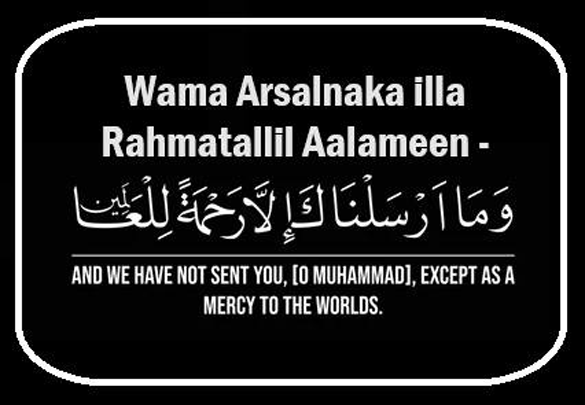
“He who does not show mercy shall not be shown mercy.” (Sahih al-Bukhari no. 6063, Kitab al-Adab)
This highlights that mercy begins within the family, through love, tenderness, and emotional connection. It extends further into social conduct, as the Prophet (peace be upon him) said:
“He who is unkind to the young and disrespectful to the old is not one of us.” (Sunan al-Tirmidhi no. 2043, Kitab al-Birr wa’l-Silah)
A truly merciful society is one where both the young and the elderly are treated with dignity and care. The Prophet (peace be upon him) broadened this teaching when he said:
“The merciful are shown mercy by the Most Merciful. Be merciful to those on earth, and He who is in heaven will be merciful to you. Kinship ties are connecting branches from the Most Merciful. Whoever maintains them will be maintained by Allah, and whoever cuts them will be cut off by Allah.” (Sunan al-Tirmidhi no. 2049, Kitab al-Birr wa’l-Silah)
The life of the Prophet (peace be upon him) was the greatest example of mercy in action. As Hazrat ‘Aisha (may Allah be pleased with her) reported:
“The Messenger of Allah never struck anything with his hand, neither woman nor servant. He only did so while striving in the path of Allah. Nor did he ever take revenge for personal wrongs. He only did so when Allah’s sacred bounds were violated, and he would act for the sake of Allah, the Most High.” (Sahih Muslim no. 6195, Kitab al-Fada’il)
The Prophet (peace be upon him) also illustrated the vastness of divine mercy in a powerful way:
“Allah made mercy one hundred parts. He held back ninety-nine parts and sent down one part to earth. It is from that part that creatures show mercy to each other, such that a mare lifts her hoof over her foal, fearing that she might harm him.” (Sahih al-Bukhari no. 6066, Kitab al-Adab)
This hadith shows that all the compassion seen in the world is only a fraction of divine mercy. Finally, the Prophet (peace be upon him) emphasized the balance between hope and accountability:
“If the believer knew the punishment of Allah, he would never feel assured of His Garden, and if the unbeliever knew the mercy of Allah, he would never despair of His Garden.” (Sahih Muslim no. 7155, Kitab al-Tawbah)
The Prophet’s life consistently reflected these teachings through compassion, forgiveness, and respect in all relationships.
Such teachings broaden the scope of mercy. It is not limited to grand gestures; it includes everyday interactions: how we speak, how we treat family members, how we respond to disagreement, and how we handle power and authority. Mercy is shown through patience, listening, forgiveness, and even small acts of care. Humans, endowed with reason and moral responsibility, are expected to embody it fully.
In today’s context, spreading a culture of mercy means addressing both personal and social challenges. At the individual level, it requires self-restraint, empathy, and a willingness to forgive. In families, it calls for nurturing relationships based on love and understanding. In society, it demands justice tempered with compassion, ensuring that laws and systems do not strip people of dignity.
Globally, where conflicts and misunderstandings often dominate, mercy can serve as a bridge. It encourages dialogue instead of hostility, understanding instead of prejudice, and reconciliation instead of revenge. Mercy does not mean the absence of justice; rather, it ensures that justice is carried out with humanity and fairness.
Importantly, Islamic teachings maintain a balance between hope and accountability. The Prophet (peace be upon him) taught that if people truly understood Allah’s mercy, they would never despair, and if they fully understood His punishment, they would never feel completely secure. This balance prevents both hopelessness and arrogance, guiding believers toward humility and continuous self-improvement.
Ultimately, spreading a culture of mercy begins with recognizing it as a divine gift and a human responsibility. It requires moving beyond words to action, embodying compassion in daily life, and influencing others through example. In a world searching for peace and stability, mercy offers not just a moral ideal but a practical path forward.
When individuals and communities embrace mercy as a guiding principle, they contribute to a more just, compassionate, and harmonious world. In doing so, they reflect the very essence of the divine names with which every meaningful action begins: The Most Compassionate, the Ever-Merciful.
……..
A regular Columnist with NewAgeIslam.com, Ghulam Ghaus Siddiqi Dehlvi is a Classical Islamic scholar with a Sufi background and English-Arabic-Urdu Translator.
New Age Islam, Islam Online, Islamic Website, African Muslim News, Arab World News, South Asia News, Indian Muslim News, World Muslim News, Women in Islam, Islamic Feminism, Arab Women, Women In Arab, Islamophobia in America, Muslim Women in West, Islam Women and Feminism