
Social Harmony and Unity Through Traditions

By Dr. Zafar Darik Qasmi, New Age Islam
13 April 2026
Abstract:
Social customs and traditions are essential for maintaining the identity and unity of any society. People naturally protect their cultural practices because they connect them to their history and values. However, it is important to clearly distinguish between religion and social customs, as some traditions are mistakenly treated as religious acts. Islam allows customs as long as they do not contradict its teachings. The Prophet Muhammad (peace be upon him) accepted many cultural practices, especially those related to joy and celebration, provided they were harmless. Examples from his life show tolerance towards cultural expressions like celebrations, performances, and music on special occasions. Customs also promote harmony, brotherhood, and social cohesion. In modern times, Muslims must carefully evaluate traditions, accepting those that align with Islamic principles and avoiding those that harm the true message of Islam.
Main Points:
· Social customs preserve cultural identity and connect people with their historical roots and traditions.
· Religion and customs must remain separate to avoid misunderstanding cultural practices as religious obligations.
· Islam accepts traditions that do not contradict its teachings and basic moral principles.
· Customs help build unity, love, and harmony among people during social and cultural occasions.
· Muslims should carefully examine traditions and avoid those that harm Islamic values and teachings.
—-
The customs and social traditions of any country, nation, or society are very important. This is why no society or nation wants to give up its customs and social practices. Whenever any ideas or beliefs try to remove these traditions, people unite to protect their values and culture. This is natural, because traditions help maintain the identity of a society
However, it is important to understand that some customs are practised as if they are part of religion, even though they have no real connection with religion. Similarly, some customs enter a society from other cultures. So, an important question arises: which customs should be protected?
The simple answer is that religion and its teachings must be clearly separated from social customs. Any practice done in the name of religion should be carefully examined, so that people do not consider a mere custom as a religious act or perform it for spiritual reward. Today, we often see that many social customs are treated as part of religion.
For example, the famous traveller Ibn Battuta noted that in India, during Hindu weddings, the groom wears a flower garland called sehra. This is a cultural custom. However, many Muslims later adopted it and started considering it part of religion, performing it with the belief of gaining reward. Therefore, it is necessary to identify such customs and clarify their true status.
At the same time, it is true that customs are an important part of a society’s identity and cultural heritage. They pass from one generation to another and strongly influence people’s lifestyle and thinking. Through customs, we preserve the traditions, values, and history of our ancestors.
Customs also play a big role in creating unity and harmony in society. During events like weddings, Eid celebrations, and other occasions, customs bring people closer and promote love and brotherhood. They also give a sense of identity to a community and help maintain cultural diversity.
However, customs should always be chosen with wisdom and in the light of religion.
Islam teaches social harmony, tolerance, and respect. It does not support unnecessary or negative criticism of any religion, belief, or custom. Therefore, Islam gives importance to social needs and traditions. When the Prophet Muhammad (peace be upon him) came to a society, many of its customs were allowed to continue, as long as they did not go against Islamic teachings.
This shows that social customs are acceptable in Islam, but only if they do not contradict religious principles.
There are many examples from the time of the Prophet (peace be upon him). When he migrated to Madinah, he saw that people celebrated certain days of joy. When he asked about them, they said these were days of celebration in the pre-Islamic period. The Prophet then said that Allah had replaced those days with two better days: Eid al-Fitr and Eid al-Adha.
In another narration, some Abyssinians were performing a traditional display (a form of play or martial activity) in the mosque. When Umar (may Allah be pleased with him) tried to stop them, the Prophet (peace be upon him) told him to let them continue.
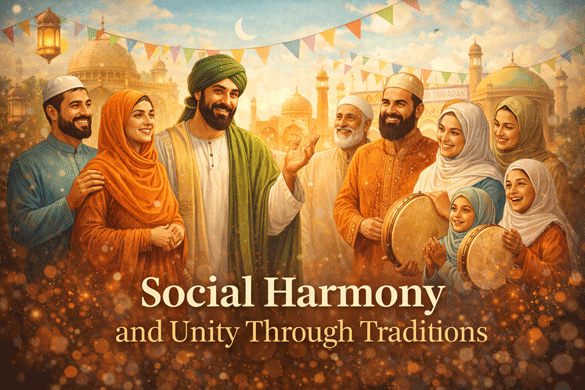
Similarly, people of Madinah used to express happiness by playing the duff (a musical instrument). This was also accepted. On one occasion, two girls were singing and playing the duff in the presence of Aisha (may Allah be pleased with her). When Abu Bakr (may Allah be pleased with him) objected, the Prophet (peace be upon him) told him to allow it because it was a day of Eid.
These examples clearly show that Islam respects social customs, especially those related to joy and happiness, as long as they do not go against Islamic teachings.
In today’s society, it is important to adopt social customs carefully. Before accepting any custom, we must ensure that it does not harm the spirit of Islamic teachings. If a custom contradicts religion, it should not be followed.
At the same time, Islam allows people to celebrate happiness and joy. The way of expressing happiness may differ from one society to another, and this is acceptable. However, any method that harms the message of Islam should be avoided.
—-
Dr. Zafar Darik Qasmi is an Islamic Scholar, author and Regular Columnist for New Age Islam.
URL: https://newageislam.com/islamic-ideology/social-harmony-and-unity-through-tradition/d/139651
New Age Islam, Islam Online, Islamic Website, African Muslim News, Arab World News, South Asia News, Indian Muslim News, World Muslim News, Women in Islam, Islamic Feminism, Arab Women, Women In Arab, Islamophobia in America, Muslim Women in West, Islam Women and Feminism