
Let Us Understand Sacrifice And The Festival Of Eid-Ul-Adha

By Dr. Muhammad Zakiullah Misbahi, New Age Islam
31 May 2026
" Sacrifice means slaughtering one's natural desires by using the knife of courage and resistance against hatred, envy, pride, greed, enmity, love of the world and other such perversions within the heart."
Qurbani in Urdu, sacrifice is derived from the Arabic word Qurban. Sacrifice is called Udhiyyah or Adhaat in another Arabic word. Adha is plural of both of these words. And which mean the animal offered in sacrifice - thus this festival has been named Eid-ul-Adha. It has become common among the people and even at the government level to miswrite and pronounce it as "Eid ul-Zuha". Zuha is an Arabic word - which basically means sunlight, morning (chaasht) and the purification of something.
Zuha: Its main religious uses are:
Zuha: The time after sunrise and shortly before noon is called Zuha.
Zuha (chaasht) prayer: The optional prayer offered during this time is called "Salat-ul-Zuha".
Quranic Surah: Surah number 93 of the Holy Quran is also called "Surah-e-Duha/Zuha". Therefore, in this context, it is completely wrong to call it Eid-ul-Zuha. Eid-ul-Adha is correct.
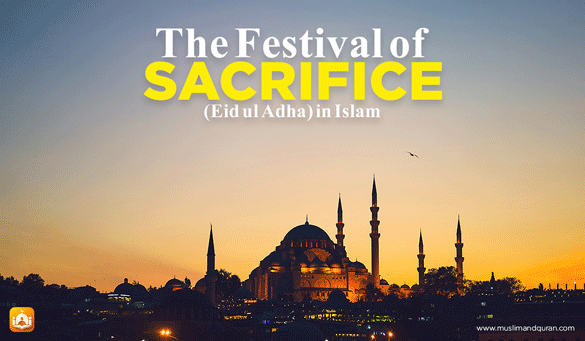
Sacrifice or Udhiyyah is a specific Islamic law and custom, ritual or rite during Eid-ul-Adha (three days) - in which livestock/animals are sacrificed (slaughtered). The word "Qurbani" means "sacrifice", "martyrdom", "sacrifice", "offering", and "Qurbani" is also called "a means or means of closeness to someone" or simply "closeness". In Islamic law, Qurbani or Udhiyyah refers to the sacrifice of a specific animal (sacrificial animal), which is offered by a specific person (the wealthy man) on specific days (the days of sacrifice) to gain the pleasure and reward of Allah. The word "Qurbani" (sacrifice) occurs three times in the Quran: Once in the context of animal sacrifice. 1. About sacrificial animals: Surah Al-Ma'idah (5:27): This is the story of the two sons of Prophet Adam (peace be upon him). Both of them offered "Qurbani" (sacrifice/Udhiyyah) to Allah. One was accepted and the other was not.
And twice in the general sense of any action. 2. General meaning (closeness to God) Surah Al-Ahqaf (46:28): This refers to those who made others besides Allah their 'Qurban' (means or means of getting close to someone). Here the word is used as a 'means or means of getting close to someone' rather than a specific action. Surah Al-Imran (3:183): This refers to those who said that they would not believe in a prophet until he brought them a 'Qurban' (offering) that would be consumed by fire. Here the term refers to a general religious offering or miracle. Nearness to Allah can be achieved by giving up or sacrificing worldly things. In contrast, Zabiha (a common animal) is offered on ordinary days, while Qurbani or Udhiyyah (a special sacrificial animal) is offered on special occasions such as Eid -ul-Adha.
The Origin of Sacrifice in History
Islam traces the history of the sacrifices of Cain and Abel, which are mentioned in the Quran. Abel was the first human to sacrifice an animal to Allah. Hazrat Ibn Kathir (may Allah have mercy on him) narrates that Abel offered a goat and his brother Qabil offered a portion of the produce of his land. Allah’s prescribed method was that fire would descend from the sky and consume the accepted sacrifice. Accordingly, the fire consumed the animal that Abel had slaughtered, thus Abel’s sacrifice was accepted, while Qabil’s was rejected. This led to jealousy on the part of Qabil, which resulted in the first human death when he killed his brother Abel. Qabil was not forgiven by Allah when he failed to repent of his actions.
The Sacrifice of Hazrat Ibrahim (peace be upon him)
The tradition of sacrifice dates back to Hazrat Ibrahim (peace be upon him), who had a dream in which Allah commanded him to sacrifice his most precious possession. Hazrat Ibrahim (peace be upon him) was in a dilemma because he could not decide what his most valuable possession was. Then he realized that it was his son's life. He trusted in Allah's command. He explained the purpose of his son's expulsion from home. His son Hazrat Ismael (peace be upon him) agreed to obey Allah's command. However, Allah intervened and informed him that his sacrifice had been accepted and a sheep had been taken in its place. This alternative either points to the religious organization of the self or to the self-sacrifice of the future Islamic prophet Hazrat Muhammad (peace be upon him) and his companions (who were destined to emerge from the descendants of Hazrat Ismael (peace be upon him) for the sake of their faith). Since that day, once a year on the occasion of Eid -ul-Adha, Muslims around the world slaughter an animal in memory of Hazrat Ibrahim's (peace be upon him) sacrifice and self-sacrifice.
Philosophy of Sacrifice
The philosophy behind sacrifice is that it is a demonstration of submission to Allah, complete obedience to Allah's will or command, and the sacrifice of everything for His pleasure. Hazrat Ibrahim (peace be upon him) demonstrated this spirit of self-sacrifice in the best possible way. When faced with the challenge of love and loyalty, they chose to submit unconditionally to Allah and suppressed personal desires and love for their family and child.
Sacrifice is the act of slaughtering one's natural desires by using the knife of courage and resistance against hatred, envy, pride, greed, enmity, love of the world and other such perversions within the heart.
The Ritual and Tradition of Sacrifice
In Islam, animal sacrifice can be performed from the dawn of the 10th of Dhul-Hijjah until the sunset of the 12th of Dhul-Hijjah, the last month of the Islamic calendar. Muslims around the world perform Qurbani on specific days, which means sacrificing an animal. It was symbolically re-enacted by Prophet Abraham (peace be upon him) when he sacrificed a ram in place of his son, Prophet Ismael (peace be upon him). Sacrifice is an important belief in Judaism and is also common in Islam. Islamic preachers will use this opportunity to comment on the fact that Islam is a religion of sacrifice and to remind Muslims that they have a duty to serve humanity with their time, effort and wealth.
Most schools of thought in fiqh (Islamic religious law) accept that the slaughter of an animal must be in accordance with the rulings on slaughter and that the animal must be a domesticated animal.
URL: https://newageislam.com/islamic-ideology/understand-sacrifice-festival-of-eid-ul-adha/d/140212
New Age Islam, Islam Online, Islamic Website, African Muslim News, Arab World News, South Asia News, Indian Muslim News, World Muslim News, Women in Islam, Islamic Feminism, Arab Women, Women In Arab, Islamophobia in America, Muslim Women in West, Islam Women and Feminism