
Why Muslims Should Reconsider Ritual Animal Slaughter: A Maqasid al-Shari'a Perspective

By V.A. Mohamad Ashrof, New Age Islam
21 April 2026
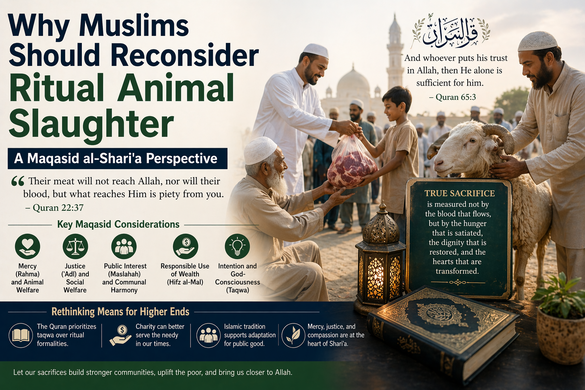
This paper examines the practice of ritual animal slaughter - known in Islamic jurisprudence as udhiyah or qurbani - through the rigorous analytical lens of Maqasid al-shari'a, the higher objectives of Islamic law. While the practice commands deep scriptural authority and centuries of communal observance, this study argues that its contemporary execution, particularly in pluralistic and economically stratified societies such as India, frequently subordinates ethical substance to ritual form. By interrogating the ontological self-sufficiency of God (al-Samad), the Quranic insistence that neither flesh nor blood reaches the Divine, the hermeneutical primacy of taqwa (God-consciousness), and the socio-welfare mandate embedded in sacrificial theology, this paper contends that the mass slaughter of millions of animals during Id al-Adha often conflicts with Maqasid imperatives of mercy (rahma), justice (adl), and public interest (maslaha). Drawing on the classical Maqasid hierarchy of al-Shatib'i's al-Muwafaqat - which ranks the preservation of life (hifz al-nafs), religion (hifz al-din), intellect (hifz al-aql), lineage (hifz al-nasl), and wealth (hifz al-mal) as inviolable necessities (daruriyyat) - alongside the expanded contemporary frameworks of Ibn Ashur and Jasser Auda, this study proposes that the means (wasa'il) of ritual slaughter be critically reassessed in light of its ends (ghayat). Historical precedents from Mughal adaptive governance, modern Hajj meat redistribution reforms, and contemporary scholarly ijtihad collectively affirm the Islamic tradition's internal capacity for ethical renewal. The paper concludes that reconsidering ritual slaughter is not an abandonment of sunnah but a return to its deepest humanistic principles: that true sacrifice is measured not by the blood that flows, but by the hunger that is satiated, the dignity that is restored, and the hearts that are transformed.
Ritual and the Imperative of Moral Inquiry
Ritual animal slaughter during the festival of Id al-Adha - commemorating the Prophet Ibrahim's supreme act of submission in his willingness to sacrifice his son, and God's merciful substitution of a ram - occupies a singular position within the Islamic religious imagination. For over fourteen centuries, the act of udhiyah has served as an annual covenant between the believer and the Divine: a tangible gesture of gratitude, communal solidarity, and ethical renewal. The slaughter of livestock, divided among the family, neighbours, and the poor, has historically embodied one of the most socially integrated dimensions of Islamic worship. Yet the question this paper poses is not whether the practice has roots - it undeniably does - but whether its contemporary execution faithfully embodies the moral and theological purposes that gave it life.
Islamic jurisprudence has never been a static enterprise. From the earliest systematic attempts to derive principles from revelation, Muslim legal scholars recognised that the Shari'a functions not as a rigid code of petrified rules but as a living ethical framework oriented towards human flourishing. The concept of Maqasid al-shari'a - the higher objectives and purposes of Islamic law - expresses this orientation most comprehensively. Developed by al-Ghazali (d. 1111) and systematised with magisterial rigour by Abu Ishaq al-Shatib'i (d. 1388) in his al-Muwafaqat fi Usul al-Shari'a, this framework insists that every legal ruling serves a discernible purpose and that where means conflict with ends, ends must prevail. The law aims to secure and protect human benefit (maslaha) and to repel harm (mafsada); it is not indifferent to consequences.
Applied to udhiyah, this framework demands a penetrating set of questions. Does the mass slaughter of millions of animals within a compressed window of seventy-two hours across the globe genuinely cultivate taqwa, feed the hungry, and embody mercy? Or has ritual form - the purchasing of an animal, the act of slaughter, the distribution of meat - become its own end, an outward observance increasingly disconnected from the inward transformation it was designed to produce? These are not questions born of secularist scepticism or hostility to tradition; they emerge from the heart of Islamic hermeneutics itself.
The Indian context lends particular urgency to this inquiry. India is home to approximately 200 million Muslims - the second largest Muslim population in the world - living within a constitutionally secular but religiously plural society where the cow holds profound sanctity for the Hindu majority. In this context, ritual slaughter - particularly of bovines - has historically been a flashpoint for communal tension, periodic violence, and state-level legislative restriction. From the Mughal emperors' adaptive farmans (royal decrees) to the contemporary patchwork of state cattle protection laws, the intersection of Islamic ritual and Indian pluralism has never been simple. A Maqasid-informed reading of this context would regard the preservation of communal life and social harmony not merely as a political concession but as a genuine Shari'a imperative.
This study proceeds in twelve thematic sections. It begins with the theological foundations of the argument in divine transcendence, then examines Quranic hermeneutics, the social welfare mandate of sacrifice, the Maqasid hierarchy and its application to udhiyah, the centrality of intention (niyyah) and its contemporary erosion, the financial dimensions and opportunity cost of udhiyah, the specific Indian context, critiques of excessive ritualism, contemporary reform precedents, principal counter-arguments, and a reimagined ethics of sacrifice. The paper argues, in sum, that Muslims - especially in India - are called by the logic of their own highest legal principles to critically reassess, and in many contexts substantially to reform, the practice of ritual animal slaughter. Such reassessment is not heresy; it is the most authentic form of fidelity to the tradition's own deepest values.
It bears emphasis at the outset that this paper does not advocate the abolition of udhiyah as an Islamic practice. It argues, rather, that the practice must be continually evaluated against the Maqasid it serves, that alternative or supplementary forms of sacrifice-as-charity deserve full jurisprudential legitimacy alongside the traditional form, and that in specific contexts - particularly the Indian subcontinent - the balance of Maqasid considerations tilts strongly towards substantive reform. The spirit of Ibrahim's submission is inexhaustible; it need not be imprisoned within a single form.
Critique of Material Sacrifice
The most fundamental challenge to any interpretation of ritual sacrifice that regards the physical act of slaughter as intrinsically meritorious lies in the Islamic doctrine of divine transcendence (tanzih). The Quran describes God with an array of attributes that collectively negate any notion of need, lack, or material dependency. Chief among these, for the present inquiry, is the attribute of al-Samad, affirmed in Surat al-Ikhlas (Quran 112:2): "God, the Eternal Refuge." Classical commentators - among them al-Tabari, al-Zamakhshari, and Fakhr al-Din al-Razi - consistently interpret al-Samad as designating the One upon whom all things depend, but who depends upon nothing. God neither eats nor drinks (Quran 6:14); He is al-Ghani, the Absolutely Self-Sufficient (Quran 47:38). This ontological self-sufficiency has direct and inescapable implications for the theology of sacrifice.
In the pre-Islamic religions of Arabia - and indeed across many ancient cultures from Mesopotamia to Greece - sacrifice functioned as a form of nourishment or appeasement directed at deities presumed to be, in some sense, hungry or dependent on human offerings. Blood was smeared on the walls of the Ka'ba; the aroma of burning flesh was thought to ascend as divine sustenance. The Quranic revelation categorically rejected this framework. A God who is al-Samad cannot be propitiated, appeased, or benefited by any material offering. Therefore, the killing of an animal cannot, in itself, constitute an act of worship that carries intrinsic value independent of the moral and spiritual state it is intended to cultivate. As al-Razi observes in his Tafsir al-Kabir, any lingering notion that ritual slaughter "does something" for God materially is not merely philosophically naive - it borders on the theological error of attributing to God a form of creaturely dependency incompatible with the cardinal doctrine of tawhid (divine unity).
The logic is inexorable: if God cannot benefit from animal blood, then the killing of an animal is, at the level of direct divine-human transaction, an empty act. Its value, if any, must be entirely instrumental - located in what it produces in the human being who performs it, and in the community that receives its material benefits. This theological premise transforms udhiyah from a quasi-sacramental act (as if blood itself possesses redemptive power) into a pedagogical and social institution whose legitimacy is entirely contingent on its capacity to produce the ethical and communal goods it promises. When those goods are absent or better produced by other means, the theological case for the specific ritual form dissolves.
The Hermeneutical Key of Quran 22:37
If the theological principle of al-Samad provides the negative argument against material sacrifice, the Quran provides a positive hermeneutical framework in one of its most decisive verses on the subject. Surat al-Hajj (22:37) states:
"Their meat will not reach God, nor will their blood, but what reaches Him is piety [taqwa] from you. Thus have We subjected them to you that you may glorify God for that to which He has guided you; and perhaps you will be grateful." (Quran 22:37)
This verse was revealed, according to classical occasions of revelation literature, in response to pre-Islamic Arab customs of smearing sacrificial blood on the walls of the Ka'ba and piling flesh upon it in offerings to idols. The Quran's response is a categorical reorientation: neither flesh nor blood "reaches" God. The Arabic verb yabalugh (reaches, attains) implies that God cannot receive, benefit from, or be pleased by material offerings as such. What reaches Him - what is truly "received" - is taqwa: God-consciousness, moral uprightness, and ethical transformation.
This verse functions as a hermeneutical master-key for the entire jurisprudence of sacrifice. It establishes a foundational priority: the interior state of the believer is the substance of the act; the external ritual is its vehicle. Al-Tabari, al-Qurtubi, and Ibn Kathir each emphasise this point in their respective tafsir works. The ritual slaughter is a symbol - an ayah (sign) - not an end. If the symbol ceases to perform its symbolic function - if it no longer produces taqwa, charitable sharing, and moral reflection - then, by the Quran's own logic, nothing meaningful has been accomplished. The skin of the ritual remains, but its soul has departed.
The verse also reaffirms the social orientation of sacrifice: the act of "glorifying God" over the animal is embedded within a passage (22:28-36) that specifically commands the feeding of "the desperate poor" (al-ba'is al-faqir). The theological and the social dimensions are inseparable: ritual without genuine charity is theologically hollow. It bears the form of devotion while lacking its substance.
The Abrahamic Narrative as Symbolic Pedagogy
The narrative foundation of Id al-Adha is the story of Ibrahim and his son - identified in Islamic tradition as Isma'il - recounted in Surat al-Saffat (37:102-107). Ibrahim's willingness to sacrifice his son in obedience to a divine vision, and God's timely substitution of a great ram, constitutes one of the most theologically charged narratives in the Quran. Yet a careful reading reveals that the narrative's purpose is not to establish animal slaughter as a perpetual sacrament but to illustrate the supreme virtue of submission (islam) and trust (tawakkul). God does not, in fact, permit the sacrifice of the son; He interrupts it, substitutes an animal, and declares: "Indeed, this was the clear trial" (37:106). The trial is fulfilled by the disposition, not the act.
The lesson of Ibrahim is therefore not "kill animals to please God" but "be willing to relinquish what you love most in obedience to the Divine." The ram is a concession - a divine mercy that spares human life and redirects the instinct of devotion towards a more ethically manageable form. This substitutive logic is theologically significant. It suggests that sacrifice is always already a displacement, a symbolic gesture pointing towards something more fundamental: the interior disposition of radical obedience and detachment from worldly attachment. When contemporary Muslims insist that the annual slaughter of an animal purchased from a commercial market faithfully commemorates this narrative, they risk literalising what the Quran intended as profound pedagogy.
We commemorate the ascension of the Prophet (isra' wa'l-mi'raj) without physically travelling to the heavens; we observe the migration to Medina (hijra) without walking from Mecca. Ritual commemorations are inherently representational - they point beyond themselves to the spiritual realities they signify. The question is always whether the representation remains transparent to its referent or whether it has become opaque, capturing attention and effort that were meant to flow through it towards the reality it symbolises.
The Quran is consistently and emphatically suspicious of ritual that has become detached from ethical substance. In Q.2:177, the Quran deconstructs a facile understanding of piety: "Righteousness is not that you turn your faces towards the east or west, but [true] righteousness is in one who believes in God, the Last Day, the angels, the Book, and the prophets and gives wealth, in spite of love for it, to relatives, orphans, the needy, the traveller, those who ask for help, and for freeing slaves." The verse's rhetorical structure - negating directional ritual to affirm social ethics - mirrors the logic of 22:37 precisely. True worship is inseparable from moral action.
Surat al-Ma'un (107:1-7) is equally instructive: those who neglect prayer and make ostentatious display while refusing small kindnesses are condemned not for failing to perform rituals but for failing to let rituals produce the compassion they promise. This Quranic anti-ritualism is not a marginal theme; it runs through the critique of prior communities who were reproached for honouring the form of the covenant while dishonouring its substance. Applied to udhiyah, this hermeneutical tradition demands that Muslims ask whether their practice of sacrifice represents genuine moral engagement or culturally entrenched performance - an annual habit mistaken for an annual act of worship.
Social Welfare Core of Quranic Sacrifice
Any honest engagement with the Quranic mandate of sacrifice must acknowledge its deeply social-welfare dimension. The relevant passages in Surat al-Hajj are unambiguous: "Eat of them and feed the miserable poor" (22:28); "So mention the name of God upon them when lined up for sacrifice; then when they are lifeless on their sides, eat from them and feed the needy supplicant and the needy who does not supplicate" (22:36). The Prophetic practice, as recorded in hadith collections by Abu Dawud and Muslim, similarly prescribed the tripartite division of sacrificial meat: one-third for the family, one-third for neighbours, one-third for the poor.
In the social context of seventh-century Arabia - a desert economy marked by subsistence pastoralism, chronic food insecurity among the urban poor and nomadic communities, and the near-absence of institutional welfare mechanisms - this redistributive function was genuinely revolutionary. As Fakhr al-Din al-Razi observed in his commentary on Surat al-Hajj, pre-Islamic Arabian elites hoarded surplus livestock and refused to share beyond kinship networks; Islam democratised protein distribution by making it a religious obligation. Seen in this light, udhiyah was one of Islam's earliest poverty-alleviation instruments: elegant, decentralised, and powered by theological motivation.
The socio-economic landscape of the twenty-first century differs radically from seventh-century Arabia. In contemporary urban India, where the majority of Muslim communities now reside, meat is neither scarce nor reserved for the wealthy. Middle-class Muslim households typically consume meat on a weekly or even daily basis. The annual slaughter of an Id animal, in this context, does not represent a meaningful redistribution of scarce nutrition from the prosperous to the marginalised; it is more often an enhancement of existing consumption patterns, a festival elaboration of an already protein-sufficient diet.
Survey data consistently reveals the practical disconnect. A significant proportion of urban Muslim households consume the bulk of their sacrificial animal within the family unit, sharing with neighbours and relatives who are similarly provisioned. The mandatory "third for the poor" - where it is honoured at all - often reaches domestic workers or neighbourhood acquaintances rather than India's most structurally deprived communities. India's Global Hunger Index rank of 111 out of 125 nations (2023) places it among the most food-insecure countries in the world; yet the one-time influx of perishable meat that accompanies Id al-Adha does little to address chronic malnutrition, which requires sustained nutritional support, not a festival surplus that may be difficult to store, distribute, or consume before spoilage.
From a Maqasid perspective, this disconnect is jurisprudentially significant. If the illa (effective cause) of the ruling commanding sacrifice was the relief of the desperate poor, and if the existing form of the practice systematically fails to achieve that illa in its contemporary application, then - as al-Shatib'i's Maqasid theory demands - the form requires reassessment. The means must serve the end; when it does not, the logic of maslaha authorises, and arguably requires, the seeking of more effective means. A jurist who insists on the form when the end is better served by a different form has confused the map for the territory.
Objectives and Assessment of Udhiyah
Al-Shatib'i's al-Muwafaqat remains the locus classicus of Maqasid theory. His framework identifies three tiers of human need that the Shari'a aims to protect. The first and highest tier - the daruriyyat (necessities) - comprises the five indispensable foundations of human life: the preservation of religion (hifz al-din), life (hifz al-nafs), intellect (hifz al-aql), lineage or social continuity (hifz al-nasl), and property or wealth (hifz al-mal). These are inviolable; their destruction constitutes a grave wrong. The second tier - hajiyyat (needs) - comprises those things necessary for a life of dignity and ease; their absence occasions hardship. The third tier - tahsiniyyat (enhancements) - comprises refinements, acts of devotional embellishment that enrich human life without being strictly necessary.
Al-Shatib'i is explicit that when a lower-tier objective conflicts with a higher-tier one, the higher prevails without exception. A tahsiniyyah must yield to a darurah; a hajah cannot override a necessity. This hierarchical logic is not merely theoretical; al-Shatib'i and subsequent Maqasid scholars including Muhammad Abduh (d. 1905) and Ibn Ashur (d. 1973) consistently applied it to evaluate specific legal rulings in changing contexts.
Where does udhiyah stand in this hierarchy? Across the four Sunni legal schools, the practice is classified as sunnah mu'akkadah (emphatically recommended sunnah) - not fard (obligatory) - for the majority position held by the Shafi'i, Maliki, and Hanbali schools. The Hanafi school treats it as wajib (binding duty, a category below fard but above mere sunnah) for those of financial means. In neither classification does udhiyah attain the status of a darurah - an absolute necessity whose absence would constitute a violation of the inviolable five foundations. It is, in the formal Maqasid taxonomy, a tahsiniyyah: an act of devotional enhancement that enriches the practice of religion without constituting its sine qua non.
This classification has profound implications. When udhiyah, as a tahsiniyyah, produces or contributes to outcomes that threaten daruriyyat - when public slaughter triggers communal violence that endangers human life (hifz al-nafs); when the financial burden of animal purchase impoverishes vulnerable households (hifz al-mal); when the mechanisation of slaughter produces animal suffering antithetical to the prophetic principle of ihsan (excellence) - then al-Shatib'i's hierarchy unambiguously demands that the tahsiniyyah yield to the darurah. The logic admits no exception.
Muhammad al-Tahir Ibn Ashur, in his landmark Maqasid al-Shari'a al-Islamiyya (1946), substantially expanded the Maqasid framework beyond al-Shatib'i's original five. Most relevant for the present argument is Ibn Ashur's inclusion of social order, community flourishing (al-umran), and civilisational progress among the Shari'a's objectives. These extensions reflect the Maqasid tradition's responsiveness to the complexities of modern societies in ways that classical texts could not have anticipated. In the Indian context, the preservation of intercommunal harmony - of the conditions that allow a Muslim minority community to practise its faith freely, safely, and with dignity - constitutes, on Ibn Ashur's expanded framework, a genuine Maqasid imperative.
Similarly, Jasser Auda's contemporary systems-based reformulation of Maqasid theory, articulated in Maqasid al-Shariah as Philosophy of Islamic Law (2008), insists that the framework must account for ecological sustainability, animal welfare, and global interconnectedness. Auda's approach regards the Quranic assertion that animals form "communities" (umam) like humans (6:38) as theologically significant for animal ethics, suggesting that the mass slaughter of sentient creatures without compelling necessity conflicts with the Shari'a's broader commitment to the preservation and honouring of life in all its forms.
Classical jurisprudence also furnishes the principle of sadd al-dhara'i - blocking the means to harm - as a tool for preventing permissible or even recommended acts from producing impermissible outcomes. The principle holds that if a lawful act (mubah) or a recommended act (sunnah) reliably serves as a pathway to a prohibited harm (mafsada), the act may be restricted or prohibited to prevent the harm from occurring. Al-Qarafi (d. 1285) and Ibn al-Qayyim (d. 1350) are among the classical scholars who developed this principle most extensively.
Applied to the Indian context, the logic is compelling. Public slaughter in urban Hindu-majority areas has repeatedly - historically and in recent decades - served as a proximate cause of communal violence that has cost Muslim lives, destroyed Muslim property, and eroded the conditions for peaceful religious practice. If the recommended act of udhiyah reliably produces, in this specific context, outcomes that threaten hifz al-nafs (preservation of life) and hifz al-din (the conditions for the free practice of religion), then sadd al-dhara'i requires restriction or modification of the practice in those contexts. This is not a capitulation to social pressure but a rigorous application of classical jurisprudential logic.
Erosion of Ethical Integrity
The opening hadith of Sahih al-Bukhari - transmitted on the authority of Umar ibn al-Khattab and universally accepted across all schools - declares: "Actions are judged by intentions (innama al-a'mal bi'l-niyyat), and each person will have what they intended." This principle is not merely a pious addendum to Islamic ethics; it is, as al-Ghazali demonstrated in his Ihya' Ulum al-Din, the animating soul of all worship. No outward act possesses genuine religious value without the corresponding inner orientation - the sincere, conscious alignment of the will with the Divine purpose the act is meant to express.
The implications for udhiyah are significant. If the Quran tells us that what reaches God from the sacrifice is taqwa - God-consciousness - then the niyyah (intention) behind the act must be one that genuinely cultivates and expresses taqwa. Taqwa involves humility, gratitude, moral accountability, detachment from excess, and active compassion for the vulnerable. An act of slaughter performed primarily from social conformity - because "everyone does it," because not doing it would mark one as lax in religious observance, or because the act has become a culturally expected feature of Id celebrations - is an act performed without the niyyah that gives it spiritual substance. The form persists; the soul is absent.
Contemporary practice reveals a troubling inversion. The prophetic and Quranic model of sacrifice entails genuine cost: Ibrahim risked what was dearest to him; the early Muslim community shared meat that represented a significant portion of their annual nutrition with those who had none. In contemporary urban contexts, the act of udhiyah rarely involves genuine deprivation. An affluent or middle-class Muslim household that purchases a goat at a commercial market, hands it to a butcher for slaughter, and distributes meat to family members and neighbours who are already well-nourished has not, in any meaningful sense, "sacrificed." The experiential and emotional dimensions of the Abrahamic narrative - the terror, the obedience, the mercy, the profound gratitude of a father who discovers that God does not require what he most feared losing - are absent from the transaction.
More critically, if the primary consequence of udhiyah is not the feeding of the genuinely poor but the enhancement of family consumption - meat feasting across the Id festival - then the niyyah of social solidarity and charity that the Quran mandates has been replaced by the niyyah of familial enjoyment. The ritual has not merely failed to produce taqwa; it has potentially produced its opposite: a self-congratulatory feeling of religious compliance that masks the absence of genuine moral transformation. In al-Ghazali's penetrating taxonomy, this is the replacement of ibada (worship) with ada (habit) - a distinction he regards as legally and spiritually decisive.
The question posed by a rigorous Maqasid analysis is therefore not only "Is udhiyah permissible?" - it clearly is - but "Does its contemporary performance embody the niyyah, produce the taqwa, and achieve the maslaha that constitute its raison d'etre?" Where the honest answer is negative, the tradition itself demands reassessment.
Financial Allocation and Justice
The financial dimensions of udhiyah in the Indian context are striking and demand serious ethical attention. A sacrificial goat or sheep in urban India currently costs between approximately Rs. 10,000 and Rs. 25,000, depending on the animal's weight and local market conditions. Larger animals - cows, buffaloes, or camels, where communal shares are purchased - command significantly higher prices. Across India's forty million-plus Muslim households, conservative estimates suggest that the aggregate expenditure on sacrificial animals during a single Id al-Adha season runs to many tens of thousands of crore rupees - a figure that represents an enormous concentration of communal wealth deployed over a period of three days.
From the perspective of hifz al-mal - the Maqasid imperative to protect and wisely steward wealth - this scale of expenditure demands ethical scrutiny. The Islamic tradition is not indifferent to the productive use of resources; al-Shatib'i, Ibn Khaldun (d. 1406), and contemporary Islamic economists consistently hold that wealth is an amanah (trust) whose stewardship is a religious obligation. The question of opportunity cost - what these resources could accomplish if deployed otherwise - is therefore not a secular economic question but a Maqasid question.
Consider what the equivalent of a single sacrificial animal's cost - Rs. 15,000, for the purposes of illustration - could accomplish if redirected toward structured charitable or developmental initiatives. It could provide mid-day meals for approximately 500 schoolchildren for a month; it could fund a year of primary education for an orphaned child; it could provide a livelihood asset - a sewing machine, a set of tools, agricultural inputs - for a family living below the poverty line; it could contribute to a community water purification scheme in a drought-affected village. Any of these outcomes represents a more direct, sustained, and measurable fulfilment of the Maqasid objectives of hifz al-nafs (through nutrition and health), hifz al-aql (through education), and hifz al-nasl (through the protection and development of children and families).
The Quranic concept of awlawiyyat - priorities - is directly relevant here. Al-Qaradawi, in his Fiqh al-Awlawiyyat (1996), argues that Islamic ethics demands a hierarchical ordering of goods, always directing resources and energies towards the most pressing and impactful objectives. In a society where Muslim literacy rates - particularly among women - remain among the lowest of any major community (National Family Health Survey 2019-21 data show Muslim female literacy at approximately 57 per cent, well below the national average), and where Muslim infant mortality and maternal health outcomes reflect chronic under-investment in healthcare, the devotion of enormous communal resources to an annual three-day ritual should be subject to serious ethical scrutiny. The principle of awlawiyyat demands that necessities (daruriyyat) take precedence over enhancements (tahsiniyyat).
The concept of waqf (endowment) provides an instructive alternative paradigm. Rather than consuming communal wealth in a single recurring ritual, the diversion of a proportion of Id charitable giving into permanent endowment structures - generating sustained income for education, health, or poverty alleviation - would exemplify the Quranic ideal of al-baqiyat al-salihat: good deeds that endure. This is the difference between a one-time gift of fish and the provision of a fishing boat; the Maqasid framework consistently prefers the latter.
The Indian Context: Pluralism, Public Interest, and Historical Precedents
Islamic jurisprudence recognises, alongside the five formally protected Maqasid, the broader principle of maslaha mursala - unrestricted public interest: goods and protections that are not explicitly named in scripture but that manifest the Shari'a's general orientation towards human benefit. Imam Malik ibn Anas and, subsequently, al-Shatib'i accorded maslaha mursala significant jurisprudential weight; Imam al-Tufi (d. 1316) went further, arguing that in matters of mu'amalat (interpersonal relations and social affairs), maslaha could override explicit textual evidence if it better served the Shari'a's fundamental purposes. The preservation of intercommunal peace, of the social conditions necessary for a religious minority to practise its faith freely, and of the collective reputation and safety of the Muslim community all constitute goods that fall within the ambit of maslaha mursala.
In pluralistic India, these goods are not abstract. The Indian Constitution's guarantee of religious freedom coexists with a social reality in which the public visibility of certain religious practices generates communal friction with real, measurable costs. Periodic riots triggered or inflamed by perceptions of cattle slaughter have produced loss of life, destruction of property, displacement, and lasting damage to Hindu-Muslim relations across multiple decades of post-Independence history. The violence in Dadri (2016), multiple incidents in Uttar Pradesh and Rajasthan, and the periodic targeting of Muslim meat-traders and transport workers associated with the cattle trade constitute a pattern of harm that a Maqasid jurisprudence serious about hifz al-nafs cannot dismiss.
The history of Muslim governance in India furnishes important precedents for adaptive, maslaha-informed responses to the challenge of udhiyah in a Hindu-majority context. The Mughal period offers the most extensively documented examples of this adaptive jurisprudence in action.
Emperor Akbar (r. 1556-1605), whose reign represents the most sustained experiment in Islamic governance within a pluralistic South Asian context, issued farmans (royal decrees) at various points prohibiting or severely restricting cow slaughter in territories with significant Hindu populations. Abu'l Fadl documents in the A'in-i Akbari (translated by H. Blochmann, 1873) that Akbar's sensitivity to Hindu religious sentiment on this question was not merely politically expedient but reflected a sincere conviction that Muslim governance of a multi-religious empire required active accommodation of the spiritual sensitivities of non-Muslim subjects. Akbar promoted alternative sacrificial animals - goats and sheep - during Id, and in some periods observed personal fasting as a gesture of solidarity with Hindu subjects.
Emperor Jahangir (r. 1605-1627) extended his father's policies, adding prohibitions on animal slaughter during specific periods of the Hindu and Jain calendars - notably during the Jain festival of Paryushana - in recognition of the religious sensibilities of a significant portion of his mercantile subjects. Francois Bernier, the French physician and traveller who spent extensive periods at the Mughal court, noted in his Travels in the Mughal Empire (1670) that Shah Jahan (r. 1628-1658) similarly enforced restrictions on public cattle slaughter in Agra and other cities with large Hindu populations.
The conventional portrayal of Aurangzeb (r. 1658-1707) as an uncompromising religious literalist obscures the more complex jurisprudential reality of his governance. Jadunath Sarkar documents in his History of Aurangzib (1912-1916) that Aurangzeb issued farmans in the 1660s restricting public animal slaughter in Hindu-majority regions of Gujarat and Rajasthan, citing the principle of avoiding public offense (daf al-fitna) as grounds for the restriction - a legal move that maps precisely onto the classical Maqasid principles of sadd al-dhara'i and the preservation of social order. Crucially, these restrictions were not regarded as abandoning the Shari'a but as sophisticated applications of its governance principles (siyasa shar'iyya) to a complex social reality.
In the colonial and early nationalist periods, Syed Ahmed Khan (1817-1898) advocated Muslim restraint in the public performance of cow slaughter as part of a broader strategy for Muslim-Hindu coexistence. During the Khilafat movement of the 1920s, as Gail Minault documents in The Khilafat Movement (1982), leading scholars associated with Darul Uloom Deoband issued fatawa permitting or recommending reduced ritual observance in service of Hindu-Muslim political solidarity against British colonialism. These precedents collectively demonstrate that the Islamic legal tradition - in its most respected and authoritative Indian manifestations - has consistently recognised the legitimacy of adapting ritual practice to the imperatives of social harmony. This is not capitulation; it is mature jurisprudence.
Contemporary Islamic scholarship has produced the sub-discipline of fiqh al-aqalliyyat - the jurisprudence of Muslim minorities - as a systematic attempt to develop Maqasid-informed legal guidance for Muslims living as minorities in non-Muslim societies. Scholars including Taha Jabir al-Alwani and Yusuf al-Qaradawi have contributed to this field, arguing that Muslim minorities bear a special responsibility to demonstrate Islam's compatibility with civic coexistence, to avoid practices that unnecessarily alienate the majority, and to prioritise the long-term welfare and dignity (hifz al-ird) of the Muslim community over the short-term assertion of ritual rights.
Within this framework, the visibility of public animal slaughter in India - where it regularly generates media coverage framed in terms of cultural insensitivity and provokes legislative responses ranging from local bans to state-level cattle protection laws - represents a classic fiqh al-aqalliyyat problem. The question is not whether Muslims have a right to practise udhiyah - they do - but whether the unrestricted assertion of that right, in contexts where it predictably produces communal friction, political backlash, and physical danger to Muslim communities, represents the wisest exercise of that right from a Maqasid perspective. Rights and wisdom are not synonymous; the possession of a right does not exhaust the question of whether and how to exercise it.
Critiques of Excessive Ritualism: Justice, Mercy, and Social Welfare
The critique of excessive ritualism is not imported from outside the Islamic tradition; it is one of the tradition's most persistent internal themes. The Sufis, the Islamic philosophers, and the jurists themselves have consistently warned against what al-Ghazali called the "worship of habit" - the performance of religious obligations as mechanical routine, without the accompanying transformation of the heart that constitutes their purpose. His monumental Ihya' Ulum al-Din is, at one level, an extended critique of the formalism that had overtaken Muslim religious practice in his era: the reduction of worship to outward compliance, the divorce of legal obligation from spiritual reality.
Ibn Taymiyya (d. 1328), writing from within the Hanbali tradition and with a characteristic emphasis on the primacy of intention and purpose, observed in his Majmu' al-Fatawa that the objective of sacrifice is to spend for the sake of God and to cultivate solidarity with the poor; and that if giving the monetary value of the animal achieves this objective more effectively in a given context, such an alternative may be superior. While Ibn Taymiyya ultimately affirmed the preference for actual slaughter in ordinary circumstances, his reasoning explicitly subordinated the ritual form to the Maqasid it serves - a jurisprudential opening that later scholars have developed further.
A Maqasid analysis in the twenty-first century cannot ignore the ecological and animal welfare dimensions of mass ritual slaughter. Modern industrial-scale udhiyah involves the movement of millions of animals across vast distances in often inhumane conditions; the concentrated slaughter of enormous numbers of animals within a compressed timeframe; the generation of significant quantities of biological waste; and a substantial carbon footprint associated with livestock farming, transportation, and processing. India's urban centres - Delhi, Mumbai, Hyderabad, Kolkata - experience intense logistical and sanitation challenges during Id al-Adha that have prompted municipal authorities to impose restrictions on public slaughter in residential areas.
The Quran's assertion that animals form umam - communities, peoples - like human communities (6:38) is not merely anthropological rhetoric; it implies a moral regard for the lives and experiences of non-human creatures. The Prophetic tradition is replete with injunctions of mercy towards animals: the prohibition on using animals for target practice (Muslim), the command to sharpen the slaughter knife before use to minimise suffering (Muslim), the declaration that "God has prescribed ihsan (excellence, kindness) in everything" (Muslim). These traditions establish a baseline of animal welfare below which Islamic practice may not fall. Documentation by animal welfare organisations consistently reveals that a significant proportion of ritual slaughter in India involves inhumane conditions - poorly maintained instruments, inadequately trained slaughterers, and distressed animals crowded in unhygienic conditions. This systematic failure of ihsan in contemporary udhiyah represents a jurisprudential problem, not merely an ethical concern.
Contemporary Adaptations and Reform Precedents
The most significant contemporary precedent for Maqasid-driven reform of ritual slaughter comes from the transformation of sacrificial practice during the annual Hajj pilgrimage. For most of Islamic history, the slaughter of millions of animals in the valley of Mina during the days of tashreeq produced an environmental crisis of considerable proportions: carcasses in intense heat, sanitation emergencies, and the wastage of enormous quantities of meat that could not be consumed or distributed in time. The situation had become, by any Maqasid criterion, a clear case of israf (waste) and potential fasad (corruption of the environment) - both explicitly prohibited by the Quran.
In response, the Saudi Arabian government, with the backing of Islamic Development Bank scholars and a consultative process involving major jurisprudential authorities, established the Adahi Project - a managed system for Hajj sacrificial meat. Pilgrims pay a standardised fee to a centralised authority; animals are slaughtered under controlled conditions in certified facilities; meat is professionally processed, frozen, and distributed to the needy in Saudi Arabia and dozens of countries across Africa and Asia throughout the year. This logistical reform prioritises welfare over localised consumption, proving that Maqasid reasoning can transform practice while retaining devotional intent.
This reform is theologically significant. Scholars including al-Qaradawi and Abdullah bin Bayyah have endorsed it as a valid Maqasid-based transformation of the ritual: the form changed - from individual, localised slaughter to centralised, professionally managed distribution - while the substance of taqwa, gratitude, and feeding the poor was preserved and, indeed, substantially enhanced. If this level of reform is valid for the rituals of Hajj - the holiest and most non-negotiable of Islamic obligations - the case for comparable reform of the less obligatory udhiyah practice is a fortiori compelling.
Beyond the Hajj model, numerous national and regional reform initiatives illustrate the Maqasid framework's practical adaptability. Turkey's Directorate of Religious Affairs (Diyanet), since 1985, has operated a cash udhiyah system enabling Turkish Muslims to pay an equivalent monetary contribution that is then used to purchase and distribute meat to disadvantaged communities in Turkey and globally. Indonesia's Nahdlatul Ulama - the world's largest Islamic organisation, with approximately 90 million members - has periodically affirmed the permissibility of charitable substitution for udhiyah in contexts where slaughter is impractical or where alternative giving achieves superior welfare outcomes.
Darul Uloom Deoband, in advisory positions echoing stances developed during the 1920s Khilafat period, has affirmed the permissibility of proxy slaughter abroad - enabling Indian Muslims to have animals slaughtered in regions of greater food insecurity while avoiding the communal complications of local slaughter. Kerala's Muslim community offers a distinctive regional model: historically shaped by a tradition of relative communal accommodation, many Kerala Muslims have practised indoor or community-facility slaughter rather than Public Street slaughter, minimising visibility and friction while honouring the substance of the obligation. These varied precedents collectively demonstrate that the Islamic legal tradition possesses the internal resources for the reforms this paper advocates; the question is one of scholarly will and communal vision, not jurisprudential possibility.
Counter Arguments and Their Maqasid Responses
The most powerful counterargument to this paper's position is the appeal to prophetic sunnah. The Prophet Muhammad consistently performed udhiyah and strongly encouraged it among his companions; multiple reliable hadith traditions celebrate its spiritual merit. To abandon or substantially modify udhiyah, on this argument, is to deviate from a well-established sunnah and to diminish the Muslim community's connection to the prophetic model.
The Maqasid response to this argument is grounded in the distinction between illa (the underlying rationale of a ruling) and the hukm (the ruling itself) - a distinction systematically developed in usul al-fiqh. The methodology of ta'lil (identifying the effective cause) holds that when the illa of a ruling is identifiable, the ruling follows the illa wherever it goes. The illa of udhiyah, as established by the Quran itself in 22:37, is taqwa and the welfare of the poor - not the shedding of blood as such. Where taqwa and welfare are better served by a different means, the illa is better served by that means. The sunnah is honoured by pursuing its purpose, not by insisting on its historical form when the form has become detached from the purpose.
Furthermore, the classical distinction between ta'abbudi (purely devotional acts whose wisdom is hidden from human reason) and mu'allal (acts with discernible rationales) is decisive here. Acts that are purely ta'abbudi cannot be adapted, because their rationale is beyond human discernment. Udhiyah, however, is extensively explained in the Quran as a social-welfare and taqwa-cultivating institution; it is paradigmatically mu'allal, meaning its adaptation in light of changing circumstances is jurisprudentially legitimate.
A second counterargument, specifically relevant within the Hanafi school predominant in the Indian subcontinent, holds that udhiyah is wajib (binding duty) for any Muslim of financial means. On this view, it cannot be substituted by charity without genuine jurisprudential grounds, and the mere existence of alternative welfare opportunities does not suffice.
The Maqasid response notes first that even within the Hanafi school, the classification of udhiyah as wajib is derived from a process of ijtihad rather than from qat'i (unequivocal) scriptural evidence; the majority of scholars across other schools do not share this classification. More fundamentally, al-Shatib'i's Maqasid theory is explicit that wajib rulings derived from zanni (probable, non-definitive) evidence can be suspended or modified when their continuation conflicts with established daruriyyat. If the continuation of udhiyah in a specific context predictably threatens hifz al-nafs or hifz al-mal through the impoverishment of already deprived households - and extensive evidence suggests it does - the suspension of the wajib for maslaha is jurisprudentially legitimate, a position affirmed by both Mughal historical practice and contemporary Deobandi scholarship. The law serves life; when a legal ruling threatens the life it was ordained to protect; the ruling must yield.
A third counterargument holds that udhiyah is not merely a ritual but a marker of communal identity - a visible, annual affirmation of Muslim collective practice that binds the community together and expresses its distinctiveness. On this view, abandoning or drastically modifying the practice risks eroding the communal cohesion and cultural-religious identity that the act sustains.
This argument has sociological weight, and the Maqasid response does not dismiss it. However, communal identity is better understood as a means (wasilah) than as an end (maqsad) in itself. The genuine maqsad of communal cohesion is the strengthening of the ummah's capacity to support its members, embody Islamic ethics, and fulfil its vocation as a "witness to humanity" (Quran 2:143). If the particular form of communal identity-expression represented by public animal slaughter simultaneously generates communal danger, financial strain, and reputational harm to the Muslim community, then a different form of communal identity expression - one that is equally unifying but serves the maqsad of communal wellbeing more effectively - is not a diminution of Islamic identity but its affirmation in a wiser key.
The Spirit of Ijtihad and the Living Shari'a
Islamic jurisprudence has always understood itself as a living intellectual tradition rather than a fixed historical deposit. The concept of ijtihad - the sustained effort of qualified reasoning to derive guidance from the sources of revelation in response to new circumstances - is not an emergency measure for times of crisis but the ordinary operating mode of Islamic law in its most vital expressions. The contemporary Muslim world's return to Maqasid-based ijtihad - represented in the work of scholars from Muhammad Abduh and Rashid Rida through to al-Qaradawi, Ibn Bayyah, and Auda - represents not a novelty but a recovery of the tradition's most generative intellectual energies.
A reimagined ethic of sacrifice grounded in Maqasid principles would proceed from the recognition that the essence of qurbani - drawing near to God (the word derives from the Arabic root q-r-b, proximity) - is enacted through the willing sacrifice of what is dear in service of God's purposes. In seventh-century Arabia, that willingness was expressed through the sharing of scarce nutritional resources with the community's most vulnerable. In twenty-first-century India, God's purposes - as articulated by the Quran's explicit commands to feed the poor, protect life, cultivate God-consciousness, and embody mercy - may be more faithfully served through alternative or supplementary expressions.
Without being rigidly prescriptive - since ijtihad must always be contextually sensitive - this paper suggests several practical directions for Maqasid-aligned reform of udhiyah in the Indian context.
First, Islamic scholars in India should collectively develop and publicise a framework for "ethical udhiyah" that affirms the permissibility - and in certain contexts the superiority - of charitable monetary substitution for those who choose it. This would not abrogate the practice for those who wish to continue it under humane conditions but would remove the stigma currently attached to choosing charitable alternatives. The framework would draw explicitly on the Hajj Adahi precedent, Deobandi historical positions, and al-Shatib'i's Maqasid hierarchy.
Second, for those who continue to perform udhiyah, communities could establish collective, regulated facilities that ensure strict compliance with ihsan requirements - minimising animal distress during transport and slaughter - and that guarantee near-total redistribution of meat to genuinely food-insecure communities rather than family consumption. The act of sacrifice should involve personal cost and personal presence; its benefits should reach those who most need them.
Third, communities could establish a "Unity Sacrifice Fund" - an annual collective giving initiative coordinated around Id al-Adha - that channels donations equivalent to the cost of sacrificial animals towards education, healthcare, microfinance, and disaster relief. Such a fund, if properly administered and publicly reported, would make the social outcomes of sacrifice transparent and measurable, transforming taqwa from an internal sentiment into a publicly verifiable commitment.
Fourth, Muslim educational institutions and mosques should invest in Quranic and Maqasid literacy - helping community members understand the theological foundations of sacrifice well enough to engage in the kind of informed, principled adaptation that Islamic jurisprudence has always permitted and, in changing circumstances, required. A community that understands why it does what it does is far better equipped to determine when a different form better serves the same ultimate purpose.
The argument advanced in this paper is, at its core, a deeply traditional Islamic argument. It proceeds not from scepticism about revelation but from the most rigorous engagement with it; not from hostility to the Prophetic legacy but from a determination to honour its deepest purposes; not from secularist indifference to ritual but from the jurist's insistence that ritual serve the ends for which God ordained it. Maqasid al-shari'a, from al-Ghazali to al-Shatib'i to Ibn Ashur, has always maintained that the Lawgiver's intent is the flourishing of humanity in this world and the next - and that when means conflict with ends, ends must prevail.
The Quran's declaration that neither flesh nor blood reaches God is not a peripheral aside but a theological manifesto: it defines the entire grammar of Islamic worship. God is al-Samad - He needs nothing from His creation. What He invites from the believer is taqwa: the transformation of the heart, the extension of compassion, the willingness to part with what one loves for the sake of those who have nothing. For fourteen centuries, the slaughter of an animal served, in its proper social context, as one vehicle for this transformation. It was never the only vehicle, and it was never the point.
In contemporary India, where millions of Muslims navigate the complex realities of minority life in a pluralistic democracy - where enormous communal resources are spent annually on ritual while structural poverty, illiteracy, and healthcare deprivation persist, where the public spectacle of slaughter generates communal friction with real costs in human life and communal dignity - the Maqasid framework does not merely permit reconsideration of udhiyah. It demands it. The greatest tragedy would be to mistake the preservation of a ritual form for faithfulness to the tradition, when the tradition's own highest principles point insistently beyond the form towards its transcendent purpose.
To reconsider ritual slaughter is not to abandon the sunnah; it is to rescue the sunnah from its own ossification. It is to insist, with al-Shatib'i, that the Shari'a came to secure human benefit. It is to say, with the Quran, that what reaches God is piety - not blood. The sacrifice of the future, if it is to be worthy of Ibrahim's name, will be measured not by the carcasses it produces but by the hunger it relieves, the ignorance it dispels, the lives it protects, and the harmony it builds. In that reimagined sacrifice - sustained, structural, compassionate, and just - the spirit of Islam finds its truest contemporary expression. God seeks hearts, not carcasses; taqwa, not theatrics; mercy, not the mere mechanics of ritual. This has always been the teaching. The call of this paper is simply to take it seriously.
Bibliography
Al-Ghazali, Abu Hamid. Ihya' Ulum al-Din. Translated by Nabih Amin Faris. Lahore: Sh. Muhammad Ashraf, 1962.
Al-Qaradawi, Yusuf. The Lawful and the Prohibited in Islam. Translated by Kamal El-Helbawy et al. Indianapolis: American Trust Publications, 1992.
Al-Shatib'i, Abu Ishaq. Al-Muwafaqat fi Usul al-Shari'a. Discussed extensively in Wael B. Hallaq, A History of Islamic Legal Theories. Cambridge: Cambridge University Press, 1997.
Auda, Jasser. Maqasid al-Shariah as Philosophy of Islamic Law: A Systems Approach. London: International Institute of Islamic Thought, 2008.
Bernier, Francois. Travels in the Mughal Empire, 1656-1668. Edited by Archibald Constable. London: Oxford University Press, 1934.
Blochmann, H., translator. A'in-i Akbari, by Abu'l Fazl. Calcutta: Asiatic Society of Bengal, 1873.
Global Hunger Index. 2023 Global Hunger Index: Fear and Finance. Dublin: Concern Worldwide, 2023.
Ibn Ashur, Muhammad al-Tahir. Ibn Ashur: Treatise on Maqasid al-Shariah. Translated by Mohamed el-Tahir el-Mesawi. London: International Institute of Islamic Thought, 2006.
Ibn Khaldun, Abd al-Rahman. The Muqaddimah: An Introduction to History. Translated by Franz Rosenthal. Princeton: Princeton University Press, 1967.
Ibn Taymiyya, Taqi al-Din. Majmu' al-Fatawa. Edited by Abd al-Rahman ibn Muhammad ibn Qasim. Riyadh: Dar Alam al-Kutub, 1991.
Khan, Syed Ahmed. Asbab-e Baghawat-e Hind [The Causes of the Indian Revolt]. Translated by Sir Auckland Colvin. Aligarh: Medical Hall Press, 1873.
Minault, Gail. The Khilafat Movement: Religious Symbolism and Political Mobilization in India. New York: Columbia University Press, 1982.
Sarkar, Jadunath. History of Aurangzib. 5 vols. Calcutta: M.C. Sarkar and Sons, 1912–1916.
…
V.A. Mohamad Ashrof is an independent Indian scholar specializing in Islamic humanism. With a deep commitment to advancing Quranic hermeneutics that prioritize human well-being, peace, and progress, his work aims to foster a just society, encourage critical thinking, and promote inclusive discourse and peaceful coexistence. He is dedicated to creating pathways for meaningful social change and intellectual growth through his scholarship.
New Age Islam, Islam Online, Islamic Website, African Muslim News, Arab World News, South Asia News, Indian Muslim News, World Muslim News, Women in Islam, Islamic Feminism, Arab Women, Women In Arab, Islamophobia in America, Muslim Women in West, Islam Women and Feminism