
The Social Conditions of India At the Time of The Prophet's Birth (PBUH)

By Dr. Zafar Darik Qasmi, New Age Islam
Abstract:
At the time of the birth of Prophet Muhammad (peace be upon him), the social condition of India was very weak and unjust. Society was deeply divided, and moral values were declining. There was no system that treated all people equally or respected basic human dignity. The equity-based system of Buddhism had been banished to neighbouring countries. The caste system had become an important part of social life, dividing people into fixed classes based on birth. This system promoted inequality, discrimination, and injustice.
Religious leaders, especially Brahmins, played a major role in strengthening the caste system. They presented it as divine law created by God, not by humans. This made people accept it without question. Priests gained great power and controlled both rulers and common people by using religion and blind belief. Hindu religious texts also supported this system by defining social status according to birth. As a result, large sections of society were denied equality, justice, and human rights. This rigid and unfair social structure shaped India’s society during that period.
Main Points:
· Indian society was morally weak, divided, and lacked justice at the time of the Prophet’s birth.
· 2. The equity-based system of Buddhism had been banished to neighbouring countries.
· The caste system divided people into fixed classes based on birth and social status.
· Brahmins presented caste as a divine system to stop people from questioning it.
· Priests gained strong power and controlled kings and common people through religion.
· This rigid system denies equality, justice, and human dignity to large parts of society.
—--
At the time of the birth of the Prophet Muhammad (peace be upon him), the social and moral condition of India was neither stable nor pleasant. Many immoral practices were common in society. There was no organized system that could give people equality and equal human dignity. Social life was deeply divided, and justice and fairness were largely absent. The equity-based system of Buddhism had been banished to neighbouring countries.
Maulana Abul Hasan Ali Nadwi has written about India in the sixth century CE:
“Indian historians agree that the period beginning from the sixth century CE was the lowest phase in India’s history in terms of religion, collective life, and morality. This country, which was once a center of knowledge, civilization, and moral movements, had fallen into serious decline. In the surrounding countries also, social and moral decay was visible, and India was not behind them. In addition, there were some special features in which India had a unique distinction. These features can be summarized under three headings: excessive multiplicity of gods, extreme imbalance in sexual desires, and rigid class divisions with social discrimination.”
(Insani Duniya Par Musalmanon ke Urooj o Zawal ka Asar, pp. 48–49)
Among Hindus, there existed another concept according to which human beings were divided into four classes. This class and caste system was closely connected with ideas of superiority and inferiority. Because of this, each class was treated in society according to its supposed status and rank.
Maulana Abul Hasan Ali Nadwi writes:
“In the history of nations, it is very uncommon to see such strict class differences and fixed life roles as those found in ancient Indian religious and social laws. During the later Vedic period, society was divided into castes, and people were forced to follow specific professions. The Aryans believed this system was necessary to protect their race, keep their control over the land, and maintain their power as rulers.”
(Insani Duniya Par Musalmanon ke Urooj o Zawal ka Asar, p. 52)
Dr. Gustav Le Bon presents this sectarian and caste-based concept in the following words:
“By the end of the Vedic age, people usually followed the same jobs as their parents. The caste system had started, but it was not complete yet. The Aryans wanted to stay separate from the people they ruled. When a small number of Aryans ruled over many local people, this feeling became stronger. The law makers understood that if the ruling group did not protect itself, it would slowly mix with the local people and lose its identity.”
(Tmaddun-i- Hind, p. 211)
In promoting the caste system among Hindus, the Brahmins played a central role. The well-known writer Ishwar Attopa writes in his book Hindustani Tamaddun:
“Brahmins played a major role in the creation of caste. The way the theory of caste was explained shows that caste was not presented as a product of human effort, but as something created by divine power. In this way, the caste system was declared sacred, and people were discouraged from criticizing it. However, if we look closely, it becomes clear that the divine appearance of caste was created by priests so that people would not raise their voices against this institution and would consider it sacred and beyond human control.”
(Hindustani Tamaddun, Vol. 1, p. 43)
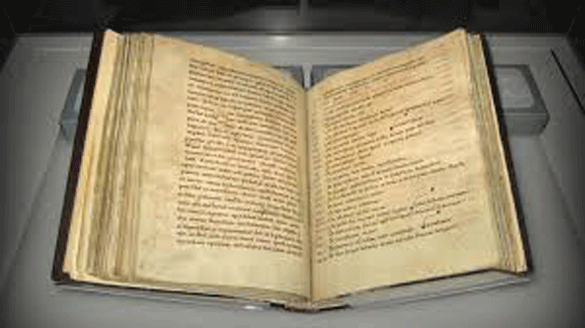
As a result of this unchecked power, the priest divided society very harshly. He understood human weaknesses well and knew the art of controlling people. He did not aim to bring a social revolution, nor was reform his goal. He supported a specific way of life and never openly challenged social institutions. His success was not based on force or violence, but on exploiting the blind devotion and weakness of the common people.
According to his thinking, society could not fully accept the law of caste unless people were made to believe that this institution was not created by humans, but by a non-human, divine force. Thus, the caste system was presented as a divine command. The priest also taught that nations which followed the caste system were blessed by God, while those who rejected it faced divine anger. According to this belief, no man, woman, or child could escape this divine power. Therefore, the law of caste was declared universal and unquestionable.
(Hindustani Tamaddun, pp. 56–57)
This sectarian and caste-based mind-set can also be seen clearly in Hindu religious scriptures. For example, Manu Dharma Shastra states:
“For the welfare of the worlds, He created the Brahmins from His mouth, the Kshatriyas from His arms, the Vaishyas from His thighs, and the Shudras from His feet.”
(Manu Dharma Shastra, Chapter 1, Verse 31)
On the basis of this birth-based ranking, the status of human beings in society was clearly defined, and specific duties were assigned to them accordingly. The Brahmins were considered the highest caste, followed by the Kshatriyas, then the Vaishyas, and finally the Shudras, who were placed at the lowest level of society.
This rigid system shaped the social structure of India at the time of the Prophet’s birth (peace be upon him), creating deep inequalities and denying basic human equality and dignity to large sections of society.
—
Dr. Zafar Darik Qasmi is an author and a New Age Islam Regular Columnist.
URL: https://newageislam.com/islamic-history/social-conditions-india-time-of-prophet-birth-/d/138685
New Age Islam, Islam Online, Islamic Website, African Muslim News, Arab World News, South Asia News, Indian Muslim News, World Muslim News, Women in Islam, Islamic Feminism, Arab Women, Women In Arab, Islamophobia in America, Muslim Women in West, Islam Women and Feminism