
Conquest Of Samarkand: Best Example Of Islamic Justice In The History Of Warfare

By
Ghulam Ghaus Siddiqi, New Age Islam
2 December
2023
First, Samarkand Was Conquered By The Muslim Army
Under The Command Of General Qutaybah Ibn Muslim. Later, Islamic Justice, Under
The Leadership Of Caliph Umar Bin Abdul Aziz, Led To The Return Of Samarkand To
Its Native Inhabitants.
-----
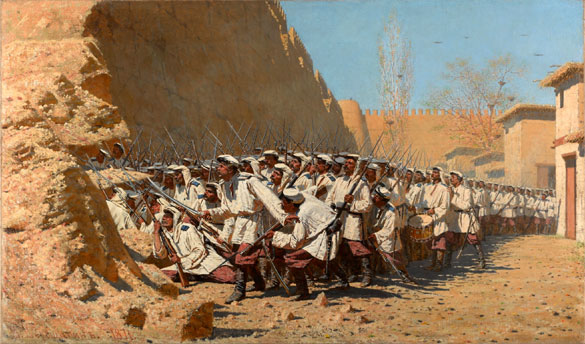
Siege
of Samarkand (1868) - Wikipedia
-----
You may
question why the world has lost such wonderful and just leaders after reading
Miss Fatma Dawood’s account of a unique event that took place during the reign
of Umar bin Abdul Aziz, the grandson of the second Caliph, Hazrat Umar Farooq.
This event revolves around Samarkand, the well-known Muslim general Qutaybah b.
Muslim Bahili, and the justice that Caliph Umar bin Abdul Aziz demonstrated.
Samarkand
is the second-largest city in Uzbekistan. This city has a grand history of its
own. Samarkand means "fortress of the earth." It suffices to know
that Qutaybah ibn Muslim Bahili always dreamed of riding a horse and conquering
new territories. How many conquers he made is best known to Allah, the
Almighty. During the Umayyad era of Umar Bin Abdul Aziz's caliphate, Qutaybah
ibn Muslim invaded Samarkand in 87 AH and placed the Islamic flag over it.
Following
the conquest of Samarkand, the priests who had previously ruled the region
escaped to a temple atop a mountain and took refuge in their homes. The people
of Samarkand were initially terrified of Muslims and avoided leaving their
houses, not even to meet their needs. However, Muslims gradually won them over
by exhibiting peace and trust, which caused people to go about their business
again. It was discovered that Muslims were honest and did not lie or cheat in
businesses and dealings. The perception of trust increased when a confrontation
between two Samarkand and Muslim individuals ended with a Muslim Qaazi [judge]
ruling in favour of the Samarqandi citizen and against the Muslim individual.
When the monks at the temple heard about this impression of trust, they felt
that the Muslim caliph must be a just leader. As a result, they sent a young
man to inform the Muslim caliph about how unjustly Samarkand had been seized by
Qutaybah ibn Muslim.
When the
young man reached the Caliph of the Muslims, ‘Umar ibn Abdul Aziz, he
complained about Qutaybah ibn Muslim. The young man told the Caliph that the
conquest of Samarkand was unfair and then asked him if he would agree to the
Islamic tradition for Muslim armies about giving their enemies three options when
they advance to conquer a territory: accept Islam, pay tribute, or prepare for
battle.
The Caliph
agreed with the Islamic tradition narrated by the young man, stating that each
adversary is free to choose any one of the three choices. The Caliph was then asked
if it is permissible in Islam to launch a surprise attack to take land. He
answered, "It is not our custom to do so, and Allah Almighty has ordered
us not to do so, and our Prophet forbade us from being unjust." The young
man continued by saying that, in defiance of Islamic tradition, Qutaybah ibn
Muslim had launched a surprise attack on Samarkand. When the Caliph heard this,
he wrote a short letter to the governor of Samarkand and told the young man to
bring it to him so that he might correct the wrong that had taken place there.
Upon his
return to Samarkand from Damascus, the young man brought the letter to the
priests, who ordered him to forward it to the governor. The letter astonished
the governor since it asked him to appoint a judge between the Samarkand
priests and Qutaybah Ibn Muslim, whom the governor was afraid of. He promptly
designated a judge to make a ruling about the priests and Qutaybah. The judge
questioned Qutaybah regarding the complaint and his answers to the questions.
According to Qutaiba, Samarkand was a barrier and a cause of great loss for
Muslims, and the war was a trick.
The judge
asked Qutaybah if he had offered them to choose between Islam, tribute, or war.
In response, Qutaybah said, “No, we surprised them with what I told you
earlier." The judge said, "Qutaybah, you confessed, and by this, the
court’s duty ends," and stated that Allah supports the nation only through
religion, avoiding treachery, and setting up justice. The judge issued a ruling
that all Muslim armies should leave Samarkand and give the people the
opportunity to prepare for war. If they chose war, they would fight. Following
the commandment of Almighty Allah and the Sunnah of Prophet Muhammad, peace be
upon him, Muslims declared that they would depart Samarkand as they had
entered, taking nothing with them and giving Samarkand back to its people.
The priests
were astounded by this high standard of justice. The people of Samarkand
observed the Muslims departing the region. One of the priests said that the
actions of these Muslims prove "that their religion is right." The
priests all converted to Islam, declaring that there is no god but Allah and
that Muhammad is His Messenger." This story is considered the greatest
example of justice in history, making the people of Samarkand satisfied with
the rule of Islam and resulting in a large number of people entering the faith.
------
By
Fatma Dawood
13 Jul 2011
The judge
said, "Qutaybah, you confessed, and by this, the court’s duty ends."
Samarkand
is a great country located in North Asia. It has green mountains, hills, and
forests that you can never imagine. Samarkand is a city filled with gold and
silver, silk, porcelain, and natural resources. The people of Samarkand used to
worship idols they made of jewellery. They placed these gods in a temple in the
mountains. The temple was specifically made for senior monks, and there were a
lot of small temples in the centre of Samarkand.
In that
era, Muslims were ruled by a Caliph who was an example because of his good
manners, piety, and fear of God. He had many of the attributes of his
grandfather, the second caliph, Al-Farooq ‘Umar ibn Al-Khattab; may Allah bless
him. He governed a huge country that had never been ruled by anyone, not even
by the Persian Chosroes, Roman Caesars, or Hakan. His kingdom extended from
China to the Atlantic Ocean. His wife Fatima, the daughter of Caliph ‘Abd
al-Malik and also the sister of Caliph Sulaiman, was the most honourable woman
of her time, as seven of her relatives had been rulers. He was the Caliph,
‘Umar ibn Abdul Aziz.
The Islamic
army was under a commander who was very seasoned and merciful. His name was
Qutaybah ibn Muslim. When the Islamic army led by him reached the outskirts of
Samarkand, he ordered it to go to the mountain behind the city because he
didn't want the people of Samarkand to see them. The Muslim army attacked the
city. The battalions behind the mountains attacked as if they were a hurricane.
They reached the centre of Samarkand without resistance. The monks had fled to
the great temple in the mountains and hid in their homes. The people of
Samarkand didn't go out of their homes for fear of the Muslims, but for
Muslims, the situation was stable.
Slowly, the
people of Samarkand began to come out of their homes to fetch water and food.
They started sending their young children to perform these tasks, and the
Muslims didn't trouble them. Instead, the Muslims helped them fetch food and
water. The children entered their homes with happiness. This situation began to
spread feelings of trust and tranquillity in the hearts of the people of
Samarkand. As a result, people returned to their shops, farms, and properties
after some time. They found them intact, the same as they had left, nothing
more or less. Normal life returned between Muslims and the people of Samarkand.
They found that Muslims are faithful in their business and dealings; they did
not lie or cheat. This impression rose when two people quarrelled. One of them
was from the people of Samarkand, and the other was a Muslim. They went to the
judge, who favoured the man from Samarkand.
The news
reached the runway monks in the mountain temple. They said that if this was
their judgement, then they must have a fair ruler. They ordered their men to go
to the ruler of the Muslims and tell him what happened.
A young man
went out. When he arrived in Damascus, he was full of fear. He saw a large
palace. He told himself that this was the palace of their leader, but he saw
people enter and exit without being stopped by a guard or soldier. He
encouraged himself to enter this palace. It turned out to be the "Umayyad
Mosque." It was studded with precious gems, ornaments, and majestic
minarets. People kneeled down in this wonderful place. He saw Muslims praying together
and was surprised to see how those people were sitting and how they lined up
quickly.
He stood up
after the prayer and asked a Muslim about the palace of the ruler: "Where
is your leader?" That Muslim told him he was the man who led the prayer.
Didn't you see him? He said, "No. The Muslim told him, "Did you pray
with us?" He said, "What is prayer?" The Muslim said: It is
worshipping the Almighty Allah alone and becoming obedient to Him without any
partner. The Muslim asked him, "Are you not a Muslim?" He said, "No.
The Muslim smiled and asked him, "What is your religion?" He said,
"the religion of the priests of Samarkand." The Muslim asked,
"What is their religion?" He said, "They worship idols."
The Muslim told him; we are Muslims. We worship God only.
He described
the caliph's home to him. The man went to that place and found an old clay
house and an old man who was mending the wall. His clothes were full of mud. He
went back to the mosque and told that Muslim who was making fun of him. “I
asked you about your leader’s place, and you sent me to a poor man mending his
wall,” he said.
The young
Muslim came with the stranger to that house and told him, "This is the
Emir who is mending his wall." The stranger said, "Don't make fun of
me.” The Muslim was swearing by Allah and said, "This is our leader."
The stranger from Samarkand remembered the priests and how they were so proud
that they did not easily talk to their people.
While the
stranger still stood surprised, a woman came with her son and asked the Caliph
to increase her share of the grant from the Treasury because she had many
children. Suddenly, the son of the woman hit the caliph's son and hurt him.
They fought over a small toy. The Caliph's wife hurried towards her son and
carried him away, shouting at the woman. The Caliph bandaged his son's head,
went out to the woman, calmed her down, and took the toy from his own son and
gave it to the woman's son. Then he told her to go to the treasurer and say
that he could increase her money.
The
Caliph's wife said, "Her son hit your son, and then you raised her
money". The Caliph told her, "You frightened her, and the Messenger
of Allah, peace be upon him, said that whoever frightens a Muslim, Allah will
frighten him on the Day of Resurrection.” He then went to complete the repair
of his wall.
The young
man from Samarkand was surprised at what he saw. He dared and moved forward to
‘Umar ibn Abdul Aziz and said, you are the Emir of the Muslims? The Caliph Omar
answered, "Yes, and what's your business?" The young man replied,
"I have a complaint about Qutaybah ibn Muslim."
The young
man completed his story: Samarkand priests sent me, and they told me that it's
from your traditions that when you conquer any country, you make them choose
one of three things: invite them to Islam, ask them to pay tribute, and, in the
event of their refusal of both choices, give them the choice of war. The Caliph
said: Yes, this is our custom, and every country has the right to choose among
the three. The young man said, "Is it in your custom to start the assault
by surprise?" The Caliph said: "It is not our custom to do so, and
Allah Almighty has ordered us not to do so, and our Prophet forbade us from
being unjust." The young man said, "Qutaybah ibn Muslim did not do what
you say, and his army attacked us by surprise."
When the
Caliph heard that Qutaybah did not make any suffering offers, it was not his
habit to listen to only one side. He decided to write to the governor of
Samarkand. He wrote a few lines and ordered the young man to take it to the
governor of Samarkand, who would remove the injustice that had taken place
there.
The young
man returned from Damascus to Samarkand, wondering about what a paper can do in
front of the swords of Qutaybah ibn Muslim! When he arrived at Samarkand, he
gave the paper to the priests, who told him, in return, to take it to the
governor to do what's written in it. The young man went to the governor and
gave him the letter. The governor was surprised to notice the seal on the
letter. He read the letter, which contained the following: "To the
governor of Samarkand, peace and mercy of God be upon you. Appoint a judge
between the priests of Samarkand and Qutaybah ibn Muslim; put yourself in the
place of Qutaybah."
The Caliph
didn't want to distract Qutaybah from his duties and defence activity. The
governor could not do anything except obey what was written in the letter. He
appointed a judge quickly. The judge selected a day to meet in the mosque and
ordered the priests to be present during the meeting. He ordered the people as
well to come in the presence of Qutaybah ibn Muslim. The judge did not like to
hear the case in the absence of Qutaybah, who was at the time a very strong
commander. He was the head of the most powerful army in the world at the time.
Qutaybah had reached China, continuing his conquests. But the judge ordered him
to return, and he did return after two days.
When the
priests knew that Qutaybah had returned, they became very fearful. Qutaybah
entered the mosque, put down his sword, and took off his shoes. The judge told
him to sit next to his opponent. The priest stood up and said, Qutaybah ibn
Muslim entered our country without warning us. He didn't give us a warning or
give us the options of invitation to Islam, payment of tribute, or war. Instead,
he attacked us without warning. The judge turned to the commander, Qutaybah ibn
Muslim, and asked him, "What do you say about this complaint?"
Qutaybah said, "War is a trick. This country is a great obstacle to us,
and all those who were like it did not resist paying tribute and did not want
to enter Islam, and had we fought them, they would have killed more of us than
we would have killed from them." He continued, “And with the help of Allah
and surprise, we defended Muslims from great harm, and history is witness to
what I say. And all the countries beyond them became easy to conquer. Yes, we
surprised them but rescued them and let them know about Islam.” The judge said,
"Qutaybah! Did you invite them to Islam, tribute, or war?” Qutaybah replied,
“No, we surprised them with what I told you before." The judge said,
"Qutaybah, you confessed, and by this, the court’s duty ends. Qutaybah,
Allah supports this nation only through religion, avoiding treachery, and
setting up justice. We were out of our homes for jihad, for Allah's sake. We
didn't go out to conquer lands and occupy countries unjustly."
Then the
judge issued his ruling: "I rule that all armies of Muslims in this
country should get out of this country and give it back to its people and give
them the opportunity to prepare for war, and then make them choose between
Islam, tribute, or war. If they choose war, then we will fight. Muslims will
get out of Samarkand without anything just as they entered and deliver the city
to its people, and that is the application of the law of Almighty Allah and the
Sunnah of our Prophet Muhammad, peace be upon him."
After this,
Muslims started to leave the city. The judge came out in front of the priests.
The priests did not believe what they were seeing. The people of Samarkand kept
watching Muslims until they all went out of their city.
The young
priest said, "What they did proves that their religion is right." I
witness that there is no god but Allah and that Muhammad is His
Messenger." Now all the priests pronounced that there is no god but Allah
and that Muhammad is His Messenger, and they entered Islam.
This is the
story of the greatest court in history. It made the people of Samarkand
satisfied with the rule of Islam, and, as a result, people entered Islam in
hordes.
----
(References:
Stories from History, The Story of Samarkand Court by Sheikh Tantawi, and Islam
and International Law by Sheikh Wahbeh al-Zuhaili)
Source: How
Samarkand Was Conquered
URL: https://newageislam.com/islamic-history/conquest-samarkand-islamic-justice-warfare/d/131236
New Age Islam, Islam Online, Islamic Website, African Muslim News, Arab World News, South Asia News, Indian Muslim News, World Muslim News, Women in Islam, Islamic Feminism, Arab Women, Women In Arab, Islamophobia in America, Muslim Women in West, Islam Women and Feminism