
Repository Of Old Delhi’s Wisdom Fights for Survival
By Amin Ali
Apr 15, 2014
Last Mughal Emperor Bahadur Shah Zafar wrote poetry in Punjabi, too, and had his works published at Royal Press situated inside Red Fort in 1855. A mathematics professor of Benaras College John Thompson had his A Hindustani-English Dictionary published in 1881 and Sir Syed Ahmed Khan, known as the brain behind Aligarh Muslim University had written A'thar-as-Sanadid (Great Monuments) documenting historical places of Delhi in 1854. These details are not mere trivia but actual works of literature housed along with 16,000 other rare works at Hazrat Shah Waliullah library at Pahari Imli area of Jama Masjid.
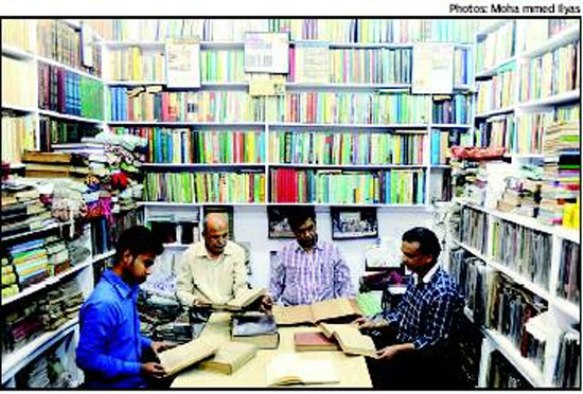
KEEPING a LOST WORLD ALIVE: the Shah Waliullah library near Jama Masjid
What started as a hobby among a group of friends to collect books in 1994 has today translated into a well stocked literary treat. Research students frequent the library for unknown details about Islamic history, complete collection of Urdu works of Zauq, Dard and Mir or handwritten prescription notes of fabled hakims of Delhi. Among the gems on shelves are a 625-year-old Arabic book on logic, a 225-year-old Persian manuscript on Sufism, a century-old handwritten Sanskrit Ramayana and a Bengali-to-English dictionary.
This library also doubles as the office of Delhi Youth Welfare Association, an NGO that promotes education among local Muslims. Muhammed Naeem, who heads the NGO, tells that the place where the library is today used to be the meeting place of his friends. "We would while the night away, playing carrom or cards here. Riots of 1987 put an end to our night time gathering," he recalls.
His friends formed the NGO in 1990 and started going from door to door collecting textbooks to be distributed to students in need. Along with course material people also started donating some of these rare books as they had no place to preserve them.
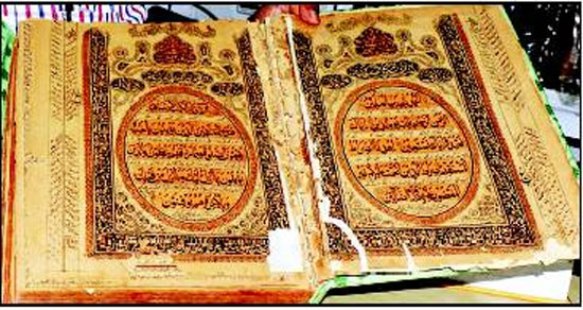
Holy Quran
Some of the texts he got, such as a 108-year-old Holy Quran with 113 styles of calligraphy, a dictionary by a Begum of Bhopal in six languages and ancient maps detailing history of the city, made him turn his personal space into a library. They decided to name the library after a prominent eighteenth century Islamic scholar Shah Waliullah, known for his works that talked of teaching Islam in scientific context of that era and his Arabic to Persian translation of Holy Quran so that more and more people could get the true message. The library has been open to all since then and gets a steady flow of visitors from India and abroad.
Despite being a treasure trove of Urdu, Persian, Arabic, Sanskrit and Hindi works, including some rare manuscripts, the library also is a picture of official apathy. Space constraints and poor infrastructure mean some of these exceptional works might be lost to termites. Sikander Changezi, who usually helps students in their research works at the library, explains that the place is run on the contribution of members and a new space is the need of the hour. They have packed some books in plastic and lined their shelves with water resistant materials. Changezi is now working on building an online catalogue of these books so that the books can be accessed and preserved in digital format.
Naeem claims he has written several letters to the corporation representatives and the MLA, asking for space for his books, but nothing has happened. The only solution he was offered, he says, was to part with his books to the authorities. For him, his collection is a hard work of years and he cannot trust them to anyone else's care. "We have never asked for any money. We can run the place on our own. All we need is a place where we can keep our books and turn it into an open library," he asserts. "A place of learning will never be the priority of authorities or religious leaders," he shrugs while quietly keeping the books back in shelf.
Source: http://timesofindia.indiatimes.com/city/delhi/Repository-of-old-Delhis-wisdom-fights-for-survival/articleshow/33755848.cms
------
Encroachments of Pathan-Era Monuments in Delhi Eat Up Slice of History
By Richi Verma
Apr 15, 2014
Tucked away in Mehrauli, three Lodi-era monuments—two mosques and a tomb—have escaped the local authorities' attention and memory. They have turned into popular haunts for slum-dwellers and shop owners. According to experts, all the three buildings are more than 700 years old.
Growing encroachments and vandalism by slum inhabitants have restricted access to these structures over the years. The owners of Jhuggis have, over the decades, established their residence within the structures. With new alterations being made in the area every few months, historians say that it is just a matter of time before the original character of the monuments is lost irrevocably.
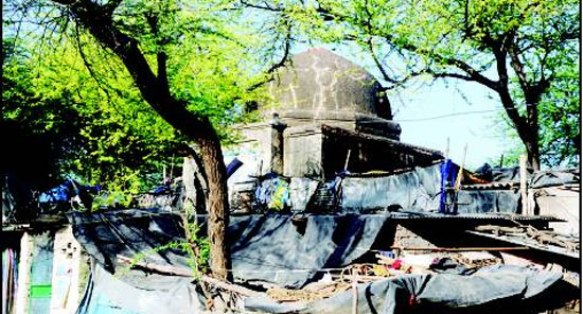
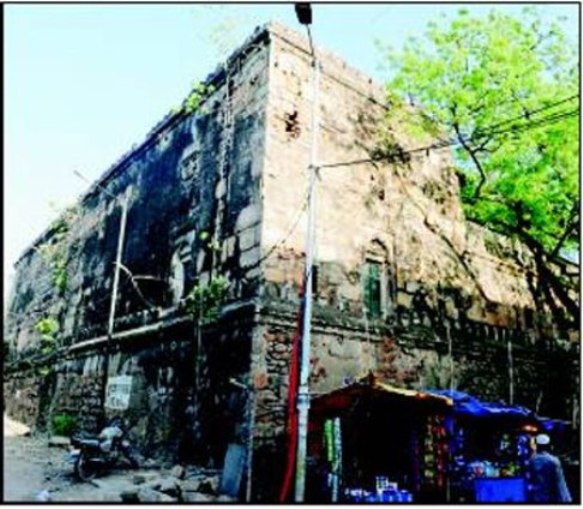
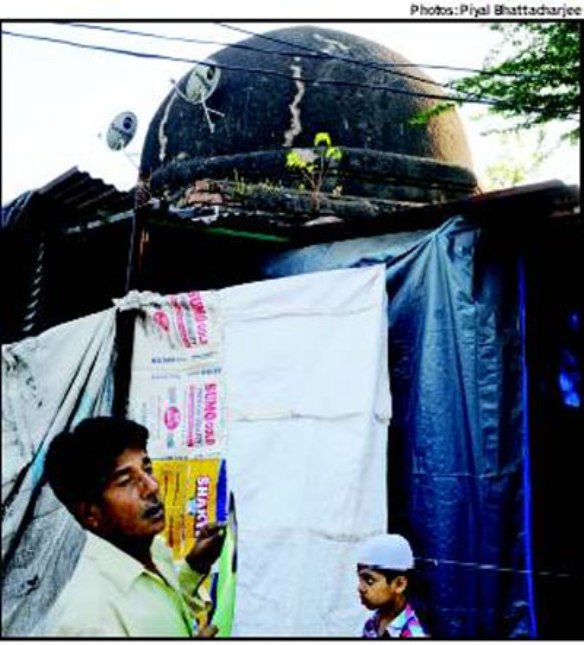
IN A SHAMBLES: The buildings are in danger of losing character
The three monuments are overshadowed by their more popular neighbour, ASI-protected Jahaz Mahal, which is just a short distance away. While the latter enjoys central protection with conservation of the main structure being taken up time and again, these buildings are barely visible from the main road. "To reach these monuments, you have to find your way through a maze of slums that have spread all over. Locals are using the interiors of the buildings as extensions of their residence, and the facade has been defaced completely," says a conservationist. Piles of garbage lie next to each building; if you are able to go inside any of these structures, you will find them in a shambles and about to fall apart. Dish antennas have been drilled into the dome of one of the tombs with a portion at the rear is serving as a cowshed. Slum-dwellers are hostile to visitors in the area.
When the Delhi government signed an MoU with Intach for conservation of 155 historical buildings, these structures were also identified. Experts say the failure to implement these plans, including conservation and protection of these monuments, is posing a threat to the buildings. "Already about 30 buildings in the Zafar Hasan list have vanished. If things go at this rate, many more could meet the same fate," says an expert. Currently only 15 monuments in Phase I have been conserved but not given final protection under the Delhi Archaeology Act, while conservation under Phase II, where 18 buildings would be attended to, has been on hold for about a year for lack of funds.
Two of the buildings are mosques but the ownership of the area is disputed. While the Delhi Waqf Board claims that the Masjids and the adjoining land are their properties, DDA calls it their land. An anti-encroachment drive a few years ago had sparked off violence with locals alleging attack on one of the mosques. Since then, the matter lies in court but encroachments have been thriving.
Source: http://timesofindia.indiatimes.com/city/delhi/Encroachments-of-Pathan-era-monuments-in-Delhi-eat-up-slice-of-history/articleshow/33755813.cms
URL: https://newageislam.com/islamic-history/repository-old-delhi’s-wisdom-fights/d/66547