
Two Top UK Women’s Groups Ban Transgender Members, Citing UK Supreme Court Ruling On Biological Sex
New Age Islam News Bureau
05 December 2025
· Two Top UK Women’s Groups Ban Transgender Members, Citing UK Supreme Court Ruling On Biological Sex
· Iranian Authorities Block Singer Fatemeh Ataei’s Instagram, Arrest Asmar Hamidi, Female Vocalist
· Students Protest ‘No Hijab’ At Goregaon College, Principal Says No Such Ban
· Minister Defends Decision To Deport Afghan Women And Girls
· Zahraa Ghandour's Flana: A Powerful Iraqi Documentary Exposing Honour Crimes And The Erasure Of Women
· Critics Kick As German Court Bans Hijab-Wearing Woman From Judicial Post
· AirAsia Introduces More Inclusive Cabin Crew Uniform Policy With Hijab Option
Compiled by New Age Islam News Bureau
URL: https://newageislam.com/islam-women-feminism/uk-women-members-supreme-court/d/137904
-----
Two Top UK Women’s Groups Ban Transgender Members, Citing UK Supreme Court Ruling On Biological Sex
4 Dec, 2025
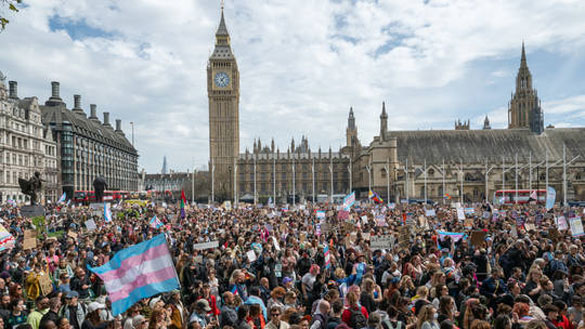
FILE PHOTO. © Guy Smallman / Getty Images
-----------
Two of Britain’s biggest organizations for women and girls, Girlguiding and the Women’s Institute, have said they will no longer accept transgender members, citing a court ruling on biological sex.
Girlguiding, Britain’s equivalent of the Girl Scouts, said in a statement on Tuesday that “trans girls and young women will no longer be able to join” the organization. The Women’s Institute, which is more than 110 years old, followed suit on Wednesday, announcing that it will “restrict formal membership to biological women only.”
Both organizations said the changes were not their preferred option but were prompted by the risk of legal action following the UK Supreme Court’s April ruling. The court said that the term “woman” refers to biological sex, not gender identity.
The ruling followed a challenge by For Women Scotland to a Scottish Government measure on women on public boards, which included transgender women with legal recognition as female. The group asked the court to confirm that “woman” means a biological female.
The court stated that “the terms ‘women’ and ‘sex’ in the Equality Act 2010 refer to a biological woman and biological sex,” adding that interpreting sex to include acquired gender “would lead to incoherence” in provisions protecting women on the basis of pregnancy, maternity, and other sex-specific criteria.
A poll conducted shortly after the decision found that a majority supported the ruling, with 59% agreeing that a transgender woman is not legally a woman, according to Electoral Calculus. British author J.K. Rowling, one of the most prominent supporters of For Women Scotland, also hailed the decision.
Earlier this year, the England Football Association said it would change its rules, stating that “transgender women will no longer be able to play in women’s football in England,” with the policy implemented from 1 June 2025. British Rowing has also barred transgender and non-binary athletes assigned male at birth from its women’s racing category, saying that only athletes “assigned female at birth” can compete, while others may enter an Open category.
Recent reports have said the IOC is moving closer to banning transgender women from female Olympic events.
Source: rt.com
https://www.rt.com/news/628951-uk-women-groups-transgender-ban/
------
Iranian Authorities Block Singer Fatemeh Ataei’s Instagram, Arrest Asmar Hamidi, Female Vocalist
DECEMBER 4, 2025
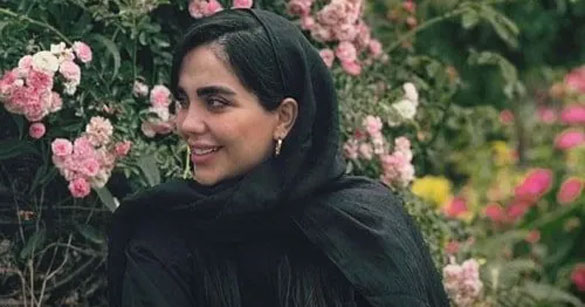
The Instagram page of Fatemeh Ataei was shut down by Iran’s public security police, according to a message posted on her account
------------
Iranian authorities have blocked the Instagram account of a popular female singer and arrested another vocalist, the latest actions against women performing music in the Islamic Republic.
The Instagram page of Fatemeh Ataei was shut down by Iran’s public security police, according to a message posted on her account.
The singer has more than 1 million followers.
The blocking notice says the page was closed for “producing criminal content” and that authorities have “dealt with” those responsible. No further details were provided.
Separately, security forces arrested Asmar Hamidi, a Kurdish singer living in Bojnord, during a raid on her home Saturday.
Hamidi was released on Monday on temporary bail, according to reports. Officials have not disclosed what charges, if any, Hamidi faces.
Women in Iran are prohibited from performing solo vocal performances in public under religious rules imposed after the 1979 Islamic Revolution.
Authorities consider female singing voices to be provocative and inappropriate for male audiences.
In recent years, Iranian authorities have repeatedly taken legal action against women who sing in public spaces or publish their performances online.
The crackdown has extended to social media platforms, where many female artists have shared their work to circumvent official restrictions.
Despite the prohibitions, some Iranian women have continued to sing and share recordings online, facing potential arrest, prosecution, and bans on their social media accounts.
Source: iranwire.com
https://iranwire.com/en/women/146746-iranian-authorities-block-singers-instagram-arrest-another-female-vocalist/
-------
Students Protest ‘No Hijab’ At Goregaon College, Principal Says No Such Ban
Dec 4, 2025
Mumbai: Members of the All India Majlis-e-Ittehadul Muslimeen (AIMIM) and a few female students of Vivek Vidyalaya & Junior College in Goregaon West staged a protest on Thursday to oppose the institute's alleged ban on hijab. While police filed an FIR in the matter, the college clarified that there is "no ban on hijab in the institution".
In a letter, the college principal Sheeja Menon said: "Our institute has no reservation for Muslim girl students wearing hijab and in fact, there is no ban to said practice. It seems there is a misrepresentation which has led to unnecessary issues which were totally avoidable."
AIMIM Mumbai president Farooq Maqbool Shabdi, who led the protest, claimed: "Some students had approached us complaining that they were told to remove hijab before entering classrooms. After we protested, the college management said there is no ban on students wearing hijab." A video of the protest went viral on social media during the day.
Police said that a few students have been booked under the charge of disobedience to order promulgated by public servant. No one was arrested and the matter was later settled peacefully, said a police officer.
Source: indiatimes.com
https://timesofindia.indiatimes.com/city/mumbai/students-protest-no-hijab-at-goregaon-college-principal-says-no-such-ban/articleshow/125772471.cms
------
Minister defends decision to deport Afghan women and girls
December 5, 2025
Caretaker asylum and migration minister David van Weel has defended the immigration service’s decision to reject asylum claims from several Afghan women, saying there is no reason to change current policy despite the Taliban’s extreme restrictions on women and girls.
In answers to parliamentary questions from Volt, the SP and D66, Van Weel said the immigration service IND can still assess individual cases and deny protection where it concludes there is “no necessity for asylum”.
The questions followed reports showing that the IND had decided in at least three cases that women could be returned to Afghanistan, despite the Dutch government holding the Taliban regime responsible for grave and systematic violations of the Convention on the Elimination of Discrimination against Women.
Van Weel, who is also foreign affairs minister, acknowledged that conditions for women have become “very difficult” since the Taliban takeover in 2021.
He said women and girls may qualify for protection if they face such severe restrictions on their development and participation that return would significantly limit their lives.
In most cases the IND grants asylum, he said, but “not every restriction in life amounts to persecution”. To win the write to stay, applicants must show they were or would be affected by discriminatory measures.
The IND, he said, has rejected claims from “only a few” Afghan women, adding that it is not currently possible to deport those that fail to meet Dutch criteria to stay.
Reports on the four women concerned show they had largely carried out household work, were not “westernised”, had not previously gone out alone and, in the IND’s view, had shown no ambitions to work or study – activities banned for women under the Taliban.
Van Weel said he does not comment on individual cases and that negative decisions can be reviewed by the courts.
Courts in Haarlem and Middelburg have overturned two deportation orders, saying both the IND and Van Weel misinterpreted a key ruling from the European Court of Justice, which found that the discrimination faced by Afghan women is such a fundamental denial of rights that it constitutes persecution.
Refugee status
The Middelburg court said this means all Afghan women and girls applying for asylum in the Netherlands are therefore entitled to refugee status.
In another case, a judge sided with the minister, though the ruling did not consider the European court’s decision. The Council of State will examine all the cases early next year.
The women themselves fear returning to Afghanistan. “A dog has a higher status than a woman,” one of them told Nieuwsuur earlier. Another, aged 79, says she has not slept since learning of the decision. She fled to the Netherlands 15 years ago after the Taliban demanded her daughter be handed over.
Source: dutchnews.nl
https://www.dutchnews.nl/2025/12/minister-defends-decision-to-deport-afghan-women-and-girls/
--------
Zahraa Ghandour's Flana: A powerful Iraqi documentary exposing honour crimes and the erasure of women
04 December, 2025
When Iraqi actress and filmmaker Zahraa Ghandour began digging into the disappearance of her childhood friend Nour, she already knew the landscape she was walking into.
Working for TV and media, for nearly 15 years, she has documented the lives of Iraqi women and girls — stories marked by early marriage, honour crimes, legal loopholes, and the quiet, relentless policing of female existence.
What she didn't know was how deep this specific story would cut into her own family history.
"I was absolutely aware of the issue with girls abandoned or killed by their families only because they were female," Zahraa tells The New Arab.
"But I was not aware of what happened with Nour exactly. I've been telling stories about what's happening to women for about 15 years. People even make jokes about me in Iraq. They say I'm too feminist. But I don't care what I am called and even reproached about. I believe in the importance of exposing these issues."
Zahraa Ghandour's new film Flana, one of the nine features, presented at this year's Horizons of Arab Cinema Competition of the Cairo International Film Festival, braids her childhood friend Nour's mysterious missing with the filmmaker's own memories, tracing how girls disappear long before they physically vanish: uncelebrated at birth, restricted at home, married too young, blamed in death.
The film won a Special Mention for Best Arab Feature Film at the 46th Cairo International Film Festival.
However, disappearance has another vocabulary in Iraq, one that Zahraa threads through the film with quiet precision.
Flana is an Arabic word used across the region, pronounced differently but carrying the same meaning: a woman whose name is forgotten, erased, or deemed unworthy of mention.
"It's the term you use when the woman's name is gone, when she becomes no one, people just say 'flana died, flana was killed.' Not even a person worth naming."
For Zahraa, the word marks a societal reflex: women reduced to placeholders, their identities swallowed by shame or violence. In a graveyard shown in the film, we see that the stones themselves bear no names.
"Just blank markers," Zahraa says. "That's flana."
But at the heart of the film stands another woman: Zahraa's aunt, who's been the community's midwife for many years and helped Nour come into the world — a fierce, unfiltered, self-described non-regretful single woman who becomes both witness and guide.
The inherited silence
When Zahraa sits across from her aunt in the film's opening, the intimacy is disarming. The camera barely feels present.
"My aunt shocked me," Zahraa laughs. "It was the first time I turned the camera on her, and she just talked. No hesitation. I asked her, 'Have you appeared in a film before?' She said: 'After all these years, you think that your little camera is going to scare me?'"
The aunt, whom Zahraa describes as a "second mother", had lived through her own ruptures: leaving home at 14, building an independent life, refusing marriage in a society where marriage is still viewed as a woman's primary identity.
"She's the ultimate feminist in my life," Zahraa says. "She always told me: 'Why would I marry someone who wants to control me?' You cannot tell this woman what to do. Ever."
One of the film's quieter revelations is that many of today's Iraqi women and men remain single.
"It's happening everywhere," Zahraa says. "But in Iraq, women are more aware of how marriage can take away their liberty. Men too. People want partners who understand them, not just someone to have children with."
Divorce rates are "insane" in Iraq now, she adds. "It tells you something about the shift."
The warmth of the exchanges between the filmmaker and her aunt is punctured by grief: revisiting Nour's story and her sudden disappearance without a trace means revisiting a pattern they all recognise.
"When we spoke about Nour, after filming, we just sat in silence," Zahraa says. "There are things that are still too heavy for both of us."
'What did she do?' — the reflex that kills
Zahraa has spent years documenting honour crimes for Iraqi television. She describes the ritualised public reaction: "Whenever a girl is murdered, the first question people ask is: 'What did she do?' Even in my own family. Even yesterday, an Egyptian woman in the audience asked me: 'Why are they killing their daughters?' As if there could be a reason. There is nothing a girl can do that justifies being murdered."
Yet the law suggests otherwise. Iraq's penal code still contains provisions dating from 1969 that sharply reduce sentences for honour crimes. If a man claims he killed a female family member "for honour", he typically receives no more than three years, and often spends only days in custody.
"Some don't go to prison at all," Zahraa explains. "They go to the police station, explain themselves, and leave."
The consequences ripple through families: girls denied inheritance so male relatives can claim full ownership of property; daughters thrown into the street; children forced into labour or abused by traffickers.
"When a newborn girl is not celebrated – and many families still don't celebrate girls – that's where it begins," adds the filmmaker.
"The uncelebrated baby becomes the disrespected child, and sometimes the murdered woman."
The girls who survive
One of the film's central figures, Leila, survived this chain of disposability. Her sister did not escape unscathed: sold to a pimp at age nine and forced into sex work. She appeared briefly in an early edit of the film.
"But I took her out," Zahraa says. "I had to. It would have ruined her chances at a future in Baghdad. She accepted being exposed, but I couldn't do that to her."
Leila herself lives in a fragile state of independence, renting a small room in a rough Baghdad suburb with another woman.
"It's her first home ever after living in a girl's shelter," Zahraa says. "Her first taste of safety. And because of that, I will not screen the film in Baghdad until she leaves the city."
There is more at stake. Zahraa is already preparing for a legal battle with the Ministry of Labour, which oversees the disclosure of the terrible conditions in the shelter where Leila lived, described in the film.
"They threatened me," she says calmly. "But I knew this day would come. It's worth it."
Fighting to tell Iraqi stories differently
The film took over six years to complete, partly because Zahraa refused to surrender creative control. Early in the process, a German co-producer attempted to acquire the movie entirely.
"They sent me a contract that basically said the film is theirs and I'm just someone on the ground," she recalls.
"It was insulting. They didn't know me, didn't care about the women, and never asked how things were going. They just wanted ownership."
The producers required the film to lean into protest, activist-type of footage – "the sexy, expected way," she says, rather than the intimate personal narrative she insisted on.
"There's a Western gaze that expects screaming in the streets," Zahraa says. "But that's not the film I was making."
Also, since taking the film abroad, another recurring comment has followed the director: that she "doesn't look Iraqi."
"It's the media," she says, amused.
"These stereotypes come from the images the West keeps reproducing: Iraqi women as sad, miserable, suffering. But come to Baghdad, and see everything – different faces, classes, colours, styles. We don't look one way."
She walked away from the producer's proposal and continued producing on her own until French partners joined in post-production. Today, she retains 80% of the rights.
"I'm constantly telling Iraqi filmmakers: don't rush to sign. It's better to struggle than to lose your film."
The project eventually found support from Doha Institute, the Arab Fund for Arts and Culture, the Whickers Award, described by Zahraa as "the hardest competition of my life", the Doxa Fund, CNC, Bertha/IDFA Fund, and finally, in the film's last stage, Iraq's newly launched national film fund.
"The Ministry of Culture promised they would evaluate the quality of the storytelling, not the political subject," she says. "And they kept that promise."
Zahraa Ghandour is currently developing an impact campaign for screenings in Iraq and internationally.
But her goal remains the same as when she pointed a camera at her aunt's kitchen table: "I want people to understand that these girls don't just disappear — they're erased. And someone has to keep insisting on their stories."
Source: newarab.com
https://www.newarab.com/features/flana-film-tracing-vanishing-names-iraqi-women
-------
Critics Kick As German Court Bans Hijab-Wearing Woman From Judicial Post
5 Dec 2025
A German court has ruled that a Muslim woman cannot serve as a judge or prosecutor if she refuses to remove her headscarf during court proceedings, a decision critics call a violation of religious freedoms.
The administrative court in Hesse announced its ruling on Monday, upholding the authorities’ decision to reject the woman’s application.
In a statement, the Darmstadt court acknowledged that the lawyer’s religious freedom carries significant constitutional weight. However, it ruled that this right is outweighed by competing constitutional principles—including state neutrality and the religious freedom of trial participants.
According to the court’s statement, the woman was asked during her application interview whether she would remove her headscarf when interacting with trial participants. She clearly said she would not.
Hesse authorities rejected her application, arguing that wearing a religiously symbolic garment during judicial proceedings violates the principle of state neutrality and could undermine public confidence in the justice system’s impartiality.
Civil rights advocates condemned the Hesse decision, arguing that Germany’s expanding body of neutrality regulations is increasingly used as a mechanism to police Muslim visibility rather than ensure genuine impartiality.
They warn that court rulings like these contribute to a growing perception that Muslim women’s religious expression is incompatible with democratic institutions.
The decisions also come as Muslim communities report a rise in anti-Muslim hate crimes.
Associations have documented increased assaults, vandalism targeting mosques, and harassment of women who wear the headscarf.
Critics said that by framing the headscarf as a symbol that must be removed to uphold state neutrality, courts risk giving social prejudice legal grounding.
Advocacy groups argue the rulings send a chilling message: that Muslim women must choose between their profession and their faith at a time when discrimination, hostility, and political rhetoric targeting Muslims are already deepening societal divides. (Anadolu Agency/American Muslim Today)
Source: dailytrust.com
https://dailytrust.com/critics-kick-as-german-court-bans-hijab-wearing-woman-from-judicial-post/
------
AirAsia Introduces More Inclusive Cabin Crew Uniform Policy With Hijab Option
Dec 5, 2025
KUALA LUMPUR, 5 December 2025 – AirAsia has announced an update in its cabin crew uniform policy, which allows female crew members to wear the hijab while on duty if they wish to do so.
This is in line with AirAsia’s people-first culture and continuous evolution shaped by employee and public feedback. AirAsia prides itself in creating a workplace where every Allstar feels confident, comfortable, and proud to represent the airline wherever they fly.
Bo Lingam, Group CEO of AirAsia Aviation Group said, “I am proud that this latest update reflects AirAsia’s growth and expansion as a global airline with a diverse workforce that mirrors the communities and cultures we connect every day. Our uniforms have always reflected professionalism, safety and comfort, and this evolution builds on that foundation by giving our people the confidence to represent AirAsia in ways that align with their beliefs.”
AirAsia’s cabin crew have used the hijab as part of operations on select routes, such as Jeddah, where it is required by local regulations. The latest update extends this flexibility to all female cabin crew members who choose to wear it, ensuring consistency across the airline’s network while upholding AirAsia’s professional and distinctive brand identity.
Suhaila Hassan, Group Head of Cabin Crew Department said, “Our Allstars come from many backgrounds, cultures and beliefs, yet we are united by a shared commitment to deliver world-class service and care to our guests, as evidenced by our winning of major airline awards every year. This latest policy reflects that diverse and dynamic spirit that defines AirAsia. We will continue gathering feedback from our Allstars and work closely with them on the detailed design and implementation before rolling this out. We hope to start during Ramadan in 2026.”
Tony Fernandes, CEO of Capital A, said, “One of the greatest strengths of AirAsia has always been our diverse and outspoken Allstars. When our cabin crew raised this with management, it was important for us to listen. Respecting different views and beliefs is not only part of our culture but what has shaped our success over the years. This is how we grow: by evolving together, guided by the voices of our people.”
AirAsia’s iconic red cabin crew uniform will remain unchanged, with the professionally tailored hijab and pants option extending the same design currently worn by crew operating on Jeddah routes. This ensures comfort, safety, and brand consistency across the network.
Source: airasia.com
https://newsroom.airasia.com/news/airasia-introduces-more-inclusive-cabin-crew-uniform-policy-with-hijab-option#gsc.tab=0
------
URL: https://newageislam.com/islam-women-feminism/uk-women-members-supreme-court/d/137904