
Two Muslim Women, Swaleheen And Noor Fatima, Turn Hindu To Wed Long-Time Boy Friends In UP
New Age Islam News Bureau
19 July 2025
· Two Muslim Women, Swaleheen And NoorFatima, Turn Hindu To Wed Long-Time Boy Friends In UP
· Salma Nasoordeen and ShenaiAini, UC Irvine Protesters, Sue Orange County Sheriff Over Hijab Removal
· Indian Choreographer Saroj Khan Got ‘Unofficially Married’ To A 30-Year-Old Man At 13, Converted To IslamOn Her Own'
· Against The Odds, Afghan Women Are Building Livelihoods And Resilience
· Girls Returning From Iran: Despair Over Education And Fear Of Forced Marriage In Afghanistan
Compiled by New Age Islam News Bureau
URL: https://newageislam.com/islam-women-feminism/muslim-women-hindu-friends-up/d/136225
----
Two Muslim Women, Swaleheen And NoorFatima, Turn Hindu To Wed Long-Time Boy Friends In UP
19 Jul 2025
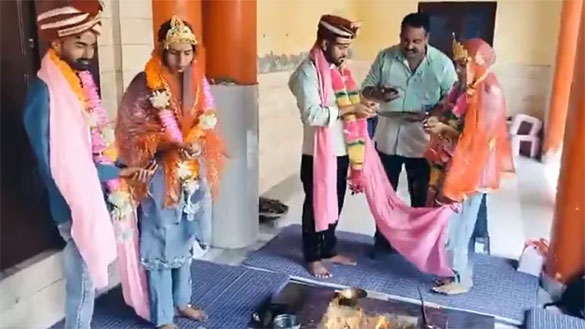
In a big development from Uttar Pradesh’s Moradabad, two Muslim women have embraced Hinduism to marry their long-time Hindu partners. The women, previously known as Swaleheen and Noorfatima, solemnised their weddings in an Arya Samaj temple ceremony held earlier this week in Hapur.
Swaleheen, who has now taken the name Shalini, hails from Katghar, Moradabad. She had been in love with Amit Kumar, a local resident, but faced family opposition to their relationship. Prioritising her safety and commitment, she converted to Hinduism to marry Amit.
Meanwhile, Noorfatima, now known as Neelam, comes from Bhojpur, Moradabad. She too voluntarily embraced Hinduism to wed Gaurav Kumar, her partner. Both couples followed Hindu rituals and customs during the Arya Samaj wedding ceremony. The Arya Samaj authorities have officially confirmed that the conversions and marriages were carried out according to due legal and religious procedures.
Community and official response
Shalini has voiced concerns over her safety, claiming to have received threats and little support from her family. Both couples have sought police protection, and local police have assured ongoing surveillance to prevent any untoward incidents.
The weddings come at a time when Moradabad has been under heightened attention over religious conversion cases, with recent controversies involving figures like Chhangur Baba. Public reaction has been mixed—while many on social media wished the couples happiness, others warned against revealing their identities publicly given the sensitivities involved.
Arya Samaj procedure
Arya Samaj marriage protocols permit interfaith weddings if both parties adopt Hinduism. Both women underwent the “Shuddhi” conversion ritual before the marriage.
Source: heraldgoa.in
https://www.heraldgoa.in/globe/moradabad-love-story-muslim-women-turn-hindu-to-wed-longtime-boyfriends/425173
-------
Salma Nasoordeen and ShenaiAini, UC Irvine Protesters, Sue Orange County Sheriff Over Hijab Removal
July 18, 2025
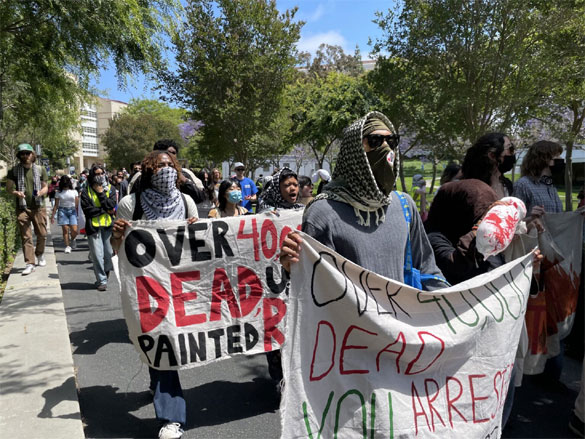
Photo by Joey Ni / Staff
----------
Two Muslim women who participated in a pro-Palestinian protest at UC Irvine in May 2024 sued the Orange County Sheriff’s Department (OCSD). The women filed a lawsuit against the deputies for allegedly forcibly removing their hijabs during their arrests.
The lawsuit, filed on June 30, claims that the OCSD and Sheriff Don Barnes violated the women’s constitutional rights when they forcibly removed their religious headscarves in public and photographed them without their hijabs. According to the women, those photographs have been further disseminated in public, violating their religious and cultural rights.
The plaintiffs, Salma Nasoordeen, 22, and ShenaiAini, 26, claim deputies ripped off their hijabs during their arrests at UCI and then forced them to remove them again in front of male staff at the Santa Ana Intake Release Center (IRC). The plaintiffs are currently being represented by the Greater Los Angeles office of the Council on American-Islamic Relations (CAIR-LA) and the Asian Law Caucus (ALC).
“The county government not only were negligent, intentionally inflicted emotional distress, violated the First Amendment’s protection of religious liberties and the Religious Land Use and Institutionalized Persons Act of 2000, but also failed to train rank and file deputies in their own policy,” claimed the plaintiffs on July 1, 2025.
ALC Chief Strategy Officer Belinda Escobosa characterized the incident as “a profound violation of their right to religious freedom.” Escobosa supports the lawsuit seeking justice for the women.
“It [the lawsuit] also seeks systemic change — because no woman, of any faith, should ever be forced by those sworn to uphold the law to choose between her religion and her dignity,” Escobosa said.
Plaintiff Nasoordeen claims that while she was participating in a peaceful protest on campus, her hijab was ripped from her head and stomped on by a deputy before removing her from campus during her arrest. She said it caused her humiliation and emotional distress as her uncovered hair was revealed to the public and the media.
Plaintiff Aini called the incident “an attack not only on myself, but every Muslim woman,” describing it as “a sense of power and humiliation by the OC Sheriff’s Department.”
OCSD rejected the claims made by Nasoordeen and Aini. According to Carrie Braun, a spokesperson for the OC Sheriff Department, it was “only when women were present at the time” that Aini and Nasoordeen were required to remove their hijabs.
In a previous media statement concerning similar incidents, the department indicated booking procedures must comply with identification and security protocols, though accommodations for privacy and gender matching are outlined in official protocol.
OCSD previously implemented a policy requiring female-only deputies to be present for the removal of religious head coverings following a similar lawsuit in 2007, involving a Muslim woman who was forced to remove her hijab in the presence of male officers during booking. The 2007 lawsuit led to a settlement for new guidelines requiring same-gender deputies and private settings for searches involving religious attire.
The lawsuit is currently pending in federal court, and no hearing date has been scheduled.
Source: newuniversity.org
https://newuniversity.org/2025/07/18/two-muslim-uci-protesters-sue-oc-sheriff-over-hijab-removal/
-------
Indian Choreographer Saroj Khan Got ‘Unofficially Married’ To A 30-Year-Old Man At 13, Converted To IslamOn Her Own'
Jul 19, 2025
Indian dance choreographer Saroj Khan, one of the most well-known figures in the industry, had a story that many of her followers rarely knew. She rose to fame by becoming one of the leading choreographers in the industry after experiencing numerous hurdles in both her professional and personal life.
Her first marriage ended in trauma, as she lost her child shortly after birth. She once revealed why she got married twice and why she later chose to follow the Islamic faith.
Early Struggles After Partition
Saroj was born just a year after India gained independence, and her family was forced to start a new life in India after partition. She lost her father at an early age, and the burden of supporting the family fell on her tiny shoulders.
In an old interview with the BBC, Saroj revealed that her mother used to put pans on the stove to pretend she was cooking food, hoping the children would fall asleep while waiting. By the age of three, Saroj was already working in films as a child artiste. She remembered frequently acting opposite the legendary actor Balraj Sahni. She also had to look after her brother and sister. She needed to earn money for their education and marriage.
A Childhood Burdened by Responsibility
She would often dance alone at home, using her shadow as her partner. But her mother grew worried about her habit of dancing and took her to a doctor, thinking it was a disease. However, the doctor corrected her and suggested she try cinema, which could also help the family financially.
Her debut as a background dancer came in the iconic number ‘AaiyeMeherban’ in Howrah Bridge, starring Madhubala.
A Secret Marriage at 13
Saroj met S. Sohanlal, a seasoned choreographer from the South, when she was just 12 years old. He was 30 years her senior, and by the age of 13, she was ‘unofficially’ married to him. He tied a black thread around her neck without telling her that he was already married and had children. She learned about his marriage only after giving birth to their first child.
Personal Tragedy and Betrayal
Saroj was just 14 when she gave birth to their son. Later, she had a daughter who tragically passed away at eight months old. The loss deeply affected her, and Sohanlal never officially accepted her. He also refused to acknowledge the fatherhood of their children. He returned to Madras and vanished forever after the loss of their daughter.
In 1975, Saroj married Sardar Roshan Khan, who already had children. Their union came with a promise: he would adopt her children. She said, “He had four children, I had two… I agreed, but on the condition that he adopts my children.” She described him as a caring father figure who never let her children feel excluded. “My second husband never let my children feel like outsiders… They both loved him very much,” she told DD.
Saroj Khan embraced Islam
She converted to Islam after marrying Khan. “I was a Hindu. My name was Saroj Kishan Chand Sadhu Singh Nagpal. We are Sindhi Punjabis. I met my husband, fell in love, and converted. I love Islam. I went to a mosque on my own, changed my religion, and became a Muslim. People have asked me if I was forced. I told them I lost a baby girl, and she would come to me in my dreams, calling for me from inside a mosque…” she shared in an old interview with DD.
Saroj passed away in 2020, during the early phase of the COVID-19 pandemic.
Source: indiatimes.com
Please click the following URL to read the text of the original Story
https://timesofindia.indiatimes.com/entertainment/hindi/bollywood/news/saroj-khan-got-unofficially-married-to-a-30-year-old-man-at-13-converted-to-islam-after-her-second-marriage-i-went-to-a-mosque-on-my-own/articleshow/122771112.cms
------
Against the odds, Afghan women are building livelihoods and resilience
18 July 2025
Kabul, Afghanistan — Even in the face of relentless obstacles, Afghan women continue to find opportunities to lead, build and hope, with UN Women standing by them and investing in their potential.
One powerful example is the story of a woman in the eastern province of Parwan who was studying economics at a university when the doors to higher education closed for women and girls in Afghanistan. To protect her identity, her name is not used in this article.
Faced with limited options to earn an income, the woman turned to knitting, a skill she had developed as a hobby.
“I was inspired by a talented woman who ran a similar business,” she says. “I started learning from her and gradually developed my own style.”
Over the next four years, the woman persevered, knitting bags, purses and jewelry and trying to find ways to connect with buyers, but her income — around 4,000–5,000 Afghanis per month (about $60) — was not enough to overcome her financial difficulties.
“There is no space for us to work outside our homes,” she says. “There’s also no local market where we can display and sell our products.”
A turning point came when the woman received business and digital skills training through a local civil society organization, with support from UN Women and the Government of Japan.
“It was through a survey that I got connected to UN Women,” she says. “The trainings helped me a lot, especially in improving my business and going digital.”
Through the success of an online shop that she established with the support of the training, the woman’s work is now recognized not just in Parwan but also in neighboring provinces.
“Through this project and my online shop, I became well known,” she says. “I’m earning money, solving my financial problems, and becoming self-sufficient.”
With funding from the Government of Japan, UN Women has worked across Afghanistan over the past three years to expand women’s access to livelihoods, income and essential services. These initiatives provide business development skills, financial support, market access, and safe spaces for literacy and vocational training.
From greenhouse cultivation to poultry farming and tailoring to handicrafts, women are using these tools to make income and gain a stronger voice in making decisions in households and building resilience in communities.
More than 5,100 women entrepreneurs have been supported to launch or grow their businesses and 3,700 women have accessed services through safe spaces.
UN Women and the Government of Japan have launched a new phase of the initiative, to further promote Afghan women’s resilience, empowerment and leadership. The focus is on improving women’s livelihoods and their ability to respond to climate-related risks, from equipping farmers with climate-smart tools to increasing women’s access to finance and technology.
Recognizing that Afghan women – especially women-headed households – often carry the heaviest burden of economic hardship and climate-induced shocks, the new phase combines humanitarian assistance with opportunities for long-term growth, supporting women-only safe spaces, markets and business centres.
The new phase of the initiative, which runs from 31 March 2025 to: 31 March 2026, is called Strengthening the Resilience and Livelihoods of Afghan Women to Respond to Humanitarian, Socio-economic and Climate Shocks.
Source: unwomen.org
https://asiapacific.unwomen.org/en/stories/news/2025/07/against-the-odds-afghan-women-are-building-livelihoods-and-resilience
-------
Girls Returning from Iran: Despair Over Education and Fear of Forced Marriage in Afghanistan
July 19, 2025
AvizhaKhorshid
With the widespread forced expulsion of migrants and the collective anguish they endure, young and adolescent girls who had left for education have been marginalized alongside the fate of other girls. Some of these young and adolescent girls, who have returned from Iran, express concern about an uncertain and bleak future, criticizing the ongoing restrictions and deprivations imposed on women. They emphasize that, given the current circumstances, they have no hope for the reopening of schools or the continuation of their education. Meanwhile, some of these girls also perceive themselves as at risk of forced marriage.
Among the thousands of returning and deported migrants, several young and adolescent girls who had once left Afghanistan to build a brighter future have been forcibly returned to the same atmosphere of fear, uncertainty, restriction, and deprivation.
Maryam (pseudonym), one of the girls recently returned from Iran, says her mother is the head of their household. She adds, “When the Taliban took control of Afghanistan, we heard numerous reports that they were forcibly marrying off single girls.”
She stresses that this fear led her family to force her older sister into a marriage with a relative—a marriage that took place without her sister’s consent, devoid of any affection, and which her sister still does not accept. Maryam continues, explaining that they left Afghanistan hoping to pursue education and a better future, but upon their return, the pressure and fear stemming from the current situation, along with an uncertain fate and lack of a clear future, constantly haunt her mind.
Maryam says, “When we went to Iran, I was full of hope. I thought my future was bright because I could study. But now, having returned to Afghanistan, I feel my fate might end up like my sister’s. I no longer have hope for life because I’ve been deprived of my most basic right—education.”
Asma, another young girl, shares similar fears about the future, which have become part of her daily life. She explains that after the Taliban’s takeover, her family migrated to Iran. Their life had seemingly stabilized, and hope for a better future had begun to grow in her heart. However, the forced expulsion of Asma and her family brought them back to their homeland. With sorrow, Asma says that since their return, she has lost all hope.
This young girl states, “There’s no future here for us girls anymore. Since we returned, the image I have of the future is only despair and darkness because I can no longer continue my studies. I have no hope that schools will reopen one day, allowing me to study again. I see no way out. Being away from my friends and unable to attend school torments me more each day.”
Asma adds, “When I look at the situation in Afghanistan today, fear of the future consumes me entirely. I’m afraid my family, out of desperation or external pressures, might force me into marriage.”
Farida, a mother of a seven-member family with three young daughters, returned to Afghanistan a week ago. Visiting a hospital for treatment, she says with regret, “I wanted my daughters to become doctors one day, but how could I have known what fate had in store for them?” She adds that they mortgaged their house and left for Iran to escape restrictions and unemployment. Now, they not only grapple with unemployment and homelessness, but the future of her daughters has become one of her greatest mental concerns and anxieties.
Concurrently with the fears of these young and adolescent girls upon returning to Afghanistan, The Telegraph newspaper, in a report on the situation of returning migrants, has warned that girls who have returned face the risk of forced marriage.
Meanwhile, women, girls, and human rights organizations state that since taking control of Afghanistan, the Taliban have turned discriminatory policies and the systematic exclusion of women into the official policy of their regime. Closing schools to girls above the sixth grade, banning university attendance, prohibiting women from accessing recreational areas, shutting down beauty salons, and barring women from working in domestic and international organizations have made life increasingly bitter and unbearable for them.
While the Taliban have imposed extensive restrictions on girls’ education, the United Nations has declared that Afghanistan has the highest illiteracy rate globally.
Roza Otunbayeva, the Special Representative of the UN Secretary-General, has stated that only 50 percent of men and 20 percent of women in Afghanistan can read and write.
Source: 8am.media
https://8am.media/eng/girls-returning-from-iran-despair-over-education-and-fear-of-forced-marriage-in-afghanistan/
-------
URL: https://newageislam.com/islam-women-feminism/muslim-women-hindu-friends-up/d/136225