
‘The Noor Campaign’: How Iran Uses Digital Surveillance to Enforce Hijab Laws While Cracking Down on Women’s Freedom
New Age Islam News Bureau
3 April 2025
· ‘The Noor Campaign’: How Iran Uses Digital Surveillance to Enforce Hijab Laws While Cracking Down on Women’s Freedom
· Iran Executes Four Women Among 58 Prisoners In March
· Ilford Hospital Introduces Disposable Hijabs To Champion Inclusivity For Staff And Patients
· Iranian Youth Reject Maryam Rajavi’s and the Mujahedin-e Khalq’s Embrace of Mandatory Hijab
· Saudi model Roz on her homecoming: ‘It feels emotional in the best way’
· ‘Are Muslim Women Entitled To Permanent Alimony On Divorce’, SC To Decide
· Caught On Camera: Man Hurls Insults At Muslim Women Praying In Alpharetta
· Singapore Mother Jailed 19 Years For Abusing Daughter To Death, Helping Burn Body
· Young Sicilian Woman Killed In Broad Daylight By Stalker, Shockwaves Across Italy
Compiled by New Age Islam News Bureau
URL: https://newageislam.com/islam-women-feminism/women-freedom-surveillance-hijab-laws/d/135049
------
‘The Noor Campaign’: How Iran Uses Digital Surveillance to Enforce Hijab Laws While Cracking Down on Women’s Freedom
Apr 3, 2025
Namya Sinha
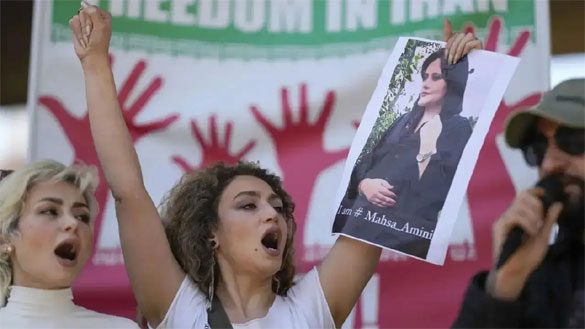
Mahsa Amini’s death sparked global protests. (Photo: File Photo/AP/Andre Penner)
-----------
It has been years of struggle for Iranian women fighting for freedom and bodily autonomy. Women in Iran are required by law to wear hijab, Islamic head-coverings, in public places. On 16th September 2022, Mahsa Amini, a young Iranian woman in her 20s, died while in the custody of Iran’s Gasht-e Ershad (morality police). Her death sparked nationwide protests, which were brutally suppressed by the government.
The regime has implemented various laws to enforce the country's compulsory hijab rule. Just last year, in April, Iran introduced the Noor Campaign to intensify its crackdown on women. According to the Foundation for Defense of Democracies (FDD), "Iranian officials claim that while the morality police focus on whether citizens are wearing 'proper hijab,' the Noor campaign deploys the Law Enforcement Command (LEC) to prosecute women who do not cover their hair in any capacity and fail to abide by the Islamic Republic’s compulsory hijab laws."
Iranian women have taken to social media to recount experiences of being physically assaulted, detained, and photographed by the morality police as a means of intimidation. Disturbing videos have also surfaced on social media showing women being violently attacked by security officers and the morality police.
While the Noor Plan is just one of the many ways in which the Iranian regime is cracking down on those who flout hijab rules, the UN’s Independent International Fact-Finding Mission on the Islamic Republic of Iran has also noted that, despite pre-election assurances by the current President, Masoud Pezeshkian, to ease the enforcement of mandatory hijab laws, repressive measures continue. These include "increased use of technology and surveillance, including through State-sponsored vigilantism, that further infringe upon women and girls’ fundamental rights."
Digital surveillance includes the use of mobile apps such as Nazer and Gershad, which allows citizens to report women for violating hijab rules. The report also states that under Article 28, the Law Enforcement Command of the Islamic Republic of Iran is required to use technological systems—such as traffic monitoring cameras and artificial intelligence—to identify potential offenders. It further mandates that “law enforcement agencies must deploy online monitoring systems for violations against social norms and for the normalization of so-called ‘indecent behaviour’ and report offenders to the judiciary.”
Source: timesnownews.com
https://www.timesnownews.com/lifestyle/people/explained-the-noor-campaign-and-how-iran-uses-digital-surveillance-to-oppress-women-through-hijab-enforcement-article-151338930
---------
Iran Executes Four Women Among 58 Prisoners In March
APRIL 2, 2025
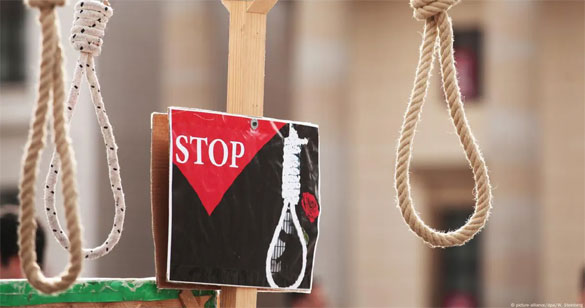
At least 58 prisoners were executed in prisons across Iran during March - a 222 per cent increase from the 18 executions recorded in March 2024
----------
At least 58 prisoners were executed in prisons across Iran during March - a 222 per cent increase from the 18 executions recorded in March 2024.
The Hengaw Organization for Human Rights has confirmed the identities of all 58 executed prisoners.
Four women were among those executed - two in Urmia and one each in Mashhad and Isfahan.
Three were convicted of murder, and one of drug-related offenses.
Iranian state media and judiciary outlets did not officially report any of these executions.
Four executions were conducted secretly, without notifying families or allowing final visits.
Iran executed at least 169 people in January and February, according to Mai Sato, the UN Special Rapporteur on human rights in Iran.
During her first presentation to the UN Human Rights Council, Sato warned that if this pace continues, Iran will execute more than 1,000 people this year.
“I am very concerned about the rapid rise in the number of executions, especially in just the last two months as well,” Sato told IranWire in an exclusive interview following her presentation.
“I believe, looking at last year’s patterns, January and February are usually quiet months, but we’ve already identified at least 169 executions,” she added.
Source: iranwire.com
https://iranwire.com/en/news/140014-iran-executes-58-prisoners-in-march/
--------
Ilford hospital introduces disposable hijabs to champion inclusivity for staff and patients
3rd Apr 2025
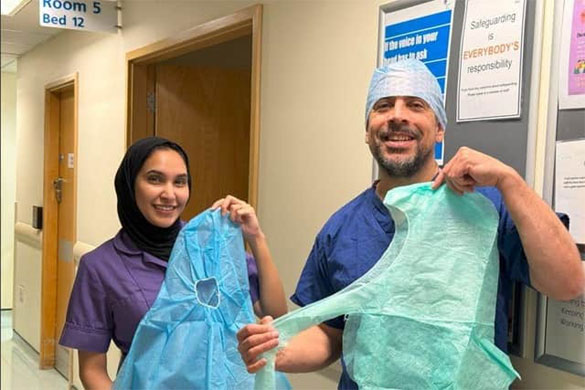
Steven Palmer with colleague Marium Shoma, Practice Plus Group Hospital, Ilford
----------
An Ilford hospital has introduced disposable hijabs to help Muslim patients to feel more comfortable during surgery.
The hijab holds deep cultural and religious significance for Muslim women around the world: it is a symbol of modesty, faith, and identity. But in sterile hospital environments that adhere to strict infection prevention and control policies, wearing a hijab can feel challenging for both patients and hospital staff.
Driving this initiative at Practice Plus Group Hospital, Ilford, is Steven Palmer, an operating department practitioner. Determined to address the gap, Steve collaborated with colleagues who wear hijabs to better understand their needs and concerns. Their insights helped the hospital team to develop a simple but effective solution: the introduction of disposable hijabs.
These specially designed head coverings offer the necessary coverage while adhering to infection control guidelines, allowing patients to maintain their sense of identity while also ensuring hygiene standards are met.
Commenting on his ‘light bulb moment’, Steven says: "One day, I had three female Muslim patients, all wearing hijabs, and all visibly anxious before their procedures. While we provide theatre hats, I realised we didn’t have anything specifically designed to accommodate patients who wear hijabs. It struck me that inclusivity isn't just about policies—it’s about small, practical changes that make people feel comfortable and respected. The real reward is seeing patients feel more at ease.”
The introduction of disposable hijabs in surgical theatres by Practice Plus Group Hospital, Ilford, highlights the importance of understanding and respecting the diverse needs of its patients and staff.
Hospital Director, Mark Gilmour, comments: “Inclusivity in healthcare is about making small, thoughtful changes that help individuals feel comfortable, valued, and respected in environments that can otherwise feel intimidating or isolating.
“The impact of this initiative has been overwhelmingly positive. Patients have expressed relief at being able to wear a modified version of their hijab, which helps them maintain their cultural and religious identity in an unfamiliar environment.
"Additionally, this innovation has made the theatre environment more accessible for aspiring female Muslim healthcare professionals. For example, for student nurses or junior doctors, this initiative removes one more potential barrier to entering the healthcare profession, helping to foster a more diverse workforce.”
Practice Plus Group Hospital, Ilford, continues to help reduce NHS waiting lists in routine procedures such as hip and knee surgery, general surgery such as hernia repair, endoscopy, diagnostics and cataract surgery. Private patients can book consultations directly with Wellsoon private healthcare from Practice Plus Group, and NHS patients can ask their GP for a referral to the hospital.
Source: londonworld.com
https://www.londonworld.com/community/ilford-hospital-introduces-disposable-hijabs-to-champion-inclusivity-for-staff-and-patients-5065087
--------
Iranian Youth Reject Maryam Rajavi’s and the Mujahedin-e Khalq’s Embrace of Mandatory Hijab
April 2, 2025
Shay Khatiri
Recently, the U.S. House of Representatives passed a resolution supporting Mujahedin-e Khalq of Iran (also known by its acronyms MKO, MEK, and NCRI). That the U.S. government, especially with Republican support, would back an Islamist-Marxist organization with a history of terrorism was not on anybody’s bingo card, especially since young Iranians see the group as favoring the status quo over reform in important ways.
Put aside the fact that the Mujahedin-e Khalq is the only political faction with a lower popularity inside Iran than the Islamic Republic itself. Despite the Islamic Republic’s many vices, it mobilized Iranians to fight against Saddam Hussein’s invasion when the Mujahedin-e Khalq joined Saddam’s military.
Among the younger generation who do not remember the war, the cleavage is cultural. In 2022, Iranians rose up over compulsory hijab. Young Iranian women and girls filmed themselves burning their hijabs and going out in public with their hair uncovered. The problem is that the Mujahedin-e Khalq leader Maryam Rajavi wears the hijab. To understand why Rajavi’s wearing a hijab is so problematic, Americans need to realize how the question of hijab differs in Iran and America.
Americans see the hijab through the liberal lens of religious practice and tolerance. The Islamic Republic is not a liberal country, though. In a theocracy where religion and politics are intertwined, the hijab has become a political symbol. The young generation bemoans that their country is culturally and politically backward, shackled by traditionalism and religion, by misogyny and gender oppression. Youth see secularism as the remedy. They seek to do away with traditionalism and misogyny, symbolized by the turban and hijab.
The hijab, just like the turban, is an attachment to Iran’s Islamic, non-Iranian heritage from which the youth want freedom. It is the female subjugation to the turban. The hijab represents a choice, not simply of religion, but of what Iranians want their country to be like: a traditional nation or a Westernized one. The Iranian youth have chosen the latter. When the girls burn their headscarves, they are not merely rejecting the compulsory hijab; they are embracing modernity. It is not just the regime that they are protesting. They are also protesting older generations who disapprove of dating, not because they are religious, but because they are traditional and believe in arranged marriage. They are objecting to notions such as namus and ghayrah that give men control over women. Young Iranians are not only revolting against the state; they are challenging the Islamic norms that are incompatible with modernity.
A few months before the 2022 protest, Iranians took to Twitter to make the #No2Hijab hashtag trend. The young want the state that will succeed the Islamic Republic to embody change. They will not embrace a regime run by either a hijab-wearing woman or turban-donning man.
Rajavi is the hijab-wearing woman the youth now fight to prevent the hijacking of their future. She once supported Ayatollah Khomeini and the Islamic Revolution; they do not believe her embrace of hijab shows an evolution of thought.
While the Mujahedin-e Khalq and its shell groups in the United States and Europe portray the group as a feminist organization for having a female leader, young Iranians reject it for embodying the same sexist, backward practices that characterize the current regime.
The contrast between the popularities of secular opposition figures and Rajavi is also telling. Social media activities and polling among Iranians show that figures such as Masih Alinejad (best known for her activism against compulsory hijab), Nasrin Sotudeh, and Hollywood actress and activist NazaninBoniadi are popular among young Iranians, and none of them covers her hair. The son of the late shah is also popular, as is his mother, the former empress. Neither she nor his wife and daughters wear hijab; rather, they dress like American and European women. What little support Rajavi has comes from older Iranians living outside Iran.
If Americans want to effect regime change in Iran, it is better that they rally behind someone who resembles a change that young Iranians envision, not promote someone who represents a return to the religious conservatism and oppression of decades past.
Source: meforum.org
https://www.meforum.org/mef-observer/iranian-youth-reject-maryam-rajavis-and-the-mujahedin-e-khalqs-embrace-of-mandatory-hijab
---------
Saudi model Roz on her homecoming: ‘It feels emotional in the best way’
HAMS SALEH
April 03, 2025
DUBAI: Roz — famed for being the first Saudi female model to work internationally, and for recently starring in the reality show “Dubai Bling” — has returned to Saudi Arabia after a decade abroad, marking a pivotal moment in her career and personal journey.
Roz shot to fame in 2019 when she modelled for a Victoria’s Secret’s Pink campaign.
She had moved to the US in 2013 to pursue a degree in interior design, but her modelling soon took over. Her Instagram feed (she has more than 15 million followers) is littered with photographs of her various advertising campaigns, as well as visits to many a product launch party — from NYX Cosmetics events to TikTok gatherings.
Roz’s homecoming reflects both her cultural pride and her desire to reconnect with her roots.
“It feels emotional in the best way,” she told Arab News. “I’m not moving back just yet, but I’ll be visiting more often to show the world how beautiful my country truly is. Being back on Saudi soil after so long brought back so many memories. There’s a deep sense of pride in seeing how much the country has evolved — and experiencing that change in person is really special.”
The model, who has been working on the international fashion circuit for years, says she has seen a remarkable transformation in the Kingdom’s fashion scene.
According to Roz, the country is now fostering a new generation of creatives who are pushing boundaries and embracing self-expression through fashion. This shift is not only inspiring but also deeply personal to Roz, who sees it as a celebration of identity that she had long hoped to see.
“The transformation is incredible,” she said. “There’s a whole new generation of creatives pushing boundaries and telling their own stories through fashion. What excites me most is seeing that self-expression is finally being celebrated, and I’m honored to witness it during my visit.”
One of the key motivations behind Roz’s visit was her desire to be part of the dynamic changes unfolding in the region, especially in fashion and entertainment.
“It’s my country, and I’ve always wanted to come back, but I was stuck in the US due to visa issues,” she said. “Once I finally sorted that out, I knew it was time to visit and reconnect. With everything happening in the region and how quickly things are progressing in fashion and entertainment, I wanted to be present, show support, and be part of this exciting moment in some way.”
Roz’s career journey to date has been far from easy, she said.
“There were so many (challenges). I faced judgment, stereotypes, and a lack of representation. But I kept going because I knew I was paving a path that didn’t exist yet,” she said. “Every step was about proving that a Saudi woman can take over the international stage and still stay true to who she is.”
Her role on “Dubai Bling” has also significantly impacted her celebrity status. “It definitely opened me up to a broader audience — people may have only seen me through fashion campaigns before. It also showed a more personal side, which helped people relate to me,” she said. “It came with more eyes, more opinions, but also more love and support than I ever imagined.”
Roz sees fashion as a form of self-expression, and embraces her roots as a strength that makes her style unique.
“To me, fashion is all about storytelling. I love merging global trends with elements of my identity, whether in how I carry myself or the brands I choose to represent. Staying true to my roots is never a limitation; it’s actually what makes my style stand out,” she said.
Roz is keeping her upcoming projects under wraps, but says her focus is on staying authentic and using her platform to inspire young Saudi women.
“I hope they see that there’s no mold they have to fit into. You can be proudly Saudi, proudly creative, and take up space in any industry,” she said. “I hope my journey shows what is possible, and that their stories deserve to be told on a global scale.”
Source: arabnews.pk
https://www.arabnews.pk/node/2595758/lifestyle
----------
‘Are Muslim women entitled to permanent alimony on divorce’, SC to decide
Apr 03, 2025
Can a family court award permanent alimony to a Muslim woman on dissolution of her marriage as per the Dissolution of Muslim Marriages Act, 1939?
The Supreme Court has appointed Solicitor General Tushar Mehta and senior advocate Siddhartha Dave as amicus curiae to assist it in deciding the contentious issue.
It would also decide if such permanent alimony could be modified on the re-marriage of the woman.
“We request the learned amicus curiae also to file their written submissions within two weeks,” a Bench of Justice Sanjay Karol and Justice Prashant Kumar Mishra said, posting the matter for April 15.
The March 24 order came on an appeal filed by a Muslim man against the Gujarat High Court's March 19, 2020 order upholding a family court's decision to grant a decree of divorce to a Muslim woman and asking the man to pay Rs 10 lakh as permanent lumpsum maintenance for lifetime.
Relying on the top court’s verdict in DanialLatifi vs Union of India (2001), the family court had held that the husband was liable to make a reasonable and fair provision for the future of the divorced wife, including her maintenance.
While upholding the constitutional validity of the Muslim Women (Protection of Rights on Divorce) Act, 1986, the Supreme Court had in DanialLatifi’s case ruled that Muslim husbands were liable to provide maintenance to their divorced wives beyond the ‘iddat’ period, as mandated by Section 3(1)(a) of the Act.
‘Iddat’ is a mandatory waiting period a Muslim woman observes after divorce or death of her husband during which she can’t remarry to ensure clarity regarding potential pregnancy.
The Gujarat High Court had upheld the family court's order and refused to modify it even after being informed that the Muslim woman in question had remarried.
Noting that the right of maintenance and right in the matrimonial property were the consequences of the marriage or its dissolution, the high court had said, “Those reliefs are incidental to the main relief of 'dissolution of marriage' and therefore, these reliefs are very much an integral part of the decree of 'dissolution of marriage'.”
The high court emphasised that the law cast two separate and distinct obligations on the husband, ie, to make "reasonable and fair provision" for his divorcee wife and to provide "maintenance" for her.
“The obligation to make a reasonable and fair provision for the divorced wife is not restricted until the divorced wife remarries…The provision for permanent alimony is incidental to the granting of a decree or judicial separation, divorce or annulment of marriage,” the HC had said.
Source: tribuneindia.com
https://www.tribuneindia.com/news/india/are-muslim-women-entitled-to-permanent-alimony-on-divorce-sc-to-decide/
-------
Caught on camera: Man hurls insults at Muslim women praying in Alpharetta
April 2, 2025
ALPHARETTA, Ga. - Three Muslim women say they were violently verbally attacked by a man while they were praying in an Alpharetta parking lot.
This is the first time they're showing their faces and telling their story.
What we know:
The women say the man went out of his way cursing and hurling racist remarks at them in the parking lot of the Avalon Shopping Pavilion on Sunday. They want action taken.
They provided FOX 5 Atlanta with a video of the incident.
What they're saying:
"We are here today to stand up for our community, and we realize it's important to stand up for our community and for ourselves," Amna, one of the victims, said.
"We came here just to enjoy some desserts," another victim, Nesrine, said. "It was time for one of the prayers to end, so we wanted to make sure we reached it. We set our carpet up, our prayer rug, right next to our car in an empty parking spot tucked away in the corner."
"The first thing I thought of was recording just in case he did try to physically assault us, or pulling out a gun on us or hurt us in any way," Amna said.
The women say they tried to walk away but say the man kept following them.
"You're worshiping a false god," the man can be heard saying in the recording. "Go back to your country."
"In Georgia, over the last two years CAIR Georgia has recorded a 250% increase in anti-Muslim incidents," Azka Mahmood said.
Azka Mahmood is the Executive Director of the Council for American Islamic Relations has called for action over the incident.
"I feel very concerned that people feel comfortable enough and bold enough to spew such hatred in a public space," Mahmood said.
"This is not behavior that should be normalized, and this is not behavior that we are going to allow in our community. We believe at the very least the Avalon Property should speak up and ban him from this property moving forward," Attorney Ali Awad said.
Meanwhile, the women say they simply want a public apology.
"We don't want this to happen to any other Muslim or any other woman. We are just three women that a grown man talked to. There's fear as a Muslim, and then there's fear as women," Nesrine said.
Alpharetta police respond
What they're saying:
FOX 5 reached out to Alpharetta police and they sent this statement saying:
"The comments made in the video circulating on the internet are disgusting and do not reflect the diversity and understanding that Alpharetta values. However, in our community all speech is protected - even the speech we may not agree with. After thoroughly watching the video, we have determined no crime was committed. And, while we do not condone activity like this, absent any new information coming forward, our investigation is closed and no criminal charges will be made."
The women and their attorneys feel differently. They say they want the man to apologize. If he doesn't, they say they will be looking at further actions they could take.
Source: fox5atlanta.com
https://www.fox5atlanta.com/news/alpharetta-muslim-women-praying-avalon
-------
Singapore Mother Jailed 19 Years For Abusing Daughter To Death, Helping Burn Body
03 Apr 2025
SINGAPORE, April 3 — A woman who abused her four-year-old daughter for over a year until the child died, then helped burn her body, was sentenced to 19 years in jail today.
Foo Li Ping, 29, mistreated Megan Khung with her then-boyfriend, Wong Shi Xiang, 38, who ultimately delivered a fatal punch to the child.
According to Channel News Asia (CNA) Wong was sentenced to 30 years in prison and 17 strokes of the cane for his role in Megan’s death and various drug offences.
Both had pleaded guilty in February, and during today’s sentencing, they remained silent as the verdict was read.
Justice HooSheau Peng described their actions as “heinous, deplorable and violent”, highlighting that Megan, as a young and vulnerable child, was entirely dependent on them.
The judge said Megan repeatedly begged for food, clothing, and to be allowed to leave the planter box where she was forced to sleep, but her pleas were ignored.
Instead, Foo mocked and taunted her daughter, while the couple recorded the child’s suffering, which the judge said displayed their “absolute depravity”.
“For their own sadistic ends, the accused persons robbed Megan of her basic dignity. Ironically, it is these very chilling recordings which shed light on Megan’s plight during that period,” Hoo was quoted as saying.
She added that even after Megan’s death, Foo and Wong showed “utter callousness and cruelty” in their attempts to revive her.
“Over months, they prioritised their interests of self-preservation, to cold-heartedly plan for and then deviously execute the disposal of Megan’s body. At the end of her life, they denied Megan of the dignity of a proper laying to rest.
“Nothing of Megan, not even her ashes, remained,” said the judge.
A third individual, Nouvelle Chua Ruoshi, 35, who is accused of assisting in disposing of Megan’s body, is still facing court proceedings.
Foo had earlier pleaded guilty to charges of allowing the death of a child, child abuse, and disposing of a corpse, with an additional child abuse charge taken into consideration.
Wong admitted to culpable homicide, disposing of a corpse, drug trafficking, and drug consumption, with 11 other drug-related charges also considered.
During their earlier hearing, CNA reported disturbing videos of the abuse were played in court, with the public warned about their graphic nature.
Source: malaymail.com
https://www.malaymail.com/news/singapore/2025/04/03/singapore-mother-jailed-19-years-for-abusing-daughter-to-death-helping-burn-body/171751
---------
Young Sicilian Woman Killed In Broad Daylight By Stalker, Shockwaves Across Italy
3 April 2025
The murder of a young Sicilian woman by a stalker in broad daylight has sent shockwaves across Italy, where 11 women have been killed since the start of the year.
University student Sara Campanella, 22, was killed by an acquaintance on Monday afternoon in the Sicilian city of Messina.
Witnesses told media that they saw a man - later identified by prosecutors as 27-year-old Stefano Argentino - walk up to Ms Campanella and stab her on the street. She tried to get away and screamed "Stop it, let me go, stop it," before collapsing, they said.
A passer-by who reportedly heard Ms Campanella's screams tried to chase the attacker, who managed to flee.
Ms Campanella died on her way to the hospital. Mr Argentino was arrested a few hours later in the nearby town of Noto.
Raffaele Leone, Mr Argentino's lawyer, told Italian media on Wednesday that his client had admitted the charges against him, but had not explained why he had attacked her.
"I can't say if he's remorseful, he's quite closed up," Mr Leone was quoted by Ansa news agency as saying.
The Messina prosecutor, Antonio D'Amato, said that Stefano Argentino had "insistently and repeatedly" harassed Sara Campanella since she started university two years ago. She was studying to become a biomedical technician.
One of her friends once had to intervene when Mr Argentino kept complaining that Ms Campanella no longer smiled at him, Mr D'Amato said.
But he added that Ms Campanella never went to the police as she did not feel that Mr Argentino's attentions were particularly "threatening or pathological".
In the police detention order quoted by Italian media, prosecutors said that Mr Argentino had been "regularly pestering the victim, asking her to go out with him and get to know each other better, and refusing to back down even when she would turn him down".
Mr D'Amato said that, shortly before being stabbed, Ms Campanella sent a message to some friends, telling them that "that sick guy is following me".
Writing on Facebook, Ms Campanella's mother said that her daughter "bravely thought her 'No' would be enough because [Stefano Argentino] meant nothing to her, they weren't together, she just wanted him to leave her alone, she wanted to live and dream and graduate.
"You always need to speak up and go to the police! Help me give Sara a voice," she said.
In an emotional interview to Italian TV, Ms Campanella's brother said that unrequited love or attention could never be a reason for "act like this one".
"There are no justifications, and someone like him doesn't even deserve words."
The father of Giulia Cecchettin, who was also 22 when she was killed by her ex-boyfriend, told Italian newspaper La Repubblica that there are "entire generations of men who don't accept rejection".
"Love is not possession, jealousy is not love, and saying 'No' is a right. In Sara's case there hadn't even been a relationship," Mr Cecchettin said.
"Women continue to be killed by those who don't accept their rejection. We need to make an extraordinary effort, a collective act of rebellion... against this culture of death," said Mara Carfagna, a former minister and lawmaker.
The issue of violence against women is keenly felt in Italy, where femicides are frequently reported by the media. Last month alone, four women died at the hands of their partners or ex-partners.
On Wednesday, less than 48 hours after her death, Sara Campanella's murder was pushed out of the headlines by news that the body of 22-year-old Ilaria Sula had been found in a suitcase in Rome.
The university student had gone missing last week. According to Italian media, her ex-boyfriend has confessed to her murder.
Source: bbc.com
https://www.bbc.com/news/articles/cx208nn4v3jo
-----
URL: https://newageislam.com/islam-women-feminism/women-freedom-surveillance-hijab-laws/d/135049