
Syria: Women Should Wear Burkinis, 'Appropriate' Swimsuits On Beaches
New Age Islam News Bureau
11 June 2025
· Syria: Women Should Wear Burkinis, 'Appropriate' Swimsuits On Beaches
· What Daily Life Is Really Like For Women And Girls Surviving Under Israeli Siege In Gaza
· Mothers Of The Environment: Afghan Women In The Fight Against Plastic Pollution
· World Handicrafts Day: Women In Afghanistan Strive To Preserve Cultural Heritage And Drive Economic Growth
· Women Unite Across Middle East And North Africa For Rights And Peace
· Nora Hauptle: Zambia Women’s Coach Discusses Her Journey In Africa
· Iran Judiciary Claims Opponents Exploiting Woman’s Murder Case
· Are UAE Banks Doing Enough To Get Women On Board?
Compiled by New Age Islam News Bureau
URL: https://newageislam.com/islam-women-feminism/syria-women-wear-burkinis-appropriate/d/135841
-----
Syria: Women should wear burkinis, 'appropriate' swimsuits on beaches
June 10, 2025
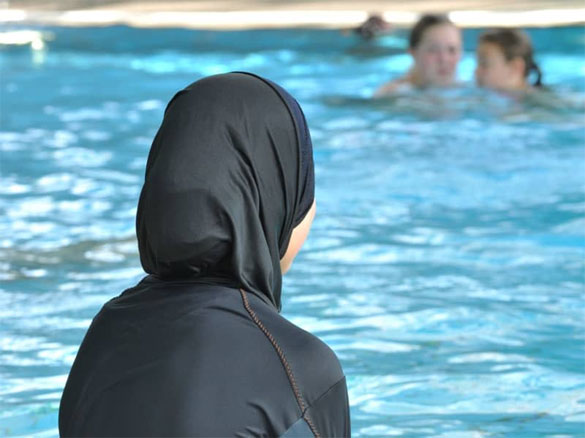
A Muslim woman sits on the pool wearing a burkini in Freiburg. The Syrian Tourism Ministry on Tuesday said women should wear burkinis or "appropriate" swimsuits at public beaches. Rolf Haid/dpa
------------
The Syrian Tourism Ministry on Tuesday said women should wear burkinis or "appropriate" swimsuits at public beaches.
"People are asked to wear conservative swimsuits at public beaches and shores (burkinis or swimsuits which cover the whole body," a ministry statement said.
"Swimmers and general beach visitors in general are required to wear appropriate swimming attire and behave in a manner that respects public taste," the statement added.
The decision came six months after an Islamist coalition seized power and overthrew longtime dictator Bashar al-Assad in December 2024.
Outside public swimming areas, women should wear loose-fitting clothing, and men must not walk around bare-chested even in hotel lobbies and restaurant areas, the statement said.
During al-Assad's rule, women in Syria were not seen wearing swimsuits, especially on public beaches.
But the ministry said the restrictions do not apply to private clubs, pools and luxury hotels.
"It is allowed to wear regular Western swimsuits provided that appropriate behavior is adhered to," the statement said.
Syria is currently led by a transitional government. It is largely comprised of the Islamist group Hayat Tahrir al-Sham.
Since the takeover, the rights of minorities and women have been under particular scrutiny.
Source: yahoo.com
https://www.yahoo.com/news/syria-women-wear-burkinis-appropriate-161632333.html
--------
What Daily Life Is Really Like For Women And Girls Surviving Under Israeli Siege In Gaza
JumanaKhamis
June 10, 2025
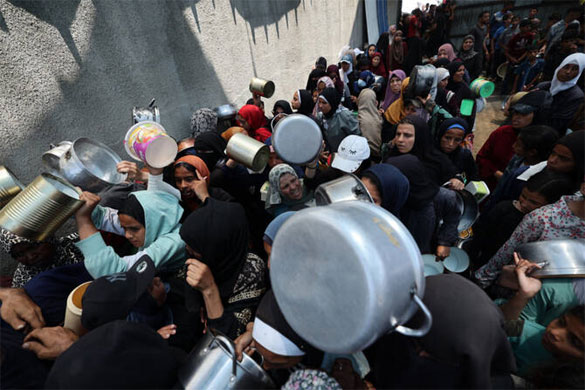
Palestinian women gather at a hot meal distribution point in Nuseirat in the central Gaza Strip, on June 4, 2025. Thousands of women in Gaza are now the heads of their households, often caring for children without adequate shelter or essential supplies. (AFP/File)
---------
DUBAI: Since the war in Gaza began in October 2023, more than 28,000 women and girls have been killed — an average of one every hour — according to UN Women, making the besieged Palestinian enclave one of the most dangerous places in the world to be female.
Thousands more have been injured and nearly a million displaced. As food, water and basic healthcare become increasingly scarce under Israeli blockade, survival has turned into a daily struggle — and women and girls are bearing the brunt.
According to a group of independent UN human rights experts, nearly 13,000 women in Gaza are now the heads of their households, often caring for children without adequate shelter or essential supplies.
On May 21, experts issued an urgent appeal to the UN Security Council, condemning what they described as Israel’s “unprecedented assault” on Gaza’s civilian population — and warning of its particularly devastating impact on Palestinian women and girls.
“The devastation experienced by women, girls and entire communities is not incidental — it is the consequence of intentional policies and actions by Israel,” they said.
“The killings of thousands of women and girls may constitute the deliberate infliction of conditions of life calculated to bring about the physical destruction, in whole or in part, of the Palestinian people.”
Israeli forces launched military operations in Gaza in response to the Hamas-led attacks on southern Israel on Oct. 7, 2023, during which 1,200 people — mostly civilians — were killed and about 250 others, many of them non-Israelis, were taken hostage.
Since then, at least 56,000 Palestinians have been killed in Gaza, according to local health officials. Israel maintains that it does not deliberately target civilians and accuses Hamas of using Gaza’s population as human shields.
The crisis has been compounded by repeated Israeli blockades on humanitarian aid and commercial goods, pushing the territory into famine and prompting accusations that food is being weaponized.
Despite ongoing international attempts to broker a ceasefire, the conflict has devastated the enclave, triggering one of the world’s worst humanitarian disasters.
“More than two-thirds of Gaza’s population, about 1.7 million people, are now estimated to be crammed into an area of 69 sq. km — less than a fifth of the Strip,” HadeelQazzaz, Oxfam MENA’s regional gender coordinator, told Arab News.
In overcrowded tents and displacement camps, privacy is almost nonexistent. Care responsibilities have increased for women, and water shortages are taking a disproportionate toll.
“From queuing for hours in the heat for water to facing daily health risks due to lack of proper sanitation, the lack of clean and safe latrines is leading to serious health issues, including infections among women,” said Qazzaz
At displacement sites reached by Oxfam in May 2024, water points were reportedly located up to a kilometer away. Women and girls were spending up to three hours a day collecting water — compared to 1.7 hours for men and boys.
But water is only part of the problem. Food insecurity presents another growing threat. Nine out of 10 displacement sites show visible signs of malnutrition among residents, with female-headed households among the most vulnerable.
“Women are skipping meals so their children can eat,” said Qazzaz. “Many are putting their own health at risk to keep their families going. When food parcels arrive, women often eat last — or not at all.”
An estimated 71,000 children and 17,000 women are expected to require urgent treatment for acute malnutrition in the coming weeks, highlighting the scale of the emergency and the desperate need for sustained aid access.
“Even when food is available, women often have to cook on open fires due to fuel shortages — exposing them to health risks and doubling the time needed to prepare a meal,” said Qazzaz.
Pregnant and breastfeeding women are especially at risk, with many becoming dangerously undernourished.
Since October 2023, Gaza has seen a 300 percent increase in miscarriages. Premature births and maternal deaths have surged, with many women forced to give birth without proper medical support.
“Maternal care is nearly nonexistent,” said Qazzaz. “Women are giving birth in tents, without skilled help, clean supplies or even pain relief.”
These accounts are echoed by medical workers on the ground.
“The situation in Gaza is precarious for everyone, but especially for pregnant women,” Denise Potvin, a Canadian nursing activity manager with Medecins Sans Frontieres at Nasser Hospital in Khan Younis, told Arab News.
“Over the past weeks, we’ve seen malnutrition steadily increase. It’s very visible — there’s a huge vulnerability for pregnant and lactating women. The small amount of food entering Gaza through aid crossings is nowhere near enough to meet the needs of this population.”
Maternity departments are seeing more women arriving late — after giving birth at home — or showing up in emergency rooms because they could not reach a hospital in time.
“Colleagues, including midwives and health professionals, are being woken up in the middle of the night to assist in home deliveries because women simply cannot reach hospitals,” said Potvin.
“Constant displacement, insecurity and lack of transport make it incredibly difficult for pregnant women to access care.”
Routine antenatal check-ups have become nearly impossible to access. With clinics shutting down, the ability to detect or treat complications has all but vanished.
“The space that organizations operate in is decreasing by the day,” said Potvin. “More people are displaced, and it’s harder to meet the growing needs of the population.”
She called on the international community to recognize the extreme vulnerability of pregnant women under siege.
“Imagine being a pregnant woman in this situation — living in a tent, unable to access prenatal care, giving birth without medical help, while also trying to feed your family, find clean water and maintain basic hygiene,” she said.
“Daily survival is already a huge challenge, and pregnancy only adds to it.”
Reports from UN Women, the UN Population Fund and independent rights monitors paint an increasingly bleak picture.
Women and girls with disabilities face even greater risks, including neglect, violence and denial of basic services.
From bombardment to birth complications, period poverty to famine, every aspect of life has been made much harder.
With 90 percent of households facing extreme water shortages, women and girls struggle to manage menstruation without access to clean water, soap, sanitary pads or private spaces.
A rapid gender analysis by Oxfam found that 690,000 menstruating women and girls lack access to clean facilities and sufficient water for basic hygiene.
Each person is allocated just 6.6 liters of water a day — less than half the global emergency minimum. Toilets are unsanitary, overcrowded and often unsafe for women and girls, with up to 1,000 people sharing a single facility.
The Oxfam report warned: “Girls are vulnerable to harassment and abuse and resort to using old clothes or only their underwear when sanitary pads are unavailable” — a situation that has led to infections, maternal complications and even infant deaths.
Despite the immense logistical challenges, the UN Population Fund continues to address urgent sexual and reproductive health needs.
Since October 2023, it has distributed two-month supplies of disposable menstrual pads to more than 300,000 women and girls. More than 12,000 new mothers have received postpartum kits for recovery in conditions where professional care is almost impossible.
To help women regain a sense of dignity and autonomy, the agency has also provided cash and voucher assistance to more than 150,000 women and girls, enabling them to buy essential hygiene items like soap, towels, pads, and underwear amid severe shortages.
These relentless hardships — from caregiving and hunger to hygiene struggles in unsafe conditions — are taking a psychological toll. Mental health issues are on the rise, with mounting reports of stress, anxiety and depression among women and girls.
With Gaza’s education system in collapse, many girls have become full-time caregivers for their younger siblings.
“Girls are being more deeply affected,” said Qazzaz. “The war has pushed many out of school and into caregiving roles. Some are being forced into early marriages as families try to reduce economic burdens.”
As household tensions rise, so too does gender-based violence.
Experts say only a ceasefire would offer immediate relief to the women and girls of Gaza.
“Even a temporary end to the violence would offer critical psychological relief for women carrying enormous emotional and caregiving burdens,” said Qazzaz. “It would give families a chance to breathe, regroup, and begin to heal.”
A truce would also help restore access to hospitals, allow medical teams to resume work, and ensure that essential aid — from food and medicine to hygiene supplies — reaches those in need.
Meanwhile, the independent UN experts have issued a stark warning about the wider implications of the conflict.
“In Gaza, the rules of engagement and fundamental protections owed to civilians have been intentionally, persistently and flagrantly violated,” they said.
“If the Security Council fails to confront this profound breakdown in compliance and accountability, and what it means for humanity and multilateralism, the very foundations of international law risk becoming meaningless."
Source: arabnews.com
Please click the following URL to read the text of the original Story
https://www.arabnews.com/node/2604065/middle-east
-------
Mothers of the Environment: Afghan Women in the Fight against Plastic Pollution
KazimHamayoun
11/06/2025
Each year, on June 5, the world observes World Environment Day—a moment to honor the Earth and reflect on our shared responsibility toward nature. In 2025, the day is marked with the theme “Beat Plastic Pollution”, a powerful call to confront the global crisis of plastic waste and take urgent action to curb its devastating impact.
Plastics, particularly single-use plastics, have become a silent but deadly enemy of the planet. From oceans to deserts, they are now among the most persistent pollutants on Earth, leaving traces even within the human body. Microplastics, having infiltrated water, soil, and air, have been detected in human blood, breast milk, and even in the placenta of newborns. What deepens this crisis further is the lack of effective waste management in low-income and conflict-affected nations like Afghanistan. The country not only suffers from inadequate infrastructure, but Afghan women, who have long been the backbone of households, are now, in many regions, deprived of the right to education, employment, and participation in environmental initiatives.
During the years of the republic, promising efforts were made to raise environmental awareness. As the former head of Kabul’s Environmental Protection Agency, I witnessed hundreds of Afghan women participate in training workshops on waste separation, plastic reduction, and recycling techniques. In these programs, I introduced the internationally recognized “4Rs” model: Reduce (consumption), Reuse, Recycle, and Recover (energy). These concepts were taught to empower women to not only keep their environments clean but also engage in small-scale income-generating activities to support their families.
One shining example of these efforts is a woman named Mahtab, a resident of the Khairkhana district in Kabul. She was one of many women who attended those workshops. Today, despite enormous challenges and restrictions, Mahtab has become a symbol of environmental commitment and grassroots activism. She separates household waste, sorting out batteries, rigid plastics, metals, and other recyclable components, which she sells. The modest but steady income she earns from this simple, practical work helps her meet the daily needs of her family. But Mahtab is more than a waste picker—she is an informed and purposeful woman who now teaches others what she has learned.
Mahtab doesn’t stop at waste separation. During shopping trips, she encourages her family and neighbors to avoid products wrapped in non-reusable packaging and instead opt for recyclable alternatives. When someone plans to buy cooking oil, she advises them to choose thick plastic containers—ones that can later be repurposed as flowerpots, water buckets, or storage containers for flour and rice. She even collects used plastic bags, washes them, and reuses them multiple times. To the children in her neighborhood, she tells stories about oceans filled with plastic where fish die with bellies full of waste. She urges them to love the Earth.
In truth, Mahtab deserves to be called a “Mother of the Environment”—a woman who, armed with knowledge from the past, has not only kept her own home clean and sustainable but has also rekindled hope in her neighborhood. Many other women, like her, could walk the same path if only given the opportunity. Mahtab is a living embodiment of this year’s World Environment Day theme: “Beat Plastic Pollution”. For her, it’s not just a slogan on a banner, but a principle woven into her daily life.
Environmental science emphasizes that the fight against plastic pollution must begin at the household level. Waste separation at the source, reduced consumption, and replacing plastic with sustainable materials all start at home. Here, women play a pivotal role. They are often responsible for shopping, cooking, cleaning, and teaching children. When women are empowered to participate in decision-making, the environmental crisis no longer remains ownerless.
In many developed countries, experience shows that waste management programs succeed only when women lead them. If Afghan women are once again allowed to participate freely, there is little doubt a new wave of change will emerge—not through slogans, but through small, effective actions like those of Mahtab.
This article is not only a response to the 2025 World Environment Day theme; it is also a call to return to the women who form the true pillars of sustainable development in Afghanistan—women who love the soil, understand the air, protect the water, and see every plastic bag as poison. If Mahtab, with so little, has aligned her life with nature, imagine what could happen if millions of other women followed the same path. That would be the day when Afghanistan rises from the ashes of plastic waste and breathes freely once again.
Source: 8am.media
https://8am.media/eng/mothers-of-the-environment-afghan-women-in-the-fight-against-plastic-pollution/
----------
World Handicrafts Day: Women in Afghanistan Strive to Preserve Cultural Heritage and Drive Economic Growth
11/06/2025
June 10 marks World Handicrafts Day, a celebration of the rich artistry of handicrafts and their vital role in preserving cultural heritage and supporting economic development across societies. In Afghanistan, this day arrives at a time when women, despite facing severe restrictions, have turned to handicrafts as a means of cultural preservation and economic empowerment. Many have successfully built businesses, achieved financial independence, and promoted traditional crafts both domestically and internationally. Over the past four years, these women have fought to carve out spaces for themselves and others, often starting from the smallest of openings and transforming them into opportunities for dozens of other women. With unwavering resolve and hopeful hearts, they have excelled in handicrafts, tailoring, and commerce, defying limitations and reclaiming their agency.
These women, who have endured the bitter sting of deprivation under nearly four years of Taliban rule, say they have not only reached financial self-sufficiency but also helped other women survive the economic hardship by enabling them to earn a minimal income.
Tahmina Mangal is one such entrepreneur. In less than two years, she has established three tailoring and handicrafts workshops for women in Kabul. Her workshops employ over sixty women in fields like sewing, embroidery, beadwork, and weaving. Her mission is to empower women economically, promote the traditional clothing of Afghanistan, and encourage women’s presence in public life.
“Given the limitations on women’s work and education, including the closure of schools and the worsening economic situation, I established these tailoring and handicraft workshops to serve both myself and women of my generation,” she explains. “Now, more than sixty women work with us across various departments, including machine stitching, leatherwork, bead embroidery, and weaving.”
She adds that some of the girls who were left out of school and had fallen into depression due to the education ban have also joined the workshops. After a period of training, they are now actively employed.
Husna Raoufi, another pioneering entrepreneur, has made a notable impact in both national and international markets over the past four years by promoting the handicrafts of Afghanistan. She launched her business in 2022 after universities were closed to women, turning the closure into a call to action. “After the universities were shut to women, we established the Rah-e-Danesh (Path of Knowledge) workshop. This wasn’t just a protest—it was a way to create opportunities for women and girls to learn and work,” she says. “Now, thirteen women are working full-time with us in the tailoring section and have become financially self-reliant.”
With the Rah-e-Danesh workshop, which combines training and handicrafts, Husna realized her lifelong dream and became a symbol of resilience and leadership for other women. Her goal, she says, was always to help women break free from dependency in a society that consistently renders them subordinate. “Even back in school, I saw the deteriorating conditions women faced. I dreamed of being someone who could create safe workspaces for them. When we started, we had just one student. But as time passed, more joined, and now we run various programs in the workshop.”
Source: 8am.media
https://8am.media/eng/world-handicrafts-day-women-in-afghanistan-strive-to-preserve-cultural-heritage-and-drive-economic-growth/
--------
Women unite across Middle East and North Africa for rights and peace
10/06/2025
More than 250 women from 17 countries across the Middle East and North Africa (MENA) gathered in the Iraqi Kurdish city of Sulaymaniyah (Silêmanî) on 15-17 May for the first congress of the Regional Democratic Women’s Coalition (NADA), vowing to deepen transnational solidarity in the face of war, patriarchy, and state violence.
Under the banner ‘Towards a Democratic Society Based on the Women’s Revolution’, participants from countries including Palestine, Egypt, Lebanon, Morocco, Sudan, Iran, and Turkey debated the impacts of authoritarianism, environmental destruction, and systemic violence on women’s lives.
In an interview with CeylanŞahinli of Mezopotamya Agency, EbîrHasaf, a member of the Women’s Council of the Autonomous Administration of North and East Syria (AANES) and NADA delegate, described the congress as “a historic moment for collective resistance”.
“We are living through the peak of a Third World War,” she said. “While these crises deepen, we must build joint responses. That’s why 250 women met in Sulaymaniyah—to explore the roots of the crises and to map out ways forward.”
Workshops focused on women’s roles in creating democratic societies, resisting ecological devastation, and confronting violence tied to nationalism and patriarchal state structures. Hasaf emphasised that discussions addressed how women’s bodies and ecologies are jointly targeted in war zones, and how communities can reclaim autonomy through grassroots organising.
A central reference point in the final declaration was the political philosophy of imprisoned Kurdish leader Abdullah Öcalan, whose ideas on democratic confederalism were cited as “visionary” by Hasaf.
“We believe Öcalan’s proposals help us rethink peace and collective life. Women gain strength from each other, and our struggles—despite geographic distance—are profoundly similar,” she said.
NADA emerged from a decade-long process beginning with a 2013 women’s conference in Diyarbakır (Amed), followed by a major assembly in Beirut in 2021. The coalition’s aim is to build enduring networks of solidarity that challenge borders, militarism, and oppression from below.
“We are moving from shared pain toward shared strength,” Hasaf said. “This is just the beginning.”
Source: medyanews.net
https://medyanews.net/women-unite-across-middle-east-and-north-africa-for-rights-and-peace/
-------
Nora Hauptle: Zambia women’s coach discusses her journey in Africa
10/06/2025
Zambia women's national team head coach Nora Hauptle has shared thoughts on her journey so far on the continent after spending time with the Copper Queens following a spell with the Ghana women's national team (the Black Queens).
The Swiss trainer qualified the Black Queens for the 2024 Africa Women’s Cup of Nations (WAFCON) but left the post following the expiration of her contract to take over the helm of Zambia women’s team.
The 41-year-old, who will lead Zambia at the next Women's Africa Cup of Nations (WAFCON) in Morocco in July, shared her thoughts with CAF Online.
“For me, it’s a privilege to work in Africa. There’s a vast reservoir of talent, not just in the players, but in the potential for overall development,” Hauptle said.
“There’s incredible passion for football. I’ve also learned so much culturally. I strive to stay open-minded because it’s a true exchange; I give, but I also receive so much. I’m deeply inspired by the continent’s history and its people. I really want to continue this journey here.”
“With Zambia right now, I genuinely feel there’s a chance to raise the level of the game. I enjoy playing the role of developer, taking teams to the next level.”
“What struck me the most is the incredible passion. People in Zambia are crazy about football, wherever I go, even outside of a professional setting, people approach me and share their love for the game.
Zambia have been drawn in a challenging Group A at the WAFCON, where they will face hosts Morocco, DR Congo, and Senegal.
Source: panafricafootball.com
https://www.panafricafootball.com/post/nora-hauptle-zambia-women-s-coach-discusses-her-journey-in-africa
-------
Iran Judiciary Claims Opponents Exploiting Woman’s Murder Case
JUNE 11, 2025
Iran’s judiciary spokesman accused the Islamic Republic’s opponents on Tuesday of exploiting the murder of a 24-year-old woman to create social outrage, as conflicting accounts emerge about her death.
Asghar Jahangir said at a press conference that “anti-revolutionary and hostile currents are trying to link ElahehHosseinnejad’s murder to social insecurity.”
He claimed, “Some want to use ElahehHosseinnejad’s murder case to paint a dark picture and make society appear unsafe.”
Jahangir said Iran’s institutions, particularly the judiciary, “stand firmly on maintaining social security and protecting public peace and would not allow enemies to create anxiety through rumors, lies, and painting dark pictures.”
Contradictory official and unofficial accounts about how the young woman was killed have circulated in recent days.
Regarding the murder details, Jahangir said the forensic medical examiner determined the cause of death was “a sharp object hitting the chest, which was the source of death.”
He added that investigations into “other alleged matters raised about the deceased’s body condition” are continuing and that no final results have been announced.
Jahangir said updates would be provided as soon as new results are received from forensic medicine, stating that additional information is not currently available.
ElahehHosseinnejad worked at a beauty salon in Tehran and disappeared on May 25 near Azadi Square while returning home to Islamshahr after leaving work.
She was last seen getting into a vehicle. Her phone was turned off one hour later, and contact with her family was cut.
Her body was found 10 days later outside Tehran.
Source: iranwire.com
https://iranwire.com/en/news/141941-iran-judiciary-claims-opponents-exploiting-womans-murder-case/
------
Are UAE banks doing enough to get women on board?
June 11, 2025
Recently, I stood on stage at the MENA BFSI Leaders Conclave in Dubai — facing a room full of CEOs and decision-makers from top banks across the region: Emirates Islamic, First Abu Dhabi Bank, Emirates NBD, The Saudi Investment Bank, Mashreq, Wio Bank, Doha Bank, and more.
What I told them is what I’ll tell you now: We’re about to witness one of the biggest wealth transfers in human history. And the face of that wealth is female.
Over the next decade, Gen Z and Millennials will inherit close to $100 trillion — and a significant share will go to women, according to Citi Private Bank.
Globally, women already control one-third of the world’s wealth. By 2030, that will rise to nearly 50%, as per Citi Private Bank.
Let that sink in. Women will no longer just be consumers. They’ll be investors. Decision-makers. Legacy builders.
This shift is global — and it’s happening right here in the GCC. More women are starting businesses, building financial literacy, and managing their own wealth. And yes, they’ll inherit significant assets in the years to come. Governments are paving the way, too.
The UAE mandates at least one woman on every listed board. Banks like Emirates NBD or FAB have pledged to reach 30% women in leadership by 2025.
And yet, the banking sector still feels like a men’s club. One executive whispered to me after the event: “This industry is still very male-dominated.”
The numbers prove it. Women hold just 18% of C-suite roles in banking globally, according to Deloitte). In the region, 70% of women cite gender bias as a major workplace barrier, says Bain & Company, and nearly half of women in finance say lack of sponsorship is what holds them back (Oliver Wyman).
So many end up leaving the workforce frustrated — because they don’t see enough role models, or they’re forced to navigate a workplace not built for them to thrive. There's often zero flexibility. So they leave.
What does this mean for your business — your bank or your insurance company?
It means you’re not ready.
Because many of you are chasing women as customers — investors or clients — but failing to promote them as leaders inside your companies.
The very women who could open new markets, understand female clients better, and drive growth are being overlooked. The point is that women you are chasing don’t just invest like men; they invest differently. They prioritize impact, sustainability, and long-term security. In this region, many feel more comfortable talking to a woman about money.
So let’s be honest. If you don’t understand them, if you don’t have top women to lead this new market share, someone else will. In a competitive market like ours — that’s a risk you simply can’t afford.
But not all is bleak. Some banks and institutions are making progress.
Wio Bank’s CEO told me proudly they’ve reached over 40% female workforce. And yes, we see strong women leading banks like FAB or Standard Chartered.
Still, too many are behind. Too many are underestimating the RoI and RoE (return on equity) of gender inclusion.
Let’s look at the numbers:
Companies with 30% women in leadership earn up to 6% more profit (EY).
Boards with three or more women saw 37% higher earnings per share and 10 full percentage points in RoE (Morgan Stanley Capital International).
Diverse teams are 38% more innovative (BCG).
This isn’t charity. It’s smart business. It’s smart banking.
So here’s the question I left that powerful room with — and now I leave with you:
Will you keep doing business as usual? Losing talent. Missing growth. Falling behind. Trying to catch up later — when it will cost you more to claim that market share?
Or will you invest now — In the future of your bank or your company. In the power of your female talent. Not just to do the right thing. But to unlock the financial rewards for your shareholders and the ROI for your business.
Source: gulfnews.com
https://gulfnews.com/business/analysis/are-uae-banks-doing-enough-to-get-women-on-board-1.500159543
--------
URL: https://newageislam.com/islam-women-feminism/syria-women-wear-burkinis-appropriate/d/135841