
Stay Home To Avoid Rape: Controversial Posters On Women’s Safety Spark Outrage In Ahmedabad
New Age Islam News Bureau
02 August 2025
· Stay Home To Avoid Rape: Controversial Posters On Women’s Safety Spark Outrage In Ahmedabad
· All Ceylon Makkal Congress Urges Health Minister To Uphold Muslim Women’s Right To Wear Hijab In Trincomalee
· Ghaziabad ‘Love Jihad’ Case: Muslim Man Arrested Again Despite Hindu Wife Denying Abduction Claim
· MARGINALIA: Gender Justice between Guidance and Governance
· Taliban Has Suppressed Afghan Women's Rights, Says US SIGAR Report
Compiled by New Age Islam News Bureau
URL: https://newageislam.com/islam-women-feminism/controversial-posters-women-safety-ahmedabad/d/136383
----
Stay Home To Avoid Rape: Controversial Posters On Women’s Safety Spark Outrage In Ahmedabad
By Muslim Mirror
August 2, 2025
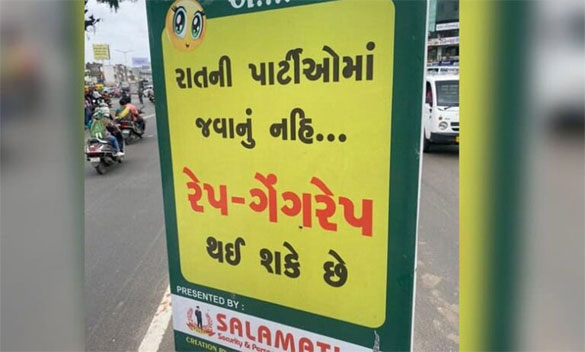
A poster linked to the Ahmedabad Traffic Police warning women against night parties A poster linked to the Ahmedabad Traffic Police warning women against night parties- X
------------
A series of posters allegedly linked to a traffic safety campaign in Ahmedabad have sparked controversy and criticism for their messaging around women’s safety. The posters, which appeared in areas like Sola and Chandlodia, advised women to avoid late-night outings and isolated locations to prevent rape or gangrape. Statements on the posters included: “Do not attend late-night parties, you could be raped or gangraped,” and “Do not go with your friend to dark, isolated areas, what if she is raped or gangraped?”
These posters triggered a backlash from the public and opposition parties, who raised concerns over the messaging and questioned the Gujarat government’s commitment to women’s safety. Critics argued that the posters promoted victim-blaming rather than addressing the root causes of sexual violence.
Deputy Commissioner of Police (Traffic West), Neeta Desai, clarified that the Ahmedabad traffic police had not authorized the content of the controversial posters. She explained that the department had approved a campaign focused solely on traffic safety, not women’s safety. According to Desai, the posters were created and distributed by Satarkta Group, a local NGO, without prior approval.
“The NGO approached us for conducting traffic awareness programmes in educational institutions. They showed us posters about traffic safety, and we agreed to let our staff accompany them for awareness activities. However, the posters that appeared on the streets were not the ones shown to us and were put up without our knowledge,” Desai said. She added that once the issue came to their attention, the posters were promptly removed.
The Aam Aadmi Party (AAP) condemned the incident, criticizing the BJP-led Gujarat government. In a statement, AAP said, “While the BJP government claims to promote women’s empowerment, these posters reflect the real situation on the ground. In the past three years, Gujarat has reported over 6,500 rape cases and more than 36 gang rape incidents. The average is over five rapes a day.”
AAP further questioned the government’s stance on women’s freedom of movement, asking, “Should the women of Gujarat not step out of their homes at night?” — With Agencies Inputs
-----
All Ceylon Makkal Congress Urges Health Minister To Uphold Muslim Women’s Right To Wear Hijab In Trincomalee
1 August 2025
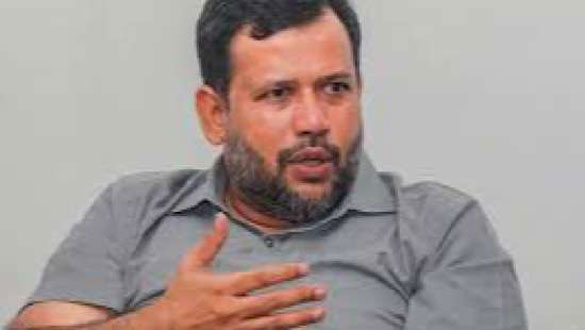
All Ceylon Makkal Congress (ACMC) Leader and Parliamentarian Rishad Bathiudeen has called on Health Minister Dr. Nalinda Jayatissa to intervene immediately and safeguard the constitutional rights of Muslim women working in the public health sector in Trincomalee.
In a letter addressed to the Minister, MP Bathiudeen expressed concern over recent directives allegedly issued by the Provincial Director of Health Services in the Eastern Province, reportedly instructing Muslim female health workers to refrain from wearing the Hijab—a traditional religious head covering—while on duty.
“This directive has caused significant distress among the affected women,” Bathiudeen wrote, warning that it contradicts their constitutionally guaranteed rights to religious freedom, personal dignity, and cultural identity.
Highlighting that Muslim women in the Trincomalee health sector have long performed their duties while wearing the Hijab without any impact on service delivery, the MP said the sudden change has sparked backlash from civil rights advocates and local communities.
In his appeal, Bathiudeen stressed that:
• Religious freedom is enshrined in Articles 10 and 14(1)(e) of the Constitution;
• Wearing the Hijab does not interfere with medical or administrative duties;
• Cultural and religious diversity must be respected in public institutions;
• The request is not for a new privilege, but the continuation of an established practice.
The ACMC leader urged the Health Minister to issue a clear directive permitting the wearing of religious attire within public health institutions, as long as it adheres to reasonable health and safety guidelines.
-----
Ghaziabad ‘love jihad’ case: Muslim man arrested again despite Hindu wife denying abduction claim
By Anant Gupta
August 2, 2025
The couple got married in 2022, but the woman’s family had objected to their relationship.
The police in Uttar Pradesh’s Ghaziabad on Friday arrested a Muslim man on charges of abducting his Hindu wife, despite the woman saying in a video two days earlier that she left home of her own will.
The man, Akbar Khan, and the woman, Sonika Chauhan, got married in August 2022. They had, however, not been living together as Chauhan’s family objected to their relationship. The couple had eloped on May 24, after which local Bharatiya Janata Party leaders stepped in to help the Chauhans separate the couple and bring Sonika back to her family.
Khan was arrested for the same offence on May 25, but was released on bail on June 8. Scroll had reported on the couple’s ordeal at the time. A mob that claimed that the couple’s marriage was a case of “love jihad” had vandalised their businesses on May 26.
Love jihad is a Hindutva conspiracy theory that holds that Muslim men pose as Hindus to trick Hindu women into relationships with the aim of converting them to Islam.
...
MARGINALIA: Gender Justice between Guidance and Governance
Mansoor L. Limba
August 2, 2025
MAKATI CITY (MindaNews / 02 August) – There are moments in one’s professional journey that arrive quietly yet carry the weight of meaning…
…like being asked to sit beside the Fatwa Division Chief of the Bangsamoro Darul-Ifta’ in a legislative committee amendment session as a Shari‘ah counselor, offering reflections on the draft Bangsamoro Gender and Development Code (Parliamentary Bill No. 336).
It was not just a professional task. It felt like a sacred duty, a calling perhaps, to ensure that the emerging laws of our homeland would honor both the dignity of every soul and the divine guidance etched in our shared texts and traditions.
The draft GAD Code is, to me, a laudable endeavor. Its language is progressive. Its aspirations are inclusive. It seeks to open pathways for all constituents—women and men, young and old, Muslim and non-Muslim—to thrive in a society where gender justice is both a goal and a guarantee.
But in law, as in architecture, strength lies in both the design and the details.
As I scanned the Code and shared my thoughts, I felt both hope and hesitation. Hope because we are creating something historic. Hesitation because, unless we fine-tune certain areas, we risk building a bridge with missing beams.
Here are the key pillars I recommended, or would like to recommend, to strengthen the structure.
1. Gender justice grounding. The Bangsamoro is not just a political or cultural entity; it is a moral community. Our legal system must reflect that. While the GAD Code nods to inclusivity, it must also be anchored deeply in the tri-justice system not to limit progress but to legitimize it within our context.
For instance, discussions on gender identity must be situated in the traditional Islamic (and also Christian and IP) recognition of male and female, while allowing for compassion and dignity for all. On reproductive health, Islam’s reverence for life means the Code must unambiguously prohibit abortion while promoting maternal care and family planning. And while encouraging women’s leadership, the Code must engage with diverse Islamic jurisprudential views, lest it create silent divides instead of sincere dialogue.
This is not about compromise. It’s about coherence.
2. Clear enforcement. A code, no matter how beautifully worded, is powerless without enforcement. I stressed, or would stress, the importance of defining the roles of Gender and Development focal points in agencies and LGUs. There must be a clear chain of accountability. Regular reports. Oversight. Penalties for non-compliance. A really functioning VAW desk, not just a literal ‘desk’ that exists only during external monitoring.
In the absence of consequence, even the best intentions wither into symbolism.
3. Empowering women the halal way. Many of our women are eager to participate in economic life—but are blocked by invisible barriers. One of the most formidable is riba (interest-based financing), which makes conventional loans religiously impermissible for many.
Imagine if the regional government could partner with Islamic microfinance providers to offer zero-interest loans to women entrepreneurs. Murabaha, Mudarabah, Qard Hasan. Couple that with skills training and incentives for private employers to hire women in tech, governance, and agriculture.
And we won’t just be talking about empowerment. We’ll be doing it.
4. Awareness, awareness, awareness. Laws change little if minds and hearts remain unmoved. We need a cultural campaign rooted in faith; for instance, community education that explains how Islam dignifies women and how justice is not a foreign concept but a Qur’anic command.
Men must be part of this journey. Real transformation involves husbands, fathers, brothers, and sons. Teach them that gender justice is not a threat but a trust. Equip them with examples from the Prophet’s life. Support them as allies.
5. Safety and dignity. If our sisters are to lead, work, and thrive, they must be able to move through our towns and institutions with safety and dignity.
That means well-lit streets. Women-only transport options. Breastfeeding stations in government buildings. Separate prayer areas. Childcare support in workplaces. These are not luxuries. They are necessities.
As the session drew to a close, I looked around the room. The faces bore the weight of history, the scars of conflict, the resolve of a people long denied justice. And yet, here we were—crafting a legal framework for a better future.
I believe the Bangsamoro GAD Code can become a landmark document. Not by copying what works elsewhere, but by crafting what resonates in the homeland. If refined with cultural sensitivity and rooted in indigenous values, it can serve as a bridge between faith and freedom, tradition and transformation.
In the end, we carry this belief with us:
That gender justice in the region must not be imposed. It must be composed. Woven like a tapestry of shared hopes, interpreted through lenses of trust, and implemented with hearts as much as hands.
For justice to rise at home, it must wear the garb of both divine wisdom and local will.
And that, I pray, is a conversation we never stop having.
https://mindanews.com/mindaviews/2025/08/marginalia-gender-justice-between-guidance-and-governance/
....
Taliban has suppressed Afghan women's rights, says US SIGAR report
Aug 02 2025
The Special Inspector General for Afghanistan Reconstruction (SIGAR) released its 68th and final report, as per Tolo News.
The report addresses issues such as US aid to Afghanistan, the situation of women and girls, security, the economy, counter-narcotics efforts, recent developments, SIGAR's monitoring process, the conclusion of its mission, and the role of other US government agencies in overseeing Afghanistan's affairs.
SIGAR claims in the report that the Taliban in Afghanistan has broadly stripped Afghan women and girls of their rights over the past nearly four years.
Abdul Sadeq Hamidzoy, a political affairs analyst, said: "International institutions have so far highlighted public concerns in their reports, but have taken no concrete action to resolve them."
According to the report, the US allocated only around $342 million in humanitarian aid to Afghanistan in fiscal year 2025, a sharp drop from over $968 million in 2023, Tolo News reported.
This steep reduction in aid, at a time when Afghanistan's internal needs are growing, has had significant effects on people's livelihoods.
The Ministry of Economy said that US aid to Afghanistan should not be politicised and rejects the claim that the Islamic Emirate of Afghanistan interferes in US assistance.
Abdul Latif Nazari, Deputy Minister of Economy, stated, "The recent SIGAR report has both positive and negative aspects, but I want to emphasise two points: First, the US has politicised humanitarian aid, which contradicts humanitarian principles and international law. Second, it is alleged that the Islamic Emirate interferes in international aid, and we strongly and categorically reject this claim."
SIGAR presented its first quarterly report to the US Congress in October 2008. Now that the body has concluded its operations, the question remains: how effective and beneficial was its oversight?
Idris Mohammadi Zazai, a political affairs analyst, told Tolo News, "Since 2008, despite SIGAR's reports on administrative corruption, it was neither prevented nor eradicated."
It's worth noting that SIGAR previously stated the US has provided over $3.83 billion in aid to Afghanistan since 2021.
(Only the headline and picture of this report may have been reworked by the Business Standard staff; the rest of the content is auto-generated from a syndicated feed.)
....
URL: https://newageislam.com/islam-women-feminism/controversial-posters-women-safety-ahmedabad/d/136383
New Age Islam, Islam Online, Islamic Website, African Muslim News, Arab World News, South Asia News, Indian Muslim News, World Muslim News, Women in Islam, Islamic Feminism, Arab Women, Women In Arab, Islamophobia in America, Muslim Women in West, Islam Women and Feminism