
Spokane Valley Councilwoman Jessica Yaeger – I Am a “Proud Islamophobe”
New Age Islam News Bureau
24 November 2025
· Spokane Valley Councilwoman Jessica Yaeger – I Am a “Proud Islamophobe”
· Stop Honour Killings: Nesa Rastgoo, Victim Of Child Marriage, Killed by Husband in Iran
· Benjamin Brière Former French Hostage: I’m Going to Mahsa Amini’s Hometown After Iran Falls
· UN HR Rapporteur Bennett: Violence Against Women “Unacceptable” In Afghanistan
· Syrian Women Face 530 Deaths In One Year
Compiled by New Age Islam News Bureau
URL: https://newageislam.com/islam-women-feminism/spokane-valley-proud-islamophobe-councilwoman/d/137786
-----
Spokane Valley Councilwoman Jessica Yaeger – I Am a “Proud Islamophobe”
Nov. 25, 2025

During a Spokane Valley City Council meeting Tuesday, Councilwoman Jessica Yaeger listens to a stream of public comment chastising her for Islamophobic comments she posted on her personal Facebook. (COLIN MULVANY /THE SPOKESMAN-REVIEW)
---------------
Dozens of people called for Spokane Valley Councilwoman Jessica Yaeger’s resignation and want her to apologize for a controversial post she made on her personal Facebook last week.
Yaeger declared she is a “proud Islamophobe” in a post Thursday morning. During an interview with The Spokesman-Review last week, Yaeger said she does not believe Islam is a religion but a style of government. She also said that Islam has no home in Spokane Valley.
More than 100 people attended Tuesday’s City Council meeting, the first since Yaeger made the declaration. A rally was held on the sidewalk outside Spokane Valley City Hall, where nearly a hundred people gathered, clad in puffer coats, hijabs and blankets, and many holding signs that simply read “Love.”
Nearly every person who spoke during the public comment portion of the meeting criticized Yaeger for her post. Some were critical of other council members for not standing more firmly against Yaeger’s beliefs.
“When an elected official uses her platform to target a big community, it implies hostility,” Kawkab Shishani, a Washington State University professor of public health and nursing, said during public comment. “History has taught us over and over that words like these do not remain abstract, they create conditions that lead to fear and unsafe environments for families. Council member Yaeger’s messages encouraged hostility against Muslims. Our community felt the impact immediately.”
Shishani invited Yaeger to have coffee with her and said she’d like to have a conversation about Islam.
“This is our home. We are part of this community,” Shishani said. “My invitation to you is to help you understand our values and how they can be an asset if you decide to replace the hate in your heart with love.”
Ben Lund, a Spokane Valley resident and frequent speaker at council meetings, was the only person to speak in Yaeger’s defense. He said that Yaeger helped his 99-year-old mother find housing, and that’s a side of Yaeger that people don’t see on social media. Lund also said that what is happening in the Valley is the beginning of sharia law influencing local laws.
Most Muslim Americans believe sharia law stands as ethical personal guidelines that should not be held over the Constitution and practice the faith while keeping with American laws, according to the Brookings Institution.
Yaeger sent a written statement to The Spokesman-Review on Friday night claiming that her post was meant to express basic moral truths that she would not apologize for believing.
“Let me be absolutely clear: pedophilia is wrong, rape is wrong, female genital mutilation is wrong. These are not controversial positions. They are universal human rights and truths. Anyone pretending that speaking out against these atrocities is somehow hateful or extreme is being deliberately dishonest,” Yaeger wrote.
Naghmana Sherazi, a local Muslim, said during the public comment portion of the meeting that Yaeger’s language is “offensive and must be addressed.”
“We respectfully require a statement from Spokane Valley City Council be made at the start of your next meeting that affirms the value of your Muslim neighbors.”
Spokane Valley Mayor Pam Haley read a statement at the beginning of the council meeting, stating that she was “deeply troubled” by Yaeger’s post and that hate speech and discrimination have no place in the Valley or public discourse. Haley and every council member, including Yaeger, also reaffirmed a resolution the council passed in 2017 that said Spokane Valley is an inclusive city where all are welcome.
“Thank you for your words earlier, but we need more than that,” Sherazi said. “This statement must include an apology for the harm done and a strong affirmation of your commitment as public officials to represent all users of the City of Spokane Valley, regardless of faith.”
The Spokane Islamic Center, Jaffaria Community and Muslims for Community Action and Support put out a joint statement responding to Yaeger’s post on Monday morning, calling her “Islamophobia” discriminatory.
“When an elected leader engages in rhetoric that targets an entire religious community, it undermines the safety, dignity, and belonging of Muslim residents,” the statement reads. “Spokane Valley is home to a diverse Muslim community that contributes to the region’s civic life, economy, and culture. We live here, work here, raise families here, and are committed to building a safe and inclusive community for everyone.”
Yaeger’s post also garnered attention from the nation’s largest Muslim advocacy organization, the Council on American-Islamic Relations, which posted a statement calling for locals to repudiate Yaeger’s comments on Friday.
Yaeger also wrote in her statement that The Spokesman-Review did not include any of her comments from her interview on Thursday, even though Yaeger is quoted many times throughout story.
“I was elected by the people of Spokane Valley to be straightforward, candid, and unafraid to speak on difficult topics. That is exactly what I will continue to do. I will not be intimidated into silence because my words make some people uncomfortable,” Yaeger wrote.
Source: spokesman.com
https://www.spokesman.com/stories/2025/nov/25/hundreds-rally-against-spokane-valley-councilwoman/
------
Stop Honour Killings: Nesa Rastgoo, Victim Of Child Marriage, Killed by Husband in Iran
NOVEMBER 25, 2025
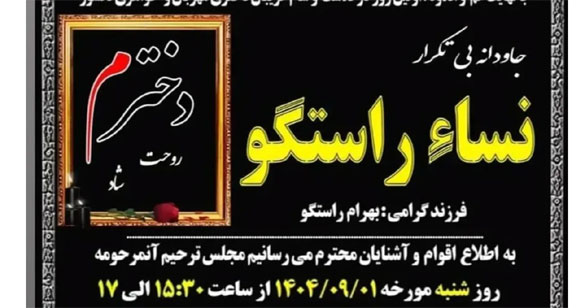
At least seven femicides and gender-based killings happened in Iran in November alone
-------------
An 18-year-old woman was stabbed to death by her husband in northwestern Urmia, activists reported.
Nesa Rastgoo was killed with 17 stab wounds on the evening of November 10, according to the Stop Honour Killings campaign.
She had been forced into marriage eight months earlier and was a victim of child marriage, the campaign said.
Rastgoo was from a village near Noshin Shahr, a suburb of Urmia, and was buried in the village cemetery.
Fatima Babakhani, founder of the Mehr Shams Afarid safe house that supports abused women in Urmia, posted on Saturday that Rastgoo’s family was informed of her killing on Friday morning, although the crime occurred on Thursday evening.
Iranian laws provide no protective mechanisms for women facing domestic violence.
At least seven femicides and gender-based killings happened in Iran in November alone.
Source: iranwire.com
https://iranwire.com/en/women/146541-18-year-old-woman-killed-by-husband-in-iran-after-forced-marriage/
-------
Benjamin Brière Former French Hostage: I’m Going to Mahsa Amini’s Hometown After Iran Falls
NOVEMBER 24, 2025
AIDA GHAJAR
Benjamin Brière spent 1,079 days as a hostage in Iranian prisons after being arrested in June 2020 while sleeping in his van near the Turkmenistan border.
The French national, now 39, was convicted of “espionage, propaganda against the Islamic Republic, and drinking alcohol” despite having no evidence against him beyond possession of a toy drone.
Released in May 2023 after three years of imprisonment, Brière witnessed executions, shared cells with death row inmates, and endured psychological torture alongside common criminals in Iran’s Quchan and Mashhad prisons.
This year, he published Freedom, a book documenting his experience and advocating for legislative protections for state hostages in France.
In an interview with IranWire, Brière discusses his arrest, imprisonment conditions, the Iranian prisoners he befriended - four of whom have since been executed - and his determination to return to Iran after the fall of the Islamic Republic, specifically to Saqqez, the hometown of Mahsa Amini, whose death in custody sparked the Woman, Life, Freedom movement.
“I have no anger against Iran and Iranians,” Brière says. “I’m angry at the miserable little Islamic Republic. That’s all. These are not the same.”
It’s been more than two years since you were released and came to France. How are you? Do you still suffer from your imprisonment experience in Iran?
I still have pain. I have a lot of pain about everything that’s still happening there. Many of my memories related to things I saw and endured come back to me. When I see the news again… I saw what they did to prisoners, especially Iranian prisoners, but I really didn’t see what was happening outside [prisons]. Now I have more information, and the pain is greater.
Are you angry?
I have no anger against Iran and Iranians. I’m angry at the miserable little Islamic Republic. That’s all. These are not the same. Expressing this matter is very important to me as a Frenchman in relation to what I witnessed, the narrative I have, and my book. [Expressing this difference] started with my family and my mother and father - we have no problem with Iran and 95 per cent of Iranians.
How did you end up in Iran?
I really wanted to go to Iran. I had previously lived in Asia and the Middle East. One day I left everything behind. I bought this van that I renovated by myself. My goal was to go to India. I went through part of Europe, Turkey, Iraq, and Iran. I entered Iran on December 15, 2019. My visa was for a maximum of three months. I had to leave by mid-March, go to Pakistan, and continue my journey. My Pakistan visa was ready. A few days before leaving, the borders closed. There was no longer any possibility of leaving. We immediately received a paper from Iran’s Ministry of Foreign Affairs that was also sent to all European embassies stating that foreign nationals whose visas might expire and who couldn’t leave would have no problem staying given the exceptional and global circumstances. We were allowed to stay. I remember I spent three weeks in the Varzaneh desert near Isfahan. We still didn’t know about COVID. There wasn’t really any quarantine. It was as if the virus had stopped at the border. The lying had started right there.
Before traveling to Iran, had you heard about the Iranian government’s hostage-taking?
At that time, there were hundreds of thousands of other tourists who wanted to travel to Iran. The probability of being arrested wasn’t much higher than being attacked somewhere else. Actually, I was aware that the Islamic Republic bears no resemblance to a republic and is more like a dictatorship. The media only shows what’s bad, and when we travel [to these places], we see what’s going well and the beauties. We meet people and become interested in the culture. I have no regrets about going to Iran. I wasn’t aware that even at the time I was in Iran, there were hostages - it hadn’t become very public then. In fact, I was lucky to travel in Iran for six months. This trip remains for me one of the most beautiful trips I’ve had. Even though I was imprisoned as a hostage for three years, I returned full of love, and I left part of my heart there. While I defend the Iranian people. [Iran] has 90 million inhabitants, 85 million of whom are hostages. The Islamic Republic wants to build walls - we build bridges over them. This is important to me.
At the moment you were arrested, when, where, and what were you thinking?
I remember that night completely. French media said I was arrested while flying a drone in a military or restricted area. When they arrested me, I was asleep. I was sleeping in the van. It might have been 1 or 2 in the morning. It was dark. I was in the Shamkhal valley near the Turkmenistan border. I think it’s about an hour from Quchan. I was sleeping like every night. I remember very well that there was hard pounding on the vehicle body. Well, I wake up, put on my T-shirt and come out of the van, and immediately I see a Kalashnikov pointed at me. We’ve all seen nighttime checks everywhere, including at midnight. This was the first time I’d seen a weapon drawn on me.
How many people were there?
There were six or seven people. I’m sure three of them had Kalashnikovs. The rest were also armed, but I don’t know what weapons. I’m not a weapons expert - we all recognize Kalashnikovs from movies.
What were they wearing?
As far as I remember, it was military. A few hours later, someone from the Quchan security service arrived. He wasn’t like the others. He was threatening. He was violent. There was psychological domination too. He wanted to gain control over you. In my book, he is “the man with black eyes.”
So the violence started from that moment.
Psychological violence was there from the first moment of arrest. Physical violence started those first hours with this man. A week later, there was also a judge who beat me to get a confession. He wanted me to say I was a spy, and when I didn’t say it, he hit harder. The beatings continued until my face changed shape. But compared to [the torture of] Iranians, it’s nothing. I know. I witnessed it.
What did you see?
I wasn’t in a political prison. I was with common crime prisoners. Drugs, murder, fraud… But we’re all human. There were a few political prisoners. There were Kamal Jafari, Mohammad Sepehri, Hashem Khastar. Hashem Khastar is still strongly in my heart. There were prisoners who were accused of being ISIS just for being Sunni. Even though we were prisoners, we were all human first. We laughed. We lived. There were several mentally disabled prisoners. I spent a lot of time with them. They were like children. Maybe they were 40 years old, but they were 10. In the sleeping hall, dancing was forbidden. I danced. But I was French, I had monetary [exchange] value. So I didn’t experience what I saw. I saw lash marks on [prisoners’] backs. I heard the stories. I remember Abdolrahman Girgij told me they emptied a tear gas canister in his back. He was executed this year.
During your years of imprisonment, were you also with prisoners sentenced to death?
Yes, so many. I don’t know how many. I didn’t count. I don’t have enough fingers and toes to count. Just this year, four of my friends were executed. Farhad, Tajmohammad, Hakim, Abdolrahman. Issa is still there in Block 6-1, waiting.
When you heard the news of their executions, what did you think about?
I only think about their families. Their wives, the fathers and mothers who are themselves hostages of this regime. We never get used to it. I always think about them. I still have the photo of the rose flower in his garden that Tajmohammad gave me. It’s in my home refrigerator.
They said you had a drone when you were arrested. What’s the story with this drone? Did you have it or not?
I had it. I had a drone. I never hid it. In Marivan on the Iraqi border, I spent a day with border police, customs. They searched all my belongings. The drone was in my things. There was a laptop. I had my phone. The drone was a toy. It wasn’t forbidden either.
Did you have a permit?
Well, I didn’t have a permit. I had never researched whether you needed to get a permit to fly a drone. Whether in Iran or France, when there’s a prohibition sign, well, you don’t fly it. It was Islamic Republic propaganda that said I flew the drone in a military or restricted area. Fine. Well, where? They never answered. Then they printed photos from the drone and said here. When it was somewhere else.
In what language did they interrogate you?
At first, they only spoke to me in Persian. So I didn’t understand, and then the interrogations were always in English. Never, not even once, did they bring a French translator. There was a female translator in the Revolutionary Court, but it was useless. They want to show they have a fair, independent judicial system. As if a judicial power exists. It’s not like that at all. I very quickly realized that my freedom wouldn’t be determined in court. The judge is a puppet, a clown, a figurine. That’s all. He knew it, I knew it, my lawyer knew it. Everyone knew. But everyone participates in the “justice” game. Because [my freedom] was done through negotiations between two countries. So we’re convicted. I was sentenced to eight years in prison for espionage and eight months for propaganda against the regime. They could have put in 20 or 30 years. My freedom wasn’t determined by the judge.
I had never been to prison before. Prison is very hard. It’s very hard to even be isolated because of language because you can’t even talk. We’re lied to, we’re psychologically manipulated, we see filth and pollution, human degradation, we see others suffering who are abandoned like dogs. The light is on 24 hours. Spoiled food, you’re confined to the sleeping hall almost all the time, you don’t have permission to contact your loved ones. That’s it.
The first time you could talk to your family, what did you tell them?
I love you. That’s it.
To your sister?
Yes.
What did three years of imprisonment in Iran add to you?
When you’re in solitary, for example, you have nothing, no phone, no internet. Just ourselves and our thoughts. Maybe I resolved some things with myself. We have two options in solitary. First, you go crazy; second, you think and work, work, work. It’s hard and scary. It hurts. It makes you cry, but you still think. I resolved some things. Like any other experience, we can choose to remain in anger, in hatred of Iran and Iranians and the regime. Or choose to transform it into something else. I didn’t write this book to say how miserable my condition was and how badly I was treated. These things don’t matter to me. What matters to me is how I can transform this into something else. I try to transform it into messages of peace and tolerance toward the Iranian people so there’s no misunderstanding and collective labeling. I transform it into support for today’s hostages and their families. Together with my companions, I’m advancing the state hostage status bill in France. Because there will be hostages again later. If we don’t do this, it will be the same for them too - they’ll also return like me without any help. I don’t want this to happen.
Do you think the French government acted correctly toward you and other French prisoners?
The French government isn’t completely innocent in these affairs either. Three years of my life, several years of other hostages’ lives are nothing compared to all the agreements and negotiations taking place between the two countries. It’s not just between France and Iran. Many other countries are also conducting exchanges and commercial and energy agreements with Iran. These happen at very high levels. It’s not something we’re aware of. Our lives were just used to apply pressure. Three years of my life is nothing to the French government with the important issues that exist. But I returned. So naturally I’m grateful. The main reason I was treated well - in quotes “treated well,” not like Iranians - is because I’m French. But the first reason I was arrested is also because I’m French. But I’m not aware of everything that’s negotiated. I’m not asked, my family isn’t told. It’s not talked about at all.
The Islamic Republic has always used hostage-taking policy. There are several differing opinions about prisoner exchanges. You who were a hostage in Iranian prisons, what do you think about this?
It’s not just prisoner exchange. There are many other things too. Last spring, France had filed a complaint against Iran in the International Criminal Court for non-compliance with consular visit rights. In September, without any explanation, the complaint was withdrawn. Iran had also said yes, we have no problem, and strangely, a few days later, a hostage was released. Prisoner exchanges with Islamic Republic terrorists also take place. I think of [Hamid] Nouri, I think of [Assadollah] Assadi. There are also commercial agreements. Agreements that happen in the Human Rights Commission in Geneva. Sanctions, reductions, cancellations, and the freezing of financial resources. It’s not just prisoner exchange. Its scope is very broad. That’s why we have no value. Three years of my life is nothing. Personally, when I saw the French embassy consul in Tehran for the first time, the first thing I said was that if I’m here for a prisoner exchange, don’t negotiate. We don’t negotiate with terrorists. Otherwise, they continue. I don’t want a dangerous person to be released because of me, even if I’ve done nothing.
Did you start writing the book Freedom in prison?
I didn’t write the book in prison, but I wrote many things in prison. I remember after ten days, they came from intelligence to the prison to ask questions. Each time they said you must say it and then write it. The same old technique against Iranians and non-Iranians. They gave paper and pen. Over three days, I wrote everything they wanted. About my life, my relationships in Iran, people I knew, things I’d done. After that, I continued writing for myself. The next day, I went to the internal manager, asked for paper and pen, and they gave it to me. I continued writing. I made copies. I wrote two versions. I showed one to the security officer. It disappeared. I wrote the next copy very small. When I left Quchan prison after four months, I told someone that in a place, there were lots of papers. Four hours later, they brought them to me. Same in Mashhad. Whether I was happy or sad, I wrote. I wrote for my sister and my family. After a year, I was allowed to correspond with my family. The guards thought they would get a lot of information from this correspondence. But I knew. I wrote to my family about love and joked around, and in another corner were my other notes that I managed to get out. For me, for Iranians, I have many pieces of evidence and testimonies. From those executed too. I translated them into French and got them out of Iran. I took them to the UN, but it doesn’t matter to them, or I gave them to the human rights rapporteur - they say give them to us to archive. Archive? These are human lives. But I didn’t think they’d become a book. I think 80 per cent of what’s in the book was written in prison. Today if the Islamic Republic goes, tomorrow I’ll go [to Iran]. Maybe I’ll ask the next government to please let me go to Vakil Abad prison. I want to go back and see it.
You saw many cities in Iran. The day after the Islamic Republic, when you return, which city will you go to?
Saqqez. Because everything started there. Because I didn’t live and experience it myself - on September 16, 2022, I was in prison. We had the regime’s television broadcasting: “Everything’s okay. There’s no problem.” We in prison saw every day that they brought up to 50 people. They were young. Fifteen, sixteen years old. Not very old. The second reason is Nazila Maroufian, whom I love very much. She wrote the afterword of my book, and I can never thank her enough, because it was very important for an Iranian woman’s voice to be heard in this book to show once again the solidarity between us.
Source: iranwire.com
https://iranwire.com/en/features/146523-former-french-hostage-after-the-islamic-republic-falls-im-going-to-mahsa-aminis-hometown/
-----
UN HR Rapporteur Bennett: Violence Against Women “Unacceptable” In Afghanistan
By Fidel Rahmati
November 26, 2025
UN human rights rapporteur Richard Bennett said violence against women in Afghanistan is “unacceptable,” urging greater protection as abuses continue to rise.
Violence against women and girls in Afghanistan remains “unacceptable,” UN Special Rapporteur Richard Bennett said on Tuesday, marking the International Day for the Elimination of Violence Against Women.
Bennett stressed that Afghanistan’s women “deserve support and human dignity,” adding that access to justice is a fundamental right, not a privilege. He also underlined that child marriage and forced marriage are crimes and must be treated as such.
His remarks come as the UN Assistance Mission in Afghanistan (UNAMA) reports a sharp rise in violence against women, estimating a 40 percent increase over the past two years.
UNAMA says more than 14 million women and girls in the country now require protection and urgent assistancl, an alarming figure that reflects severe erosion of women’s safety and rights.
Bennett and other UN officials say the escalating violence cannot be separated from the broader environment of repression that Afghanistan women face daily.
Human-rights advocates are urging the international community to strengthen pressure on Taliban authorities and expand support for Afghanistan women, warning that failure to act risks allowing the crisis to deepen further.
The UN’s warning coincides with sweeping Taliban restrictions that have effectively eliminated Afghanistan women from public life, blocking their access to work, education, healthcare and basic freedoms.
Source: khaama.com
https://www.khaama.com/bennett-says-violence-against-women-unacceptable-in-afghanistan/
-------
Syrian women face 530 deaths in one year
November 26, 2025
2025-11-26
The Syrian Observatory for Human Rights (SOHR) said on Tuesday that 530 women were killed over the past year by various actors and groups.
The SOHR noted in a statement that despite growing public discussion about empowering women, conditions on the ground show the opposite, with Syrian women facing deeper marginalization and widespread exploitation.
Alongside kidnapping—now used as a tool of intimidation—Syrian women endure psychological, physical, and sexual violence, the Observatory said. It also pointed to the rise of digital violence, including smear campaigns, online harassment, and incitement based on religion.
The announcement coincides with the International Day for the Elimination of Violence Against Women on November 25, which is observed each year to spotlight the persistence of violence against women.
Source: shafaq.com
https://shafaq.com/en/Middle-East/Syrian-women-face-530-deaths-in-one-year
------
URL: https://newageislam.com/islam-women-feminism/spokane-valley-proud-islamophobe-councilwoman/d/137786