
Sarah Mullally, a Woman, Appointed Archbishop of Canterbury; A Historic First For The Church Of England
New Age Islam News Bureau
03 October 2025
· Sarah Mullally, a Woman, Appointed Archbishop of Canterbury; A Historic First For The Church Of England
· AI Islamophobia Explodes, Muslim Women’s Sexualised Images Dominate Hate Content
· As The Taliban Erases Afghan Women, The World Looks Away
· UAE: Man Ordered To Pay Dh30,000 After Filming Woman Without Her Consent
· Criticism Of Swedish MEP’s Proposal To Ban Hijab In The European Parliament
· Family Searches For Missing Teen Iran Says Never Existed
· Women With Disabilities Graduate From Digital Marketing Training
Compiled by New Age Islam News Bureau
URL: https://newageislam.com/islam-women-feminism/sarah-mullally-woman-church-england/d/137093
-----
Sarah Mullally, a Woman, Appointed Archbishop of Canterbury; A Historic First For The Church Of England
CNN
Christopher Lamb, Christian Edwards, CNN
October 3, 2025
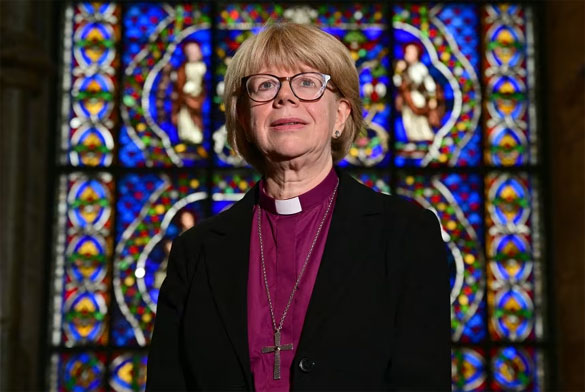
Britain's new Archbishop of Canterbury-designate, Sarah Mullally, at The Corona Chapel at Canterbury Cathedral, England, on Friday, October 3. (Ben Stansal/AFP/Getty Images)
-------------
Sarah Mullally was on Friday appointed as the new Archbishop of Canterbury, becoming the spiritual leader of 85 million Anglicans worldwide and the first woman to hold the role in its 1,400-year history.
Mullally, 63, was made Bishop of London in 2018 – the Church of England’s third most senior bishop after the archbishops of Canterbury and York. Before her ordination, Mullally worked as a nurse at hospitals in London, going on to serve as Chief Nursing Officer for England.
“As I respond to the call of Christ to this new ministry, I do so in the same spirit of service to God and to others that has motivated me since I first came to faith as a teenager,” Mullally said.
“At every stage of that journey, through my nursing career and Christian ministry, I have learned to listen deeply – to people and to God’s gentle prompting – to seek to bring people together to find hope and healing.”
Mullally will preside over an institution struggling to stay relevant in a more secular nation, attempting to bridge divides between its more conservative and liberal wings, and fighting to reclaim trust after a child abuse cover-up scandal.
Justin Welby, the former archbishop, resigned last year over his failure to report John Smyth, who was accused of physically and sexually abusing dozens of boys, including those he met at Christian camps, in the 1970s and 1980s.
A damning independent report found that by 2013 the Church of England “knew, at the highest level,” about Smyth’s abuse, including Welby, who became archbishop that year.
Welby’s resignation, according to church historian Diarmaid MacCulloch, was “historic and without exact precedent in the 1,427-year history of Archbishops of Canterbury” given no previous archbishop had stepped down to accusations of negligence over sexual abuse.
“Our history of safeguarding failures has left the legacy of deep harm and mistrust,” Mullally said Friday, after her appointment. “As archbishop, my commitment will be to ensure that we continue to listen to survivors, care for the vulnerable and foster a culture of safety and wellbeing for all.”
Mullally’s elevation to archbishop was only possible due to reforms under Welby, who allowed women to be consecrated as bishops a decade ago. But while the vastly experienced Mullally is viewed by church insiders as a safe pair of hands in testing times, the appointment of a woman has rankled the institution’s more conservative faction.
“Today’s appointment makes it clearer than ever before that Canterbury has relinquished its authority to lead,” said GAFCON, a grouping of Anglican churches across Africa and Asia, regions where congregations have grown in recent years.
Due to the spread of Christianity during the British Empire’s, the vast bulk of Anglicans – around three out of four – live not in Britain but in its onetime colonies. Analysts say this has pulled the faith’s center of gravity toward the more conservative global south, deepening divides with the West’s more liberal outlook.
For years, Mullally led the church’s process of exploring questions of marriage and sexuality, and was supportive of the move to allow ministers to offer blessings to gay couples in churches. She is renowned as a strong administrator who has worked to modernize the running of her London diocese while playing a leading role in the church’s response to the Covid-19 pandemic.
The Archbishop of Canterbury is the most public face of an institution that has struggled to stay relevant in a more secular nation. The archbishop is often called on to speak at significant national moments, presiding over major royal events, including the recent coronation of King Charles.
Candidates for the Archbishop of Canterbury are chosen by the Crown Nominations Commission, a body chaired by Jonathan Evans, the former head of MI5, Britain’s domestic security service. The commission, comprising 17 voting members, decide on a preferred candidate, to whom Prime Minister Keir Starmer then gives his assent.
It is, however, King Charles, the Supreme Governor of the Church of England, who formally appoints the archbishop. The British monarch’s role dates to when King Henry VIII broke away from the authority of the pope and declared himself head of the new church.
In July, Evans had said he wanted to avoid a list of candidates “all of whom are white, Oxbridge, male and come from the southeast of England.” He said there was “a desire for somebody who can give genuine spiritual leadership and direction to the church,” and who can “speak authoritatively and graciously with a Christian voice into the affairs of the nation.”
Announcing Mullally’s appointment, Evans thanked the members of the public who shared their views on the direction of the church in a public consultation earlier this year. “I shall be praying for Bishop Sarah as she prepares to take up this new ministry in the coming months,” he said.
Mullally will be installed officially in a service at Canterbury Cathedral in March 2026, becoming the 106th archbishop since Saint Augustine arrived in Kent from Rome in 597. She will lead efforts to address declining numbers of church goers, including reaching younger people, and address financial challenges.
Source: .aol.com
https://www.aol.com/articles/two-women-seen-frontrunners-ahead-144803226.html
-----
AI Islamophobia Explodes, Muslim Women’s Sexualised Images Dominate Hate Content
OJAS JAISWAL
03 October, 2025
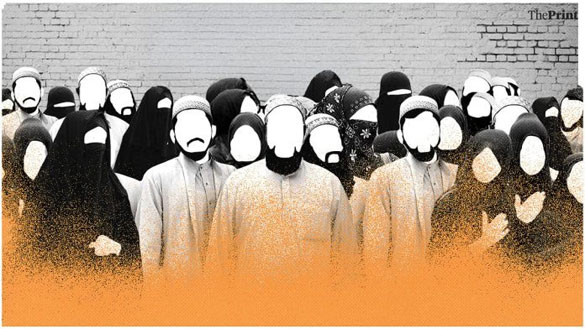
Illustration: The Print team
-----------
New Delhi: Artificial Intelligence (AI)-generated hateful content has “sharply risen” since mid-2024, a recent report by the Centre for the Study of Organised Hate (CSOH), a Washington, DC-based non-profit think tank, has revealed. The report said that such content was “minimal” through 2023 and the first half of 2024.
However, there was a sudden surge after June 2024, with AI-generated hateful content peaking notably in September 2024 and again in March 2025. The rise in September occurred in parallel with the emergence of the “Rail Jihad” conspiracy theory, and the March spike coincided with the popularity of Ghibli Art.
For the report, the CSOH compiled 1,326 publicly available Artificial Intelligence-generated images and videos, retrieved from 297 accounts across three social media platforms. The posts were uploaded earlier, sometime between May 2023 and May 2025.
Nearly 187 posts across X, Facebook, and Instagram, considered to violate community guidelines, had been reported. But none of the posts were removed, highlighting the persistent failure of the platforms to enforce their policies.
The report highlighted that AI-generated hateful content primarily revolved around four key themes: the sexualisation of Muslim women, exclusionary and dehumanising rhetoric, conspiratorial narratives, and the aestheticisation of violence.
Among these, posts featuring the sexualised depiction of Muslim women had the highest engagements—6.7 million. These images frequently portrayed Muslim women in burqas surrounded by groups of men, with captions insinuating incestuous family ties.
AI-generated imagery was also heavily used to reinforce conspiracy theories such as “Love Jihad,” “Population Jihad,” and “Rail Jihad”. All such posts were listed under the conspiratorial narrative theme and suggested the Muslim community’s involvement in undermining the national integrity or security of India.
Posts under exclusionary and dehumanising rhetoric encouraged violence against Muslims and accounted for 23.4 percent of the AI-generated hateful imagery. Many of these used animal imagery to depict Muslims and portrayed them as intent on damaging property and threatening national interests.
Posts in the category of aestheticised violence used AI to normalise and legitimise anti-Muslim violence, the report found.
The findings point to a rising wave of anti-Muslim sentiment, hence the CSOH report being titled “AI-generated Imagery and the New Frontier of Islamophobia in India”.
These posts received a total engagement of 2,73,00,000 across X, Instagram, and Facebook, as measured by the sum of likes, comments, reposts, and shares.
The 1,326 posts analysed in the report showed uneven distribution across the three platforms. The highest number came from X (509), followed by Instagram (462) and Facebook (355).
X had the highest engagement, with 24.1 million views, 5,64,400 likes, 29,200 comments, and 1,79,800 shares. In comparison, the engagements on Instagram numbered around 15,30,000 likes, 24,800 comments, and 3,13,100 shares. Meanwhile, Facebook recorded 1,19,000 likes, 16,000 comments, and 8,200 shares.
The CSOH report also said, “Hindu nationalist media outlets, notably OpIndia, Sudarshan News, and Panchjanya, played a central role in producing and amplifying synthetic hate, embedding Al-generated Islamophobia into mainstream discourse”.
Source: theprint.in
https://theprint.in/india/big-tech-looks-away-as-ai-islamophobia-explodes-muslim-womens-sexualised-images-dominate-hate-content/2756132/
-------
As the Taliban erases Afghan women, the world looks away
2 October 2025
By Faye Curran
Thirty paragraphs into the BBC’s article on Afghanistan’s nationwide internet shutdown, imposed by the Taliban government, comes the line: “Women and girls have also been particularly hard-hit.” Afghan women, already barred from education after the age of 12, had turned to the internet as their last remaining gateway to learning. The preceding 29 paragraphs focus on the shutdown’s impact on online banking and payments, air traffic control and telephone services.
Concerted, thorough efforts are typically made by the broadcaster to cover the plight of Afghan women, but this article was a mirror of Western journalistic indifference that has been typical for women and girls in Afghanistan since the Taliban reasserted control in August 2021, following the withdrawal of US and Nato forces. When the Taliban annulled the country’s constitution and dismantled laws, global attention focused on trade, geopolitics and transnational jihad.
In the four years since, the Taliban has effectively erased women from Afghan public life. And the draconian repressions have intensified sharply over the past year. By June, the government had enacted a “vice and virtue law” that silences women in public and bans those without a mahram (male chaperone) from using transportation. The law is enforced by “morality inspectors,” who detain individuals suspected of violating the code and bring them before Taliban courts for prosecution – where a large number of female detainees report torture, sexual assault and abuse. Women and girls remain banned from attending medical appointments, participating in sports, visiting parks or public baths, travelling more than 72 km or appearing in public without mahram. According to Afghan Witness, some 94 per cent of all women’s protests now take place indoors.
The New Statesman reported in July that the Taliban had to some extent “abandoned jihad”. For other Islamic State groups and affiliated media, this shift was baffling: a movement once defined by attacks on foreign powers now allegedly appears to accept borders and engage in diplomacy. But it seems the Taliban had turned their aggression inwards. The new priority was implementing Sharia law and imposing authority on Afghan citizens – particularly women.
This shift has played out in deadly and unpredictable ways. Last month, the Telegraph reported that, following a 6.6-magnitude earthquake, Afghan women were left to die in the rubble of their homes. Taliban rules forbade male rescuers from touching women to whom they were not related, leaving injured and dying women hiding behind broken walls to avoid being seen. “We can’t speak with the women or try to contact them because it’s prohibited. Touching even a dead woman will have consequences,” said one rescue worker.
The question of how to meaningfully assist these women remains both unanswered and, arguably, unanswerable. Western intervention in Afghanistan is not likely in the near future. International aid struggles to penetrate Taliban barriers. On feminist forums, users grapple with the dramatic rise in violence and oppression. Some have called for the recognition of “gender apartheid” as a formal crime against humanity. But we have seen in Gaza that affixing such a label to a country with a determined and oppressive regime does little to restrain tyrannical rulers. Cutting off aid to exert pressure has similarly limited effect. Activists now encourage donations to organisations such as the Afghan Girls Financial Assistance Fund and Rescue Afghan Women Now, whose activities include helping women escape the country. One Reddit user suggested praying to the Archangel of Transition and Death, hoping it would systematically visit every member of Afghanistan’s morality police. “So many of the morality police will suddenly be expiring from heart attacks, strokes, aneurysms, accidents, etc, almost as if they are being targeted by spiritual warfare,” they hoped.
The plight of Afghan women under the Taliban underscores the human cost of a regime fixated on control rather than governance. Their circumstances remain a stark reminder that the struggle for basic rights is not only ongoing but intensifying under the Taliban’s inward-looking authority. This blackout is another, likely deadly, blow: it is not merely censorship – it is the deliberate severing of Afghan women’s last lifeline to freedom. And yet, from the BBC’s 29 paragraphs on disrupted air traffic to the broader silence across global outlets, the media still consign their suffering to the margins – treating it as a footnote when it should be the headline.
Source: newstatesman.com
https://www.newstatesman.com/world/2025/10/as-the-taliban-erases-afghan-women-the-world-looks-away-
-------
UAE: Man ordered to pay Dh30,000 after filming woman without her consent
3 Oct 2025
Afkar Ali Ahmed
A man has been ordered to pay a total of Dh30,000 in fines and compensation after an Abu Dhabi court had convicted him of filming a woman without her consent, finding him guilty of violating her privacy.
The Abu Dhabi Criminal Court earlier fined the man Dh10,000 for taking photos of the woman without permission. Following the ruling, the woman filed a civil lawsuit seeking damages for the emotional and reputational harm she suffered.
Court records showed that the Abu Dhabi Family, Civil and Administrative Court has also ordered the man to pay the woman Dh20,000 in compensation, in addition to legal costs.
The ruling means the man will pay a total of Dh30,000, including the earlier criminal fine and civil damages.
The court noted that the criminal conviction was final and binding, and established the man’s liability for the offence. Judges cited provisions of the UAE Civil Transactions Law, which require compensation for any act that causes harm to another person, including moral and emotional distress.
The woman told the court the incident had damaged her reputation in the community, caused her psychological pain, and maligned her dignity.
Source: khaleejtimes.com
https://www.khaleejtimes.com/uae/crime/man-pay-dh30000-filming-woman-without-consent
-------
Criticism of Swedish MEP’s Proposal to Ban Hijab in the European Parliament
2 October 2025
AhlulBayt News Agency (ABNA): A right-wing Swedish member of the European Parliament has launched a campaign to ban the wearing of hijab and other Islamic attire within the institution, a move that has sparked widespread reactions.
Charlie Weimers, head of the Sweden Democrats delegation in the European Conservatives and Reformists group, sent an email to lawmakers urging them to sign a petition banning the hijab, niqab, and other Islamic headscarves for employees and contractors of EU institutions. He pledged to submit the request to European Parliament President Roberta Metsola by Friday, October 3.
In his letter, Weimers claimed that banning the hijab would contribute to neutrality and equality in public services and serve as a sign of support for “women oppressed under Islam.” He further cited security concerns and difficulties in identification as reasons behind the proposal.
However, the initiative faced strong opposition from some lawmakers. Martin Schirdewan, co-chair of The Left group, condemned the move as an “Islamophobic distraction,” stating that right-wing politicians are targeting Muslim women instead of addressing Europe’s real challenges. Hana Jalloul Moro, a member of the Socialists and Democrats, also denounced the letter as “a hate-filled, sexist, and Islamophobic attack,” calling it contrary to fundamental freedoms.
The debate has intensified amid the backdrop of several European countries previously banning the niqab in public spaces, while the hijab ban remains a contentious issue across Europe.
Source: abna24.com
https://en.abna24.com/news/1734209/Criticism-of-Swedish-MEP-s-Proposal-to-Ban-Hijab-in-the-European
-------
Family Searches for Missing Teen Iran Says Never Existed
OCTOBER 3, 2025
MARYAM DEHKORDI
In the winter of 2023, a teenage girl named Nazireh disappeared from a marginalized neighborhood on the outskirts of Tehran.
Two years later, her family is still searching for answers. But their quest faces an obstacle: in the eyes of Iranian authorities, Nazireh never existed at all.
She had no birth certificate, no identity card, no legal proof that she was ever born. Like thousands of other Baluch women living on the margins of Iranian society, Nazireh belonged to an invisible population - people who fall through every crack in the system, unrecorded in life and easily forgotten in death.
Her story reflects a devastating intersection of poverty, gender discrimination, and ethnic marginalization that leaves some of Iran's most vulnerable women defenseless against violence and exploitation.
Nazireh, 15, was born into a Baluch family in which no one possessed identity documents - not her parents, not her siblings, not even her extended relatives.
For families like hers in impoverished areas, such as Baqershahr - a settlement on the outskirts of Tehran - the absence of official recognition forces them to live on society's margins.
Civil society workers and charitable organizations are well acquainted with Baqershahr. The area is home to a mixed population of Iranians and immigrants, many living in severe poverty.
Social problems multiply in neighborhoods where residents lack access to basic services, legal protections, and economic opportunities.
Nazireh grew up in this environment with her two sisters, two brothers, and parents. Like many teenage girls, she had big dreams. But without documentation, those aspirations were permanently out of reach.
She could not attend school, obtain legal employment, access healthcare, or claim any rights afforded to documented citizens.
Nazireh also became a victim of child marriage. She had fallen in love with a young man and hoped to marry him. Instead, her family forced her to wed a distant relative named Shabir.
According to information obtained by IranWire, Shabir struggled with drug addiction and routinely subjected Nazireh to violence.
The teenager found herself trapped in an abusive marriage with no legal recourse and no support system beyond her family.
Three weeks before her disappearance, Nazireh fled to her parents' home after a severe beating.
She told them she was suffering constant violence and did not want to return. Her family's response proved devastating: they sent her back within days.
"He is your husband," they told her, according to accounts shared with IranWire. "Did he beat you? It's natural. He got angry; it's okay. Go back to your home and live."
But Nazireh wanted something different for herself - a life free from violence, a chance to pursue her dreams. Two days before she disappeared, she made one final phone call to her family.
It would be the last time they heard her voice.
On the night Nazireh vanished, Shabir was involved in a violent altercation with another local resident, also a Baluch man without identity documents and a distant relative of both families.
The fight escalated dramatically. The other man beat Shabir nearly to death and stabbed him with a knife.
Shabir fell into a coma. Nazireh's family learned of the incident only indirectly, when her uncle heard about it from the assailant's father.
When Nazireh's mother contacted Shabir's brother to ask about her daughter's whereabouts, the family claimed complete ignorance.
From that day forward, no one has seen or heard from Nazireh.
According to activists familiar with the case, at least two other women and girls have disappeared after entering Shabir's household - one of his wives, the other a teenage Baluch girl. Neither has ever been found, alive or dead.
A Baluch activist in Iran told IranWire that Shabir's confession - made while severely injured and shortly before falling into a coma - provides the only clue to what may have happened.
He said he overheard Shabir instructing a relative to take Nazireh to another house and hide her.
But Shabir's family has given contradictory accounts each time Nazireh's relatives have asked questions.
At various times, they have claimed she fled with Shabir's assailant or that she is being hidden for her own protection.
"Anything can happen during family disputes," the activist explained. "In this case, considering Shabir's history of hiding at least one woman and another teenage girl, we may be seeing the same scenario again. But the problem is that aside from Shabir's confession, there is no evidence."
For documented Iranian women, a disappearance would trigger an official investigation, media coverage, and legal proceedings.
For Nazireh, none of these protections exist. Her family waited two weeks before even beginning to search, believing Shabir's relatives were simply hiding her.
There is no missing persons report because she never officially existed. No marriage certificate exists because her wedding was never legally registered. If she has been killed, there will be no death certificate, no investigation, and no justice.
The activist who spoke with IranWire said the outcomes of such cases are typically tragic, citing the story of Nazila Khosha, a 19-year-old woman forced to marry a violent man when she was 14.
Her family lost contact with her after she moved to Zahedan. Eight months later, authorities discovered her body in a burial site.
Source: iranwire.com
https://iranwire.com/en/features/145278-family-searches-for-missing-teen-iran-says-never-existed/
------
Women with disabilities graduate from digital marketing training
Oct 2, 2025
Eastern Bank PLC (EBL) and Bangladesh Business & Disability Network (BBDN) have celebrated the graduation of fifteen women with disabilities from a specialised digital marketing training programme.
The certificate-giving ceremony was recently held at the Skill Jobs office, with representatives from EBL, BBDN, Skill Jobs, and B-SCAN.
The training was aimed at equipping participants with market-relevant skills and preparing them for opportunities in the digital economy.
Ahead of the sessions, BBDN arranged a sensitisation workshop for instructors to ensure an inclusive environment. Candidates were identified and enrolled in collaboration with B-SCAN.
The programme also provided sign language interpretation and transportation allowances to enable equal participation.
Speakers at the event underscored the importance of partnerships that open opportunities for women with disabilities.
"If we want to prosper as a society, we must prosper together. Excluding persons with disabilities is not an option. This initiative is a small but meaningful step, and we are committed to doing much more," said Ziaul Karim, head of communications and external affairs at EBL.
"The graduates of this training are ready to contribute their skills and energy to the digital economy. Women with disabilities face multiple layers of marginalisation, yet they hold immense untapped talent. We thank EBL for supporting this initiative, and we call on others in the private sector to create more pathways for women with disabilities to thrive and lead," said Aziza Ahmed, director of operations at BBDN.
Sharing her excitement, Sangita Ghosh, a participant with a hearing and speech disability, said she plans to use the skills to expand her online dance tutorial channel through social media.
BBDN is a platform of employers, associations, disability organisations, NGOs, Organisations of Persons with Disabilities (OPDs), civil society, and development partners working to advance inclusive practices and economic empowerment for individuals with disabilities.
Source: thedailystar.net
https://www.thedailystar.net/business/organisation-news/press-releases/news/women-disabilities-graduate-digital-marketing-training-4000181
--------
URL: https://newageislam.com/islam-women-feminism/sarah-mullally-woman-church-england/d/137093