
Saima Razzaq: First Muslim Woman To Lead Pride in Britain Says Life’s Mission Is To Promote Inclusivity
New Age
Islam News Bureau
26 June 20123
Saima
Razzaq: First Muslim Woman To Lead Pride
in Britain Says Life’s Mission Is To Promote Inclusivity
Kuala
Lumpur Non-Muslim Kelantanese Woman Fined For Wearing Shorts In Public
Women’s
Volleyball Coach Rashidi Expects Bright Future for Iran
Afghan Supreme
Leader Says Women 'Saved From Oppression' By Taliban
‘These Works
Are An Act Of Resistance’: Inside Three Generations Of Iranian Female
Photography
Iran Women
Athletes Make History In Sporting Events
Pakistan:
Over 900 Cases Of Violence Against Women, Children Reported In 4 Months
Compiled by New Age Islam News Bureau
URL: https://newageislam.com/islam-women-feminism/saima-razzaq-muslim-britain-inclusivity/d/130078
-------
Saima
Razzaq: First Muslim Woman To Lead Pride
in Britain Says Life’s Mission Is To Promote Inclusivity
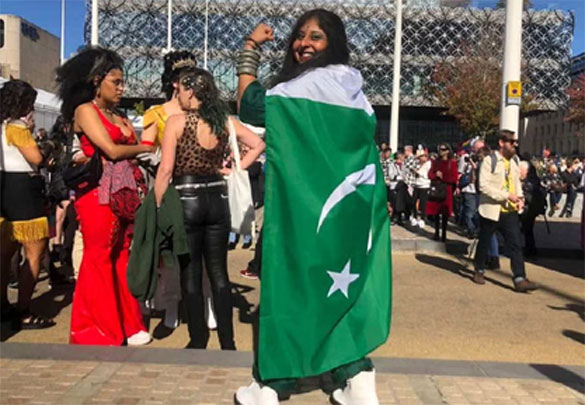
Saima Razzaq, pictured at Birmingham Pride in 2022, said her
life-mission is to ‘promote the inclusivity of sexuality and gender’ (Saima
Razzaq)
------
26-06-23
An
activist, who was the first Muslim woman to lead a Pride parade in Britain,
says her mission in life is “to promote the inclusivity of sexuality and
gender”.
The PA
news agency is interviewing a series of people celebrating Pride Month in June,
including Saima Razzaq, 38, from Birmingham.
Ms
Razzaq is the director of change and communications at Birmingham Pride, and
she uses her platform as part of the LGBT+, South Asian, and Muslim communities
to carve out a space within the intersection.
Ms
Razzaq, who is a lesbian but also uses the queer umbrella to describe her
sexuality, became the first Muslim woman to lead a Pride parade in Britain at
Birmingham Pride in 2021.
“Leading
Pride was a monumental moment and obviously now I work at Pride as a result of
that,” Ms Razzaq told PA.
After
taking part in the Birmingham Pride Parade on May 27 this year, Ms Razzaq said she
will be talking to and working with the community in the city for the remainder
of Pride Month.
“Now,
the thing is about getting into conversations within my own community,” she
said.
“It’s
about organising and working with the everyday communities of Birmingham, and
taking them on this journey and working towards, ‘what can we do next?'”
– When
did you ‘come out’ and how did your family respond?
Ms
Razzaq said her mother approached her about her sexuality when she was 29 while
they were driving to pick up a takeaway.
“She
made me drive and she waited until we were on a dual carriageway and said, ‘do
you like women?’
“I was
like, ‘oh my god, why now?’,” Ms Razzaq recalled.
“Since
that moment, I’ve seen a massive change in my mum. Now, she’s changing her language.”
Ms
Razzaq added she looks up to members of her family, and she regards them as her
“superheroes”.
“People
look up to influences and all these famous people, I don’t, I look up to my
aunties and uncle – they’re my superheroes,” she said.
“Even though
my aunties and my uncle might not understand my queerness, they’re there.”
She
added: “Faith is really important for me, and just because I’m queer, doesn’t
mean I’m not Muslim, and they’ve not othered me for that either.
“Again,
I think it’s really important for me to have this supportive family to allow me
the space to do this.”
– What
is your relationship with your faith?
Ms
Razzaq said her faith helps her to “do better” and to “fulfil her mission in
life”.
“I am a
Muslim, I have a relationship with God, I feel very connected with God, like
right now, I feel the most connected I’ve ever been.”
She
added: “The Koran tells me to focus on where I am and the people I’m surrounded
with and to do better and to fulfil my mission in life.
“I feel
my mission in life is to promote the inclusivity of sexuality and gender.
“There
is a really positive thing happening in Birmingham, and in time, Insha’Allah,
the wider world will see it.”
– Have
you experienced any hate or abuse since coming out?
Ms
Razzaq said that while everyone is “happy” for her in regards to her sexuality,
she receives “far more Islamophobia and racism” for being a woman of colour in
a leadership position.
“Everyone
is really happy for me to be queer, but when I suddenly say, ‘yes I’m also
Pakistani’, ‘I’m also Muslim’, and ‘I’m proud of those intersections’, it’s a
narrative that people aren’t that familiar with,” she said.
“People
aren’t used to that side of the story. I get far more Islamophobia and racism
for being a woman of colour in leadership.”
Ms
Razzaq said she has been the victim of several hate crimes, including someone
urinating on her bed on the narrow boat where she lives.
“I’ve
had my car stolen, for example, in a really horrific way, I’ve had people
urinate in my bed on my boat, I’ve had horrible calls.”
She
added that she “doesn’t need anybody to judge my Muslimness”, and she finds
that it’s those who are not of the faith that tend to judge her more.
“And
actually, it’s non-Muslims who will judge my Muslimness more than Muslims,” she
said.
“Our
communities will work through things, but we need everyone else to allow us the
space to work through things as well.”
– What
are the challenges within the intersections of faith and queerness?
Ms
Razzaq said “it isn’t easy” for those in faith communities to bring up the
subject of queerness, but she said she has noticed more people in South Asian
communities coming out.
“Everyone
will have difficulty bringing in the subject of queerness because it has been
so polarised.
“It
isn’t easy for most people in faith settings, and I think it’s really important
that we reclaim this narrative.
“What
I’ve noticed since I’ve come out is, and that’s just within the circle I’m part
of, I’ve seen other South Asians come out, and their parents support them in
that journey.”
On what
advice she would give to someone in a faith setting who wished to come out, she
said: “The most important thing to remember is that you’re valid, you’re
absolutely valid.
“Your
queerness or your gender identity is absolutely valid, be your authentic self.
“There
are people like you, and for me, finding other queer South Asians, other queer
Muslims, has been the best part of my journey.”
Source: independent.co.uk
https://www.independent.co.uk/news/uk/home-news/saima-razzaq-muslim-woman-pride-birmingham-b2364017.html
--------
Kuala
Lumpur Non-Muslim Kelantanese Woman Fined For Wearing Shorts In Public
By
Shathana Kasinathan
Monday,
26 Jun 2023
KUALA
LUMPUR, June 26 — A non-Muslim Kelantanese woman received a fine from the Kota
Baru Municipal Council (MPKB) for wearing indecent clothing.
New
Straits Times today reported that the council’s enforcement officers issued a
fine to the 35-year-old woman who operates a clothing business during their
inspection to the outlet which is located at Jalan Merbau about 11am.
“The
non-Muslim owner was found to have been wearing shorts in public places and for
that, she was slapped with the compound,” MPKB’s president Rosnazli Amin was
quoted as saying by the news portal.
Rosnazli
said that the woman had violated the provisions outlined in section 34(2)(b) of
the Business and Industrial Trade By-Laws 2019.
“This
by-law existed a long time ago and many locals, including non-Muslims,
understand it,” he was quoted as saying.
It has
been revealed that the woman has been granted a period of seven days, starting
from the date of the notice, to settle the imposed fine or failure to do so may
result in legal action.
According
to the report, a relative of the woman shared the compound notice on social media,
which caused a wave of discontent as the Kelantan state, led by PAS, has
consistently assured that its Shariah-inspired by-laws would not have any
impact on non-Muslims.
Source: malaymail.com
https://www.malaymail.com/news/malaysia/2023/06/26/non-muslim-kelantanese-woman-fined-for-wearing-shorts-in-public/76420
--------
Women’s
Volleyball Coach Rashidi Expects Bright Future for Iran
June,
26, 2023
TEHRAN
(Tasnim) – Iran’s women’s volleyball team head coach Fatemeh Rashidi is happy
for finishing in fifth place in the 2023 AVC Challenge in Indonesia and expects
a bright future for Team MelliBanovan.
Iran
beat Australia 3-1 (25-20, 19-25, 25-18, 25-20) on Sunday in Gresik, Indonesia.
Mona
Ashofteh scored 21 points, including 10 that she made in the 4th set alone.
Soodabeh Bagherpour and captain Mahsa Kadkhoda contributed with double-digits,
posting 14 points and 11 points respectively.
“I am so
happy that we finished this competition with a big win. We want to try more and
work even harder this year as we have set some goals to reach,” Rashidi said.
“I think
we can play better. In the next competition, we can really do more because of
the experience we learned here in Indonesia,” she added.
Iran now
looks ahead to a bright future for the next generation of players, with several
key events lined up, including the 22nd Asian Senior Women’s Volleyball
Championship in Thailand and 19th Asian Games Hangzhou 2022.
“I think
this is a really good preparation for our young players. We have one setter who
started to play again. This is a really good competition for my players and for
Iran volleyball,” the Iran coach concluded.
Source: tasnimnews.com
https://www.tasnimnews.com/en/news/2023/06/26/2916404/women-s-volleyball-coach-rashidi-expects-bright-future-for-iran
----------
Afghan Supreme
Leader Says Women 'Saved From Oppression' By Taliban
25 June,
2023
Afghanistan's
supreme leader said Sunday the country's women were being saved from
"traditional oppressions" by the adoption of Islamic governance and
their status as "free and dignified human beings" restored.
In a
statement marking this week's Eid al-Adha holiday, Hibatullah Akhundzada - who
rarely appears in public and rules by decree from the Taliban's birthplace in
Kandahar - said steps had been taken to provide women with a "comfortable
and prosperous life according to Islamic Sharia".
The
United Nations expressed "deep concern" last week that women were
being deprived of their rights under Afghanistan's Taliban government and
warned of systematic gender apartheid.
Since
returning to power in August 2021, Taliban authorities have stopped girls and
women from attending high school or university, banned them from parks, gyms
and public baths, and ordered them to cover up when leaving home.
They
have also barred them from working for the UN or NGOs, while most female
government employees have been dismissed from their jobs or are being paid to
stay at home.
However,
Akhundzada said "necessary steps have been taken for the betterment of
women as half of the society".
"All
institutions have been obliged to help women in securing marriage, inheritance
and other rights," his statement read.
Akhundzada
said a six-point decree issued in December 2021 guaranteed women their rights.
Among
other things, the decree outlawed forced marriages and enshrined the right to
inheritance and divorce.
"The
negative aspects of the past 20-year occupation related to women's hijab and
misguidance will end soon," Akhundzada said.
A report
to the UN's Human Rights Council last week by Richard Bennett, the special
rapporteur for Afghanistan, said the plight of women and girls in the country
"was among the worst in the world".
"Grave,
systematic and institutionalized discrimination against women and girls is at
the heart of Taliban ideology and rule, which also gives rise to concerns that
they may be responsible for gender apartheid," Bennett said.
UN
Deputy High Commissioner for Human Rights Nada Al-Nashif added: "Over the
past 22 months, every aspect of women's and girls' lives has been
restricted."
"They
are discriminated against in every way."
Despite
his rare public appearances, Akhundzada has regularly issued lengthy
"state-of-the-nation"-style statements ahead of important Muslim
festivals and holidays.
"At
the national level, the independence of Afghanistan has been restored once
again," he said.
He praised
Afghanistan's economic resilience, efforts to eradicate poppy cultivation, and
the improvement in national security.
"It
is our shared responsibility to protect and serve our Islamic system," he
said.
"The
current system is the result of the sacrifices of thousands of mujahideen.
Let's stand by each other, eliminate conspiracies, value security and
prosperity and work together for its further enhancement.
Source: newarab.com
https://www.newarab.com/news/afghan-leader-says-women-saved-oppression-taliban
--------
‘These
works are an act of resistance’: Inside three generations of Iranian female
photography
Kamin
Mohammadi
Mon 26
Jun 2023
She
wears a black coat, a black headscarf and black boots in compliance with Iran’s
Islamic dress code. But her gaze is direct and on her hands are red boxing
gloves. This is the modern Iranian woman on the cover of a new photography
book, Breathing Space: a woman ostensibly complying with the rules, yet
standing defiant and ready to fight.
Edited
by the curator Anahita Ghabaian, who founded the Silk Road Gallery, Tehran’s
first space dedicated to contemporary photography, Breathing Space showcases
the work of 23 female Iranian photographers across three generations. The
images span documentary and reportage to portraits and staged scenes, and offer
a female lens through which to see the country at a time when Iranian women’s
fight for their rights has come to the attention of the world.
Recent
protests have highlighted the depth of repression and discrimination. When
22-year-old Mahsa Amini died last September after being taken in for “bad
hijab” by the nation’s “morality police”, the demonstrations that followed were
led by women, and their repression has shown the world the brutality with which
the Islamic Republic of Iran controls its people. And yet how is it that in
Iran these women can produce work, exhibit and even find fame at home and
abroad?
On a
call from Tehran, Ghabaian explains that “in Iran, no one accepts all the
restrictions. It is a very particular and peculiar situation here. Of course,
there are many difficulties and challenges. But artists circumvent the
restrictions in order to express themselves, to say what they have to say, to
push the limits of what is possible. Sure, it is not like being in the UK where
you are free to say what you like, but it’s also not true that because there
are restrictions, everyone just shuts up and sits at home and does nothing.”
Iran’s
long history has seen many dictatorships and invaders, and much repression, so
its art is traditionally indirect, using metaphor and symbols to say things
that are otherwise outlawed or unacceptable. The work of these photographers
shows the latest development of this sensibility.
Common
themes include the Iran-Iraq war, the sense of nostalgia and loss within modern
life, and a land and climate in crisis. “The Iran-Iraq war,” says Ghabaian, has
left “a deep scar on the Iranian psyche”. She points to the work of the
photographer ShadiGhadirian, who was a child during the conflict and whose
series Nil Nil juxtaposes articles of war with everyday objects; Maryam
Takhtkeshian’s series No Soldier Has Returned from War reflects on the personal
loss her family suffered by using expired black-and-white film to create
overexposed, blurred images that make the soldiers pictured unidentifiable,
eerie and ghostly. Meanwhile, SolmazDaryani’s The Eyes of Earth series is an
ongoing project that charts the impact of the rapid drying up of Lake Urmia –
once the Middle East’s largest saltwater lake – with apocalyptic shots of bird
skeletons and discarded tyres lying in dry salt.
Although
photography, especially by women, is a young art form in Iran, its evolution is
apparent. As Ghabaian points out: “This is an artistic book but it’s also a
historical book. We have three generations of women photographers, and what’s
interesting is that the first generation, who were shooting from the late 1970s
onwards”, focused on the “public: what happened in the street, what happened in
the university, what happened in the factory. They don’t focus on themselves.”
From the
90s, the second generation of photographers such as Ghadirian and
NewshaTavakolian “speak more of the condition of women but without really
talking about themselves”, says Ghabaian, “while the third generation, whose
work is from the last few years, are really only speaking of themselves.
“I think
the older generations wouldn’t have given themselves permission to talk of
themselves,” says Ghabaian. “They were documenting what was happening, looking
outside of themselves. Then the following generation started to set things up,
to stage what they wanted to say, to look inside. We have come out of pure
reportage and documentary and gone towards a sort of staged self-expression.
Now our young people are like young people everywhere: they see things on the
internet, on social. This generation is really open and self-aware, and they
have shifted their gaze inwards.”
In spite
of the breadth of the work, and the different ages and styles of the
photographers, “there is a bitterness to the book, a sadness, to all the
works,” says Ghabaian. “Because in Iran we have these problems and difficulties
that everyone here knows about, that we don’t want to be silent about any more.
This book also serves to tell the world about these challenges. It is an act of
resistance.”
View
finders: five female photographers from Iran
Rana
Javadi’s When You Were Dying, 2008
“Javadi
is part of the first generation of female photographers; during the 1979
revolution she was photographing what was happening in the universities. When
she was not given permission to photograph the Iran-Iraq war because of her
gender, she turned to studio work. This picture, with traditional textiles,
represents the past and emphasises the power of nostalgia. Yet she has placed a
mirror on the image, too, and reflected in there is a plant, a sign of hope.”
NazliAbbaspour’s
Reincarnation, 2017-2019
“Several
photographers have nostalgia; maybe because the present is so difficult.
Abbaspour uses her own family photos and adds elements such as the butterfly,
representing delicacy and brevity of life.”
MalekehNayiny’s
Updating a Family Album, 2004
“Nayiny
takes old, faded pictures and adds strange elements to them, making them bright
and colourful,” says Anahita Ghabaian. “So while it contains much nostalgia –
which we all suffer from in Iran – it also brings joy and hope, taking away the
bitterness of our yearning for a better past.”
ShadiGhadirian’s
Like Everyday, 2000-2001
“Ghadirian
is a committed feminist,” says Anahita Ghabaian. “This was her protest about
women not just in Iran but also the world. She realised all her wedding gifts
were pans or Hoovers or colanders – all objects for doing domestic work.”
NewshaTavakolian’s
Imaginary CD cover, from the series Listen, 2010 (main image)
“It is
illegal for women singers to release music under their own names. They have
been made voiceless. Newsha imagines artwork for imaginary CDs and puts the
woman in the very centre of the frame.”
Source: theguardian.com
https://www.theguardian.com/artanddesign/2023/jun/26/these-works-are-an-act-of-resistance-inside-three-generations-of-iranian-female-photography
---------
Iran
women athletes make history in sporting events
June 25,
2023
TEHRAN –
After the Islamic Revolution, remarkable growth has been seen in the field of
women's sports and they made history in the sporting events despite the
limitations they faced.
These
years, the importance of women's sports has increased so much that the
International Olympic Committee (IOC) has announced the slogan of gender
equality in the Olympics Games in France.
Paris
2024 will be the first Olympics in history to achieve numerical gender parity
on the field of play, with the same number of female and male athletes
participating in the largest sporting event in the world.
Iran has
participated in 18 Olympics so far. Iran took part in 9 Summer Olympics and
gained 4 gold medals during the Pahlavi era (1925-1979), also attended 9 Summer
Olympics and won 20 gold medals after the victory of the Islamic Revolution in
February 1979 [by the overthrow of the Pahlavi dynasty].
Despite
the reality that the level of competition, the participating countries, and the
progress of sports these years are not comparable to the past, Iranian athletes
have been able to shine better in international contests after the Revolution.
After
the Revolution, women have made significant progress in sports and the number
of women athletes qualified for the Olympics games is increasing.
Kimia
Alizadeh was an Iranian Taekwondo athlete who won a bronze medal in the
taekwondo 57 kg weight class at the 2016 Summer Olympics in Rio de Janeiro by
defeating a Swedish athlete. This made her the first Iranian woman to win a
medal at the Summer Olympics.
Addressing
Iranian Olympic and Paralympic medalists at the 2020 Tokyo Games on September
18, 2021, Ayatollah Khamenei said that Iranian female athletes have proven in
these competitions that the Islamic hijab is not an obstacle preventing one
from shining in sports fields. Similarly, women have previously proven this in
the fields of politics, science, and management.
“The
hijab of women athletes, which our dear lady mentioned, is really a great
value. Raising the flag of the country by a gold-winning lady wearing hijab,
displaying Iranian women’s clothing before the eyes of the whole world, and
seeing the scenes of expressing love and affection for the beloved flag of
Iran, and shedding tears of joy, tears of passion while the flag is being
raised as well as the scenes of praying, of hugging the defeated opponent …”
Zahra
Nemati is an Iranian archer who was selected to compete for Iran at the 2012
Summer Paralympics, held in London, United Kingdom, where she won two medals,
becoming the first Iranian woman to win a gold medal at either the Olympics or
Paralympics Games.
She won
her third individual recurve gold medal at her third consecutive Games, with a
6-5 victory over Italian rival at the Tokyo 2020 Paralympics, in Japan.
Nemati
also won colorful medals in various Paralympics Games, Asian Para Games, and
World Para-archery Championships. She won the 2013 Sport Accord's Spirit of
Sport Individual Award.
“We
should appreciate the value of disabled athletes, too. What they do is
astonishing. When people look at these athletes, they see that not only does
their disability not prevent them from living a normal life, but they are also
so unwavering that they become athletes and stand on the medal platform,” said
Ayatollah Khamenei. (March 11, 2013)
SarehJavanmardi
an Iranian Paralympic shooter is the first ever-female gold medalist from Iran
to win in the shooting category of the Paralympics Games. In the 2012
Paralympic Games held in London, she won a bronze medal in P2 (10m air pistol
SH1).
Later in
2014, the Asian Paralympic Committee chose her as the best Asian female athlete
with impairments. It was due to the two gold medals she won at the 2014 Asian
Para Games held in Incheon, South Korea.
At the
2016 Summer Paralympics on 9 September, she scored 193.4 points to win the gold
medal at the Rio de Janeiro in the P2 10m air pistol competition.
Javanmardi
claimed her third gold medal at the Tokyo 2020 Paralympic Games.
HashemiyehMotaghian
a Paralympic athlete represented Iran at the 2020 Summer Paralympics in Tokyo
and won the gold medal in the Women's javelin throw F56 event.
Iran's
female Para-athletes have also had remarkable participation in the 2014 Asian
Para Games in Incheon, South Korea, and the 2018 Asian Para Games in Jakarta,
Indonesia.
They won
8 gold, 14 silver, and 19 bronze medals at those Asian competitions.
"I
express my deep gratitude to athletes who mention the name of our infallible
Imams (a.s.) in international arenas, prostrate themselves, pray, and say adhan
after conquering the peak of success. I also express my gratitude to woman
athletes who wear hijab,” Ayatollah Khamenei noted. (March 11, 2013)
Despite
many challenges the Iranian women athletes face, their success in world and
international competitions continues, and these are only a small part of the
successes they have achieved in international contests. The Iranian female
athletes have proven that the Islamic hijab has not created any restrictions
for them to shine in various sports disciplines. Success for Iran's female
athletes is not limited to individual sports disciplines; the Iranian women in
recent years have shined in futsal, football, and Asian Cup as well.
The 2021
Islamic Solidarity Games held in Konya, Turkey was one of the competitions
where Iran’s female athletes made history with remarkable achievements, proving
that the hijab is not a restriction on the path to success.
Elham
Hosseini gained the first women’s weightlifting gold medal in Iran's sports
history in snatch and two bronze medals in clean and jerk and total.
AazamBakhti won the first medal in the history of Iranian women's epee fencing
in the tournament.
FarzanehFasihi
gained the silver medal in track and field competitions in 100-meter running,
breaking the national record for the second time in a single day. Fasihi also
claimed a gold medal in the 10th Asian Indoor Athletics Championships in
Astana, Kazakhstan.
Iranian
female taekwondo practitioner Nahid Kiani also claimed a gold medal in the 2021
Islamic Solidarity Games. Kiani has also made history by clinching the coveted
gold medal at the 2023 Taekwondo World Championships. With her groundbreaking
victory, Kiani has not only cemented Iran's position on the global taekwondo
stage but has also etched her name in history as a trailblazer for Iranian
women in sports.
The
Leader in a meeting with officials of the second National Congress of Sports
Martyrs, on September 11, 2022, said, “That courageous, devoted woman who stood
on the medal podium, pulled her hand back, and refused to shake the hand of a
foreign man [while she stood] there wearing an Islamic hijab before the eyes of
millions of people. Many of those people had been trained to take action and
speak against the hijab and chastity of women.”
Source: tehrantimes.com
https://www.tehrantimes.com/news/486167/Iran-women-athletes-make-history-in-sporting-events
----------
Pakistan:
Over 900 cases of violence against women, children reported in 4 months
Jun 26,
2023
More
than 900 cases of violence against women and children were reported to the
Sindh police in the first four months of this year, according to a report by
the Sustainable Social Development Organisa...
From
January 1, 2023 to April 30 2023, 771 cases of violence against women were
reported to the police, while 142 cases of violence against children were
reported. Considering social taboos in Pakista...
In
particular, 529 women were kidnapped during this period, and domestic violence
cases reached 119. Additionally, there were 56 cases of rape and 37 cases of
honour killing.
Karachi
Central, Hyderabad, and Keamari districts emerged as hotspots for violent
crimes against women. Regarding violence against children, sexual violence was
the most prevalent, with 67 reported ca...
The
report emphasises the need for increased attention and action from the
Government, police, and judiciary to ensure the safety of all citizens,
particularly women and children
In
another case from Narowal that sounds alarming, a man was sentenced to death by
an additional district and sessions judge for raping his own daughter in Bani
Silharian village, Pasrur tehsil, Sialk.
The
incident was reported by the victim’s mother on June 21, 2022, leading to the
registration of a police case against the suspect, Nazim Ali. The District
Police Officer, Muhammad Hasan Iqbal, promp.
Nazim
was found guilty and sentenced to death by Pasrur’s Additional District and
Sessions Judge, Umar Farooq Khan. The court also ordered the convict to pay a
fine or face an additional six months of.
Another
horrendous incident was reported from Pakistan, where the body of a 13-year-old
girl, who had gone missing earlier, was discovered hanging from a mango tree in
the village of Qaim Babbar on th...
The girl
was allegedly raped and murdered. Initially, some relatives prevented the
family from reporting the incident to the police, causing a delay in the
investigation.
However,
a preliminary report has been sent to the inspector general of police, and a five-member
investigation committee has been formed. The suspects are currently in police
custody and undergoing q
In terms
of violence against children, it was horrifying to observe that sexual violence
was the most prevalent, with a total of 67 cases. Furthermore, 41 children were
also kidnapped in this short ti.
Source: organiser.org
https://organiser.org/2023/06/26/180721/world/pakistan-over-900-cases-of-violence-against-women-children-reported-in-4-months/
--------
URL: https://newageislam.com/islam-women-feminism/saima-razzaq-muslim-britain-inclusivity/d/130078