
Old protest video misrepresented as Iranians rejoicing at 'elimination of hijab law'
New Age Islam News Bureau
22 January 2025
· Old protest video misrepresented as Iranians rejoicing at 'elimination of hijab law'
· Spanish Left Redefines ‘Freedom’: Hijab Encouraged in Schools
· Iranian women are leading a revolution—again
· 'How many more of us need to be killed?' Iranian woman calls on Trump to aid protesters
· What Iran’s ‘Women, Life, Freedom’ Movement Teaches Us
· 'Khamenei is scared of Trump,' exiled Iranian activist Masih Alinejad says
· 'I wasn't trying to be brave': UAE women on loss and healing at Emirates LitFest
· Meet Husna Bhanu, the first Muslim daughter of Kerala Kalamandalam
· J&K woman to lead all-men CRPF contingent
Compiled by New Age Islam News Bureau
------
Old protest video misrepresented as Iranians rejoicing at 'elimination of hijab law'
January 22, 2026
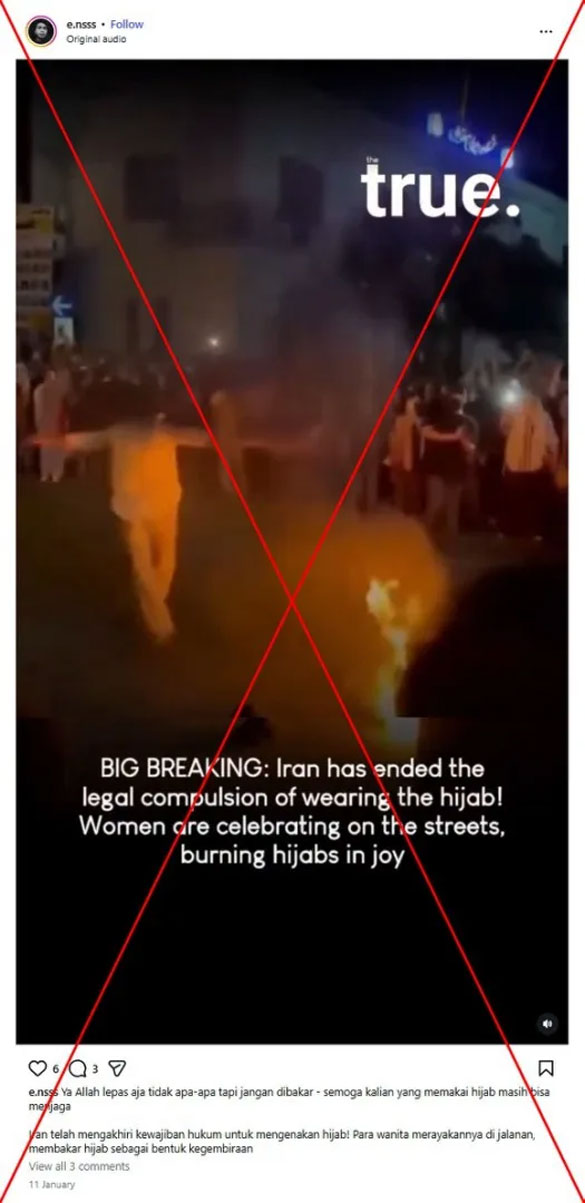
As people poured onto the streets in mass protests in Iran, a video of a woman dancing and throwing her headscarf on a bonfire was shared in posts falsely claiming it showed people celebrating the end of the hijab mandate in the Islamic republic. While analysts and activists say authorities have slackened off on imposing the mandatory hijab in daily life, Iran has not abandoned the requirement. The footage was in fact recorded in 2022 during an earlier protest following the death of a woman who died in police custody after being arrested for not wearing the hijab properly.
"Oh God, it's okay to take it off, but please don't burn it -- hopefully, those of you who wear the hijab can still protect it," reads part of the Indonesian-language caption of a video shared on Instagram on January 11, 2026.
"Iran has ended the legal obligation to wear the hijab! Women are celebrating in the streets, burning hijabs as a form of joy."
The video, which has been watched more than 1,000 times, shows a woman in a white shirt twirling near a bonfire before she tosses a piece of cloth into the fire. Other women then also throw what appears to be hijabs into the bonfire as a crowd of onlookers applaud.
English-language text on the video says: "BIG BREAKING: Iran has ended the legal compulsion of wearing the hijab! Women are celebrating on the streets, burning hijabs in joy."
The same footage was also shared in similar Instagram, Facebook and TikTok posts.
It circulated as nationwide demonstrations in Iran that started in late December to denounce the rising cost of living evolved into a movement against the theocratic regime that has ruled the country since the 1979 revolution, with people pouring into the streets in mass protests for several days from January 8 (archived link).
Iranian authorities said on January 21 that 3,117 people were killed during the protests; activists said the actual toll risked being many times higher due to a crackdown that suppressed the demonstrations
Mahmood Amiry-Moghaddam, director of the Norway-based Iran Human Rights NGO warned that if the same pattern of Iran's underreporting of executions is applied here "the actual number of people killed could be in the range of 25,000".
The video circulating online, however, does not show people celebrating an end to the country's requirement for women to wear the hijab in public.
Prior to the recent mass protests, analysts and activists said authorities had slackened off on imposing the mandatory hijab in daily life, but are far from abandoning an ideological pillar of the Islamic republic, warning a new wave of repression to re-impose it could come at any time (archived link).
There have also been no official reports about the requirement being abandoned.
A reverse image search on Google using keyframes from the falsely shared video found the video was used in a report by Voice of America posted on YouTube on September 23, 2022 (archived link).
"A woman throws her hijab into a fire on a street in Sari, Iran. Protests have swelled over the death of a young woman arrested by morality police tasked with enforcing a strict dress code for women," reads the video's description.
It refers to protests that broke out in the Islamic republic following the death of Mahsa Amini, a 22-year-old Iranian Kurdish woman who died in police custody after being arrested by Iran's morality police for not wearing the hijab properly (archived link).
The video is credited to "Anonymous/AFP".
AFP sourced and authenticated the video, which was posted online on September 20, 2022.
Source: yahoo.com
https://www.yahoo.com/news/articles/old-protest-video-misrepresented-iranians-090405918.html?guccounter=1&guce_referrer=aHR0cHM6Ly93d3cuZ29vZ2xlLmNvbS8&guce_referrer_sig=AQAAANdXtqbS3jQ2-msijV8dpNwOFpnDCexH-9bcIimRznTXrQP4sxuntDhUu6jJ4hcuzNglhJkrhZxnO5P-3oam36L76R1vkRRqs5yU_yVAxjmSEp6SwtX4Et489SaH72B6plLD1g4UtPj7Fm9SpyM_joT2KuXjs4N2uQInSFsGB12H
-------
Spanish Left Redefines ‘Freedom’: Hijab Encouraged in Schools
January 21, 2026
Javier Villamor
ANTONI SHKRABA
---------
Spain’s debate over religion in schools has taken a decisive—and controversial—turn. A new report published by the Institute of Women, an agency under the Ministry of Equality, openly defends the wearing of the Islamic hijab in classrooms and goes a step further by publicly naming schools that have limited or banned it.
The document, “‘Hands Off That!’: Discrimination Against Young Muslim Women Wearing the Hijab in the Education System,” presents these restrictions not as neutral disciplinary decisions, but as cases of institutional discrimination. According to the report, opposition to the hijab is rooted in “Islamophobia,” described as a form of cultural racism that targets Muslims—or those perceived to be Muslim—within Spain’s education system.
The report directly challenges long-standing justifications used by schools, including uniform policies, common dress codes, and the preservation of a neutral learning environment. These arguments, it claims, are selectively applied and disproportionately affect Muslim girls.
In unusually explicit terms for an official government document, the Institute of Women identifies specific centres and incidents: students barred from wearing the hijab during exams, university entrance tests, vocational training placements in hospitals or care homes, and even school sports competitions. In each case, responsibility is placed firmly on school management, accused of misusing concepts such as secularism and ideological neutrality.
The consequences, the report argues, are severe. Restrictions on the hijab allegedly lead to interrupted education, forced school changes, and, in some cases, early dropout—outcomes framed as evidence of systemic bias rather than isolated administrative decisions.
A striking reversal in feminist doctrine
What makes the report particularly striking is its sharp departure from Spain’s recent feminist orthodoxy. Until recently, institutions aligned with the Equality Ministry denounced school uniforms as instruments of control over female bodies—sometimes even as a form of sexualisation. Uniformity itself was portrayed as incompatible with women’s autonomy.
Now, a religious garment with a strong ideological and cultural meaning is officially endorsed as a symbol of freedom. The report insists that Muslim women who wear the hijab do so by choice and condemns what it describes as a Western stereotype portraying them as “submissive and without agency,” dominated by a religion characterised as “monolithic, irrational and misogynistic.”
For critics, the contradiction is hard to ignore: dress codes are oppressive—unless they are religious.
Secularism, selectively applied
The shift also reopens an unresolved question in Spanish politics: what does secularism actually mean? Under left-wing governments, public authorities aggressively limited the presence of Christian symbols in schools, particularly crosses, arguing that visible religion had no place in public education.
The new report suggests a different standard. Far from excluding religious symbols, it calls on authorities to protect them—at least when they belong to certain communities. The document urges education administrations to revise school regulations, explicitly include freedom of religion in codes of conduct, and closely monitor centres that maintain restrictions on religious symbols.
In practice, this would reduce the autonomy of schools and expand state oversight over internal rules, all in the name of equality.
Beyond Spain, the report reflects a broader European trend: traditional principles such as secularism and equality are being reinterpreted through the lens of identity politics. What was once framed as neutrality is increasingly labelled discrimination; what was once criticised as patriarchal is now defended as “empowerment”.
For Spain’s Equality Ministry, the hijab is no longer a problem to be debated but a freedom to be enforced—and schools that disagree may find themselves publicly named and politically exposed.
Source: europeanconservative.com
https://europeanconservative.com/articles/news/spanish-left-redefines-freedom-hijab-encouraged-in-schools/
-----
Iranian women are leading a revolution—again
Ellie Austin
By Ellie Austin
On December 28th of 2025, protests started in Iran’s capital in response to soaring prices and a collapsing economy. They swiftly fanned across the country and morphed into a mass movement against Iran’s theocratic government led by Ayatollah Ali Khamenei. Over three weeks later and thousands are reported dead, the result of a violent crackdown on protestors by the authorities. The majority of those murdered are thought to be younger than 30, a horrifying but perhaps unsurprising statistic in a country whose population skews young due to the baby boom that followed the 1979 revolution.
A government imposed internet blackout in the country means information about the victims is scarce, but some names have emerged: Akram Pirgazi, 40, the first woman reported to have been killed in the protests and a mother of two; Rebin Moradi, 17, a promising footballer and Robina Aminian, a 23-year-old studying fashion design at university in Tehran. Two weeks ago, after finishing class for the day, she joined an anti-regime rally. A human rights group says that she was shot in the head from close range shortly after. “She was thirsty for freedom, thirsty for women’s rights, her rights,” Aminian’s uncle told CNN in the wake of his niece’s murder.
Aminian’s spirit and unspeakable bravery is, remarkably, not unique in a country where female resistance has been a lifeblood of anti-government protest for almost half a century. Women were crucial participants in the 1979 revolution that overthrew the last Shah (king) of Iran and his oppressive rule. They hoped for a freer society. Instead, Khamenei’s new regime began policing their lives and rolling back their rights. Examples include a husband having the legal right to restrict his wife’s travel and employment, unequal divorce rights and punishment for appearing in public without a hijab ranging from fines to prison time to flogging.
The latter ignited a 2022 uprising when Mahsa Amini, 22, was dragged off the street by Iran’s morality police, a unit within the national police tasked with implementing Islamic codes, for not wearing her headscarf correctly. She died in custody, with eyewitnesses alleging that she was beaten unconscious inside a police van. Her death, along with that of a teenager, Armita Geravand, the following year in similar circumstances, stirred a collective rage that fueled the Women, Life, Freedom movement. Although its protests didn’t lead to regime change, they sparked much-needed global awareness of Iran’s human rights abuses. They also created an irreversible current of social resistance, particularly among young Iranians, that helped position women’s rights as a key pillar of the country’s democratic future. Women are at the forefront of the current protests.
A now widely-shared video from earlier this month shows an elderly Iranian woman protesting in the street, blood pouring from her mouth. “I’m not afraid,” she shouts. “I have been dead for 47 years”—the length of the current regime. From the comfort of our couches and desks, it’s hard to fathom the moral conviction of the women, young and old, whose desire for change and freedom overrides their fear of imminent death. But yet again, Iranian women are showing the rest of us what courage truly looks like.
ALSO IN THE HEADLINES
The Supreme Court today is considering Trump's bid to fire Fed governor Lisa Cook. Oral arguments begin as Trump's campaign against Fed chair Jerome Powell continues. Both Cook and Powell are expected to attend. Reuters
All the ways Uber is being held accountable for a sexual assault problem. There's a ballot initiative in California that would make ride-hailing companies legally responsible; Rep. Debbie Dingell (D-Mich.) exploring a congressional hearing; and a shareholder push from the New York State comptroller for a transparency report. Uber says it has had constructive meetings in Washington, and calls the California ballot proposal a retaliatory measure by a lobbying group. NYT
What's going on at Thinking Machines Lab? An exodus from Mira Murati's startup to OpenAI started with human drama—a cofounder's relationship with a colleague and Murati's concerns over his productivity. WSJ
Usha Vance is pregnant. With her fourth child with Vice President JD Vance, the couple announced. This will be the first time a sitting second lady has had a baby while in office. CNN
Wall Street star trader Howard Rubin was arrested for sex trafficking in September. This story pulls from legal filings and interviews to paint a picture of the secret life he was living and its impact on the women in it. WSJ
Source: fortune.com
https://fortune.com/2026/01/21/iran-protests-women-life-freedom-2026/
-----
'How many more of us need to be killed?' Iranian woman calls on Trump to aid protesters
ByTZVI JASPER
JANUARY 22, 2026
"I can say, as someone who has participated in every protest in Iran that's happened over the last few years, that this was the largest, most impressive turnout that we've ever seen in Iran's streets," said Sara, a woman from Tehran, in an interview with N12 on Wednesday.
Sara described how, even knowing about the brutality of the regime, what she saw was beyond the pale.
"Someone close to me, a young guy who'd gotten a leg injury, was taken to the hospital. After being treated, he was released and went back home. Security forces came to his address, stood in his doorway, and murdered him right there."
The response from the Iranian government to the ongoing protests against the regime has been particularly deadlyOpens link in new window., with the US-based HRANA rights group confirming nearly 5,000 deaths linked to the unrest, and an additional 9,000 under review.
"The truth is that us, those of us who returned home, who stayed alive, we lost a lot," Sara said. "Beyond the people who died, the friends who were murdered, the many who were arrested, wounded, or lost the light in their eyes. It seems that something was uprooted from within all of us."
According to Sara, only a few days before, regime forcesOpens link in new window. could be seen wandering the streets, wielding guns, batons, and military equipment, hoping to intimidate. "They're less prominent [now]," she explained, "but they still have forces in civilian clothes in places where protests are meant to happen."
'Mr. Trump, where are you now?'
The Iranian people need help fighting the Islamic Republic, Sara said.
"We're waiting for President Trump to keep his promise," she said. "Mr. TrumpOpens link in new window., where are you now?"
US President Donald TrumpOpens link in new window. had previously promised consequences if Iran did not stop oppressing and killing protestors, including threatening the regime with US strikes.
"How many more of us need to be killed so that you understand that instead of talking to the Islamic Republic, you need to act against it in a decisive military action?" Sara asked. "Our hands are empty. We can't overcome them with empty hands."
The Iranian people's only hope, Sara explained, is foreign military aid.
"If a strike...were conducted," she concluded, "then, despite all the horror we've been through and all the crimes we've seen with our own eyes, we will return to the streets."
Source: jpost.com
https://www.jpost.com/middle-east/iran-news/article-884159
-------
What Iran’s ‘Women, Life, Freedom’ Movement Teaches Us
January 21, 2026
When you think of freedom, you often think of America, the land of the free.
In this country, we live without fear of the government putting us in prisons–if we choose to use these freedoms. As a woman raised in America, I always have faith those rights are guaranteed. I choose what my style is; I can walk through the quad of our own UT Martin without campus police stopping me for what I wear or say.
This freedom we have isn’t abstract; it’s a way of life, which is why the revolution in Iran matters.
The ways of life in Iran vastly differ from our own ways of life. The women fighting in Iran are not fighting for political trends or for attention from the news; they are fighting for the most basic human rights. The movement “women, life, freedom” started because police took down a 22-year-old named Mahsa Amini, who was apprehended and then died in police custody because she allegedly broke hijab laws, igniting protests everywhere.
The Iranian dictatorship has enforced strict interpretations of religious law through legislative stunts. According to the Quran, Sharia law requires the covering of a woman’s body through the hijab. While the strictness of this law varies by country, the principle of said law remains the same, with countries like Nigeria, Malaysia, Bosnia and Turkey proving that religious traditions do not need to be strictly enforced.
Iran has gone in a completely different direction. This law isn’t just an expression of faith; it is one enforced by violence. Iranian women have been beaten, jailed and abused for breaking these laws. International human rights organizations have demonstrated multiple arrests, unlawful abuse of women and even executions.
This phenomenon has been enforced on the young population demanding freedom. There is even evidence of security firing live rounds into protest crowds.
As a woman and an American college student, the differences could not be more blatant. I can speak out against my college, challenge our political leaders and live my truth, in contrast to Iranian women who risk expulsion from university, torture or even death for speaking against the regime. The one thing tyrannies are fearful of is their people tasting freedom and wanting more, which makes their chokehold on society more fragile.
American students, especially women, cannot afford to look away from this. The freedoms we have as a way of life, we refuse to surrender them; the women’s revolution in Iran is doing just that, facing the tyranny of the dictatorship that tells them to follow a religion that they didn’t choose but were raised into. Ignoring their fight doesn’t make us neutral; it makes us submissive and comfortable.
American rights are never free. The freedom we enjoy today wasn’t handed down peacefully. They were kept and preserved by spilling blood for this country. It was through protests, fights and bloodshed that this country is what it is today, and Iran is going through this today, but the Iranian youth have made their choice. They stood up, knowing what would happen if they did.
Freedom isn’t an automatic guarantee; it is only in place if there are people who are willing to die and bleed for it, name the enemies we have and stand with those who thirst for their own freedom. The real question comes down to this: Are you willing to spend your own blood to help those who want freedoms, or do you stay comfortable in your own?
Source: thepacer.net
https://www.thepacer.net/what-irans-women-life-freedom-movement-teaches-us/
------
'Khamenei is scared of Trump,' exiled Iranian activist Masih Alinejad says
21/01/2026
In an interview with FRANCE 24, Iranian women's rights activist and journalist Masih Alinejad said Iran's Supreme Leader Ayatollah Ali Khamenei "is scared of" US President Donald Trump and called for the Iranian leader's targeted killing. "Kill Ali Khamenei the way that you kill[ed] Qassem Soleimani," she said, referring to the US assassination of the top Iranian commander in 2020 during Trump's first term in office.
Iran has just seen several weeks of protests, to which authorities responded with an "unprecedented massacre," according to Amnesty International. Activists say several thousands of people have been killed, although the exact death toll could be much higher.
"I strongly believe that people are still angry and the next wave (of protests) will be much heavier" given the brutality of the crackdown, Alinejad said.
Speaking from New York, Alinejad appealed directly to Trump: "You have promised Iranians several times that if the regime start killing them, then you will protect Iranians. The time has come." She cited the regime's suspension of 800 executions as proof that it fears Trump, urging him to unite G7 leaders to take action.
On January 13, Trump urged Iranians to keep protesting, saying "help is on the way."
Alinejad recalled meeting French President Emmanuel Macron back in 2022, when she urged him to shut down Iran's embassy in France. "When their language towards their own people is guns and bullets, they should not enjoy the privilege of diplomacy on your own soil," she told him.
Macron replied that "France is all about diplomacy", Alinejad recalled. To which she responded: "You're wrong, Mr. President. France is also about revolution. The French Revolution inspired millions of Iranians."
Source: france24.com
https://www.france24.com/en/tv-shows/t%C3%AAte-%C3%A0-t%C3%AAte/20260121-khamenei-is-scared-of-trump-exiled-iranian-activist-masih-alinejad-says
------
'I wasn't trying to be brave': UAE women on loss and healing at Emirates LitFest
22 Jan 2026
On Thursday morning, January 22, women took the stage to speak unfiltered, sharing stories of healing, loss, and growth at the Emirates Airline Festival of Literature, in collaboration with The UNMUTE Project.
The session was designed as a safe space where women could reclaim the power of their own stories, even when those stories felt unfinished, uncomfortable, or difficult to say out loud. Through collective storytelling, reflection, and shared experience, the aim was to remind participants that their voice matters, and that speaking honestly can be a form of strength.
It opened with Mariana Missakian, founder of The UNMUTE Project, speaking candidly about how motherhood, identity, and silence slowly erased her sense of self.
“When I became a mother, the world told me I didn’t matter anymore,” she said. “And the more I believed that, the more I silenced myself, until I disappeared.”
She described searching for stories that reflected her own reality, messy, uncertain, and without clear answers, and finding none. The absence of those stories, she said, convinced her that her own story did not matter either.
That moment of disappearance eventually became the reason UNMUTE exists.
“I realised that power is not a title, not a job, not even a perfectly curated social media feed,” Missakian said. “Power is voice. It’s how we use our voice to tell our story, and how we invite others to tell theirs.”
She framed the mourning as a collective journey, comparing storytelling to climbing Mount Everest. Some participants, she said, were still at base camp, others had climbed before, and some were only beginning to consider the ascent.
At it’s 18th edition of the Emirates Airline Festival of Literature, which opened its doors to visitors on January 21 and will run until January 27 at InterContinental Festival City, bringing authors from more than 40 nationalities to readers through sessions and activities.
“Storytelling is dangerous if you rush it,” she told the room. “We will meet you where you are.”
The keynote was delivered by Natasha Hatherall, founder and chief executive of TishTash Marketing Agency, who began by admitting that standing on stage was not natural for her.
“I’ve spent nearly 30 years giving visibility to other people,” she said. “This is me stepping out of my comfort zone.”
Hatherall spoke about how her carefully built professional life collapsed during Covid, when she lost 80 per cent of her clients almost overnight and feared she would not be able to pay her staff.
“I didn’t know if my business would survive,” she said. “Everything I had built was suddenly at risk.”
Overwhelmed and unsure what to do, she picked up her phone one night and shared her reality on social media, not as a polished statement, but as raw, honest reflections about fear, loss, and uncertainty.
“I wasn’t trying to be brave,” she said. “I was just being honest.”
By the next morning, thousands of messages had flooded in from people around the world, many sharing their own fears and struggles. That moment, she said, changed the direction of her life.
What followed became a daily Covid diary that lasted two years, resonating with people not because it was inspirational, but because it was unfinished.
“Real stories don’t have neat endings,” Hatherall said. “They’re messy, uncomfortable, and often still unfolding.”
As she continued, her story deepened. She spoke about her decade long IVF journey, multiple miscarriages, the loss of a child at birth, and her decision to speak openly about grief and mental health, even when it made others uncomfortable.
“Vulnerability is not weakness,” she said. “It’s the greatest strength we have.”
That honesty, she said, helped build communities, safe spaces where people felt seen enough to say, “Me too.”
She spoke about running women led communities across the UAE and the wider region, spaces where women share truths about homelessness, mental health, loss, and survival, and where help often follows words.
“When one woman shares her story,” she said, “she gives permission for others to do the same.”
Throughout the morning, participants took part in collaborative writing, illustration, and reflection, turning shared emotion into something tangible. The session closed quietly, with conversations over coffee and stories that were held, even if they were not resolved.
The message was simple but heavy, that stories do not need to be finished to be shared, and that sometimes the bravest act is not speaking loudly, but speaking honestly.
As Missakian said earlier that morning, “The world doesn’t need another perfect story. It needs yours.”
Source: khaleejtimes.com
https://www.khaleejtimes.com/uae/emirates-litfest-women-loss-healing
------
Meet Husna Bhanu, the first Muslim daughter of Kerala Kalamandalam
Chandana M K
22 Jan 2026
KOCHI: On stage, clad in the traditional off-white and gold kasavu sari, Husna Bhanu Sunnajan moves with measured grace to the rhythm of the mridangam. Off stage, her life tells a far more restless story – of resistance, quiet courage, and an unshakeable belief that art transcends faith.
At 65, Husna carries the distinction of being the first Malayali Muslim woman to graduate from Kerala Kalamandalam. Four decades ago, in the deeply conservative Kerala of the 1970s, such an achievement was both improbable and unsettling, to her community, and at times, even to the art world she embraced. “I entered dance almost by accident,” Husna recalls. “My father’s friend had got an application form for a dance class for his daughter. When she didn’t join, I did. I have never stopped learning since.”
Her formal initiation into mohiniyattam came under Kalamandalam Kshemavathy. After just 10 days of training, Husna performed in her arangettam. “I wanted to do justice to the art. Performing without mistakes was always important to me,” she tells TNIE.
While trained in multiple classical forms, mohiniyattam became her love. “The gentle lasya, the fluid movements, the subtle expressions…it all drew me in completely,” she says.
Husna credits her father, Habib Khan, for being a pillar of constant support during challenging times. His own life was shaped by defiance. Having been ostracised for marrying a Hindu woman, he stood firmly by his daughter when she chose a path few Muslim women dared to tread. “Art has no religion,” Husna says. “It is a medium of expression given to all, irrespective of faith.”
Support, however, was far from universal. Husna recalls being criticised for not wearing the hijab regularly, being renounced by her mosque, and facing whispers that followed her wherever she went.
Even performance spaces closed their doors – stages near temples were often off-limits to her.
Yet, she persisted, not just for herself, but for those who could not. “Many girls had talent, but were forced to stop because of pressure from family or religious leaders,” she says.
In the 1980s, Husna founded Nritha Kalanjaly, a dance academy rooted in spiritual understanding, where students begin not with steps, but with stories – mythology, characters, emotions. “Only when you understand the lore can the movement have meaning,” she explains. The walls of her studio are adorned with a kuthuvilakku and Hindu iconography, symbols she treats not as religious markers, but as part of the cultural language of classical dance.
Her legacy continues through her family. Her daughter, Shabana Shafeekudeen, the second Muslim woman from Kerala Kalamandalam, is an accomplished bharatanatyam, mohiniyattam and kuchipudi dancer. Shabana performs alongside her husband, B K Shafeekudeen, under the stage names Radhamadhavan and The Muslim Dancing Couple.
Across four decades, Husna has trained several noted performers, including Bhavana, Sruthy Jayan and Aparna Balamurali. Her contributions have been recognised with honours such as the Kaladharpanam award, Kerala Sangeetha Nataka Akademi’s Guru Pooja Award, and the Sangeetha Nataka Akademi Award.
Source: newindianexpress.com
https://www.newindianexpress.com/states/kerala/2026/Jan/22/meet-husna-bhanu-the-first-muslim-daughter-of-kerala-kalamandalam
------
J&K woman to lead all-men CRPF contingent
Fayaz Wani
22 Jan 2026
SRINAGAR: Simran Bala, a young CRPF Assistant Commandant from the Jammu and Kashmir border district of Rajouri, is all set to create a history by becoming the first woman paramilitary officer to lead an all-male CRPF contingent at the Republic Day parade at the Kartavya Path in New Delhi on January 26.
For the first time ever, a woman officer will command an all-male CRPF contingent of over 140 male personnel during the annual R-Day event.
Simran, 26, hails from the border area of Nowshera in Rajouri, and her journey is deeply rooted in a region shaped by conflict and resilience.
Nowshera, along with order border areas, faced the brunt of the Pakistani attack and was also at the receiving end of Pakistani shelling during the three-day skirmishes between Indian and Pakistani troops after May 7, 2025 “Operation Sindoor” launched by the Indian military to target and destroy militant infrastructure in Pakistan and PoK.
Simran joined the CRPF after clearing the UPSC Central Armed Police Forces (CAPF) examination in 2023, securing the 82nd All India Rank in her very first attempt. She was the only woman candidate from J&K Union Territory to qualify that year.
She is the first woman from J&K’s Rajouri district to join the CRPF as an officer.
Simran was commissioned into the paramilitary CRPF in April 2025. Her first posting was in the ‘Bastariya’ battalion in Chhattisgarh, where she was part of anti-Naxal operations.
Her aspiration to don the uniform and join armed forces took shape early in life.
According to Simran, right from her childhood, she wanted to join the armed forces, as she has grown in close proximity of armed force personnel as her native village is close
to the LoC, and there was constant interaction with the army personnel deployed at the frontiers.
Many of her close relatives serve in the armed forces. Having grown up observing them, she was determined and aspired to follow in their footsteps and now will be writing a history by leading all men’s contingent at the R-Day parade on January 26.
Simran’s participation in this Republic Day event will inspire young aspiring women across the country who dream big and achieve their dreams.
A first
This marks the first time a woman will command an all-male CRPF contingent
It will include over 140 male personnel during the annual R-Day event
Simran joined the CRPF after clearing the UPSC CAPF exam in 2023
Source: newindianexpress.com
https://www.newindianexpress.com/nation/2026/Jan/22/jk-woman-to-lead-all-men-crpf-contingent
------