
Noura Al-Qahtani, the Saudi Woman Was Convicted Of ‘Spreading Lies through Tweets’
New Age Islam News Bureau
06 September 2022
• Sheikha Fatima, UN Women Executive Director Explore
Cooperation between the UAE and UN Women
• Iran Sentences Two Women to Death for 'Corruption on
Earth'
• Iran to Use Subway Surveillance Cameras to Identify
and Fine Women without Hijab
• Fatana Ishaq Gilani Afghanistan Woman Association President
Urges Govt to Open Girls Schools, Allow Women to Work
• Third Femicide in Egypt in 3 Months after Young
Woman Says 'No' To Marriage Proposal
• International Conference on Women, Peace, and Security
to take place on September 8 in Abu Dhabi
Compiled by New
Age Islam News Bureau
URL: https://newageislam.com/islam-women-feminism/noura-qahtani-saudi-jailed-tweets/d/127892
--------
Noura Al-Qahtani, the Saudi Woman Was Convicted Of
‘Spreading Lies through Tweets’
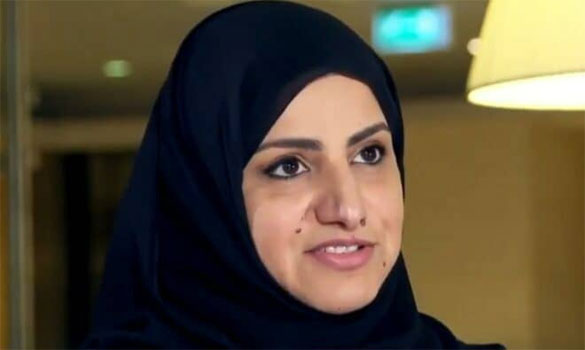
Noura Al-Qahtani
-----
Stephanie Kirchgaessner in Washington
6 Sep 2022
A Saudi woman recently sentenced to 45 years in prison
was convicted of using the internet and social media accounts to “spread lies
through tweets”, among other alleged crimes, according to a newly obtained
Saudi court document.
Noura al-Qahtani, whose case first emerged last week,
is a mother of five daughters, including one with a disability, is nearly 50
years old and has health issues, according to the court records.
The document, which describes Qahtani’s conviction and
sentencing by a special criminal court, was shared with the Guardian by
Abdullah Alaoudh, the Gulf director at Dawn, a pro-democracy group based in
Washington founded by the murdered Saudi journalist Jamal Khashoggi.
The court records reveal – for a second time in weeks
– a draconian sentence against a seemingly ordinary woman who used social media
to voice support for dissidents but was not personally engaged in political
activity. It contradicts the public image the Saudi government and its
supporters have sought to foster of women enjoying more personal freedom under
the rule of the de facto Saudi leader, Mohammed bin Salman.
Last month, a Saudi appeals court sentenced Salma
al-Shehab, a Leeds University PhD student and mother of two, to 34 years in
prison for having a Twitter account and for following and retweeting dissidents
and activists. Shehab was arrested and convicted after she had returned home to
Saudi Arabia for a holiday. The sentence was widely condemned and the US state
department said it had several discussions with Saudi counterparts to discuss
the case.
In Qahtani’s case, the court document states that she
used two anonymised Twitter accounts. One of the accounts, @Najma097, appears
to have last been active on 4 July 2021 and follows 293 Twitter accounts. Some
tweets appear to be critical of Prince Mohammed and support the rights of
political detainees.
Qahtani was convicted of several charges, including
that she sought to “besmirch” the crown prince and King Salman; that she
“encouraged participation in activities that damage the security and stability
of society and the state”; that she expressed “support” for the ideology of
those who wish to “destabilise” the kingdom; for joining a group dedicated to
these causes on Twitter and following them on YouTube. She was also convicted
of “insulting” state symbols and officials, seeking the release of detainees,
and obstructing the investigation into her social media use by “destroying and
hiding the mobile phone use in the crime”.
She was also convicted of being in possession of a
banned book, which was written by Salman Alaoudh, a well-known reformist cleric
– and father of Abdullah Alaoudh of Dawn – who is himself serving a life
sentence in a Saudi prison. Salman Alaoudh has been in prison since 2017 after
he called for peace on Twitter following the implementation of a Saudi-led
blockade on Qatar.
The book Qahtani is alleged to have possessed was not
one of Alaoudh’s political books. It was described by Abdullah – who is based
in the US – as a book about self improvement and fighting selfishness within
one’s self.
“It is a very apolitical book,” Abdullah Alaoudh said.
The court document also references a technical
analysis by state officials but it does not contain any information about how
Saudi authorities identified the Twitter handle as – allegedly – being used by
Qahtani.
Twitter did not immediately respond to a request for
comment.
The US social media company was infiltrated by Saudi
state officials in 2014 and 2015. US prosecutors have described how the
infiltration by the officials, who were employed by Twitter but were secretly
being paid by senior Saudi government officials, led Saudi authorities to gain
access to information about anonymous dissidents who were using Twitter inside
the kingdom.
The company has allowed Bader al-Asaker, a senior aide
to Prince Mohammed, who was described by US prosecutors as the mastermind
behind the Saudi infiltration, to maintain his verified Twitter account.
The court document states that Qahtani was first
sentenced to 13 years’ imprisonment in connection with her “crimes”. The
sentence was lengthened to 45 years after a prosecutor complained during her
appeal that the original sentence was too lenient.
The court document shows Qahtani presented a defence
in court, including that she was not a terrorist or planning a terrorist attack
or part of a terrorist organisation. She also stated that she was nearly 50,
had no prior record, and regretted her tweets.
The appeals court, the document shows, not only
increased her sentence to 45 years, but imposed a 45-year travel ban once she
emerges from prison, at about the age of 100. Her disabled daughter is 10 and
suffers from a genetic disorder that causes developmental disabilities.
The Saudi embassy in Washington was not immediately
available for a comment. According to the date on the court document, the new
sentence was handed down on 9 August 2022.
Source: The Guardian
--------
Sheikha Fatima, UN Women Executive Director Explore
Cooperation between the UAE and UN Women
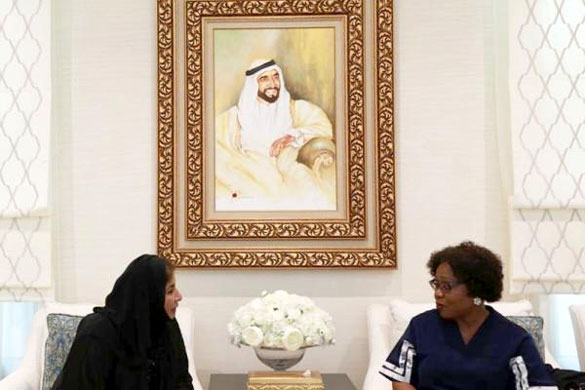
H.H. Sheikha Fatima bint
Mubarak
-----
06-09-2022
ABU DHABI, 6th September, 2022 (WAM) -- H.H. Sheikha
Fatima bint Mubarak, Chairwoman of the General Women's Union (GWU), President
of the Supreme Council for Motherhood and Childhood, and Supreme Chairwoman of
the Family Development Foundation, has discussed with Dr. Sima Bahous,
Executive Director of UN Women, the well-established strategic relations
between the UAE and UN Women and their joint efforts to build a better future
for women in the UAE and around the world.
During a phone call, H.H. Sheikha Fatima commended the
UN Women's efforts and its pioneering role in supporting women issues across
all fronts globally, based on its relentless quest to convey an inspiring
message to the world that "women are the pillar of a flourishing
civilisation and the centre for creating a peaceful, prosperous and sustainable
world."
Dr. Bahous, in turn, expressed her wishes for the
success of the International Conference on Women, Peace, and Security, which
will be hosted by the UAE capital, Abu Dhabi, from 8th to 10th September. It
will be organised by the General Women's Union in cooperation with the Ministry
of Defence, Ministry of Foreign Affairs and International Cooperation, UN Women
and the League of Arab States.
"The Commission is proud to participate in such
an important forum that joins the world under one umbrella and comes in line
with the UN's efforts to advance gender equality in all fields, especially in
the peace and security sectors," she added.
The phone call touched on the common concern to
discuss paths of cooperation for gender equality and women's empowerment,
alongside issues of mutual concern.
The UN Women Executive Director expressed her
appreciation for Sheikha Fatima's efforts in empowering Emirati women to play
their leading role in community service through strategies and programmes
presented by the General Women's Union, which had a significant impact on
Emirati women's positions.
She also appreciated the role of Sheikh Fatima and her
patronage of many programmes, initiatives and development plans to advocate for
women worldwide, giving Sheikha Fatima regional and international praise for
her sincere efforts to enhance the presence of women in various aspects of
life, especially in the peace and security sectors.
Dr. Bahous highlighted the UN Women keenness to deepen
cooperation and continue implementing the UN fifth sustainable development goal
to achieve gender equality and empower all women and girls.
Source: WAM
https://www.wam.ae/en/details/1395303080808
--------
Iran Sentences Two Women To Death For 'Corruption On
Earth'
September 05, 2022
DUBAI:
Two women have been sentenced to death in Iran on
charges of "corruption on earth" and human trafficking over the last
few days, Iran's official IRNA news agency reported on Monday.
Advocates and rights group took to social media to
share pictures of the two women, saying they are LGBT rights activists and are
Innocent. The pictures could not be verified by Reuters.
"Contrary to news published online, the sentenced
have deceived and trafficked young women and girls out of the country by
promising them educational and work opportunities, thus leading to the suicide
of several of their victims," IRNA said.
"Corruption on earth" is a term Iranian
authorities used to refer to a broad range of offences, including those related
to Islamic morals.
In March, Iran's Supreme Leader Ayatollah Ali Khamenei
described homosexuality as part of a "moral deprivation" widespread
in Western civilisation.
Western rights groups have often criticised Iran for
its treatment of LGBT issues. Under Iran's legal system, homosexual acts can be
punished by the death penalty.
Source: Tribune Pakistan
https://tribune.com.pk/story/2374933/iran-sentences-two-women-to-death-for-corruption-on-earth
--------
Iran to use subway surveillance cameras to identify
and fine women without hijab
05 September, 2022
Iranian authorities will use subway surveillance
cameras to identify and fine women who do not comply with the country’s strict
dress code, according to the secretary of Iran’s Headquarters for Promoting
Virtue and Preventing Vice.
“Technology now allows us to match images with photos
on national identity cards which leads to identifying women without hijab,”
Mohammad-Saleh Hashemi-Golpayegani said in an interview shared on social media
on August 29.
Wearing hijab, made mandatory for women in Iran
shortly after the country’s 1979 revolution, is considered a red line for
Iran’s theocratic rulers.
Women who break the strict dress code, such as by only
partially rather than fully covering their hair, risk being harassed and
arrested by Iran’s morality police, known as Gasht-e Ershad.
On Sunday, the spokesman for Headquarters for
Promoting Virtue and Preventing Vice, Ali Khanmohammadi, told the semi-official
Fars news agency that security forces have arrested “over 300 leaders of
anti-hijab groups.”
Khanmohammadi did not say when the arrests took place,
and there was no comment from Iran’s police or intelligence ministry.
Source: Al Arabiya
--------
Fatana Ishaq Gilani Afghanistan Woman Association
President Urges Govt to Open Girls Schools, Allow Women to Work
Afsana Haidari
5 Sep 2022
KABUL (Pajhwok): Afghanistan Woman Association
president Fatana Ishaq Gilani has urged the caretaker government to prioritize
combating illiteracy and give women and girls their rights Islam has given to them.
Fatana told Pajhwok Afghan News during an interview
that the Afghanistan Women Association worked with thousands of Afghan women
and girls in education and health sectors in the past one year and provided
assistance to two thousand needy widows and orphans.
During this period, she said, they even helped dozens
of security personnel of the Islamic Emirate.
Gailani said: “In the initial days after the political
change in the country when Taliban captured Kabul, I served meals to 70 or 80
Taliban fighters three times a day who were residing in our street, I bought
winter clothing and blankets for them.”
“I did not leave the country after the Taliban
takeover and stayed in the country, I was busy in welfare woks in those hard
times,” she said.
“When the Taliban seized power on August 15, their
spokesman said they will not prevent women from education and work, it made me
optimistic,” Fatana said.
She felt good after the political change in the
country and planned to extend her welfare activities for more women and girls
in the country.
But the Islamic Emirate was yet to fulfill its promise
as girls above the sixth grade still could not attend their lessons while
majority of women not allowed to work, she lamented.
Fatana doesn’t know the reason of schools closure and
said: “I do not know the reason why the doors of schools are shut for girls, I
know nothing”.
She is concerned about the closure of girls’ schools
above grade six and women’s work and asks the government to revise this
decision.
“The women are angry about this decision because it is
there right to work and study, but once again I ask the government to rethink
about its policies in this regard,” she added.
As the academic year began in March, the government
postponed the opening of girls high and secondary schools and said the
government was working on a plan after which the schools will be opened.
Islamic Emirate of Afghanistan (IEA) officials have
repeated said they are committed to giving women all Islamic rights. They say
some women are attending their jobs while others get their salaries at home.
Fatana suggested the government should consult
personalities of good reputation and women activists for solution to these
problems.
Fatana continued: “I and all other Muslim women want
their rights that Allah has given them. I want to attend proudly my job, I want
my rights guaranteed in a secure and safe environment.”
Fatana Gilani believes that Afghanistan’s problems are
caused by foreign interference and suggests the caretaker government to work
hard to stop foreign interference.
She wants the government to prioritize the struggle
for education because ignorance is one of the main causes of problems in the
country.]
Source: Pajhwok
https://pajhwok.com/2022/09/05/fatana-urges-govt-to-open-girls-schools-allow-women-to-work/
--------
Third femicide in Egypt in 3 months after young woman
says 'no' to marriage proposal
Amelia Smith
September 5, 2022
A young woman has been murdered in Egypt after turning
down a marriage proposal from a 29-year-old man from the village of Toukh
Tanbesha in Menoufia Governorate in the Nile Delta, underscoring an ongoing
tragedy in the country: violence against women and the authorities' failure to
prevent it happening.
Ahmed Fathi Amerirah shot Amani Abdul Karim, 19, on
Saturday and then reportedly turned the gun on himself and committed suicide.
Amani is the third female murder victim in Egypt in just three months – each
was murdered after refusing to marry the killer.
"What happened is not just an ordinary crime, it
is a new crime of violence against women, and it is a femicide,'" Shaimaa
Elbanna, spokeswoman for the Committee for Justice told MEMO.
"We note that violence in general is increasing
in Egypt, especially violence from the state against all citizens. At least
identifying the crime and labelling it correctly helps us determine the reasons
it is happening and helps us find solutions to protect women."
Amani was murdered not long after an outpouring of
solidarity with the student Naira Ashraf, who in June was beaten and stabbed
multiple times outside Mansoura University by Mohamed Adel.
The footage of the murder went viral and the killing
shook Egypt, especially after it emerged that Mohamed harassed Naira for a
year, to the knowledge of authorities, who failed to prevent her death.
According to a Reuters article, Mohamed edited her
face onto pornographic images and sent her death threats for months before he
stabbed her.
Naira reported Mohamed to the cybercrime police unit
and filed two restraining orders against him, yet her lawyer said the police
did not undergo proper legal procedures and action was not taken against him.
State-run media has tried to draw the focus elsewhere,
in one case running an article which argues men kill their lovers due to
"Othello's disease", or a pathological jealousy.
From Naira Ashraf to the student Amani. The story,
'Love never kills,' is an ongoing drama
Naira's autopsy was published, focusing on the results
of her virginity test and whether her hymen was intact. Then a discussion
erupted online. Why didn't Naira wear the headscarf? Could other women who
chose not to wear it be subject to the same act of violence?
"Cover up or meet the same fate," one
Al-Azhar professor said.
Then just one and a half months after Naira's brutal
murder, it happened again. At the beginning of August, Islam Mohamed stabbed
20-year-old Salma Bahgat to death 17 times in Zagazig on the eastern part of
the Nile Delta. Islam had posted a story on his social media threatening Salma
after she turned down his marriage proposal with a firm "no".
As Amina's story spreads on social media, observers
continue to mourn Naira and Salma, call for urgent justice for women in Egypt,
and for the attention to be put squarely on what happened, rather than what
they were wearing.
"The killings are an extension of violence against
women in Egypt, which began with threats, beatings and harassment, and have
continued every day without confrontation or clear rejection by society,"
Shaimaa says.
"This is due to toxic relations between men and
women, a cultural heritage that encourages violence, religious interpretations
that incited it, the absence of adequate legal protection, the existence of
legal loopholes that allow criminals to go unpunished, and the deterioration of
the security system in Egypt. And for these reasons, women don't report what is
happening to them."
In June, Naira's killer, Mohamed Adel, was sentenced
to death, the maximum penalty for murder in Egypt, with the court even asking
for the law to be changed so his execution could be televised to the nation.
In 2021 Egypt was the third highest executioner
worldwide, despite calls by human rights groups and the UN to impose a
moratorium on the death sentence as it spiralled out of control.
"A deterrent law does not mean revenge or death
sentences – that we reject completely – because as we see Naira Ashraf's killer
was sentenced to death, but this didn't stop the crime and it happened again.
Issuing a death sentence was never enough and it didn't deter and protect the
new victim," says Shaimaa.
Instead, women need a safe environment which
encourages them to report violence, she says, and which offers them protection
and takes their complaints seriously. This needs to start by schools educating
new generations and through civil society, a difficult task as censorship and restrictions
on NGOs are at an all-time high in Egypt.
"I wish patience to all women who are suffering
from trauma which is renewed with each new incident of violence against women
in Egypt and the Arab world," says Shaimaa.
Source: Middle East Monitor
--------
International Conference on Women, Peace, and Security
to take place on September 8 in Abu Dhabi
01-09-2022
ABU DHABI, 1st September, 2022 (WAM) -- Abu Dhabi will
host a high-level International Conference on Women, Peace, and Security from 8
to 10 September. The conference is organised by the Ministry of Foreign Affairs
and International Cooperation in partnership with the Ministry of Defence, the
General Women's Union (GWU), UN Women, the League of Arab States, and the Abu
Dhabi Ports Group.
The event will be held under the patronage of H.H.
Sheikha Fatima bint Mubarak, Chairwoman of the General Women's Union (GWU),
President of the Supreme Council for Motherhood and Childhood, and Supreme
Chairwoman of the Family Development Foundation (FDF).
The conference will review the achievements and
challenges relating to the implementation of UN Security Council Resolution
1325, which emphasises the importance of the equal participation of women and
their full involvement in all efforts to maintain peace and security in
conflict areas around the world and post-conflict construction. The conference
also seeks to achieve consensus on specific procedures to implement the UAE's
National Action Plan.
On this occasion, H.H. Sheikh Abdullah bin Zayed Al
Nahyan, Minister of Foreign Affairs and International Cooperation, said that
the UAE’s organisation of the International Conference on Women, Peace, and
Security stems from its belief in the important role that women play in all
fields and their contribution to societies’ prosperity.
His Highness recognised the UAE's firm commitment to
achieving gender equality and enhancing the role of women in society and
extended his appreciation to Her Highness Sheikha Fatima bint Mubarak for her
pivotal role in supporting women as partners in the UAE’s progress and for her
patronage of this high-level conference.
Sheikh Abdullah underscored the UAE’s support for the
Women, Peace, and Security Agenda under the United Nations framework,
especially in light of its current non-permanent membership in the UN Security
Council.
Mohammed bin Ahmed Al Bowardi, Minister of State for
Defence Affairs, said, "We are emphasising the importance of the
integration of women in peace and security as a priority to build sustainable
and comprehensive peace around the world. Through joint cooperation and
continuous work over the years between the Ministry of Defence and UN Women,
the League of Arab States, and the GWU, we became more certain that the role of
women is essential in conflict recovery because women are a key partner in
peacekeeping and post-war negotiations. They are also integral to various
development programmes to build stable and secure families in war and conflict
areas, which contributes to the success and stability of peace agreements.
Al Bowardi added, "The leadership of the UAE,
especially Her Highness Sheikha Fatima, has supported and endorsed the Women,
Peace, and Security Agenda since the signing of the Memorandum of Understanding
in 2018 between the General Women's Union and UN Women. All stakeholders worked
to develop the military capabilities of women and their knowledge of the
foundations of peacekeeping. The Ministry of Defence has supported the training
of more than 350 women from various Arab, Asian, and African countries at the
Khawla Bint Al-Azwar Military School with great success, and we will continue
to implement these training programmes to maintain security, peace, and
stability."
Noura Al Suwaidi, Secretary-General of the General
Women's Union, said, "This high-level conference is aligned with the UAE's
vision to strengthen its strategic partnership with UN Women and build the
capacities of women in the region and around the world and enable them to play
an active role in championing peace and security. We hope that through this
important conference we can contribute to creating an empowering environment
for women and raise awareness about the link between gender and peacebuilding
and its sustainability under the leadership, patronage, and directives of Her
Highness Sheikha Fatima."
She added, "We are pleased to express our full
confidence in the capabilities of conference participants to devise practical
outputs and recommendations to enhance the influential role of women in
building peace around the world."
Dr. Mouza Al Shehhi, Director of the UN Women Liaison
Office for the GCC, stated, "Advancing the Women, Peace and Security
Agenda is a priority for UN Women, as women have long been doing important work
in peacebuilding in many conflict zones, but there is a sharp contrast with
their participation in formal peace negotiations, where women still largely do
not play any formal roles. Between 1992 and 2019, on average, only 13% of
negotiators were women, although studies show that women’s participation increases
opportunities for sustainable peace and leads to agreements containing more
provisions that benefit women and men equally."
She added, "The conference aims to bring together
decision-makers and stakeholders from different countries to analyse the role
of women in peace and security in line with the objectives of UN Security
Council Resolution 1325. It is established that strengthening the role of women
in building peace is an entry point for the advancement of societies that
suffer from conflicts and enhances stability during post-conflict construction,
and we hope to agree to specific measures to accelerate women’s meaningful
participation."
The conference, sponsored by Abu Dhabi Ports Group,
will see the participation of international decision-makers, senior officials,
diplomats, and advocates concerned with Women, Peace and Security issues in the
Arab region and worldwide.
It also emphasises the significance of women's role in
mediation processes, thereby supporting women leaders on the ground, especially
in Africa and Asia, and aims to discuss ways to promote gender equality in the
humanitarian field and mobilise women’s participation in conflict prevention
while increasing their participation in peacebuilding. The conference will also
highlight the UAE’s efforts in Women, Peace, and Security and outline specific
procedures for the UAE's national plan to implement UN Security Council
Resolution 1325.
The conference will address ways to achieve the
ambitious goals set by the United Nations to increase the participation of
women in UN peacekeeping forces, such as increasing their percentage in units
with military missions to approximately 15% and in forces with police missions
to 20% by 2028.
Moreover, it will build consensus on specific measures
to promote equality and equal opportunities, highlighting the challenges facing
women participating in peacekeeping operations and ways to enhance their full
involvement in all efforts to maintain security at all levels of
decision-making and protect them from violence, including sexual and
gender-based violence.
The conference emphasises the need to involve women
leaders from civil society in the National Action Programme to implement
Security Council Resolution 1325 and overcome obstacles to women’s integration
in decision-making.
The conference reviews the GWU's efforts, under the
directives of Her Highness Sheikha Fatima bint Mubarak, in supporting the
Women, Peace and Security agenda globally, which resulted in the signing of a
Memorandum of Understanding between the Ministry of Defence, the GWU, and UN
Women. The "Initiative of Her Highness Sheikha Fatima bint Mubarak to
Empower Women in Peace and Security" was launched as a result, in addition
to the UAE's National Plan to implement UN Security Council Resolution 1325 and
the Fatima bint Mubarak Centre for Women and Peace and Security, as well as the
website of Her Highness’ initiative.
In 2000, UN Security Council Resolution 1325 was
adopted, establishing the Women, Peace, and Security Agenda, thereby acknowledging
women's leadership in promoting international peace and security, as well as
their contributions to conflict prevention, peacekeeping, conflict resolution,
and peacebuilding.
In 1993, women made up 1% of deployed uniformed
personnel. However, after the adoption of UN Security Council Resolution 1325,
the number of women in peacekeeping roles rapidly rose. Female staff officers
and military observers climbed from 12.3% to 17.8% between 2018 and 2021, while
female police officers increased from 22.3% to 30.4%, and women in established
police units increased from 9% to 14.8%.
Source: WAM
http://wam.ae/en/details/1395303079503
--------
URL: https://newageislam.com/islam-women-feminism/noura-qahtani-saudi-jailed-tweets/d/127892
New Age Islam, Islam Online, Islamic Website, African Muslim News, Arab World News, South Asia News, Indian Muslim News, World Muslim News, Women in Islam, Islamic Feminism, Arab Women, Women In Arab, Islamophobia in America, Muslim Women in West, Islam Women and Feminism