
Muslim Women Protest ‘I Love Muhammad’ Amid FIR Row In India
New Age Islam News Bureau
22 September 2025
· Muslim Women Protest ‘I Love Muhammad’ Amid FIR Row In India
· Swim Sessions Breaking Barriers For Bangladeshi Muslim Women
· UAE Officer, Major Aliya Al Kaabi, Becomes First Woman Elected to Interpol's Asia Committee
· Sentenced To Death In Iran: The Case Of Sharifeh Mohammadi Accused Of "Armed Rebellion Against The State"
· Temporary Marriage In Iran: Religiously Sanctioned, Socially Taboo
· Iranian Woman Falls Into Coma After Months of Seizures in Prison
Compiled by New Age Islam News Bureau
URL: https://newageislam.com/islam-women-feminism/muslim-women-protest-i-love-muhammad-fir-india/d/136935
----
Muslim Women Protest ‘I Love Muhammad’ Amid FIR Row In India
September 21, 2025
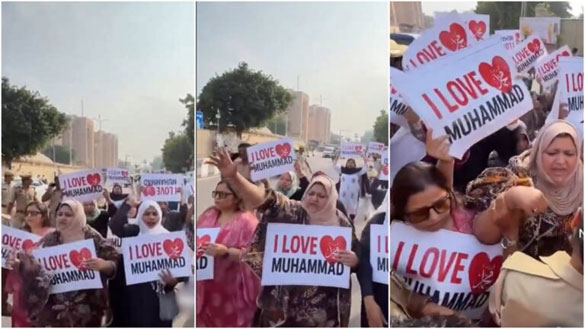
Muslim women protestors in front of the Vidhan Sabha in UP‘s Lucknow.
--------------
In a bold display of defiance, over two dozen Muslim women gathered outside Uttar Pradesh’s Vidhan Bhavan in Lucknow on September 20, protesting recent police action against Milad-un-Nabi celebrations.
Days earlier, authorities had booked more than two dozen individuals for allegedly disturbing communal harmony by erecting boards during the Prophet Muhammad’s birthday festivities. The demonstrators, brandishing placards emblazoned with “I Love Muhammad,” sought to reclaim religious expression amid accusations of selective enforcement.
Led by Sumaiya Rana, daughter of renowned poet Munawwar Rana, the group raised fervent chants honoring the Prophet, drawing attention to what they called discriminatory policing. The peaceful rally quickly descended into chaos when police intervened to disperse the crowd, resulting in the brief detention of several participants. Authorities later released them at Eco Garden, a nearby public space, without formal charges.
Speaking to reporters post-release, Sumaiya Rana lambasted the BJP-led state government, alleging it viewed the Muslim community as a threat. “The FIR is unconstitutional and strikes at India’s secular fabric,” she declared. “Law and order in Uttar Pradesh applies only to select religious communities, stifling minority voices while shielding majoritarian excesses.”
Rana’s words echoed broader grievances over rising communal tensions, where routine religious observances face scrutiny under vague “harmony” clauses.
The protest, though short-lived, amplified calls for equitable legal application, highlighting fractures in UP’s social cohesion. As similar incidents proliferate, activists urge judicial intervention to safeguard constitutional freedoms for all faiths. — With Agencies Inputs
Source: muslimmirror.com
https://muslimmirror.com/muslim-women-protest-i-love-muhammad-amid-fir-row-in-ups-lucknow/
--------
Swim Sessions Breaking Barriers For Bangladeshi Muslim Women
September 22, 2025
Shannen Headley

Nagina Khan (left) pictured with Hanna Begum and Lizzetta Grainger, said the sessions have created a positive impact on the Bangladeshi female community
------------
A women only swimming session has been helping Bangladeshi Muslim women overcome isolation and improve their health.
Participants said it has been the first opportunity for some of them to learn swimming in a setting that respects their modesty and cultural values.
Regular attendee, Ruksana Rafiq told the BBC the sessions have helped her gain confidence as well as a sense of community.
The weekly sessions at Sandwell Aquatics Centre (SAC) in Smethwick has helped break cultural, religious, and practical barriers in accessing mainstream leisure facilities, organisers said.
The SAC arranged the sessions alongside the Bangladeshi Islamic Centre (BIC) on Lewisham Road.
Nagina Khan, head of Supporting Women From Isolation To Empowerment (SWFITE) team at BIC, said the collaboration had been "incredibly positive" on the Bangaldeshi community.
She said: "For many of our ladies this has been their first opportunity to learn or improve their swimming skills in a setting that fully respects their modesty and cultural values.
"Beyond physical health, the sessions have helped to reduce feelings of isolation by providing a welcoming space for women to come together, socialise, and build supportive networks."
Ms Rafiq, 45, from Smethwick,said the sessions have helped her gain new friends.
"I have loved swimming from a young age, it was always a hobby of mine," she said.
"As a full-time mum, I never had time for myself. BIC gave me the confidence to join their swimming group as it's ladies only, which made me feel comfortable.
"I have gained time to exercise, and I have gained many new friends too, which has made me happy. What more could I ask for?".
Lizzetta Grainger, Assistant Leisure Manager at SAC said the initiative reflects the centre's commitment to community cohesion.
She said: "It ensures that all women have the opportunity to enjoy physical activity in an environment that respects their cultural and religious needs.£
Source: bbc.com
https://www.bbc.com/news/articles/c3vz3nxgg92o
------
UAE Officer, Major Aliya Al Kaabi, Becomes First Woman Elected to Interpol's Asia Committee
Sep 21, 2025
Major Aliya Al Kaabi has been elected to Interpol’s Asia Committee with 53% of the vote, making her the first woman to serve on the regional body in the organisation’s structure.
The Asia Committee is one of several regional arms of Interpol, tasked with reviewing projects, setting priorities for cross-border policing in the region, and providing recommendations to the organisation’s General Assembly and Executive Committee. Membership is decided by vote among member countries, making Al Kaabi’s election both a competitive and landmark result.
Al Kaabi’s career includes years of service in the UAE’s Ministry of Interior, where she has held senior positions in law enforcement and international cooperation. Her election comes at a time when Interpol is placing greater emphasis on regional collaboration to combat organised crime, cybercrime, and emerging security threats.
Source: cairoscene.com
https://cairoscene.com/Buzz/UAE-Officer-Becomes-First-Woman-Elected-to-Interpol-s-Asia-Committee
-------
Sentenced To Death In Iran: The Case Of Sharifeh Mohammadi Accused Of "Armed Rebellion Against The State"
Shabnam von Hein
September 22, 2025
Sharifeh Mohammadi has been in prison since December 2023. The 46-year-old activist and engineer is accused of "armed rebellion against the state" in Iran. She now faces execution again.
Already sentenced to death twice in 2024 and early 2025, this August the Supreme Court once again upheld the ruling.
Her commitment to workers' rights brought her to the attention of the authorities. She was a member of a committee for the formation of labor organizations in the northern Iranian coastal city of Rasht on the Caspian Sea, where she worked and lived with her family, including her 13-year-old son. The government considers the committee to be an "opposition group.”
Under Iranian criminal law, three offenses are punishable by death: war against God (moharebeh), corruption on earth, and rebellion (baghi), lawyer Marzieh Mohebi told DW. "The relevant articles of the law are so vaguely worded that judges can apply them to almost any form of protest or political activity."
Mohebi has been living in exile in France for two years. In Iran, she built a network of female lawyers who represented women imprisoned without charges or in difficult circumstances.
In September 2022, nationwide protests broke out following the death of 22-year-old Jina Mahsa Amini in police custody. Amini was allegedly not wearing the mandatory head covering for women correctly. A movement developed under the slogan "Woman, Life, Freedom," becoming a symbol of resistance to the compulsory headscarf and systematic discrimination against women.
Many female lawyers were arrested during the systematic suppression of the demonstrations. A court in the northern Iranian city of Mashhad initiated proceedings against Mohebi before she could provide legal support for demonstrators who had been arrested.
Vague laws, harsh penalties
"It is not difficult to quickly turn ordinary people into 'criminals'," Mohebi said. "This practice is not a constitutional procedure based on the laws created by the Islamic Republic, but rather an expression of the regime's desire to suppress any form of civil activity under the pretext of security. It shows that even in times of crisis, the regime continues to regard the suppression of domestic opposition as its most important task."
Sharifeh Mohammadi is a labor rights activist, feminist, and opponent of the death penalty. After her arrest in 2023, her family did not know where she was being held or why for months. Mohammadi later reported that she'd spent more than 200 days in solitary confinement where she was tortured and abused.
In June 2024, the court in Rasht sentenced Mohammadi to death for "baghi.” A higher court overturned the verdict in October 2024 and ordered a retrial. But after a new trial, the death sentence was upheld in February 2025.
"Under the laws of the Islamic Republic, a rebel is a person who has been directly involved in an armed uprising against the government," said social and gender researcher Fatemeh Karimi. "Sharifeh, on the other hand, had no connection to armed actions. There is no evidence of this. What Sharifeh did was union activity in the context of labor protests, which in no way corresponds to the criminal definition of rebellion."
Criticism in Iran and beyond
Human rights organizations have reported serious procedural flaws in her prosecution, calling it a politically motivated trial.
The death sentences, for example, were handed down by two different judges who are first-degree relatives. Ahmad Darvish-Goftar, chairman of Criminal Court 1, is the son of presiding judge Mohammad Ali Darvish-Goftar of Criminal Court 2.
The case has also drawn fierce international criticism. Several European trade unions, including those in Germany, France, and Sweden, as well as the International Trade Union Confederation, have called for the verdict to be overturned and for Mohammadi's immediate release.
Criticism of her death sentence is growing within Iran as well. The Iranian Teachers' Trade Association condemned the verdict as "inhumane and unjust” in a statement, describing the death sentence as a means of spreading fear and suppressing collective labor movements.
There has also been a video circulating on the internet of a peaceful gathering at a sugar cane factory in early August, where participants demanded a fair trial for Mohammadi. The works council of Haft Tappeh Sugarcane Agro-Industry Co. is one of the most active voices against repression and in support of workers' rights.
Amnesty International and numerous Iranian and international human rights organizations have called for the immediate withdrawal of the death sentence.
Source:
https://www.dw.com/en/sentenced-to-death-in-iran-the-case-of-sharifeh-mohammadi/a-74077412
-------
Temporary marriage in Iran: religiously sanctioned, socially taboo
Maryam Sinaiee
Iran's Shi'ite establishment promotes temporary marriage as a way to prevent illicit relationships. Yet even devout families often disapprove, associating the practice with prostitution and social shame.
Under Shi'ite law, a man can have four permanent wives simultaneously and any number of temporary wives. He needs his first wife’s consent for additional permanent marriages, but not for temporary ones.
Women, by contrast, can only enter one temporary marriage at a time and, after termination, must wait at least 45 days before remarrying to establish paternity if pregnant.
“I don’t know a single woman around me who would agree to a temporary marriage, unless she is involved with a married man and wants to protect herself from being charged with adultery if discovered,” said Taraneh, an art teacher in Tehran.
“In these cases, it’s more a formality than religiosity. Just like an affair, they hide it from everyone, even their family and friends.”
Taraneh explained that stigma is deeply rooted. The longstanding association between temporary marriage and prostitution, she said, reinforces secrecy and social judgment, especially against women.
“But in some poorer rural areas I’ve visited, it is somehow more common for widowed or divorced women who are unable to financially support themselves to marry temporarily with men whose wives will not allow them to officially take second wives,” she added.
“However, even these are normally longer-term and not publicized. Everyone considers very short-term temporary marriages shameful because of the money involved."
Temporary marriage in Shi'ite Islam
Under Shi'ite Islamic law, temporary marriage, known in Persian as sigheh or mut‘ah, is a marriage contract with a set duration. The term may last from a few hours to several years, depending on the agreement.
The contract is usually verbal and consists of the man and woman (or their representatives) reciting a formula (sigheh) that specifies the agreed duration and a predetermined dowry (mahr). Witnesses are not required for it to be valid.
Since 2013, temporary marriage has been legally recognized in Iran, though registration is only required if a child is conceived.
If registered or witnessed, temporary marriage allows recognition of children and provide some legal security to women. Once the term ends, the marriage automatically dissolves without requiring divorce proceedings.
Children are legally recognized, with inheritance and custody rights, though complications often arise if the marriage is not officially registered.
Unlike permanent marriage, a woman in temporary marriage is not entitled to alimony after expiration and has no right of inheritance from her temporary husband.
Widows and divorced women may enter temporary marriage without paternal consent. Unmarried girls, however, need their father’s approval, as in permanent marriage. The minimum legal age for girls is 13, fueling concern about child marriage in poor areas.
Sunni Islam does not recognize temporary marriage.
Sex trade in disguise
Islamic jurists describe temporary marriage as a legitimate solution to sexual needs and a safeguard against prostitution.
Although prostitution is explicitly criminalized and punishable in Iran, sigheh still enjoys legal backing, and its broad interpretations have created a religious-legal loophole that paves the way for exploitation.
The sex trade often operates under the guise of temporary marriage. This is especially visible in religious cities such as Mashhad and Qom, pilgrimage hubs where millions travel each year.
Since its legal recognition, numerous social media channels have openly advertised temporary marriage, offering arrangements from “one-hour to longer terms,” for fixed fees.
Even clerics who accept the principle of sigheh criticize this trend. They argue that it normalizes polygamy or masks prostitution.
“Can you believe that some ignorant, clueless people have set up [Telegram] channels to promote polygamy and temporary marriage? They claim they are reviving the Prophet’s tradition!" wrote cleric Ehsan Ebadi on X.
"Curse on you—you have understood neither the Prophet, nor Islam, nor the philosophy behind these rulings. All you are doing is tarnishing the image of religious people."
Javan newspaper, affiliated with the Revolutionary Guard, reported on September 20 that the growth of online channels and pages under the titles of matchmaking and sigheh-finding has turned into a platform for fraud and exploitation of users.
“The rapid increase of these channels is a serious alarm bell for society.”
Source: ranintl.com
https://www.iranintl.com/en/202508248456
-------
Iranian Woman Falls Into Coma After Months of Seizures in Prison
SEPTEMBER 22, 2025
ROGHAYEH REZAEI
A 42-year-old Iranian political prisoner has fallen into a coma after suffering months of epileptic seizures in prison.
Somayeh Rashidi, a seamstress arrested in March for writing anti-government slogans, is currently hospitalized at Mofteh Hospital in Varamin.
Her level of consciousness has declined to four on the Glasgow Coma Scale, indicating a deep coma with minimal brain response that typically requires artificial respiration.
Her case highlights a broader crisis in Iran's prison system, where inmates frequently die from treatable conditions due to delayed or denied medical care, according to human rights groups monitoring prisoner welfare.
Rashidi was arrested while writing slogans in Tehran's Javadiyeh neighborhood. A single woman who once worked in a chandelier factory before becoming a seamstress, she was charged with "propaganda against the Islamic Republic."
Her imprisonment began at the Shapour Intelligence Center, one of Iran's most feared detention facilities, where torture and beatings of suspects are reported to be routine. She was later transferred to the more notorious Evin Prison for interrogation.
Her ordeal deepened in June when an Israeli airstrike on Evin prompted authorities to move her and other female political prisoners to Qarchak Prison's quarantine section, described by former inmates as one of the most inhumane facilities in the country.
Throughout her detention, Rashidi suffered repeated epileptic seizures.
Despite her documented medical condition, prison authorities kept her in custody, exposing her to the stress of interrogations and the harsh conditions that characterize Iran's treatment of political prisoners.
The crisis reached its peak on September 16, when Rashidi was taken to forensic medicine to confirm her epilepsy and obtain a certificate stating she was unfit for punishment. On the way back, she became severely ill and vomited in the transport vehicle.
"When she arrived at the prison, officials told her to change clothes before going to the clinic," a source told IranWire. "While changing, she felt ill again and suffered a seizure."
This was not her first medical emergency. Sources familiar with her case say Rashidi had multiple seizures in both Evin and Qarchak prisons. Each time, prison medical staff administered unidentified medications that failed to stabilize her condition.
"Whether the medications were related or unrelated, or whether the dosages were wrong, we don't know," the source said. "They gave Somayeh medicine, but her condition never improved."
The dangerously inadequate medical response reflects systemic problems within Iran's prison healthcare system.
Former political prisoners have long described infirmaries staffed by unqualified personnel who dismiss severe symptoms and provide substandard care.
"Prison guards practically tell prisoners, 'This isn't your aunt's house or a hotel where you can go to the hospital whenever you want,'" said a former political prisoner. "Clinics often don't have doctors, or if they do, they don't do much. Prisoners are left on their own."'
When Rashidi was finally taken to the hospital, her condition rapidly deteriorated. Medical staff immediately administered intravenous fluids, but within 30 minutes, her consciousness declined. She was rushed to the intensive care unit as her body slipped into a deep coma.
Her level of consciousness dropped from five on Friday to four on Saturday, according to sources monitoring her condition. Level four consciousness is a deep coma, characterized by no verbal or eye response.
At this stage, patients typically require artificial respiration and face a high risk of severe brain damage.
Rouzbeh Esfandiari, a former Tehran emergency physician, explained the medical implications of Rashidi's condition.
He said Rashidi's score of four on the Glasgow Coma Scale places her dangerously close to the lowest possible level of consciousness.
"The scale measures eye-opening, verbal response, and motor response, with scores ranging from 15 to three, where three represents the deepest level of unconsciousness," Esfandiari said. "A score of four indicates extremely low consciousness."
He pointed out that prolonged seizures that denied her brain adequate recovery time, potential head trauma during convulsions, or respiratory complications that deprived her brain of oxygen could all explain Rashidi's condition.
"There's also a possibility that when she has a seizure, because the body experiences contractions, this contraction might have happened in the respiratory tract and the airway closed, little oxygen entered the blood, little oxygenated blood reached the brain, and the brain suffered a stroke," he explained.
The physician also highlighted the role of medication compliance and stress in triggering seizures.
"The main reason is failure to provide the patient's medication. They might not take just one dose, or it might not reach them - they will definitely have a seizure," he said. "However, there's also the possibility that stress causes seizures to worsen. Stressful conditions like prison and interrogation can manifest as seizures."
Meanwhile, Rashidi's family has reportedly come under pressure from authorities. Sources say they are being told to blame hospital negligence rather than prison conditions for her deteriorating health.
"Somayeh's family is very religious and, by one account, semi-Hezbollahi, but it's clear they are under pressure," a source said. "They are told to say the negligence happened at the hospital, not in prison."
Human rights advocates reject this narrative, pointing out that Rashidi should never have been kept in prison, particularly under the harsh conditions of Qarchak's quarantine section, given her serious medical condition and repeated seizures.
IranWire has extensively documented the conditions at Qarchak Prison, where roughly 1,000 women, including political detainees transferred after the Israeli attack on Evin, endure hunger under the pretext of power outages.
Rashidi's case is part of a larger pattern of medical neglect in Iranian prisons. In recent weeks, multiple prisoners have died due to delayed medical care, including an unnamed woman at Qarchak and Jamileh Azizi, who died after her heart attack symptoms were dismissed.
The deaths extend beyond Qarchak. Mohammad Monghali died in Yazd Prison, while Tehran lawyers report that Taher Naqavi, a prominent defense attorney for political prisoners, is in life-threatening condition after being denied medical leave for urgent surgery.
Under Iranian prison regulations, authorities are legally required to safeguard prisoners' health and ensure access to adequate medical care. They must transfer ill inmates to external facilities when prison clinics cannot provide treatment or grant medical leave when necessary.
Yet Rashidi spent more than four months in custody, much of it under interrogation, before falling into a coma. Her treatment violates both Iranian law and international standards for prisoner healthcare.
Arrested for the simple act of writing slogans, Rashidi joins thousands of Iranians imprisoned for opposing the Islamic Republic's rule.
Source: iranwire.com
https://iranwire.com/en/features/144980-iranian-woman-falls-into-coma-after-months-of-seizures-in-prison/
--------
URL: https://newageislam.com/islam-women-feminism/muslim-women-protest-i-love-muhammad-fir-india/d/136935