
Muslim Women Challenge Forced Hijab Removal in US Jails — And Win
New Age Islam News Bureau
05 May 2026
· Muslim Women Challenge Forced Hijab Removal in US Jails — And Win
· Yazidi Survivor Freed a Decade After ISIS Sinjar Abduction
· Of 59 women contested, seven won in Assam Assembly polls
· Fathima Thahiliya fought for gender parity in IUML. Now, she is party’s first woman MLA in Kerala
· HC bench drops Monira Sharmin’s writ petition from hearing list
· Women MPs not going to parliament as ornaments: Nipun
· BNP MPs from reserved women seats pay tribute at graves of Zia, Khaleda Zia
· Iran Regime Denies Family Visits to Female Political Prisoners in Evin Prison
· Kongra Star: “Women’s rights in Syria link to YPJ recognition
· Saudi Women’s Workforce Participation Jumps to Nearly 35% Under Vision 2030
Compiled by New Age Islam News Bureau
------
Muslim Women Challenge Forced Hijab Removal in US Jails — And Win
by Ulaa Kuziez
May 5, 2026
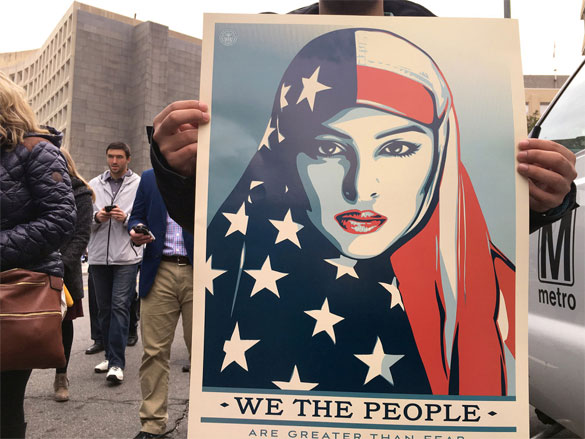
Artist Shepard Fairey produced an image titled Muslim Woman featuring a woman wearing a hijab with an American flag pattern. (RNS photo/Lauren Markoe)
-------------
More Muslim women across the United States are turning to the courts to challenge prison and police policies that force them to remove their hijabs for booking photos, arguing the practice violates their religious freedom and leaves them exposed to lasting harm.
In the last two months, at least five such cases have been filed or settled.
Attorneys say the lawsuits do not reflect a new problem so much as a new willingness to fight. A growing track record of successful cases from Minnesota to New York City has emboldened Muslim women to come forward about their experiences.
“A lot of Muslim women realized, ‘Oh, this is something I can complain about. I felt like it violated my rights. I knew it felt wrong, but I didn’t know that I could actually try to get these pictures destroyed,’” said Aya Beydoun, a staff attorney with the Council on American-Islamic Relations who has litigated several of these cases in recent years.
And arrests at pro-Palestine protests have also brought more visibly Muslim women into contact with the criminal legal system, creating more situations where such policies are enforced. A review by Religion News Service showed at least seven such lawsuits were brought by protesters since 2024.
In many of the cases, police or prison officials compelled Muslim women to remove their religious head coverings for a booking photograph despite objections. The photos were then stored in databases, printed on ID cards, viewed by male officers, and made public via records requests, according to multiple lawsuits.
When Serine Abuelhawa was arrested while protesting at a festival in Portland, Oregon, in 2024, she was asked multiple times to take off her hijab during the booking process. After explaining she could not do that in the presence of male officers, a female officer told her she wasn’t allowed to keep it in jail.
“Just because I’m in jail doesn’t mean I’m no longer Muslim. . . . I’m not taking it off,” Abuelhawa responded, according to the lawsuit. An officer then continued to pat her down and exposed parts of her body in front of male personnel, then took her to a cell with a window.
There, Abuelhawa gave her hijab to an officer and sat in the room uncovered for four hours, she said in the lawsuit.
That case, represented by Beydoun, was settled last month. The Multnomah County Sheriff’s Office and Multnomah County Detention Center agreed to change their booking policy, destroy the uncovered images, and provide a monetary settlement to the two women.
“I talked to many young women and we represented a few who were arrested at encampments or protests . . . and instead of having normal interactions with the jailhouse, their rights were violated. They had their hijabs removed. They were humiliated,” Beydoun said.
Plaintiffs in the lawsuits have said being forced to remove the hijab in custody was a severe violation of their religious beliefs, privacy and identity.
In a lawsuit filed on April 22 against an Ohio county by three women arrested for protesting the war in Gaza on Ohio State University’s campus, lawyers wrote that photos of their clients were “humiliating and violating.”
A central aspect of the arguments in these cases has been religious education, helping judges and prison officials understand why the policies are harmful.
Liz Bucar, a religious ethicist, has served as an expert witness for two New York-based cases, explaining to federal courts why removing a hijab is a serious violation for Muslim women who consider covering their hair and neck a core part of their modesty practice.
“It’s not like taking off someone’s hat. It’s like taking off their pants or removing their shirt,” Bucar said in an interview. “It’s a violation of a different sense of modesty and it can be very traumatizing.”
In one of the cases Bucar testified in, the plaintiff, Marowa Fahmy, was transferred between stations without her hijab and had her booking photo taken without it. The Long Island woman’s hair was also exposed for nine hours, according to court filings.
She won a $225,000 settlement last July, later saying that being without her hijab in front of male officers “violated everything I believe in.”
“I brought this case so no one else has to go through what I did,” Fahmy said in a statement.
In 2018, two Muslim women sued the New York Police Department for being forced to remove their hijabs for booking photos under a department policy, arguing the policy was unconstitutional. The case resulted in a settlement that both changed NYPD policy and later provided damages to people of all faiths whose religious head coverings had been removed.
The case’s high-profile success may have encouraged both new lawsuits and more people to come forward about similar violations, said Sana Mayat, an associate attorney at Emery Celli Brinckerhoff Abady Ward & Maazel LLP, who worked on the case.
That case, like others, relied on a combination of state laws and the Religious Land Use and Institutionalized Persons Act, a federal statute protecting religious rights, to argue that stripping religious head coverings during booking is unconstitutional.
But despite the growing number of lawsuits challenging jail and prison policies around religious dress, attorneys say many departments and officers remain unaware of how their practices may violate federal law.
“Generally, changing police department policies is not something they do unless they’re kind of forced to do it. It’s a lot of work and a lot of bureaucracy, so I don’t know if they would proactively go out of their way to change them,” Mayat said.
Beydoun, the CAIR lawyer, added that while many officers are simply poorly trained or are following policy, there are those who act out of hostility toward Muslim women in hijab. She said some of her clients were met with “very derogatory, discriminatory” comments that signaled hate rather than confusion about policy.
Even without sweeping changes, each lawsuit that forces a jail or police department to delete a photo or rewrite its policy becomes evidence for the next case, she said.
Last week, a federal judge ordered the Federal Bureau of Prisons to delete hijab-less images of Muna Jama, a Somali American woman in Minnesota whom Beydoun represented. The judge wrote that the bureau “failed to establish why the risk that Jama could remove her hijab to disguise herself is so great that Defendants could not destroy all uncovered photographs of her.”
While the judge did not compel the BOP to change its policies, that decision, Beydoun said, will now be a reference point for other women in federal custody facing the same violation.
“In the future, my hope is to see some policy changes. That at some point it’ll become just too tiresome for the BOP to keep accommodating, and they’ll just change the policy,” she said. —Religion News Service
Source: christiancentury.org
https://www.christiancentury.org/news/muslim-women-are-suing-jails-over-hijab-removal-booking-and-winning
------
Yazidi Survivor Freed a Decade After ISIS Sinjar Abduction
2026-05-04
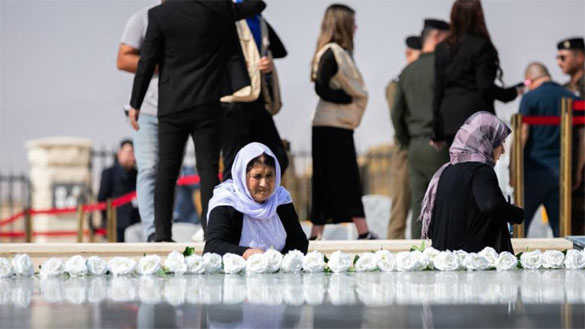
Yazidi women lay flowers in remembrance of victims of the 2014 genocide in Sinjar
-----------
ERBIL — A Yazidi woman abducted by Islamic State during the group’s 2014 attack on Sinjar has been freed, the Kurdistan Region’s Office for Rescuing Kidnapped Yazidis announced Monday.
The survivor, identified as Jamila Bapir, is from the Tel Qasab community and was kidnapped along with her family during their displacement and subsequent captivity. The office did not disclose the location where she was freed, citing security reasons.
Of the 6,417 Yazidis kidnapped at the start of the genocide in 2014, 3,594 have been rescued, while the fate of thousands remains unknown, according to official figures from the office.
Islamic State attacked Sinjar in August 2014, killing thousands of Yazidi men and forcing women and children into captivity. Many women and girls were subjected to sexual slavery while boys were indoctrinated as fighters. The United Nations has recognized the campaign as genocide. More than 5,000 Yazidis were killed, around 360,000 were displaced inside Iraq and more than 100,000 fled the country. Up to 80% of public infrastructure and 70% of civilian homes in Sinjar and surrounding areas were destroyed, according to the International Organization for Migration.
Source: 964media.com
https://en.964media.com/47345/
-----
Of 59 women contested, seven won in Assam Assembly polls
05 May 2026
GUWAHATI: Only seven, or 11.86%, of the women candidates won in the Assam Assembly elections. There were altogether 722 candidates, 59 of them women.
Of the seven who won, four are from the ruling BJP, one each from BJP allies Asom Gana Parishad (AGP) and Bodoland People’s Front (BPF) and one from the Congress.
The BJP’s Ajanta Neog, Nilima Devi, Rupali Langthasa and Niso Terangpi won the Golaghat, Mangaldoi, Haflong and Diphu seats, respectively.
Sewli Mohilary (BPF) won the Kokrajhar seat, Diptimoyee Chowdhury (AGP) won the Bongaigaon seat and Baby Begum of the Congress won the Dhubri seat.
Former college lecturer Gyanashree Bora (Raijor Dal) and London-educated Kunki Chowdhury (Assam Jatiya Parishad) lost to their BJP rivals in the Mariani and Guwahati Central seats, respectively. The two were much discussed ahead of the elections.
In the lead up to the polls, Chief Minister Himanta Biswa Sarma had ruffled quite a few feathers by going hard at Kunki’s family, claiming that her Gorkha mother, Sujata Gurung Chowdhury, is a beef eater. Sujata, who is originally from Kalimpong in West Bengal, as well as Kunki, had dismissed the claims.
Sarma had also targeted Gyanashree by stating that the people of Mariani should vote for a local candidate, alluding that she is not from the constituency. Unlike Kunki, who comes from an affluent business family, Gyanashree was born into a farmer’s family.
In the 2016 and 2021 polls, Assam had 91 and 76 women candidates, respectively.
Source: newindianexpress.com
https://www.newindianexpress.com/nation/2026/May/05/of-59-women-contested-seven-won-in-assam-assembly-polls
-----
Fathima Thahiliya fought for gender parity in IUML. Now, she is party’s first woman MLA in Kerala
Shaju Philip
May 4, 2026
The Indian Union Muslim League’s (IUML’s) Fathima Thahiliya has scripted history on Monday, becoming the party’s first woman legislator and emerging as a giant killer, defeating Kerala’s ruling Left Democratic Front (LDF) convener T P Ramakrishnan in the CPI(M) stronghold of Perambra in Kozhikode district.
A lawyer by profession and a councillor in the Kozhikode Municipal Corporation, Thahiliya’s victory came in a seat that the CPI(M) has been consistently winning since 1980.
During the run-up to the election, the United Democratic Front (UDF) — Kerala’s Opposition alliance comprising the Congress, the IUML, and other small constituents — had complained to the Election Commission, alleging that the LDF had been unleashing a communal campaign against Thahiliya.
Among 27 candidates fielded by the IUML, she was one of the two women candidates. In Kerala’s election history, before this time, the IUML had only ever fielded two other women candidates, and neither of them won.
Thahiliya rose to prominence in the IUML in 2022, seeking gender justice within the party.
Known as a reformist voice in the IUML, she was the founding state president of Haritha — the women’s wing of the Muslim Students Federation. Established in 2012, Haritha created a platform for women supporters of the IUML on college campuses. Under her leadership, Haritha played a key role in expanding the MSF’s influence across campuses.
Thahliya’s political journey took another turn when Haritha leaders raised allegations of sexual harassment against senior MSF figures. When the party leadership allegedly attempted to suppress the issue, she chose to speak out, leading to her removal as MSF national vice-president and the eventual disbanding of Haritha. She was of the view that it was not about challenging authority in the party, but about ensuring dignity and space for women within politics.
Thahliya represents a new kind of political figure in Kerala — young, articulate, and unafraid to challenge both opponents and those within her own party. Her journey also signals a broader shift in the IUML, with questions of gender, women’s representation, and internal democracy gaining traction in the party’s political discourse.
Thahiliya is presently the secretary of the Muslim Youth League, the youth wing of the IUML.
Source: indianexpress.com
https://indianexpress.com/article/india/fathima-thahiliya-iuml-first-woman-mla-kerala-10672415/
------
HC bench drops Monira Sharmin’s writ petition from hearing list
4 MAY 2026
A High Court bench today dropped from its hearing list a writ petition challenging the legality of the Election Commission’s decision to cancel the candidacy of National Citizen Party (NCP) Joint Convener Monira Sharmin for a women’s reserved seat in the 13th National Parliament.
The bench of Justice Ahmed Sohel and Justice Fatema Anwar said the petitioner’s lawyers were at liberty to move the same petition before any other competent bench, Advocate Md Muzahedul Islam Shahin, a lawyer for Monira, told The Daily Star.
Justice Ahmed Sohel, the presiding judge, expressed embarrassment to hear the matter as both his home and that of the petitioner are in the same constitutional area, Naogaon Sadar.
The petition is expected to be moved today before the High Court bench of Justice Razik-Al-Jalil and Justice Debasish Roy Chowdhury, the lawyer said.
Senior lawyers Ahsanul Karim and Mustafizur Rahman appeared for the writ petitioner, while Attorney General Md Ruhul Quddus Kazal represented the state during today’s proceedings.
Earlier, on April 30, Monira Sharmin filed the writ with the High Court challenging the legality of the Election Commission’s decision to cancel her nomination for the reserved parliamentary seat.
On April 23, the returning officer rejected the NCP leader’s nomination paper, citing that under the Representation of the People Order, 1972, she was not eligible to contest the election as three years had not yet passed since her resignation from government service.
She appealed to the Election Commission against the returning officer’s decision on April 26. However, after a lengthy hearing the following day, the EC dismissed her appeal.
Source: thedailystar.net
https://www.thedailystar.net/news/bangladesh/news/hc-bench-drops-monira-sharmins-writ-petition-hearing-list-4167431
-------
Women MPs not going to parliament as ornaments: Nipun
May 5, 2026
Newly elected BNP member of parliament from the reserved women’s seats, Nipun Roy Chowdhury, said today that women lawmakers will not remain symbolic figures in parliament but will actively represent people’s concerns and work across multiple sectors to help rebuild the country.
“We are not going to parliament as ornaments. We are going to speak for the people and bring their real-life issues to the House,” she said after paying tribute to BNP founder Shaheed President Ziaur Rahman and former Prime Minister Khaleda Zia at the Zia Udyan in the capital.
BNP Standing Committee Member Gayeshwar Chandra Roy was also present.
Nipun Roy said many women, especially those who are poor, oppressed and vulnerable, continue to face serious challenges, adding that lawmakers must not only highlight these issues but also ensure sustainable and legal solutions.
She emphasised the importance of legal awareness from an early age, saying initiatives will be taken so that children can understand the language of law and the Constitution.
“We will prove that women are not limited to women’s issues. We will speak on education, healthcare, administration and local government. We will be part of decision-making and help rebuild the nation,” the women lawmaker said.
Expressing gratitude, Nipun Roy said she felt honoured to be entrusted with such responsibility and thanked party leadership, including Chairman Tarique Rahman, for their confidence in her.
She said she was inspired by the ideals and political guidance of Ziaur Rahman and Khaleda Zia, particularly their roles in movements against authoritarianism.
Nipun Roy also congratulated those elected in the West Bengal assembly elections.
She added that Bangladesh’s future politics should be guided by people’s interests and national priorities.
“We believe BNP will not take any decision against the interests of the people of Bangladesh. That is where our confidence lies,” she added.
Leaders of Dhaka district and Keraniganj BNP, and Jatiyatabadi Chhatra Dal and other associate bodies were present on the occasion.
Source: thedailystar.net
https://www.thedailystar.net/news/bangladesh/news/women-mps-not-going-parliament-ornaments-nipun-4168126
------
BNP MPs from reserved women seats pay tribute at graves of Zia, Khaleda Zia
4 MAY 2026
A total of 36 newly elected Members of Parliament of the BNP alliance from the reserved women’s seats of the 13th Jatiya Sangsad paid tribute to BNP founder Ziaur Rahman and former prime minister Khaleda Zia.
The MPs placed floral wreaths at their graves at Chandrima Udyan around 1:00pm.
BNP Secretary General and Local Government, Rural Development and Cooperatives Minister Mirza Fakhrul Islam Alamgir was also present.
Following the laying of wreaths, a special prayer (munajat) was offered seeking eternal peace for the departed souls of Ziaur Rahman and Khaleda Zia.
Forty-nine newly elected women MPs took oath yesterday to represent their respective parties from the reserved seats.
Speaker Hafiz Uddin Ahmad, Bir Bikram, administered the oath at the Oath Room of the Jatiya Sangsad Bhaban.
The 36 BNP alliance MPs are Selima Rahman, Shirin Sultana, Rasheda Begum Hira, Rehana Akter Ranu, Newaz Halima Arly, Farida Yasmin, Bilkis Islam, Shakila Farzana, Helen Jerin Khan, Nilufar Chowdhury Moni, Nipun Roy Chowdhury, Zeeba Amina Khan, Mahmuda Habiba, Sabira Sultana, Sunsila Jabrin, Sanjida Islam (Tulee), Sultana Ahmed, Fahmida Haque, Anna Minz, Subarna Shikdar, Shamim Ara Begum Swapna, Shammi Akter, Ferdousi Ahmed, Bithika Binte Hossain, Suraiya Jerin, Mansura Akter, Jahrat Adib Chowdhury, Momtaz Alo, Fahima Nasrin, Arifa Sultana, Sanjida Yasmin, Nadia Pathan Papon, Shawkat Ara Akter, Madhabi Marma, Selina Sultana and Rezeka Sultana.
Source: thedailystar.net
https://www.thedailystar.net/news/bangladesh/news/bnp-mps-reserved-women-seats-pay-tribute-graves-zia-khaleda-zia-4167356
------
Iran Regime Denies Family Visits to Female Political Prisoners in Evin Prison
May 4, 2026
Reports from Evin Prison indicate an escalation of pressure on female political prisoners, with seven women denied family visits due to their participation in the protest campaign, “No to Executions Tuesdays.” The move comes amid intensified measures against political detainees.
Prison authorities have informed the seven women that they will be barred from visit with their families for a period of three weeks.
The decision has been directly linked to their involvement in protest activities associated with the campaign, including singing and chanting slogans.
The prisoners affected by this measure have been identified as Zahra Safaei, Forough Taghipour, Marzieh Farsi, Elaheh Fouladi, Arghavan Fallahi, Shiva Esmaili, and Golrokh Iraee.
According to available information, these women had previously been threatened by prison officials and warned that continued participation in the “No to Executions Tuesdays” campaign would result in punitive measures, including transfer to solitary confinement. The enforcement of visitation bans appears to reflect the implementation of those threats.
In recent months, multiple reports have pointed to a tightening of restrictions on political prisoners in Evin Prison and other detention facilities. These measures include reduced telephone access, limitations on family visits, increased disciplinary actions, and heightened psychological pressure.
Source: wncri.org
https://wncri.org/2026/05/04/family-visits-female-political-prisoners/
------
Kongra Star: “Women’s rights in Syria link to YPJ recognition
5 May, 2026
Amid ongoing discussions about Syria’s future, particularly following the January 29 agreement between the Syrian Democratic Forces and the Syrian Interim Government, debate has intensified over how military forces should be integrated. The Interim Government has rejected granting the Women’s Protection Units (YPJ) independent status within the structure of the Syrian army, insisting instead on integrating them only within internal security forces.
This approach has sparked discontent among women in the Jazira Canton, who expressed firm rejection of these proposals, considering them an attack on women’s role and achievements.
In this context, the Joint Platform of Women’s Movements and Organizations in Rojava launched a campaign on April 26 under the slogan: “We are all YPJ, YPJ represents us.” As part of the campaign, several members of Kongra Star in the countryside of Çil Agha spoke to ANHA Agency.
Hiboun Abdul Karim stated that the Women’s Protection Units represent the identity and existence of women in Rojava, adding that they possess a long-standing struggle legacy in protecting women and humanity from oppression and extremism. She added that the achievements women have reached in the region would not have been possible without these units.
She considered the Interim Government’s refusal to recognize the YPJ as an independent force within the army as a sign of its rejection of women’s role in Syria’s future and an attempt to push women backward, stressing that this reflects a denial of women’s free will.
Hiboun concluded by emphasizing that Kongra Star rejects the Interim Government’s policies toward women and will continue the struggle until constitutional and legal recognition of the YPJ as an independent force within the Syrian army is achieved.
For her part, Ghazwa Saif al-Din, an administrator of Kongra Star in the town of Keshk (Çil Agha), said that the Women’s Protection Units have proven their ability to protect women through their participation in battles against ISIS mercenaries and other extremist forces, affirming that they have come to represent women’s will and identity.
She added that the units will play a fundamental role in Syria’s future and that no party has the right to dissolve or eliminate them, stressing women’s rejection of any decisions targeting their existence and calling on the Interim Government to recognize this reality.
She also explained that the establishment of the Women’s Protection Units aimed to protect women and preserve their dignity in the face of mindsets seeking to marginalize their role, considering that the Interim Government’s stance is no different from previous ruling mentalities in Syria.
In turn, Atiya Haji, another Kongra Star administrator in the city, affirmed that parties refusing to recognize the Women’s Protection Units also deny women’s will, noting that women will continue their struggle as they have previously against exclusionary policies and terrorism.
She concluded by stressing continued support for the struggle of the Women’s Protection Units until achieving constitutional and legal recognition as an independent women’s force within the structure of the army in a future Syria.
Source: hawarnews.com
https://hawarnews.com/en/kongra-star-womens-rights-in-syria-link-to-ypj-recognition
------
Saudi Women’s Workforce Participation Jumps to Nearly 35% Under Vision 2030
By Fidel Rahmati
May 4, 2026
Women’s participation in the workforce in Saudi Arabia has nearly doubled in recent years, rising from about 17% in 2017 to close to 35%, according to official data, as reforms continue to reshape traditionally male-dominated sectors such as construction.
The shift is part of broader economic reforms under Vision 2030 led by Crown Prince Mohammed bin Salman, which aim to diversify the economy and expand employment opportunities for women across engineering, project management and infrastructure development.
Industry professionals say women are increasingly contributing new perspectives to construction and design, helping improve both technical execution and creative outcomes in large-scale projects across the kingdom.
Executives and consultants note that companies are also adapting, introducing more inclusive workplace policies, better safety provisions and clearer career pathways to support female employees entering the sector.
Saudi Arabia’s construction boom, driven by mega-projects and urban expansion, has created strong demand for a larger and more diverse workforce, making female participation an economic necessity as well as a policy priority.
The rise in women’s employment has also been supported by increased access to education, with more women graduating in fields such as engineering, architecture and construction, feeding into the country’s growing labor needs.
Despite progress, experts say challenges remain, including cultural barriers and the need for sustained institutional support, but momentum is expected to continue as younger generations enter the workforce with more progressive expectations.
Source: khaama.com
https://www.khaama.com/saudi-womens-workforce-participation-jumps-to-nearly-35-under-vision-2030/
------