
Muslim Women Celebrate Diwali, Perform Aarti Of Lord Ram To Promote Communal Harmony at Varanasi
New Age Islam News Bureau
22 October 2025
· Muslim Women Celebrate Diwali, Perform Aarti Of Lord Ram To Promote Communal Harmony at Varanasi
· ‘Authenticity Is Our Biggest Advantage,’ Says Princess Lamia Bint Majed
· Three Women, Soudabeh Asadi, Jamile Azizi, and Somayeh Rashidi Die In Iran Prison Due To Denial Of Medical Care, Says Rights Group
· Why More Women In The Middle East Are Embracing A Holistic Approach To Breast Cancer Recovery
· Satellite Educational Programming Targets Afghanistan’s Women
· Iran’s Regime Expands “Morality Control” Network to Intensify Crackdown on Women
Compiled by New Age Islam News Bureau
URL: https://newageislam.com/islam-women-feminism/muslim-women-celebrate-diwali-lord-ram/d/137348
------
Muslim Women Celebrate Diwali, Perform Aarti Of Lord Ram To Promote Communal Harmony at Varanasi
Oct 21, 2025
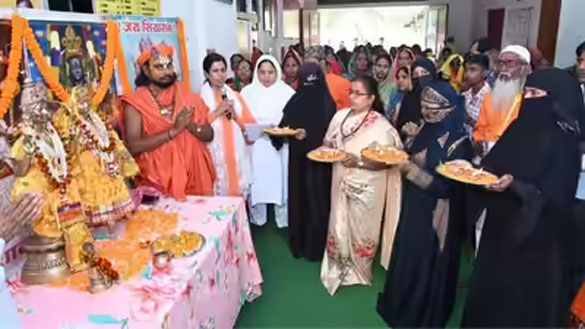
VARANASI: While Hindus celebrated Diwali across the country on Monday night, a group of Muslim women and men also joined them in the holy city of Varanasi to celebrate the festival of light with religious fervour. The Muslim women performed Aarti of Lord Shri Ram.
They made rangoli, decorated the idol of Lord Ram with flowers, and performed the aarti with full enthusiasm. They believe that the darkness of hatred can be eradicated from the world by lighting a lamp in the name of Ram.
The Muslim women gathered at the Subhash Bhavan in Lamhi village to celebrate Diwali and perform Lord Ram's aarti. They performed aarti of Lord Shri Ram and Mata Janaki's idols by lighting lamps in decorated plates. They sang the Shri Ram aarti composed in Urdu by Nazneen Ansari, the President of Muslim Mahila Foundation. After the aarti, Nazneen Ansari distributed Lord Shri Ram's prasad among the people.
“We have changed our religion, not dharma. Dharma is only Sanatan, and we all are Sanatani Hindus. All Indians are one through their ancestors and traditions. We just changed the way of worship, how can we abandon our ancestors and traditions because of this. Ram's arrival means happiness, prosperity, peace, compassion, love, kindness, relationships, values, unity, sacrifice, and respect. This is possible only through Ram's name, and every country should accumulate the wealth of Ram's name to save their family and nation,” said Nazneen Ansari, adding, “Our relationship with Afghanistan is of ancestors and blood. Lord Ram's statue should be installed in Afghanistan so that people there can connect with their ancestors' culture.”
Najma Parveen of Vishal Bharat Sansthan said, “We are not so shameless to forget our ancestors and pretend to be Arabic and Turkish. We are pure Indians and our roots are in Sanatan only. Caste and gotra are our identity. No fatwa and threat can separate us from our Ram.”
These women have been continuing the practice for 19 years under the joint aegis of Muslim Mahila Foundation and Vishal Bharat Sansthan. These Muslim women have been giving the message of communal harmony and unity by performing the Aarti of Lord Shri Ram every year since the 2006 terror blast in Varanasi.
Vishal Bharat Sansthan President, Rajiv Shriguruji, said that Ram's path is the only means to end the hatred spread in the world. Where Ram's footsteps fall, there will be the pleasant experience of Ramrajya. Ram's arrival means freedom from suffering, an increase in love, and values of service. This is what will make the nation great.
Source: indiatimes.com
https://timesofindia.indiatimes.com/city/varanasi/muslim-women-in-varanasi-celebrate-diwali-and-perform-aarti-of-lord-ram-to-promote-communal-harmony/articleshow/124716692.cms
------
‘Authenticity Is Our Biggest Advantage,’ Says Princess Lamia Bint Majed
NADA ALTURKI
October 21, 2025
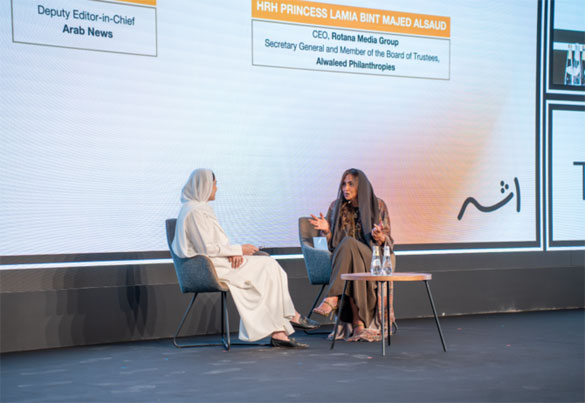
Princess Lamia bint Majed highlighted the growing influence of Saudi women in media at Athar Festival. (AN Photo/Jafar Al-Saleh)
-----------
RIYADH: Saudi Arabia’s creative spirit took centre stage at the third annual Athar Festival in Riyadh on Tuesday, where Princess Lamia bint Majed, CEO of Rotana Media Group and secretary-general of Alwaleed Philanthropies, spoke about the power of authentic storytelling in shaping Saudi narratives.
In a one-on-one fireside chat with Arab News Deputy Editor-in-Chief Noor Nugali — during a session titled “Telling the Saudi Story to the World” — Princess Lamia reflected on her journey from launching Rotana Magazine to leading one of the region’s most influential media groups. Arab News is a media partner of the festival.
“I think authenticity is our advantage,” she said. “I don’t think we need another Hollywood or Bollywood … What we have here is a new story, it’s a new tradition, new values for the world.”
She added that the Kingdom’s growing appeal lies in its cultural richness and individuality. “Now, why is everyone really interested in Saudi Arabia? Because it’s different, even from the perspective of heritage and culture, the materials, the places, the beautiful scenery, our natural resources, our tradition.”
Under her leadership, Rotana has preserved and promoted regional culture while embracing digital transformation.
“At the end of the day, we believed that there is a future for the Saudi media. Rotana is the first private Saudi entity launched as a Saudi private channel — Rotana Khaleejia — which is 100 percent Saudi. We are the first to believe in the Saudi talent and production,” she said, noting the company’s early support for films such as “Wadjda” by Haifaa Al-Mansour.
The group’s effort’s include restoring 2,300 Arabic films and using media as a form of soft power to connect with audiences in five languages.
Princess Lamia emphasized the role of Saudi youths in shaping the country’s media future: “Seventy-one percent of the population is under 35. They will be the ones to tell the stories and build the future, so those youth and this generation, they are the people that are going to tell the story … They don’t wait for someone to represent them anymore, they’re creating their own platform.”
Looking across the Athar audience, filled with students and emerging creatives, she said: “What we’re seeing here today, this is Saudi.”
She also highlighted the growing influence of Saudi women in the media, naming figures such as Jomana Al-Rashid, Nugali, Israa Assiri, and Haifaa Al-Mansour.
“The fact that women holding leadership positions in the Kingdom or doing something groundbreaking is not news anymore, that itself is a message,” Nugali said during the session.
“Now we’re writing the story,” Princess Lamia said. “We have the responsibility to keep the door open for the people (who come after). Every person is a story … You, me, and us — we will create the story of Saudi Arabia 2030.”
Source: arabnews.com
https://www.arabnews.com/node/2619712/saudi-arabia
-------
Three Women, Soudabeh Asadi, Jamile Azizi, and Somayeh Rashidi Die In Iran Prison Due To Denial Of Medical Care, Says Rights Group
OCTOBER 21, 2025
Human Rights Watch (HRW) on Monday accused Iranian authorities of causing three women to perish in Qarchak prison after systematic denial of adequate medical care, raising serious concerns over right violations and medical negligence in the country’s penal system.
The deceased prisoners were identified as Soudabeh Asadi, Jamile Azizi, and Somayeh Rashidi. Asadi, who was held on financial charges, died on September 16 after being denied timely transfer to a hospital. Azizi died on September 19 after staff reportedly dismissed her heart attack symptoms.
Rashidi, a 42-year-old political prisoner with known health issues, passed away in a hospital on September 25, ten days after suffering a seizure. According to HRW, prison officials initially accused Rashidi of feigning her illness and administered sedatives that worsened her condition. Iranian officials confirmed Rashidi’s death but stated that she had a history of drug use and neurological disorders and had received appropriate medical treatment. The official account is contested by rights advocates who point to a broader, deliberate policy of withholding necessary medical care from prisoners, particularly those detained on political charges.
HRW condemned Iranian authorities’ actions, framing medical care denial as a clear violation of the right to life. In its report, the organization stated:
The three women’s deaths are the latest in a long-standing documented policy of authorities denying prisoners access to healthcare, sometimes to punish and silence dissent. In an April 2022 report, Amnesty International detailed the circumstances surrounding the deaths in custody of dozens of men and women in 30 prisons across the country since 2010 as a result of denial of medical care. Many cases of denial of medical care and deaths in custody—in particular, prisoners detained for ordinary offenses and those from marginalized communities—goes unreported. Well-founded fears of reprisals by the authorities also severely hinder many families’ attempts to advocate for their loved ones.
Iranian prisons are notoriously overcrowded and suffer unsanitary conditions. Reports detail inadequate access to clean water, insufficient food, and rampant spread of disease. Qarchak prison is infamous for its harsh conditions. Originally a chicken farm, the facility was repurposed to house thousands of women—many of whom are political detainees or prisoners of conscience–in an environment that fails to meet basic international standards for prisoner treatment.
The deaths bring renewed attention to Iran’s obligations under international law. The United Nations Standard Minimum Rules for the Treatment of Prisoners, also known as the Mandela Rules, explicitly require states to provide prisoners with access to necessary health services without discrimination. HRW has called for urgent international action to hold Iran accountable and to protect other prisoners who remain at risk.
Source: jurist.org
https://www.jurist.org/news/2025/10/three-women-die-in-qarchak-prison-due-to-denial-of-medical-care-says-rights-group/
-----
Why more women in the Middle East are embracing a holistic approach to breast cancer recovery
JUMANA KHAMIS
October 21, 2025
DUBAI: For women diagnosed with breast cancer, survival is only a part of the story.
What follows — the emotional, physical and psychological process of recovery — often demands a different kind of strength.
Around the world, and increasingly across the region, conversations about healing are expanding beyond treatment alone to include body image, emotional safety and the right to feel whole again.
For Jen Blandos, founder and CEO of Female Fusion, that journey with breast cancer began twice.
Blandos was first diagnosed with breast cancer 13 years ago, and again in 2025. The recurrence, she says, came as both a shock and reminder of her resilience.
“After more than a decade, I never expected it to return, especially when I didn’t even feel a lump,” she told Arab News. “It was discovered during a routine scan, which made it even more surreal.”
The news, she admitted, was difficult to process. “I was frightened, not just of the cancer itself but of chemotherapy: things like losing my hair, being sick for months, and watching my body change again,” she said.
“It was an emotional rollercoaster, but I reminded myself that I’d faced it before, and I could do it again.”
What struck her most, though, was how much cancer care had evolved since her first diagnosis.
Thirteen years earlier, she found herself moving between hospitals and specialists, carrying her medical notes from one appointment to another.
“Today, in the UAE, you can walk into one hospital and have everything — diagnosis, surgery, chemotherapy or radiotherapy, and long-term care — all under one roof,” she said. “That’s a huge relief as a patient that you don’t need to be worried about remembering everything.”
Breast cancer remains the most commonly diagnosed cancer among women worldwide, with an estimated 2.3 million new cases and 670,000 deaths in 2022, as reported by the World Health Organization and the International Agency for Research on Cancer.
While survival rates have improved globally, disparities persist across developing regions where early screening and treatment access remain limited.
In the Middle East and North Africa, breast cancer accounted for roughly one in four new cancer cases among women and nearly 20 percent of cancer-related deaths in 2022, according to findings published in PubMed.
A 2023 study published in PubMed Central found that breast cancer is also the most common malignancy among women in all GCC nations: the UAE, Saudi Arabia, Kuwait, Bahrain, Qatar and Oman.
The study reported that five-year survival rates vary across the region. It reaches around 89 percent in the UAE and Qatar, compared to 72 to 75 percent in Saudi Arabia and Bahrain, reflecting differences in awareness, early detection, and access to multidisciplinary care.
As more women survive breast cancer, doctors say the next challenge lies in what comes after: how women see themselves, and how the health care system supports that journey.
“Breast reconstruction has a documented impact on the quality of life of a breast cancer patient,” said Dr. Stefano Pompei, reconstructive breast surgeon at Dubai’s Fakeeh University Hospital.
“Physical, emotional and sexual well-being are all elements of feminine life preserved also by the breast’s appearance,” he told Arab News.
Pompei explained that customized breast reconstruction should not be seen as an optional cosmetic step, but as a core part of recovery.
“These procedures reduce the negative physical and emotional experiences after a mastectomy, while improving body image and quality of life,” he said.
According to him, planning for reconstruction ideally begins the moment a patient’s cancer treatment is mapped out.
“It’s fundamental to choose a multidisciplinary breast unit with a qualified reconstructive plastic surgeon who collaborates with the breast surgeon,” he said.
“The reconstructive procedure should be planned simultaneously with the tumor excision in almost 100 percent of cases.”
Pompei added that options today are far more advanced and personalized than a decade ago.
Depending on the patient’s needs, reconstruction may involve reshaping remaining breast tissue, using an implant, or transferring tissue from another part of the body through microsurgery.
Despite the medical progress, awareness about reconstruction remains limited, particularly in the Arab region.
Many women are unaware that reconstruction can often be performed at the same time as their mastectomy, eliminating the need for additional surgeries later.
Others fear it will interfere with treatment or recovery, which doctors say is a misconception.
While surgeons or general practitioners are often the first to deliver a breast-cancer diagnosis, oncologists step in at one of the most delicate moments in a patient’s journey — when treatment decisions must be made.
“By the time we (oncologists) meet the patients, they already know what they’re facing. My role is to chart a plan and make sure I don’t overwhelm them with too much information all at once,” said Dr. Shaheenah Dawood, consultant medical oncologist at Mediclinic City Hospital in Dubai.
She emphasized that empathy and understanding are central to those conversations.
“It’s important to be honest, but also to understand how that individual is processing the information and whether they need someone close to them present,” she told Arab News.
“Each person is different, and it’s not only about individualizing therapy but also individualizing communication.”
Dawood noted that recent years have brought “an explosion of data” in breast-cancer management, with new approaches allowing doctors to personalize therapy in both early-stage and metastatic disease.
Novel clinical trials are helping physicians detect molecular changes long before they appear on scans, allowing for faster and more targeted intervention, said Dawood.
She added that new therapies such as immunotherapy for triple-negative disease and CDK4/6 inhibitors for hormone-receptor-positive breast cancer have “significantly improved overall survival.”
Despite these advances, she said barriers to early detection persist, with fear, lack of awareness, and even logistical challenges in accessing mammograms, still preventing many women from getting screened.
“Campaigns shouldn’t focus only on October. Breast cancer can occur at any time of year, and screening should be part of every woman’s regular health care routine,” said Dawood.
Beyond the scans, surgeries and statistics lies another phase of recovery, namely the silent work of rebuilding identity and peace.
For Yasmina Nagnoug, a clinical hypnotherapist, transformational coach and breast-cancer survivor, the healing journey begins where medicine ends — in the space between body, mind and soul.
“When I first received the news of breast cancer, I was scared but, strangely, not shocked,” she said. “Although I was young, active and had no genetic predisposition, my body had become the mirror of years of suppressed stress and inner conflict.”
Her experience inspired her to create the S.H.E. method — Soothe, Heal, Empower — a 12-week program that helps women process emotional trauma after illness.
“Healing isn’t about becoming someone new,” she said. “It’s about remembering who you truly are beneath the pain.”
Seven years after her diagnosis, she sees wholeness not as a return to who she was before cancer, but as a deeper alignment with herself.
“True wholeness means living from the inside out — connected to God, guided by love rather than fear,” she said. “I no longer chase perfection; I honor balance, authenticity and presence.”
Agreeing with the idea of conscious, whole-person healing is Nancy Zabaneh, who carries this belief into her work as a well-being educator and trauma-informed facilitator in Dubai.
“Healing goes beyond managing symptoms and embraces reconnection at several levels for inner strength and wholeness,” she said.
“Emotionally, it’s about allowing yourself to feel everything — fear, sadness, joy — and learning from those feelings instead of judging them.”
She believes that mindfulness and breathwork can help women bridge the distance between body and mind.
“After cancer treatment, many women describe feeling disconnected from their bodies,” she said.
“Mindfulness and gentle movement can help them release long-held tension and remind their bodies that they are safe again.”
Zabaneh, who recently spoke at Majlis Al-Amal, a well-being community by the Al-Jalila Foundation, said that compassion and connection are vital to recovery.
“We already value community deeply in this region. We simply need to extend that spirit to emotional well-being,” she said. “Healing isn’t about erasing what happened but about listening to the body with kindness rather than fear.”
That sense of connection is something Blandos, of Female Fusion, understands deeply. For her, healing meant finding strength in surrender and self-compassion. “I didn’t want to feel like I was ‘sick,’” she said.
“But I quickly realized that my body needed rest, and my business could continue without me being there.”
She credits her team for stepping up during her recovery and for showing her the value of allowing others to help. “Letting people support you isn’t weakness; it’s strength,” she said.
On the hardest days gratitude became her anchor.
“I focused on thankfulness: ‘Thank you for finding my cancer early. Thank you for my health insurance. Thank you for my doctors. Thank you for the chemotherapy making sure it doesn’t come back,’” she said.
“If I could help even one woman (feel less afraid) it would be worthwhile.”
Experts say the conversation about breast cancer in the Arab world is shifting from survival to wholeness, with growing openness around the emotional and physical impact of recovery.
As more survivors speak openly and medical care becomes increasingly integrated, the message from women like Blandos, Nagnoug and Zabaneh is clear: recovery is not just about surviving cancer, it is about reclaiming life with courage, balance and grace.
Source: arabnews.com
https://www.arabnews.com/node/2619725/middle-east
------
Satellite educational programming targets Afghanistan’s women
By Abigail Hofland
October 22, 2025
Afghanistan (MNN) — SAT-7 is a satellite TV ministry to the Middle East and North Africa. Its newest educational program is reaching an audience obscured from most of the world: women and girls in Afghanistan. Joe Willey says content is delivered in Dari, the Afghan people’s heart language.
“When you have a program in Dari, it really turns heads,” he says, pointing out that heart languages allow for greater depth of communication than do regional languages.
Willey says the programming is particularly important in Afghanistan, where girls are strictly banned from secondary or higher education.
“Really the way that girls or women in the country will be able to access any education is through a madrasa, or a religious center, but of course this is not from a Christian worldview,” Willey says.
In contrast, SAT-7’s programming is always grounded in a Biblical worldview, one that also celebrates literacy and a broader education. Beyond that, Willey says the content is culturally sensitive.
“SAT-7 is Christian content in the Middle East created by Middle Eastern Christians for the people of the Middle East, so the context is there, the understanding is there,” he says.
Satellite TV remains ubiquitous in Afghanistan, allowing SAT-7 to cast a wide net in search of an audience. Even as the country makes headlines for internet restrictions, Willey says SAT-7 can work around the shutdowns.
“SAT-7 has other ways that we can deliver the great content, but it just may be digital content via satellite, which is virtually uncensorable,” he says.
Please pray that this programming would serve as an open door for God’s Word to prick the hearts of women and girls across Afghanistan. Willey says it’s paramount for them to understand the Gospel.
“But also, what Scripture has to say about their worth.”
Would you ask the Lord to work in the hearts of Afghan women? Please pray that those viewing SAT-7’s programs would understand the value they have in the eyes of their Maker.
Source: mnnonline.org
https://www.mnnonline.org/news/reaching-afghanistans-women/
-----
Iran’s Regime Expands “Morality Control” Network to Intensify Crackdown on Women
By Mostafa Aslani
22 October 2025
In another attempt to tighten its grip on society and suppress women’s rights, Tehran’s so-called “Morality Headquarters” has announced the creation of a new repressive structure known as the “Hijab and Chastity Command Room.” This initiative, led by Ruhollah Momen-Nasab, the regime’s chief of the morality enforcement body in Tehran, marks a new escalation in the systematic oppression of Iranian women under the pretext of enforcing “virtue.”
Momen-Nasab proudly declared that over 80,000 trained morality enforcers would be deployed across Tehran to “create a major transformation” in enforcing dress codes. In practice, this means expanding surveillance, harassment, and punishment of women who reject compulsory veiling — a policy that has become a central tool of political control.
Observers note that this vast network of informants and enforcers equals the capacity of Tehran’s Azadi Stadium, a chilling reminder of the regime’s willingness to mobilize entire structures of repression to monitor its citizens.
At the same time, reports from Tehran, Qom, and Isfahan confirm the reappearance of morality patrol vans, signaling a coordinated nationwide effort to restore the same mechanisms of fear that fueled public outrage after the killing of Mahsa Amini in 2022.
While regime spokespersons claim that “no budget” has been allocated for such measures and that “the morality patrol has failed,” the reality on the ground tells another story. Momen-Nasab openly described a “smart, multilayered, data-driven operation” designed to track and analyze citizens’ behavior — in the streets, workplaces, and even online.
Despite public opposition and the visible defiance of countless women across Iran, authorities continue to enforce punitive measures:
Closure of businesses accused of non-compliance,
Fines for car owners,
Dismissal of unveiled female employees,
and bans on artists and athletes deemed “non-conforming.”
Even though the so-called “Hijab and Chastity Bill” was suspended by the regime’s security council, its implementation continues in practice, demonstrating how repression in Iran often bypasses even the regime’s own legal framework.
Divided Power, United in Repression
While regime President Masoud Pezeshkian has admitted that “force doesn’t work,” other regime institutions — including the morality headquarters, the parliament, and clerical networks — demand even harsher enforcement. This division reflects the regime’s broader crisis: it can no longer control a society that has outgrown its coercive structures.
Across Iran, women now openly appear in public without headscarves — from city streets to airports — a form of silent, powerful civil disobedience. Iranian society has written its own unwritten law — one that no command room or morality patrol can suppress.
From Street Patrols to Digital Surveillance
The morality patrol has not disappeared; it has mutated. The loud, visible vans of the past are being replaced by quieter, more insidious tools: digital tracking, message warnings, business closures, and networks of regime loyalists acting as informants.
This transformation marks a shift from overt violence to covert control, but the threat remains the same — the erosion of privacy, dignity, and basic human rights. The blurred boundaries of enforcement now mean that anyone — a neighbor, employer, or even a taxi driver — can act as an unofficial enforcer.
In such a system, no one is safe.
A Society Moving Forward
Three years after Mahsa Amini’s death, the regime has returned to its starting point — repression masked as “virtue.” Yet the people have changed. Iranian women, through their everyday acts of defiance, have turned “optional hijab” into a symbol of broader resistance — for personal choice, for dignity, and for freedom.
Repressive systems can suspend laws, fabricate fear, and issue threats, but they cannot halt a society that has already decided to move forward.
As the movement for women’s freedom grows, one truth becomes clear: fear may delay change, but it can no longer prevent it.
Source: irannewsupdate.com
https://irannewsupdate.com/news/women/irans-regime-expands-morality-control-network-to-intensify-crackdown-on-women/
------
URL: https://newageislam.com/islam-women-feminism/muslim-women-celebrate-diwali-lord-ram/d/137348