
Meet Firdosa Bashir, A Rising Star in Islamic Calligraphy from South Kashmir
New Age Islam News Bureau
02 October 2024
· Meet Firdosa Bashir, A Rising Star in Islamic Calligraphy from South Kashmir
· Iran to Enforce Prison Terms for Woman Journalists, Nilufar Hamedi and Elahe Mohammadi, In Mahsa Amini Case
· Egypt's Al Nour Wal Amal Blind Women Orchestra to Perform in Oman
· Burqa-Clad Woman Offering Prayers at Durga Puja Pandal in West Bengal a Scripted Video
· Hijab Case: Karnataka Clears AIMIM Leaders, Keeps Cases Against Hindu Students
· A Muslim Girl Was Brutally Beaten by Her Own FamilyIn Syria For Not Wearing Hijab
· Once A Tradition, Facial Tattoos Among Morocco’s Tribeswomen Disappear
Compiled by New Age Islam News Bureau
URL: https://www.newageislam.com/islam-women-feminism/firdosa-islamic-calligraphy-kashmir/d/133436
----
Meet Firdosa Bashir, A Rising Star in Islamic Calligraphy from South Kashmir
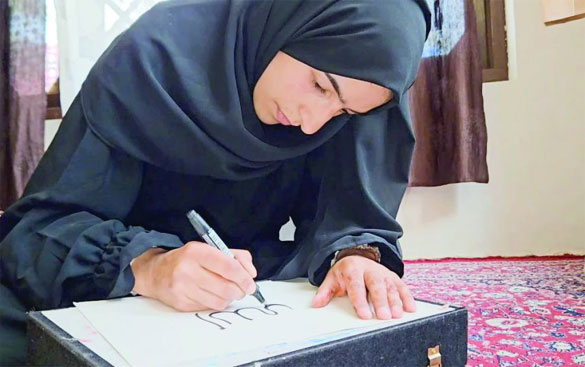
Kashmiri calligraphy artist Firdosa Bashir
------
October 13, 2024
Anantnag (J&K), October 13 (ANI): Firdosa Bashir is a talented Islamic calligraphy artist from Kehribal, Anantnag, in South Kashmir. After completing her 12th grade, she joined an Islamic seminary to delve into Islamic literature. With a profound passion for calligraphy, Firdosa has devoted herself to mastering the intricate techniques of Arabic script, skillfully blending traditional styles with her unique artistic vision. Her artwork beautifully captures the spiritual essence of Islamic teachings, showcasing the elegance and depth of the written word. Incorporating vibrant colors and intricate designs, each piece serves as a testament to her devotion and creativity. Beyond creating stunning calligraphy, Firdosa is committed to preserving and promoting this ancient art form within her community. Through workshops and exhibitions, she inspires others to appreciate the beauty of Islamic calligraphy and encourages aspiring artists to explore their creativity. Firdosa's dedication to her craft and cultural heritage has established her as a prominent figure in the realm of Islamic art. It's noteworthy that Kashmiri youth in remote areas possess immense talent; with the right exposure, they can showcase their abilities to a wider audience.
Source:aninews.in
https://www.aninews.in/videos/national/meet-firdosa-bashir-a-rising-star-in-islamic-calligraphy-from-south-kashmir/
----------
Iran To Enforce Prison Terms For Woman Journalists, Nilufar Hamedi and Elahe Mohammadi, In Mahsa Amini Case
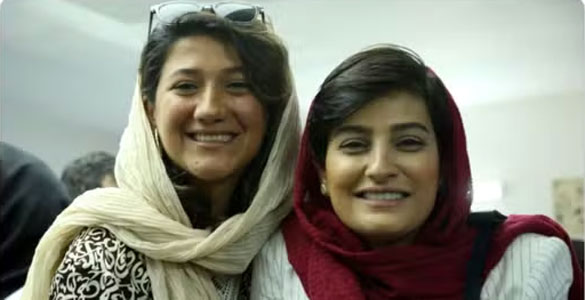
Niloufar Hamedi (left) and Elaheh Mohammadi, two Iranian journalists arrested in late September in Tehran, Iran. TWITTER
------
13 October 2024
Tehran, Oct 13 (EFE).- Iran’s judiciary announced on Sunday that the five-year prison sentences for two women journalists, who reported on the death of Mahsa Amini in police custody in 2022, will be enforced, despite calls for amnesty from their lawyers.
Nilufar Hamedi and Elahe Mohammadi were sentenced a year ago to 13 and 12 years in prison respectively. But their terms have been reduced to five years, judiciary spokesperson Asghar Jahangir told reporters.
Jahangir said the appeals court “acquitted” the two women journalists “of collaborating with the hostile American government in the appeals court.”
“As the maximum sentence of five years has been imposed, the case has been forwarded to the authorities responsible for the execution of sentences,” Jahangir said, as reported by the Mizan news agency.
However, defense lawyers PartoBorhanpour and HojatKermani said they were surprised at the announcement.
They argued that the two journalists should qualify for amnesty under a 2023 pardon decree by Iran’s Supreme Leader Ali Khamenei, aimed at those arrested during protests following Amini’s death.
“Today, the judiciary spokesperson announced that the sentences for NilufarHamedi and Elahe Mohammadi will be carried out, despite their cases falling under the amnesty decree,” one of the defense lawyers told the Shargh daily.
Hamedi and Mohammadi were initially denied amnesty due to the charge of “collaborating with a hostile foreign government.”
However, the Tehran provincial appeals court acquitted them of these charges in August, clearing the path for amnesty, according to their lawyers.
The two reporters were arrested in September 2022 after Hamedi published a photograph of Amini in the hospital, intubated and in a coma.
Mohammadi reported on Amini’s burial in the Kurdish town of Saqez, where the “woman, life, freedom” protests originated.
According to the Committee to Protect Journalists, nearly 100 journalists and photographers were arrested during the protests in Iran. Of those, 80 have been released on bail, including Hamedi and Mohammadi, who were freed last January after spending 17 months in temporary detention.
Amini’s death sparked widespread protests calling for an end to the Islamic Republic.
The protests were eventually suppressed by a government crackdown, which left 500 people dead, 22,000 arrested, and 10 executed. EFE
Source :efe.com
https://efe.com/en/other-news/2024-10-13/iran-to-enforce-prison-terms-for-woman-journalists-in-mahsa-amini-case/
----------
Egypt's Al NourWal Amal blind women orchestra to perform in Oman
Sunday 13 Oct 2024
The concert, scheduled for Thursday, 17 October, is part of the Royal Opera House's celebration of Omani Women's Day.
The evening will open with the Royal Oman Symphony Orchestra (ROSO) Ladies Chamber Ensemble, followed by Al NourWalAmal's performance in the second half, where they will be also joined by the ROSO Ensemble, alongside the Moroccan pianist NourAyadi.
Conducted by Tamer Fahmy, Al NourWal Amal, an Egyptian orchestra made up of blind and visually impaired musicians, will perform works by Josef Strauss, Dmitri Shostakovich, Wolfgang Amadeus Mozart, Camille Saint-Saëns, and Jacques Offenbach. The program also includes Mohamed Abdel-Wahab'sDoaa El Sharq.
Accompanied by the orchestra, Ayadi will perform the Allegro movement from Mozart's Piano Concerto No. 12, K. 414 in A major,
This marks Al NourWalAmal's debut performance in Oman. The same concert was initially scheduled for 19 October 2023 but was cancelled due to the outbreak of the Israeli war on Gaza (7 October 2023). In response to the war, many Arab cultural institutions and artists postponed or cancelled events in solidarity with Palestine.
The evening's original lineup also included a performance by Lebanese star Majida El Roumi, who withdrew due to the attack on her home country (1 October 2024).
For the orchestra, this concert will be their first international appearance without Amal Fikry (1929-2024), the long-serving president of Al NourWal Amal Institute, who passed away in March 2024. Fikry, who had supported the orchestra since the late 1960s, played a key role in organizing their performances in Egypt and abroad.
The orchestra is part of Al-NourWal Amal Association, an NGO for Egyptian blind girls founded in 1954 by a group of volunteers led by the late IstiklalRadi, with the aim of educating visually impaired girls and helping them integrate into society.
In 1961, seven years after the establishment of the association, Al-NourWal Amal Music Institute was founded by the late Samha El-Kholy, former dean of the Cairo Conservatory. The girls started being trained by musicians from the Cairo Conservatory and the Cairo Symphony Orchestra. The girls study all aspects of music: theory, harmony, solfege, ear-training and learn to read music in Braille.
With the dawn of the 1970s, the few musicians strong orchestra started performing across a variety of venues in Cairo and made its first appearance at the stage of the Old (Khedivial) Opera House in early 1971. International tours kicked off in 1988, when the orchestra performed in the famous Town Hall of Vienna.
In the following decades, the orchestra performed extensively in more than 30 countries on five continents.
Today, the orchestra's repertoire consists of many well-known Western classical music compositions, topped with a few works from the Arab/Oriental repertoire. Often they also add a work of the country they are visiting to their performance.
Throughout the years, the orchestra was led by maestri Ahmed Abul Eid, Ali Osman, and Mohamed SaadBasha.
The current conductor of the orchestra is Tamer Fahmy, a musicians who also teaches the girls and is the ensemble's music director.
Royal Opera House Muscat
The orchestra's first visit to Oman will be at the Royal Opera House Muscat, which describes itself as "a place of learning, entertainment, and inspiration." The Royal Opera House is a leading cultural institution in Oman, hosting top performers and ensembles from the Arab world and the international stage.
The 2024-25 season has already featured Verdi's Un Ballo in Maschera, performed by the National Centre of Performing Arts Beijing (NCPA). Upcoming performances include India's sitar virtuoso Nishat Khan accompanied by the European Philharmonic Orchestra under conductor Walter Proost. They also include a concert featuring Lebanese-Canadian soprano Joyce El Khouri, pianist SeroujKradjian, and a Lebanese ensemble performing Scheherazade, among other events.
Source: ahram.org.eg
https://english.ahram.org.eg/News/533391.aspx
----------
Burqa-Clad Woman Offering Prayers at Durga Puja Pandal in West Bengal a Scripted Video
October 14, 2024
By Kushel HM
A 4-minute 15-second video, purportedly showing a Muslim woman removing her burqa to offer prayers at a Durga Puja Pandal in West Bengal, surprising the priest and onlookers with her devotion, has gone viral across social media platforms.
“A Muslim woman came to offer Puja (prayers) to Goddess, Maa Durga, while wearing a Burqa but the Pujari (Priest) immediately stopped her and asked her if she wanted to offer prayers then she must remove her Burqa. The Muslim woman removed her Burqa without any hesitation to offer her prayers and take blessings from Maa Durga. The pujari also gave his blessings to her later. If you have faith then you can come and offer your prayers otherwise don’t come,” read an X post, sharing the purported CCTV footage, dated September 30, 2024.
Fact Check
Newschecker noticed that in one of the videos shared by a user, there was a disclaimer at the end, stating, “This reel life video footage published only for the purpose of educating the public…Characters in the video are for education and entertainment purports”, which indicates that it was staged.
We then ran a reverse image search of keyframes, which led us to the earliest instance of the video uploaded online on October 10, 2024, by actor Sanjjanaa Galrani on Facebook, titled, “This Was Unexpected...!”
“Disclaimer: Thank you for watching! Please note that this page features scripted dramas, parodies, and awareness videos. These short films are created for entertainment and educational purposes only. All characters and situations depicted in the videos are fictional and intended to raise awareness, entertain, and educate,” read the post, confirming that it was scripted.
We saw that the actor has shared several scripted videos, along with digital creator IdeasFactory, on her page. Newschecker had already debunked two such staged videos shared as real. One video went viral, falsely claiming to show a priest miraculously surviving a heart attack inside a Ganpatipandal, while the other allegedly showed a child hitting his mother with a cricket bat after she took away his mobile phone, and forced him to study.
Viral video claiming to show a burqa-clad woman offering prayers at a Durga Puja pandal found to be staged.
Source: newschecker.in
https://newschecker.in/fact-check/scripted-video-showing-burqa-clad-woman-offering-prayers-at-durga-puja-pandal-shared-as-real/
----------
Hijab case: Karnataka clears AIMIM leaders, keeps cases against Hindu students
Oct 14, 2024
The Karnataka government has stirred controversy by selectively dropping cases related to protests during the COVID-19 pandemic. The state cabinet recently approved the withdrawal of charges against All India Majlis-e-IttehadulMuslimeen (AIMIM) leaders, including Zahiruddin Ansari, who were booked for organizing a ‘Hijab is our right’ procession in Kalaburagi district’s Aland city. The protest took place during the third wave of the COVID-19 pandemic and resulted in cases filed under the Epidemic Diseases Act.
However, in a contentious decision, the cabinet declined to withdraw cases against Hindu students from Harihara of Davangere district, despite a sub committee's recommendation for withdrawal. The students, including B.Com students Dhanush and Maruthi, were charged with unlawful assembly, rioting, and disrobing the hijabs of Muslim girls during a protest against the hijab in a local college. This refusal has drawn criticism, with the Opposition BJP questioning the move.
Karnataka state BJP president BY Vijayendra said, “They are doing appeasement politics and Chief Minister Siddaramaiah is trying to divert the main issue of MUDA land scam allegations by doing this.”
Senior BJP leader Ashwath Narayan said that the state government was withdrawing cases to appease one particular community.
In addition to this, the Karnataka Cabinet also refused to drop three cases against Union Minister V Somanna, who was booked during the Cauvery water agitations. The minister faces charges from his participation in protests, but the cases remain active despite political support for their dismissal.
The government’s selective approach in withdrawing cases has fueled debates on bias and political favoritism. Critics argue that the inconsistency in withdrawing cases, especially those recommended for withdrawal by a cabinet subcommittee, reflects unequal treatment of protesters based on their political or religious affiliations. Meanwhile, supporters of the government claim the decisions were made based on the nature and severity of each case, rather than any bias.
Source: indiatoday.in
https://www.indiatoday.in/india/karnataka/story/karnataka-clears-aimim-cases-keeps-charges-against-hindu-students-hijab-row-2616545-2024-10-14
----------
A Muslim Girl Was Brutally Beaten By Her Own Family In Syria For Not Wearing Hijab
SIBY JEYYA
14/10/2024
In a deeply disturbing incident in Syria, a young Muslim girl was reportedly brutalized by her own family for refusing to wear the hijab, a traditional Islamic headscarf. According to witnesses, the girl attempted to escape her family's wrath, running through the streets as they chased her down. When they caught up to her, they dragged her by her hair and severely beat her in public. Her desperate cries for help echoed in the streets, yet no one intervened, seemingly treating the violence as routine or acceptable under cultural or religious norms.
This horrific scene highlights the harsh enforcement of conservative practices, which some communities associate with Sharia law, though interpretations of Sharia vary widely. In extreme cases, societal or familial pressure is applied to ensure that women adhere to strict dress codes, and refusal to comply can result in severe punishment, as seen in this tragic case.
Many activists and human rights organizations have condemned such acts of violence, arguing that they represent a misapplication of religious principles and a violation of basic human rights. Women's rights advocates continue to call for greater protection for women facing these oppressive practices, emphasizing that no religion or culture should justify violence against women. However, in many regions, fear and tradition still silence those who might otherwise stand up against such brutality.
Source: indiaherald.com
https://www.indiaherald.com/Breaking/Read/994753820/A-Muslim-girl-was-brutally-beaten-by-her-own-family-in-Syria-for-not-wearing-hijab-VIDEO
----------
Once a tradition, facial tattoos among Morocco’s tribeswomen disappear
October 14, 2024
As a young girl growing up in the Atlas mountains, HannouMouloud’s family took her to have her chin tattooed with the cherished lines that generations of Moroccan Amazigh tribeswomen wore.
“When I was six, they told me tattoos were pretty adornments,” recalled the 67-year-old from Imilchil village of the once-common practice among women in North Africa’s Amazigh groups.
Long referred to as Berbers, many tribespeople from the area prefer to be called Amazigh, or Imazighen, which means “free people”.
Today, like in many of the Indigenous cultures across the world where facial tattoos were long prevalent, the practice has largely faded.
Changing attitudes
Many attribute the near-disappearance of facial tattoos to Morocco’s changing religious attitudes in recent decades, with interpretations of Islam, where inked skin and other body modifications like piercings are prohibited, taking hold.
“We would use charcoal to draw the designs on our faces, then a woman would prick the drawing with a needle until blood came out,” Ms. Mouloud said, adding that they would rub the wound daily with a chewed green herb to deepen the tattoo’s colour.
The markings vary in design between the minority’s tribes and were used to signify the wearer’s origin while offering beauty and protection.
Painful custom
Being tattooed would hurt, said Hannou Ait Mjane, 71, and “we could not hold back our tears” but it “remains a tradition that our ancestors passed down to us”.
AbdelouahedFinigue, a geography teacher and researcher from Imilchil, said that women often had their chins, foreheads, or hands tattooed.
“Some women had intimate areas tattooed as a wedding gift, expressing their love for their husband,” he added.
“The woman, through her tattoos, expresses her beauty and her value as an individual independent of the man,” he said, explaining what the different shapes can mean.
“The circle, for example, represents the universe and beauty, just like the moon and the sun which occupied an important place in local rites,” he said.
But changing religious trends means fewer women are getting inked.
“In recent years, this custom has been tainted by preconceived ideas from Salafist currents,” he added, referring to a Sunni Islamist movement that seeks to return to the practices and teachings of the Prophet Mohammed. BassouOujabbour, member of local development association AKHIAM, said women with the markings have faced social pressure.
“Fundamentalists sometimes describe tattooing as the devil’s book or as the first thing to be burned on the human body,” he said.
“Some women even removed the tattoos long after getting them for fear of punishment after death.”
Source: thehindu.com
https://www.thehindu.com/news/international/once-a-tradition-facial-tattoos-among-moroccos-tribeswomen-disappear/article68751181.ece
----------
URL: https://www.newageislam.com/islam-women-feminism/firdosa-islamic-calligraphy-kashmir/d/133436