
Islami Andolan Bangladesh, Bangladesh Khelafat Majlis And Khelafat Majlis Looking To Usher In Women Voters
New Age Islam News Bureau
01 June 2026
· Islami Andolan Bangladesh, Bangladesh Khelafat Majlis and Khelafat Majlis looking to usher in women voters
· Hindu outfits launch 'saffron shawl' campaign against Karnataka hijab order
· Norway Protest: Taliban’s Recognition of Child Marriage Threatens Girls’ Future
· Everest climber launches campaign for girls’ education in Afghanistan
· Muslim interfaith activist says she will march in NYC Israel parade despite threats
· Adeeba Anam's story of becoming first Muslim woman IAS from Maharashtra is inspirational
· National scholarship for Muslim girl students can change lives
· Emirati, Polish writers redefine women's narratives
Compiled by New Age Islam News Bureau
-----
Islami Andolan Bangladesh, Bangladesh Khelafat Majlis and Khelafat Majlis looking to usher in women voters
1 JUNE 2026
Islami Andolan Bangladesh, Bangladesh Khelafat Majlis and Khelafat Majlis are moving to expand their reach among female voters and have already begun work to set up party-backed, independent platforms for women and female students.
Leaders of the Islamist parties say the initiatives aim to strengthen bases among female students, spread Islamic value-based political messaging, and develop women leaders.
According to political observers, the move reflects a restructuring of Islamist parties, influenced by the importance of female voters and rising political awareness among young women.
In the 13th parliamentary election, Jamaat-e-Islami successfully mobilised its central, associate and professional wings; women’s division; and party-affiliated student organisation. Analysts said the outreach helped increase Jamaat’s visibility among female voters and students.
Islami Andolan contested the election under the “hand fan” symbol. The party was initially part of a Jamaat-led 11-party alliance but withdrew before the polls. It secured 2.70 percent of the vote and won one seat.
Founded in 1987 under Charmonai Pir, Islami Andolan did not have a formal women’s wing for a long time. The party formed a 34-member women’s unit on International Women’s Day last year.
On the proposed female student wing, Islami Andolan Secretary General Yunus Ahmad said the initiative aims to expand dawah-based and organisational activities among women.
“Half of the country’s population is women. This initiative stems from the idea that female students should become highly educated and help carry out dawah activities,” he said.
He said work on the constitution, policy framework and organisational structure is underway to accommodate the change in policy.
Bangladesh Khelafat Majlis Ameer Mamunul Haque, in a Facebook post on May 23, announced the launch of the party’s women’s and student divisions.
He said the party is advancing with a four-stage vision of establishing Islam, from personal practice to state-level implementation of Islamic principles.
Mamunul said divisions were formed to enhance women’s rights, responsibilities and religious consciousness.
Party Secretary General Jalaluddin Ahmad said a policy decision was taken at the central committee meeting in April, and membership recruitment is underway.
“Initially, women and female students will be organised under one platform, with the possibility of separate wings later depending on capacity,” he told The Daily Star.
He said online and offline programmes are raising awareness among women about dawah, social responsibility and political participation, and the structure will be formalised as membership grows.
Meanwhile, Khelafat Majlis Secretary General Ahmad Abdul Qader said the initiative stems from the need to engage a large section of the population in dawah and organisational work.
“There are millions of women in the country. It is necessary to expand Islamic work among them,” he told this newspaper.
Past structural limitations had previously restricted such engagement, but the environment is now conducive, he said.
Speaking on the matter, political analyst Altaf Parvez said Islamist parties are focusing more on female voters and students to build support bases and expand ideological influence.
“While political awareness among women has grown through education, technology and internet access, their participation in party structures remains limited.”
He added that the move could aid organisational expansion and ideological outreach and reflects a broader effort by right-leaning forces to reorganise.
North South University professor AKM Waresul Karim said some believe Jamaat received a higher share of women’s votes in the last election. “It can be assumed that other parties are also taking similar initiatives to counter or respond to that.”
He added that many students are enrolled in madrasas outside mainstream educational institutions. “A large portion of them are female students. Therefore, these parties may feel the need for representation there and to build capacity to compete with Jamaat.”
Source: thedailystar.net
https://www.thedailystar.net/news/bangladesh/news/islamist-parties-looking-usher-women-voters-4187706
------
Hindu outfits launch 'saffron shawl' campaign against Karnataka hijab order
Jun 1, 2026
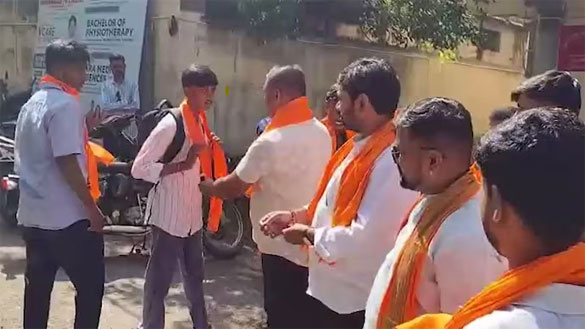
The "saffron shawl" campaign is expected to continue across the state in the coming days.
-----------
Several Hindu organisations have launched protests across Karnataka following the state government's decision to allow students to wear religious symbols, including the hijab, in schools and colleges.
Members of Sri Rama Sena and other Hindu groups have begun distributing saffron shawls to students as part of a statewide campaign aimed at opposing the government's move. The drive was launched on Sunday, with activists distributing saffron shawls in educational institutions in Hubballi and other parts of Karnataka.
Leaders of the organisations said the campaign is intended to register their protest against the government's decision to permit the hijab in educational institutions. They alleged that the move amounts to appeasement politics and argued that the policy could reignite religious divisions on campuses.
The "saffron shawl" campaign is expected to continue across the state in the coming days, potentially reviving the debate over religious attire in educational institutions that had sparked widespread controversy in Karnataka in recent years.
The protests came days after the Karnataka government issued an order allowing students to wear religious symbols such as the hijab, sacred thread (janeu), Shivadhara and rudraksha in schools and colleges.
The order effectively withdrew the previous BJP government's 2022 directive that had prohibited the hijab in government educational institutions following the high-profile hijab-versus-saffron shawl controversy.
The issue triggered a fresh political row after caretaker Chief Minister Siddaramaiah clarified last week that saffron shawls would not be permitted in educational institutions under the new policy. He said practices already in existence, including the wearing of hijabs, turbans, rudraksha beads and sacred threads, would continue to be allowed.
The BJP criticised the clarification, accusing the Congress-led government of pursuing appeasement and vote-bank politics, while the state government maintained that the order was aimed at accommodating existing religious practices.
Source: indiatoday.in
https://www.indiatoday.in/india/story/karnataka-hijab-order-sparks-saffron-shawl-protests-hindu-groups-hubballi-2920153-2026-06-01
------
Norway Protest: Taliban’s Recognition of Child Marriage Threatens Girls’ Future
01-06-2026
KABUL, AFGHANISTAN – A number of protesting women, civil society activists, and human rights defenders from Afghanistan in Norway held a protest gathering to condemn the Taliban’s recognition of “child marriage” in the “Regulation on the Separation of Spouses,” describing it as a clear violation of children’s rights.
During the gathering, which was held today (Sunday, May 31), they emphasized that the Taliban’s recognition of child marriage would facilitate increased abuse of young girls in Afghanistan and threaten the future of thousands of girls.
Participants called on the Norwegian government and the international community not to remain silent in the face of the “widespread violations of human rights in Afghanistan” and to use all diplomatic and legal tools available to increase pressure on the Taliban.
According to the protesters, depriving girls of education and pushing them into forced marriages at a young age constitutes a clear example of structural discrimination and a violation of fundamental human rights.
They urged the international community and international organizations to recognize the Taliban’s actions against Afghan women as “gender apartheid” and to provide the necessary support to the victims of these policies.
The Taliban have introduced a new decree, officially titled the “Code on Judicial Separation of Spouses,” which establishes rules governing divorce, marital separation, and related family matters in Afghanistan. Approved by Hibatullah Akhundzada, the decree grants men the unilateral right to divorce while requiring women to go through restrictive and complex judicial procedures to seek separation.
The regulation also implicitly recognizes child marriage by allowing a girl’s silence upon reaching puberty to be interpreted as consent to marriage, raising serious concerns about forced and underage marriages. Critics say the decree reinforces legal inequality between men and women and further restricts women’s autonomy within marriage and family life.
The Taliban have not specified any minimum age for marriage in the regulation. Instead, they have explained how child marriages can be annulled and how a child who was forced into marriage may request the annulment of the marriage after reaching puberty.
The publication of this regulation has sparked widespread criticism from women’s rights activists, human rights defenders, and rights organizations.
Human rights organizations have repeatedly warned that child marriage can have severe consequences for girls, including the loss of educational opportunities, increased health risks, and long-term social and economic challenges.
Earlier, a coalition of more than 100 human rights and women’s rights organizations called for immediate repeal of the regulation, arguing that it legitimizes child and forced marriage and weakens legal protections for women and minors.
In a joint statement, the groups said several articles of the code include provisions that could be interpreted as recognizing child and forced marriages, and criticized language that treats a girl’s silence after puberty as consent.
Taliban spokesperson Zabihullah Mujahid defended the decree, arguing it is based on the group’s interpretation of Islamic law and that external criticism is not important.
Since their return to power nearly five years ago, the Taliban have imposed some of the world’s most restrictive policies on women and girls. These include bans on secondary and higher education for girls, severe limits on female employment and travel without a male guardian, and wide-ranging exclusions from public and political life.
UN experts, rights groups, and activists have repeatedly said the scale and systematic nature of the Taliban’s restrictive measures amount to “gender apartheid,” describing them as an institutionalized system designed to subjugate women solely based on their gender.
Source: kabulnow.com
https://kabulnow.com/2026/05/norway-protest-talibans-recognition-of-child-marriage-threatens-girls-future/
------
Everest climber launches campaign for girls’ education in Afghanistan
By Parsa Katal
MAY 31, 2026
Zakia Ahmad, an Afghan mountaineer who recently summited Mount Everest, has launched a campaign in support of girls’ education in Afghanistan, urging people around the world to stand up for the rights of women and girls.
Ahmad said the initiative aims to draw attention to the continued denial of education for millions of girls under Taliban rule and to mobilize support for their right to attend school and university.
Her campaign comes as restrictions on female education remain firmly in place nearly five years after the Taliban returned to power.
Separately, Afghan activists and members of the Afghan diaspora gathered in Germany to demand the reopening of schools and universities to girls. Demonstrators carried banners and chanted slogans including “No to the Taliban” and “Bread, Work, Freedom,” while urging the international community not to remain silent about the situation facing women in Afghanistan.
“We ask the United Nations, the international community and human rights organizations to be the voice of Afghan women and to support Afghan women and children,” said Hasnia Faqiri, a human rights activist who participated in the gathering.
Another participant, Saleha Aini, said the protest was intended to amplify the voices of women inside Afghanistan who have been deprived of their rights.
“We are speaking on behalf of Afghan women who have been stripped of their basic rights,” she said. “No one should ignore the voices of Afghan women.”
The renewed calls for action come amid growing criticism from international advocates.
Malala Yousafzai, the Nobel Peace Prize laureate and global education activist, recently condemned what she described as international silence and indifference toward the situation of women and girls in Afghanistan. She urged world leaders not to remain passive in the face of what she called widespread violations of women’s rights.
Inside Afghanistan, many girls remain unable to continue their education.
“Since the Taliban came to power, I have been very upset,” said Nahid, a student who has been barred from attending school. “They closed the schools, they closed the universities, and we lost hope.”
The Taliban banned girls from attending secondary school shortly after returning to power in August 2021 and later barred women from universities. The restrictions have affected millions of girls and women and have drawn repeated condemnation from the United Nations, human rights groups and governments around the world.
Despite sustained international pressure, Taliban have shown no indication that they plan to reverse the policy.
The issue has gained renewed attention in recent days after Din Mohammad, the head of the Taliban’s Council of Ulema in Kabul, described education for women and girls as “forbidden.” In remarks that drew widespread criticism, he argued that women should be limited to studying certain religious subjects related to marriage, child-rearing and household responsibilities.
Human rights advocates and religious scholars have condemned the comments, saying they have no basis in Islamic teachings and further underscore the Taliban’s opposition to female education.
For Ahmad and other campaigners, the fight over education remains central to Afghanistan’s future.
Their message is that denying girls access to education not only violates fundamental rights but also undermines the country’s prospects for development and prosperity.
Source: amu.tv
https://amu.tv/241411/
------
Muslim interfaith activist says she will march in NYC Israel parade despite threats
31 May 2026
Anila Ali, a Pakistani-American Muslim and women’s rights activist, says she will lead the first Muslim group to march in the Israel on Fifth Parade in New York City today, despite threats.
Ali tells the New York Post that “nothing is deterring me.”
“We are a little worried after somebody’s been calling and saying to wear a bulletproof vest,” Ali tells the newspaper. “But we’re fighting to take back our country and it’s a fight that every American should join.”
“I’m now speaking at the height of antisemitism in America for my Jewish brothers and sisters,” the founder of the American Muslim and Multifaith Women’s Empowerment Council says, adding that she hopes to be joined by a few dozen members of the Muslim community for the march.
Last week, Democratic socialist Councilwoman Shahana Hanif wrote on X that she hoped Ali and another organizer were condemned to the Islamic equivalent of hell for joining a protest against NYC Mayor Zohran Mamdani.
Mamdani will be the first mayor of the city to skip the parade in over 60 years.
Source: timesofisrael.com
https://www.timesofisrael.com/liveblog_entry/muslim-interfaith-activist-says-she-will-march-in-nyc-israel-parade-despite-threats/
------
Adeeba Anam's story of becoming first Muslim woman IAS from Maharashtra is inspirational
31-05-2026
Adeeba Anam Ashfaq Ahmed Shaikh is Maharashtra's first Muslim woman IAS officer, and here we bring to our readers the story of her inspiring journey.
In April last year, a news item in the media caught the attention of the people across Maharashtra. History was made that day. The final results of UPSC 2024 were announced, and Maharashtra got its first Muslim woman IAS officer.
The daughter of an ordinary Muslim auto-rickshaw driver from a small village in Yavatmal had qualified for the examination to join the Indian Administrative Services. The news spread like wildfire, and a wave of joy swept across Maharashtra.
Adeeba Anam hails from the Yavatmal district, which is often in the news for farmer suicides and severe economic hardships. Adeeba's father, Ashfaq Ahmed Shaikh, drives an auto-rickshaw to provide for the family, which includes Adeeba’s mother and two younger brothers.
She was brilliant in her studies and had a particularly strong grasp of Mathematics. She achieved resounding success in both her 10th and 12th board exams, and for further studies, she moved to Pune and graduated in Mathematics (B.Sc) from the Azam Campus.
It was in Pune that she decided to try for the civil services. "If we want to bring about a change in society or solve people's problems, the Civil Services is an excellent medium," she said at the time of her clearing the Civil Services by securing the 142nd rank across India.
On his daughter’s achievement, her father Ashfaq says, "Subah roshanhai, shaamroshanhai.. Zindagi ka nizam roshanhai, Log beton pe naazkarte hain, merabeti se naam roshanhai..." (The morning is bright, the evening is bright... The system of life is bright. People take pride in their sons, but my name shines because of my daughter...). Each word he uttered was said with immense pride.
He further adds, "I never differentiated between a son and a daughter. My daughter has been highly talented since her childhood. I recognised this quality and decided to provide her with a good education. To achieve this, I even fought against my circumstances."
"Adeeba's journey up to this point was not easy," Ashfaq continues. "All of us had to endure a lot of mental stress. We constantly heard taunts from society, but I turned a blind eye to all of it. I never let it affect her education. To educate her and make her an officer was the only goal we had in our minds.
Adeeba completed her primary education at the Zilla Parishad Urdu Primary School in Zafarnagar and schooling at a government institution in Yavatmal.
Adeeba's father was a school dropout, but he resolved that his children should not suffer the same fate. Education was always given the highest priority in Adeeba's family, irrespective of financial hardships.
On an emotional note, Adeeba said, "Even when my family's financial condition was dire, my parents never asked me to drop out. Many people would advise me to take up a job. Many boys and girls around me quit their studies to work, or worked while studying. But my parents never pressured me for a job."
Coming from a small town to a big city and living alone in Pune was not easy for Adeeba. She had to manage everything on her own—food, accommodation, and travel, along with the heavy burden of studies.
In such circumstances, her family stood firmly by her side. "We live in a patriarchal society. But my family never discriminated between a boy and a girl; they raised me with the same love and affection as my two brothers. On the contrary, they always taught me to dream big and fulfil them with sheer determination," she said.
This journey was not without its share of failures. She cleared the coveted examination on her fourth attempt. After each failure, she started all over again.
She joined the Haj House IAS Training Institute and the Jamia Residential Coaching Academy (RCA) in Delhi.
Adeeba shared an interesting incident from her journey. In the personal interview, one of the panellists asked her about her background and the social issues prevalent in Maharashtra. Specifically, he wanted to know what changes she wished to bring about as a female officer.
Adeeba says consistency and disciplined study played a role in her success. She used to study 8 to 10 hours every day. Reading the newspaper daily and making her own notes were an integral part of her routine.
Adeeba emphasises that consistency and patience are essential to achieving success. "Giving four attempts to reach my goal was actually a test of my patience. But showing patience every time is not right. Because sometimes situations arise where someone is being wronged and we just stand by and watch; at such times, instead of showing patience, one must raise their voice."
In a message to girls who dream big, Adeeba says, "I want to tell my friends studying in rural areas that no matter what your circumstances are, keep your dreams big. Never drift away from education. What matters more than what is happening in society or around you is how much you focus on your goal. Work hard, stay consistent, and believe in yourself. Success will definitely be yours.
Source: awazthevoice.in
https://www.awazthevoice.in/-news/adeeba-anam-s-story-of-becoming-first-muslim-woman-ias-from-maharashtra-is-inspirational-60434.html
------
National scholarship for Muslim girl students can change lives
01-06-2026
The Central Government's Begum Hazrat Mahal National Scholarship Scheme has the potential to change lives of young women belonging to religious minorities of India with the government taking care of their expenses and not letting them drop out of school.
Though this scheme is for the girls of six religious denominations including Sikhs, Jains, Parsis Buddhists and Christians – it is in essence targeted at dealing with high dropout rate of Muslim girls.
Earlier known as 'the Maulana Azad National Scholarship for Meritorious Girls in its new version, it envisages financial incentive for female students who excel academically but find their progress hindered by financial constraints.
The scheme was launched in 2003 by the then Prime Minister, Atal Bihari Vajpayee.
Under this scheme, beneficieries studying in classes 9 and 10 are entitled to a scholarship of ₹5,000. While those in classes 11 and 12 receive ₹6,000.
This amount is transferred directly into the student's bank account. The scholarship funds may be utilized to pay school or college fees, purchase textbooks, acquire stationery, and cover expenses related to hostel accommodation or living costs.
The student must have secured a minimum of 50 percent marks in the previous academic class. Furthermore, the annual income of her parents or guardians must not exceed ₹200,000. It is mandatory that the income certificate be issued by the relevant competent government authority.
The most significant feature of this scheme is its transparent online process. Applications are accepted exclusively through the National Scholarship Portal. Students are required to submit their applications online
Selection for the scholarship is based on merit and income. State-wise and community-wise quotas have also been established.
This allocation system is determined based on the minority population recorded in the 2011 Census. If a sufficient number of applications are not received from a particular state or community, the remaining scholarships may be awarded to eligible female students from other states.
Experts believe that such schemes have a significant social impact. When a woman advances her education by securing a scholarship, it has a ripple effect on the family and society. This promotes girls' education and reduces the likelihood of girls dropping out of school.
Source: awazthevoice.in
https://www.awazthevoice.in/women-news/national-scholarship-for-muslim-girl-students-can-change-lives-60437.html
------
Emirati, Polish writers redefine women's narratives
01-06-2026
Sharjah24: Questions of identity, authorship and the changing portrayal of women in literature took centre stage at the Warsaw International Book Fair 2026, as Emirati writer and critic Dr. Hind Al Mashmoom and Polish author Grażyna Plebanek examined how female voices and experiences have evolved across literary traditions in the UAE and Poland.
Held as part of Sharjah’s Guest of Honour programme, the session, titled “Women's Stories in Emirati and Polish Literature”, brought together perspectives from two distinct cultural contexts while revealing shared literary concerns around representation, agency and the role of storytelling in reflecting social change.
Al Mashmoom challenged the distinction often drawn between “women’s writing” and “men’s writing”, arguing that literature should be assessed not through the gender of its author but through the questions it raises and the human and artistic horizons it opens.
She noted that Emirati women’s writing has undergone significant transformation over recent decades, evolving beyond questions of visibility and self-expression to engage with broader themes of identity, belonging, family, society and the human condition. Contemporary Emirati literature, she explained, reflects a growing diversity of perspectives shaped by individual experiences and creative approaches.
Discussing the portrayal of women in Emirati fiction, Al Mashmoom observed that female characters frequently appear as mothers, wives and sisters, reflecting their place within social and family structures. At the same time, she noted that contemporary Emirati literature increasingly presents women as complex and multidimensional figures whose experiences extend beyond traditional roles.
She also challenged narrow interpretations of female strength, arguing that strength should not be measured solely through resistance or confrontation. Rather, it can be found in self-awareness, self-expression and the ability to shape one's place within society.
For her part, Plebanek echoed the view that literature transcends gender categories, arguing that the strongest connection between writers lies in their shared commitment to storytelling rather than in questions of identity.
Drawing on her experience of living and writing across different cultures and languages, Plebanek described literature as a meeting place for human experiences rather than a space defined by fixed identities or rigid classifications.
She observed that women writers in Europe and Poland have spent more than a century seeking identities beyond the traditional roles historically assigned to them, with contemporary literature offering greater freedom for women to articulate their own experiences, aspirations and perspectives.
Plebanek also pointed to a broader shift taking place within European literary circles, noting a growing openness to perspectives beyond traditional Eurocentric frameworks. Contemporary literature, she argued, is increasingly shaped by curiosity about other cultures and a willingness to engage in dialogue across cultural boundaries.
The discussion reflected a broader theme running throughout Sharjah’s Guest of Honour programme at the Warsaw International Book Fair: the role of literature as a platform for cultural exchange and shared reflection on questions that resonate across societies, regardless of geography, language or tradition.
Source: sharjah24.ae
https://sharjah24.ae/en/Articles/2026/06/01/Emirati-Polish-writers-redefine-womens-narratives
-------