
Iranian Universities Voice Readiness to Admit Afghan Female Students
New
Age Islam News Bureau
02
January 2023
•
32 Saudi Women Qualify To Become Loco Pilots
•
Art Exhibition Shows Jewish And Muslim Women In Morocco Sharing A Common
Culture
•
Tanazur Debaters Twitter Space Platform Agree Women Have Right To Education
•
Women, Girls In Afghanistan Spent A Terrible Time In 2022: Report
•
'Kurdish Women Burn Themselves, Surrender To Death Out Of Despair,' Says Head
Nurse Nigar
Compiled
by New Age Islam News Bureau
URL: https://newageislam.com/islam-women-feminism/iranian-universities-afghan-female/d/128780
--------
Iranian
Universities Voice Readiness to Admit Afghan Female Students
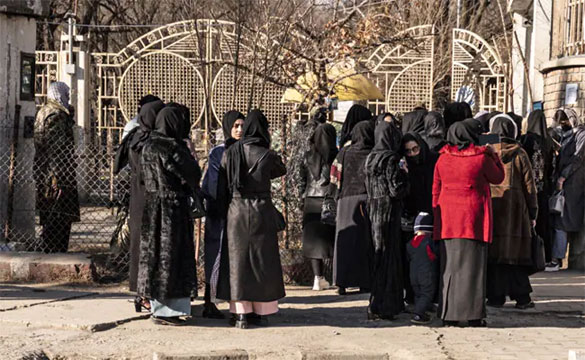
Female Nangarhar University students protest against
the Taliban decree on closing women's universities throughout Afghanistan on
December 21. Photo Credit: RFE/RL
------
2023-January-1
The
announcement was made by Iran's Deputy Science, Research, and Technology
Minister Vahid Haddadi Asl.
"The
admission of Afghan volunteers will be virtual and to a limited extent in
person," Haddadi Asl said.
The
Islamic Azad University and Payam Nour University also recently voiced their
readiness to admit Afghan students.
Chancellor
of Payam Noor University also voiced the readiness of his university to accept
5,000 Afghan students in face-to-face training courses until October 2023.
Vice
President of International Affairs and Non-Iranian Student Affairs of the
Islamic Azad University recently announced the university welcomes women who
are interested in science and knowledge from Afghanistan in its many academic
branches across the country.
Following
the Taliban government's action to restrict education for Afghan female
students, several Iranian universities such as Al-Zahra University in Tehran, Kosar
Bojnord University (KUB) in North Khorasan Province and Hazrat Masoumeh (SA)
Qom University have voiced readiness to admit Afghan women until the
restriction would be lifted.
Source:
Fars News Agency
--------
32
Saudi Women Qualify To Become Loco Pilots of One Of The Fastest Trains In The
World
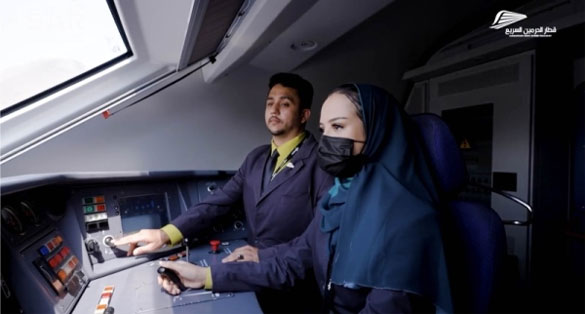
The women were trained to drive the HarmainExpress
train through a simulator
-----
January
02, 2023
RIYADH
— The Saudi Railway Company (SAR) has celebrated the graduation of the first
batch of female drivers of the Haramain Express Train. SAR has qualified 32
Saudi women to pilot one of the fastest trains in the world.
SAR
published a video on its official account on Twitter showing part of the
training operations from inside the driving cab, which the trainees undergo to
qualify them to drive trains.
Mohannad
Shaker, the trainer and train captain, said the Haramain Train is keen to train
its men and women captains to achieve the highest standards of safety and
security to guarantee that the train moves from a station and reaches its final
destination without delay or problems.
The
women train captains have expressed their pride in having this opportunity to
become the first female train drivers in the Middle East. They confirmed that
transporting pilgrims and visitors gives them motivation to work with great
care.
One
of the trainees indicated that they are being trained to drive the Haramain
Express Train through a simulator that completely represents reality, as it
contains a real driving cabin, through which all weather factors and technical
problems that they may encounter while driving the train are fully tested, in
order to help and prepare them for the real trips.
The
Transport General Authority said that qualifying Saudi women to become the
Haramain Express Train drivers is a continuation of empowering women in the
transport and logistic services sector.
Source:
Saudi Gazette
https://saudigazette.com.sa/article/628536
--------
Art
exhibition shows Jewish and Muslim women in Morocco sharing a common culture
30
December 2022
The
Jewish Museum of Belgium, located in Brussels, is currently showing the exhibition
‘Moroccan Women - Between Ethics and Aesthetics’ with focus on dresses and
jewelry used in the past by both Jewish and Muslim women in Morocco.
The
exhibition can be described as a narrative journey through a wide range of
objects from the 16th century to the present: traditional and religious
objects, clothing, ornaments, talismans and jewelry, archival documents,
photographs, drawings and orientalist paintings. The vernissage in December
attracted a large audience of local Moroccans and young Belgian people.
“I
didn’t expect such a big interest in the exhibition,” Paul Dahan, who curated
the exhibition, told The Brussels Times. “It shows the fascination and interest
in knowing more about a beautiful multicultural phenomenon which was shared by
Jews and Muslims alike in Morocco. This culture cannot be forgotten by people
with a Moroccan background living in Brussels and elsewhere.”
Paul
Dahan, a psychoanalyst by profession, not only curated the exhibition but also
collected all the objects in it. Since he arrived in Brussels because of its
multicultural diversity, he has collected ca 3,000 objects and only some of
them were exhibited this time.
“In
my work, I deal with how our memory of the past influences us in our lives
today,” he said, explaining his passion for collecting art objects from his
homeland.
He
is a member of the Council of the Moroccan Community Abroad and has long
experience of organizing exhibitions about Morocco. In for example 2010, he
curated an exhibition which was shown both in Brussels and Rabat about
Morocco’s relations with Europe during six centuries. The exhibitions are
organized under the patronage of the king of Morocco.
We
met at his office in the basement of the museum, which has its own story to
tell. The museum building is a former German-speaking school for girls and was
used by the Nazi occupation force during WWII. Passing to his office, he showed
me cells where resistance fighters and communists had been imprisoned. His
office is filled with books about the history and culture of Morocco.
The
objects in the exhibition, especially the women dresses, are extremely
beautiful and that explains the aesthetics part of the exhibition but what has
it to do with ethics?
“It’s
a matter of how men perceive and are attracted to women dressed in different
ways,” he explained. “If we judge women by stereotypes, or generalize about
them, it becomes a moral question. But in these elaborate costumes, you hardly
see the women. What attracts the eye is the costume. From that point of view,
men cannot react negatively to the women wearing them.”
Do
the costumes worn by Jewish and Muslim women differ?
“In
principle not. The main difference is
that a Jewish woman also wears a wig to cover her hair although the wig is
hardly noticed because it’s covered in a head dress. A Muslim woman normally
wears a veil but not necessarily everywhere in Morocco, depending on local
customs.”
The
majority of Moroccan Jews had arrived from Spain (‘Sepharad’ in Hebrew) and
Portugal after the Catholic expulsion from those countries more than 500 years
ago. It might come as a surprise that Sephardic Jewish women also were wearing
wigs as this today is mostly associated with Orthodox Ashkenazi women
(originating from Germany and Eastern Europe).
“In
both cases, Jewish and Muslim, it was the male-dominated society which set the
rules, Paul explained. “A virtuous woman had to cover her head or face not to
draw the attention of men.”
There
were also differences within the Jewish society in Marocco. Those who were expelled
from Spain and arrived in the western-northern part of the country brought
their own rich costume traditions. They used dresses that were composed of many
parts while the Berber Jews in the Atlas Mountains used simpler dresses.
Jewelry was an integral and expensive part of the costumes and included
different symbols.
Jewish
jewelers preserved ancient techniques inhered from the Andalusian period in
Spain. They also invented new methods of production which spread throughout
Morocco. Jewelry came in all shapes and sizes: necklaces, bracelets and large
ear-rings. There were also circular brooches that were pinned to women’s
clothing.
Were
the dresses made at home or ordered from tailors and professional seamstresses?
“They
were ordered from artisans in the market place and were mainly made by Jewish
tailors and seamstresses, both for Jewish and Muslim women. It could take a
year or so to produce these dresses which were made for a wedding. They were
thus expensive and the parents would have to save money to afford to buy a
dress for the daughter to her wedding.”
“But
it could also be seen as an investment because the dress was inherited in the
family for generations. The costume was not an every-day dress and only used at
big events and festivals.”
Are
they still used in Morocco?
“They
started to disappear in Morocco as from the 1920-ies, a process which was
accelerated after WWII,” Paul replied.
“You can hardly find them there any longer, at least not in those parts
of Morocco where the Jews settled after the expulsion from Spain.”
“Nor
can they be found in Israel to where the majority of Moroccan Jews arrived
after the establishment of the Jewish state in 1948. They were destitute,
having left everything they owned behind them, and didn’t think of preserving
their costume traditions. Possibly you can still find these costumes in Jewish
communities in other parts of the world where Jews from Morocco have settled.”
There
is a special room in the exhibition on tatous. Are tatous not forbidden in
Judaism?
“That’s
correct but they were quite common among the Berber Jews who had been living in
Morocco since ancient times before the arrival of Islam. They were living a
more isolated life in the mountains and influenced by the non-Jewish Berber
tribes, the indigenous inhabitants in North Africa.”
The
exhibition is a good example of Jewish-Moroccan cooperation and their common
interest in preserving Moroccan culture. It will run until 30 April 2023.
Source:
Brussels Times
--------
Tanazur
Debaters Twitter Space Platform Agree Women Have Right To Education
Abdul
Raqeeb Sail
1
Jan 2023
KABUL
(Pajhwok): This week’s Tanazur debate from Pajhwok Afghan News Twitter Space
platform discussed ban on women education in which experts shared interesting
views on the topic.
Some
participants believed that the teaching of Islam were against the losses that
would be incurred due to the ban on women education till further notice while
others believed that acting government was not against women education but it
was against co-education, tight uniform, violation of Hijab and other related
problems.
Acting
government recently banned women higher education till further notice and
barred women from working in the International None Governmental Organisation
(INGOs).
On
Saturday evening Tanazur debate discussed ban on women education in which four
panelists took part. The Twitter Space was viewed by 2,097 persons live.
Zahid’s
views:
Religious
scholar Dr. Rahmatullah Zahid said: “Nobody could stop a human being from
getting education. Decision to ban someone from getting education is against
the teaching of Islam and as well as the violation of basic human rights.”
He
said even till further notice ban on women education will have unaffordable
consequences and that will not be acceptable to Islam as well.
“If
ban on education is for a short time, it is not acceptable for me. The Islamic
Emirate of Afghanistan is responsible to reopen schools and universities for
women as soon as possible,” he said.
“The
western world have clear goals regarding women education and their right to
work. The fact that there were foreigners for more than 20 years in Afghanistan
it may have left some impact but it never meant that the entire system should
be challenged, if there are some problems that need to corrected,” said Zahid.
“If
there is problem in the curriculum so this is not the right thinking because if
a curriculum could mislead the ideology of a girl it could leave same impact on
boys mentality as well.”
He
stressed the eradication of Taliban was not a solution because they are
currently in power and Afghanistan could no more afford regime changes.
Shabnam’s
views
Former
Human Rights Commission Member Shabnam Salihi said: “The Taliban recent
decision was a clear violation of human rights and their commitment made in
Doha Pact. With this they showed that they are unchanged.”
She
said in Afghanistan, 25 percent families are looked after by women financially
and banning women from education faced these families with economic issues.
“The
issue of delaying women’s education and work is linked to culture, so the
protests of people in Nangarhar, Kandahar and other provinces have shown that
this is not a cultural issue, but rather the Taliban’s own desire. It is
neither related to religion nor to the culture of Afghanistan,” she said.
Salehi
added in current circumstances getting education was as vital and necessary as
eating food and getting oxygen, adding that people have no need to seek religious
permission for eating and breathing.
“Why
should the whole society sink because of one person’s crime, and if excuses are
made, then this is not a solution; In the past (during the first period of the
Islamic Emirate), the issue of the second order was not resolved, and today,
the ban on secondary education has been 18 months, but the conditions have not
been provided,” she said.
She
termed recent acting government decision as politically motivated and added,
the acting government wanted to enter recognition deal.
She
said resolution to all issues was linked with an eligible government which
should be established.
He
said current officials could not destroy the lives of Afghans and if things
move this way people would revolt.
Osuli
added acting government should introduce a law on the bases of consensus
because law was vital for the continuity of a government so that people have
proper understanding of the situation.
“There
is need to recognize the Taliban because they are the reality of this society
and the Taliban should also recognize us and others, there is need for a middle
way to take Afghanistan out of current crisis,” he added.
Waseel’s
views:
Writer
Sibghatullah Waseel, said that there was different views regarding religious
and modern education in Islam, adding that there was need for some modern
education that is based on human wisdom and experience in order to accomplish
human needs.
He
said unfriendly circumstances forced ban on women education and work, there was
opposition existed with women education.
“Officials
views showed that government was against Hijab violation; make up, tight
cladding and other issues. The fact that Afghanistan was under occupation so
there is the impact of feminism existed.”
According
to Waseel the issue was about women equality which against wisdom. Islam views
that women work should be based on necessity but west viewed it as principle.
He
said there was need for a practical solution, adding that nobody was against
education but IEA held huge responsibility to ensure the provision of condition
for education.
Writer
and Poet Shafiqa Khapalwak said: “If today Afghan girls deprived from education
the survival of Afghanistan would be difficult in the future.”
She
added there was need for active participation of women in the distribution of
humanitarian aid because men could not address women problems.
Source:
Pajhwok
https://pajhwok.com/2023/01/01/tanazur-debaters-agree-women-have-right-to-education/
--------
Women,
girls in Afghanistan spent a terrible time in 2022: Report
1
January, 2023
Kabul
[Afghanistan], January 1 (ANI): Women and girls in Afghanistan spent a terrible
time in 2022 after being banned from schooling, higher education and employment
in non-governmental organizations, reported TOLO News.
The
TOLO News report stated, “Secondary schools were closed to girls at the
beginning of the year. Universities were closed for women in December. So was
the opportunity for women to work in national and international NGOs.”
Schools
for girls were supposed to reopen on March 23, 2022. The Taliban, however, said
that schools will remain closed until further notice. They are yet to open.
Islamic
emirate officials expressed various opinions on the closure of schools. In an
interview with RTA TV, Zabiullah Mujahid said that schools for girls were
closed due to religious issues.
Afghanistan’s
acting minister under the caretaker Taliban regime later said that schools for
girls were closed due to cultural issues and that people are not willing to
send their daughters to school.
“If
(we) were acting on Pakistan’s instruction, the problems of the schools and
other problems would have already been solved. This is a religious issue and it
needs Islamic cleric’s agreement,” said Zabiullah Mujahid, the Islamic Emirate
spokesman, as quoted by TOLO News.
The
TOLO News report also quoted Noorullah Munir, the former minister of education,
saying that: “You wouldn’t need to ask me the same question if you ask how many
people in this mosque are willing to send their 16-year-old daughter to school.
You and I both grew up in the same Afghan society, and the culture is clear to
everyone.”
A
committee of eight religious experts was formed on May 26, under the leadership
of Pakistan’s Supreme Court chief Abdul Hakim Haqqani to look into the
reopening of schools for girls. The committee is yet to make its achievements
clear.
“The
committee has eight members. It includes religious scholars. The committee has
done some work to reopen high schools for girls. We hope it can be solved in
the near future,” said Inamullah Samangani, former deputy spokesman of the
Islamic Emirate, as quoted by TOLO News.
As
many as 11.6 million women and girls are no longer receiving vital assistance
in Afghanistan, the US envoy to the UN, Linda Thomas-Greenfield said on
Saturday in the wake of the Taliban’s decision to ban women from contributing
to humanitarian aid efforts in the country.
“The
Taliban’s decision to ban women from contributing to humanitarian aid efforts
is already having terrible consequences. According to the UN, 11.6 million
women and girls in Afghanistan are no longer receiving vital assistance. This
dangerous, oppressive ban must be reversed,” Thomas-Greenfield tweeted. (ANI)
Source:
The Print
https://theprint.in/world/women-girls-in-afghanistan-spent-a-terrible-time-in-2022-report/1292977/
--------
'Kurdish Women Burn Themselves, Surrender To Death Out Of Despair,' Says Head
Nurse Nigar
January
1, 2023
"The
most difficult part of my work is when I face women who are forced to lie about
their cause of burn injuries because they're being threatened with their lives
by their husbands or family."
"But
the stench of the oil gives away the foul truth," said the chief nurse at
the Burn and Reconstructive Surgery Hospital in Sulaymaniyah, one of the three
provinces of the Kurdish region in northern Iraq with a population of
1,700,000.
Celebrated
as one of the BBC's 100 most influential women of 2022 from around the world,
nurse Nigar Marf, 50, has devoted her career to helping female burn victims get
the medical care they need.
In
the Kurdish region of northern Iraq, the brutal practice of self-immolation has
become alarmingly common, and the mortality rate among these types of burn
victims is extremely high.
As
the leading form of suicide among Kurdish women, it is a desperate act of
personal protest, and those who survive bear the scars on their faces and
bodies for life.
Having
treated and spoken to burn victims, who share their personal stories of pain
for almost ten years, Nigar observed how women who have problems with their
husbands, parents or in-laws resort to suicide to escape this, by setting
themselves on fire.
In
the largely patriarchal society, Nigar noted, women have few rights, are
frequently illiterate and often have no one to turn to for help even after
making the desperate cry for help by burning themselves in fear of retaliation
and further violence from the perpetrator.
Asked
about their ordeals, Nigar replied: "Kurdish women burn themselves out of
despair and surrender to death because of the heavily conservative society. The
women are living under an authoritarian patriarchal rule and are even sometimes
set on fire by the men in their lives under the pretext of honour."
"But
even though there are still cases of self-immolation, the percentage of women
burning themselves has decreased because they have become more aware and
self-confident after having their problems solved by the law and within the
courts more often."
Across
Iraq, gender-based violence rose 125 per cent to over 22,000 cases between 2020
and 2021, according to the United Nations (UN) children's agency UNICEF, which
has also pointed to: "A worrisome increase in depression and suicide among
women and girls."
And
while some doctors estimate self-immolation has claimed the lives of as many as
10,000 women since the region gained autonomy in 1991, reliable data is scarce
due to many women failing to reach the hospital.
The
actual figures are certainly more, according to Nigar, as many women have ended
up dying from their severe burns before they reach the emergency department.
The
majority of female suicides in Kurdistan happen in the home, where women have
access to flammable liquids, such as kerosene. Moreover, it is common for
abusive households to hide the victims while treating them with primitive
methods in fear of it developing into a case for the police to investigate.
"The
most haunting case I dealt with was with a woman who poured oil on herself in
the middle of a serious quarrel with her husband after suffering from
oppression, and in a moment of desperation, she set herself on fire,"
narrated Nigar.
"All
the while, he just stood laughing and filming while her body lit up in flames
until her neighbours came to help and wrapped her in a blanket. She suffered
third-degree burns on her face, neck, chest and legs. It was cruel; her scars
and cries will haunt me forever."
Nigar
described the victims as "heavy trauma patients" who are forever
haunted by the memory of their pain at home, in addition to the intensity of
the fire.
For
long-term change, Nigar stressed that Kurdish women need to be taught to have
more confidence, so they don't succumb to pressures from society and their
parents in particular. The most effective way to achieve this, she believes, is
to begin educating the current and future generations on the importance of
equality between men and women and the value of human rights.
"We
need to educate all those at risk of suffering such fates as well as those at
risk of imposing such fates. Everyone must learn that no one is better than the
other and there is no such thing as the stronger or the weaker one," Nigar
shared.
While
Nigar admits that sometimes she is at a loss for words when trying to comfort
her patients, and witnessing traumatic situations has taken a toll on her mind,
she also acknowledges the positive impact her journey helping women recover has
had on her mental and emotional strength.
By
listening, advising and delivering practical guidance, over the years, the
nurse has become more determined to help more women and contribute towards building
a more equal and advanced society in which women can feel as safe and liberated
as men. She is optimistic.
For
her outstanding service and commitment to her community and survivors of
self-immolation in Iraq, nurse Nigar has been included on the BBC's list of 100
"inspiring and influential" women worldwide in 2022.
It
is the 10th year of the "100 Women" list, and with the decade marker,
the BBC said it was: "Taking the opportunity to explore what progress has
been made over the last decade", noting that "while there have been
huge steps forward for women's rights – from the number of female leaders to
the MeToo movement – for women in many corners of the world it still feels like
there is a long way to go."
Nigar
was featured alongside Ukraine's First Lady Olena Zelenska for her work
highlighting the suffering of the Ukrainian people, Tunisian tennis star Ons
Jabeur who became the first Arab or African woman to reach a Grand Slam final
in the Open era and Bollywood actress and producer Priyanka Chopra Jonas.
"It was all the more surprising and joyful news for me
because we, Kurdish-Iraqi women, have been living and witnessing a cycle of
injustice and oppression for years, and to see our work and efforts of building
a more civil and democratic society being recognised and celebrated is
encouraging," expressed Nigar.
"We
need to keep going and doing better."
Source:
Middle East Monitor
--------
URL: https://newageislam.com/islam-women-feminism/iranian-universities-afghan-female/d/128780
New Age Islam, Islam Online, Islamic Website, African Muslim News, Arab World News, South Asia News, Indian Muslim News, World Muslim News, Women in Islam, Islamic Feminism, Arab Women, Women In Arab, Islamophobia in America, Muslim Women in West, Islam Women and Feminism