
From Madrasas To Tech Hubs: Indian Muslim Women Embrace Coding And AI Education
New Age Islam News Bureau
21 August 2025
· From Madrasas To Tech Hubs: Indian Muslim Women Embrace Coding And AI Education
· First Hijab-Wearing JockeyKhadijah Mellah, Who Won A Horse RaceIn Britain To Make Her Amateur Debut
· Singer ShihaZikir Slams Netizen For Rude Comment On Her Hijab Post
· Iran's Temporary Marriage Law Traps Women In Legal Limbo
· Father Kills 20-Year-Old Daughter, NasibehTafakori, in Iran: Human Rights Media
· Scouting Empowering Saudi Women On Global Stage
· Muslim Women Group Condemns Gaza ‘Genocide’
· Huge Growth In Female EPFO Membership In June: Labour Ministry
· Six Shia Women Detained In Azerbaijan For ‘Staging Protest’
· Iran Hospital Units Close Due To Severe Nurse Shortage
Compiled by New Age Islam News Bureau
URL: https://newageislam.com/islam-women-feminism/madrasas-indian-muslim-women-education/d/136560
-----
From Madrasas To Tech Hubs: Indian Muslim Women Embrace Coding And AI Education
Aug 21, 2025
By Taha Ali
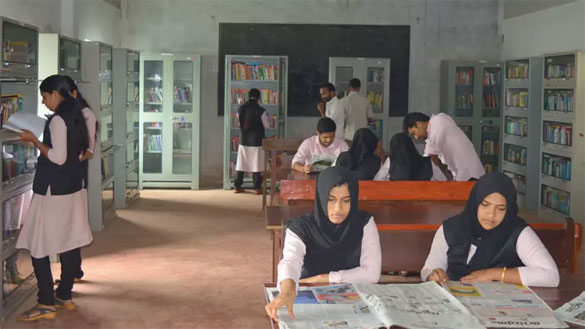
A new storyline has begun to emerge in India’s Muslim community in recent years: young women educated in madrasas are increasingly breaking the stereotype of solely learning the Quran by learning computer coding, app development, and artificial intelligence (AI). In response to state-led initiatives, NGO programmes, and the efforts of local entrepreneurs, young women from states such as Uttar Pradesh, Kerala, and Telangana now have opportunities to learn coding and technology in boot camps. This “Quran-and-laptop” agenda signals a clear and sustained shift in curriculum and attitudes in parts of the community.
The UP government has claimed that it has changed the syllabus of Madarsa “in order to connect students with the mainstream” and began offering launch classes in digital literacy, coding, and AI. UP Minister Dharampal Singh claimed that the state government wanted “children of poor Muslims [to have] a Quran in one hand and a laptop in the other” as part of a wider agenda to train students in madrasas “to become engineers, scientists, [and] IAS officers”.
NGOs and grassroots empowerment models
In addition to revised curricula, a wave of NGOs, community organisations, and ed-tech companies continues to emerge to provide digital skills training to Muslim women. The Hyderabad-based SAFA Foundation, under social entrepreneur Rubina Mazhar, supports women through ICT and coding training programmes. SAFA offers “women’s programmes which upgrade the skills of women…in…computer-based courses, information technology-enabled services…to create opportunities for livelihood for women living in poverty.” Rubina notes, “This section of society is in need of empowerment so that they may realise their value and potential.” Success stories of SAFA students are emerging in the workplace: following training, they have transitioned into IT support and data-entry jobs, allowing them the chance to earn and keep their income.
In Telangana state, the Shadan Women’s College (an engineering college that prioritises students from a Muslim minority) is now offering full-stack web development and AI workshops to their women students. Even within formal schooling, a grassroots effort seems to be emerging: in Malappuram, a district of Kerala, local educators united to engage and teach 7th grade girls (many from Madrasa backgrounds) in a maths-coding-AI summer camp, where they programmed in Python and learnt about the mathematics underlying AI.
Changing family attitudes and cultural resistance
Such programmes often appear as a twist towards the end of the family and community stories. Many parents are becoming more open, slowly changing their views about ‘secular education’. As one educator explains, ‘Families expecting only religious schooling for their children have been “happy with the training and assistance in job placement”.’ Scholars have noted that Muslim women in India are “doubly marginalised” by virtue of being a woman and a Muslim and therefore both consciously and unconsciously discriminated against in work and education.
Recent research has even revisited the labour force participation of Muslim women, which is the lowest of all groups and their ongoing hiring discrimination. In this environment, digital skills become doubly empowering: employment in tech-associated jobs can often be done flexibly and sometimes at home, lessening the impact on family and the security for conservative families.
Educational organisations and industry mentors have also observed effects beyond the participants. Educators leading the courses in Hyderabad reported that the Muslim women trainees were “very happy” with their newly acquired skills and were excited about their tech careers. Local university professors state that, as women who were previously in environments that discouraged them, they contribute a different perspective to class projects now as female coders. Indeed, some of the local employers have been observing this situation too and some have even reached out to NGOs like SAFA to recruit these trained women for entry-level IT jobs.
Feminist implications: redefining identity and agency
This wave of madrasa-to-tech occupations raises broader questions about inclusion and economic mobility. By integrating religious institutions of formal education with coding, this trend cites Islamiology in a modernist project of identity politics: women do not have to choose between being religious and pursuing modern jobs. Many see Muslim women coders as images of “successful identity”, resisting patriarchal definitions of how women behave and teaching younger girls that religious piety and professional aspiration are compatible.
Case studies and key examples
In October 2023, the state announced that all madrasa ‘(Islamic school)’ curricula starting January 2024 would include a digital literacy, coding, and AI module. Hundreds of madrasas have since received computers and study kits to empower the new curriculum. In a press release, UP’s Minority Waqf minister stated the aim is to help students from madrasas to be mainstream.
Malappuram’s Women’s College of Engineering ran an April-May 2024 summer camp, teaching Python and AI concepts to schoolgirls, many from madrasas. In Malappuram, social entrepreneurs started bilingual coding clubs and offered online courses for Muslim girls.
SAFA Foundation (est. 2006), located in Hyderabad, offers ICT and coding classes across vocational programmes. Graduates report finding jobs or freelance work. Shadan Women’s College (a Muslim minority engineering college in Hyderabad) signed papers of understanding (MOUs) with tech-training firms and transitioned students in 2023 to “full-stack development” workshops, similar to the curriculum offered at Shadan Women’s College.
Curriculum innovations
In addition to IT training, a number of madrasa boards and colleges are changing syllabi. The Tata Trusts’ Madrasa Programme (which will expand to UP, Bihar, and Jharkhand by 2024) has also developed project-based learning combining Islamic themes with STEM – for example, students map the narratives of the Prophet from Sira to examine geography and geometry. Furthermore, Muslim charitable schools (madrasas) in Kerala have begun teaching the English alphabet, mathematics, and computing basics during evening classes, including Quran recitation.
Gender and religious identity make the process complicated. Some conservative parents are still sceptical of co-educational or mixed-gender format classes—so organisers found a way to run gender-segregated classes. Some religious leaders have asked why madrasas should teach “Western” subjects. But in many families, the reality of the economy is upsetting this resistance: fathers and brothers who once insisted on sons’ education are now insisting their daughters participate and learn IT skills. An educator told me that Muslim girls winning coding competitions or landing software jobs can “change even the most doubtful parent’s mind.”
The teacher who trained the girls in the madrasa reports that many of the girls have high motivation. Many of them feel a new confidence in developing their math and logic skills. The college and tech schools, in fact, would put them in groups and comment on how these students demonstrated excellent discipline and ethics for team projects. The industry mentors stated that the awareness piece is more difficult than the possible skill gap: many Muslim women do not know these opportunities exist. Now colleges and non-profit organisations are working to develop awareness campaigns for mosques, madrasas, and local media.
Initial evidence suggests a modest impact: dozens of Muslim women from UP and Telangana have landed IT jobs or internships after completing intensive courses. In Kerala, at least one woman formerly of madrasa origin won the statewide coding competition in 2024. Observers expect that if additional examples emerge, peer impact will take over. In the end, the incorporation of technology into madrasas could spur ripple effects — provide a pathway to women’s economic mobility and challenge normative stereotypes in the Muslim community.
The new wave of Muslim women transitioning from madrasas to coding labs is deserving of careful attention. In addition to being a collection of personal success stories, it is the beginning of a quiet social change. By combining religious education with coding skills, India is experiencing a new kind of agency — the growth of women who feel they can be both faithful and modern. Indeed, these efforts—some of which started by state reforms, collaborations of NGOs, or by some community entrepreneurs—are changing cultural expectations and providing new routes into economic mobility. If the new “Quran and laptop” generation is allowed to scale and expand, they not only may cause a transformation in the lives of Muslim women, but they may also be able to contribute to India’s digital economy, which is (as it is often said) still just beginning.
Source: feminisminindia.com
https://feminisminindia.com/2025/08/21/from-madrasas-to-tech-hubs-indian-muslim-women-embrace-coding-and-ai-education/
------
First Hijab-Wearing JockeyKhadijah Mellah, Who Won A Horse RaceIn Britain To Make Her Amateur Debut
Aug 21, 2025
Christian Fuller
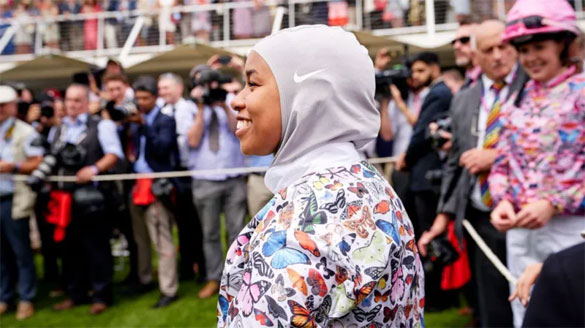
Khadijah Mellah became the first hijab-wearing jockey to win a horse race in Britain in 2019
----------
The first hijab-wearing jockey to win a horse race in Britain is to make her amateur debut.
Khadijah Mellah, then aged 18, made history by winning the Markel Magnolia Cup in 2019, months after riding a horse for the first time.
She is to ride in her debut race as an amateur jockey at Goodwood Racecourse on Friday.
"When I got the call, I completely lost my mind. This is just such a beautiful way to emerge again on the racing scene," she said.
By taking part in the Markel Magnolia Cup – an all-female, novice charity event – Ms Mellah became the first British Muslim woman to win a horse race.
Since then, she has helped set up the Riding A Dream Academy – an initiative to help young people from diverse communities and disadvantaged backgrounds get involved in horse riding.
"Visibility and seeing it to believe it is so important, but also having a relatable person to go to for advice makes a massive difference," she said.
"Diversity can bring so much excitement into this sport. There are going to be some kids who want this so badly, just as I do, and really bring out the best in racing.
"It's important for me as a role model to keep pushing to different heights and lead by example and show the kids I'm teaching that even though it's hard, you can try and do more."
The 24-year-old, who has also completed a mechanical engineering degree at the University of Brighton, is booked by trainer Eve Johnson Houghton to ride Uncle Dick in the Gay Kindersley Memorial Amateur Riders Handicap on Friday.
Goodwood Racecourse director James Crespi said Ms Mellah's win in 2019 was "nothing short of spectacular".
Source: bbc.com
https://www.bbc.com/news/articles/cwyp691r74vo
-------
Singer ShihaZikirSlams Netizen For Rude Comment On Her Hijab Post
Heidi Hsia
21 August 2025
21 Aug - ShihaZikir recently expressed her ire over some netizen's comment about a photo that she shared on Threads.
Earlier this week, the singer posted several photos of her in hijab, as she hosted a religious class at her studio. She captioned it, "Knowledge knows no age. Never stop learning."
However, a comment from one of the netizens truly rubbed her the wrong way that she decided to share a screenshot of it. The netizen posted, "Can you not be so stupid? You were not covering your awrah in your [display picture], but you covered it in this one."
She responded, "Here comes the group on Threads. You can point out a mistake, but is this the right way? I hope that you won't get upset if others call you stupid."
In another post, Shiha stated that she has no issue with people calling out a mistake, but that it has to come with manners.
"Please understand. Pray for good things for everybody," she added.
Source: yahoo.com
https://sg.style.yahoo.com/shiha-zikir-slams-netizen-rude-064700381.html
-------
Iran's Temporary Marriage Law Traps Women in Legal Limbo
AUGUST 21, 2025
ZHIVAR SARVANDI
Leila thought she had found a simple solution to her post-divorce loneliness when a married man proposed a ‘sigheh,’ Iran's religiously approved temporary marriage.
Three years after divorcing her unemployed husband, the mother of two daughters entered what she believed would be a brief, inconsequential relationship.
Now, she faces possible imprisonment and the collapse of her remarriage because of a legal document she cannot retrieve.
"I had no idea that the sigheh contract in that man's possession could have legal consequences for me," said Leila. "I asked him to return the contract and settle everything peacefully, but he refused."
Iran’s temporary marriage law, under Article 1075 of the Civil Code, places women at greater legal risk while enabling men to maintain extramarital relationships without consequences.
The practice, rooted in Shia jurisprudence, allows couples to marry for predetermined periods with specified dowries. But religious law also means that women’s subsequent relationships can be deemed criminal.
When Leila's ex-husband found work and asked to reconcile, she agreed on the condition that he maintain steady employment.
They remarried officially, but the uncanceledsigheh contract hangs over their relationship like a legal sword.
Under Islamic law, her new marriage is void because the temporary marriage was never formally dissolved, rendering her “eternally forbidden” to her current husband.
"If my husband finds out, or if that person reveals the matter, I will have to divorce my husband again, wait through the mandated period, and then remarry him," Leila explained. "I could also face imprisonment and fines. If my husband learns I was still under sigheh, everything will fall apart."
The man who holds her sigheh contract, however, faces no legal consequences.
IranWire interviewed several women whose experiences show how temporary marriage has evolved from a religious accommodation into a system that exploits vulnerable women while generating profits for online intermediaries.
Sara, a 32-year-old single mother from south Tehran, turned to sigheh after her divorce left her with custody of her child and severe financial hardship.
Through Telegram channels that charge up to $40 to post marriage listings, she connected with a man she did not realize was married.
"He promised a lot of support, and I thought at least my mind would be at ease for a few months," Sara said.
The man appeared respectable and agreed to pay her dowry at the contract’s end. But when the period expired, he disappeared, leaving behind a false address.
"The channel manager told me it was my own mistake, that I should have arranged these things from the beginning," Sara recalled, describing her failed attempt to seek help from the platform that facilitated the connection.
Hundreds of Telegram channels now operate as informal matchmaking services for temporary marriages, charging fees for postings and additional sums for contact information.
These platforms have turned sigheh into a commercial enterprise while offering little protection to participants.
The risks extend beyond financial exploitation.
Negar, a 25-year-old from northern Iran, contracted a sexually transmitted disease through a temporary marriage arranged via these channels. The man had claimed to be a wealthy merchant seeking short-term companionship.
"I thought if it was legal and religious, everything would be safer and more secure, but I was wrong," Negar said. "Now I can't even ask my family for help with treatment."
The social stigma surrounding temporary marriage creates further complications for women.
Fatemeh, a 41-year-old widow who entered sigheh because of financial necessity and her inability to remarry permanently, described the cultural contradiction at the heart of the practice.
"For me, sigheh was a way to meet my financial needs without society’s judgment," she said. "But every time I spoke to someone about it, I felt my self-respect was being questioned."
Iranian society simultaneously recognizes temporary marriage as religiously legitimate while viewing it as morally suspect, especially for women.
Legal experts say that temporary marriage functions primarily as a mechanism for male polygamy, without the financial obligations typically associated with marriage.
Men are not required to provide ongoing support or inheritance rights to temporary wives, creating an arrangement that benefits men while exposing women to significant legal and social risks.
The commercialization of temporary marriage through online platforms has further corrupted the practice’s original religious intentions.
Source: iranwire.com
https://iranwire.com/en/features/144189-irans-temporary-marriage-law-traps-women-in-legal-limbo/
-------
Father Kills 20-Year-Old Daughter, NasibehTafakori, in Iran: Human Rights Media
AUGUST 20, 2025
A 20-year-old Baluch woman was shot and killed by her father on Tuesday at the family home in Zahedan, human rights media reported.
NasibehTafakori, mother of a one-year-old child, was killed around 3 p.m. while resting in her room due to a severe headache, according to Haalvsh, a human rights outlet covering Iran’s Baluch areas.
Tafakori had returned to her father’s house after a dispute with her husband, who was also her cousin.
She decided to return to her married life after her father-in-law mediated, but her father opposed continuing the family relationship.
The father fled with the weapon immediately after the shooting and has not been arrested.
Tafakori married at 18 and had a one-year-old child. Due to limited circumstances, she did not own a mobile phone and had frequent disputes with her husband.
Neighbours described her as “an oppressed girl.” The father’s motive remains unclear.
The killing left Tafakori’s young child motherless in unclear circumstances. Experts warn this could expose the child to serious psychological and social harm.
Iranian authorities do not publish reliable statistics on femicide, though such incidents are occasionally covered in local media.
According to Etemad newspaper, 78 women were murdered by family members between March and September of last year.
In 2023, Shargh newspaper reported that at least 165 women were killed by male relatives between 2021 and 2023, with 27 murders occurring in the first three months of 2023 alone - many linked to “honor killings.”
These numbers are only reported cases; the true figures are believed to be significantly higher.
In June, IranWire also reported the release of the father of Donya Hosseini, who was fatally stabbed in February after requesting a divorce. He served only three months in prison.
Donya, who had three sisters - Shaghayegh, Rezvan, and Zahra - was murdered despite previous threats.
Under Article 301 of Iran’s Islamic Penal Code, fathers are exempt from retributive justice (Qisas) for killing their children.
They are instead required to pay blood money and face discretionary punishment.
While a 2021 amendment allows courts to revoke parental rights and prohibits early release before serving a quarter of the sentence, enforcement remains inconsistent.
Source: iranwire.com
https://iranwire.com/en/women/144174-father-kills-20-year-old-daughter-in-southeastern-iran/
-------
Scouting empowering Saudi women on global stage
PRINCESS LAMIA BINT MAJED SAUD AL-SAUD & PRINCESS SAMA BINT FAISAL BIN ABDULLAH
August 20, 2025
Scouting is more than just a youth activity; it is a universal language that connects young people from diverse cultures, developing their leadership, belonging and a sense of responsibility. In Saudi Arabia, Scouting has emerged as a vital platform for empowering youth, especially women, in alignment with Vision 2030, which places youth at the heart of the nation’s transformation.
Driven by (Princess Lamia) a deep belief in the leadership potential of Saudi women, Alwaleed Philanthropies launched a strategic initiative in collaboration with the World Scout Foundation to expand young women’s participation in Scouting both within the Kingdom and internationally. This initiative has led to the establishment of the first women’s Scout units in leading Saudi universities, and authorities including Princess Nourah bint Abdulrahman University, King Khalid University, Imam Abdulrahman bin Faisal University and the Diriyah Gate Development Authority.
The focus is not on symbolic representation, but on true empowerment. To date, more than 400 Saudi Rovers have been supported, many trained to represent the Kingdom at global events, while others lead Scout teams on campus, strengthening their presence both nationally and internationally. In 2019, the initiative enabled the first official participation of young Saudi women at the World Scout Jamboree in the US, a historic moment that marked a new era for women in Saudi Scouting. This journey continued with active participation at the World Scout Jamboree in South Korea in 2023 and now we celebrate the participation of a female Saudi delegation at the World Scout Moot in Portugal in 2025.
We also launched the first Saudi edition of the “JOTA-JOTI” virtual program in collaboration with Princess Nourah University, opening new avenues for young women to connect globally and learn in innovative digital spaces.
As chair of the Girl Scouts Committee at the Saudi Arabian Scouts Association, my (Princess Sama) focus is on transforming empowerment into tangible opportunities for building female Scout leaders in the field. We have worked to establish women’s Scout teams in universities, open pathways for participation in national and international camps, and develop leadership and teamwork skills.
The committee’s vision is to make Scouting a genuine path to leadership, through specialized programs, global representation opportunities and community-driven initiatives that promote inclusion and equality. In every event, those taking part showcase the modern Saudi woman: empowered, proactive and responsible.
Today, we see the results of that commitment: young women leading teams, representing the Kingdom abroad and creating real impacts in their communities.
What we witness is only one milestone in a longer journey toward greater empowerment, broader inclusion and deeper impact. Saudi Scouting has moved far beyond its traditional role to become a strategic platform for shaping the leaders of tomorrow, both men and women.
We firmly believe that continued support for the empowerment of young women in Scouting will help cultivate a generation capable of representing Saudi Arabia at its best, while achieving their aspirations at home and abroad. In this defining national moment, where the roots of heritage meet the vision of the future, our hopes rest on the youth of our nation, both young men and women, to stand as a cornerstone in building our country’s future.
Source: arabnews.com
https://www.arabnews.com/node/2612476
------
Muslim women group condemns Gaza ‘genocide’
20th August 2025
Godwin Isenyo
The Federation of Muslim Women’s Associations in Nigeria (FOMWAN) on Wednesday opened activities marking its 40th anniversary in Kaduna with a call for greater investment in women’s empowerment, climate resilience, and community development.
The group also condemned the killings in Gaza, describing them as genocide against women, children, and other vulnerable populations.
Speaking at a press briefing ahead of its international conference tagged Kaduna 2025, National Amirah of FOMWAN, RafiahSanni, said the association’s four decades had been defined by service, resilience, and faith.
“This year’s theme, Empowering Muslim Women: Climate Resilience, Sustainability, and Community Development, reflects our renewed focus on addressing global challenges,” she said.
Founded in 1985, FOMWAN has grown into one of Nigeria’s largest faith-based female networks with structures in all 36 states and the FCT. The group said it operates in more than 700 of Nigeria’s 771 LGAs and has established nearly 3,000 basic schools nationwide, with a School of Nursing under construction in Ibadan and plans for a university in the works.
“At 40, we are not just celebrating years but celebrating service, faith, and our commitment to building communities where women and children can thrive,” Sanni said.
She noted that the Kaduna conference, which formally opens on Thursday, would attract delegates from the United States, the United Kingdom, and several African countries, focusing on climate change, women’s leadership, and interfaith collaboration.
Sanni also praised Governor Uba Sani for providing a secure and welcoming environment for delegates.
But beyond celebration, the Amirah condemned what she called “relentless atrocities” in Gaza.
“For months, the world has watched with deep sorrow as women, children, the elderly, humanitarian workers, and journalists have been killed in indiscriminate bombings. Homes, schools, hospitals, and places of worship have been destroyed, leaving families in despair. These killings amount to genocide,” she declared.
She called for urgent global solidarity and humanitarian support, praying for relief, healing, and liberation for the people of Gaza.
Source: punchng.com
https://punchng.com/muslim-women-group-condemns-gaza-genocide/
-------
Huge growth in female EPFO membership in June: Labour ministry
21 Aug 2025
NEW DELHI: The Employees Provident Fund Organisation (EPFO) witnessed nearly 3.02 lakh new female members in June this year, marking an increase of 14.92% compared to the previous month. They are part of an overall 10.62 lakh new members who enrolled with the EPFO during June.
Releasing the provisional payroll data for the month, an official release from the Labour Ministry said, “The growth in female member additions is indicative of a broader shift towards a more inclusive and diverse workforce.”
“The EPFO enrolled around 10.62 lakh new subscribers in June 2025, representing a 12.68% increase over May 2025 and a growth of 3.61% compared to June 2024. This increase in new subscribers can be attributed to growing employment opportunities, increased awareness of employee benefits, and EPFO's successful outreach programmes,” it said.
The Organisation added 6.39 lakh new subscribers in the 18-25 age group, constituting a significant 60.22% of the total new subscribers added in June 2025.
Approximately 16.93 lakh members, who had exited earlier, rejoined EPFO in June 2025, the release added. This figure depicts a 5.09% increase over May 2025. It also displays a significant 19.65% year-over-year growth compared to June 2024.
“These members switched their jobs and re-joined the establishments covered under the ambit of EPFO and opted to transfer their accumulations instead of applying for final settlement, thus safeguarding long-term financial well-being and extending their social security protection,” it added.
Overall, there has been an addition of 21.89 lakh members, netting the highest recorded addition since payroll data tracking began in April 2018, the release added.
State-wise analysis of payroll data denotes that the top five states/ UTs constitute around 61.51% of net payroll addition, adding a total of around 13.46 lakh net payroll during the month.
Maharashtra leads by adding 20.03% of net payroll during the month. The states/UTs of Maharashtra, Karnataka, Tamil Nadu, Gujarat, Haryana, Delhi, Uttar Pradesh and Telangana individually added more than 5% of the total net payroll during the month.
Source: newindianexpress.com
https://www.newindianexpress.com/nation/2025/Aug/21/huge-growth-in-female-epfo-membership-in-june-labour-ministry
-------
Six Shia women detained in Azerbaijan for ‘staging protest’
by Yousef Bardouka
20 August 2025
Six Shia women in Azerbaijan have been remanded to three months of pre-trial detention for allegedly staging a protest ‘under the guise’ of a religious ceremony.
The social media page Hamam Times reported that the women were detained on 14 August as they were distributing alms in commemoration of Arba’in — which is observed 40 days after Ashura, the anniversary of the death of Prophet Muhammad’s grandson, Husayn ibn Ali.
According to the pro-government media outlet Report, the six women were remanded to detention on Monday.
The independent media outlet Meydan TV reported that one of the women, ShahlaFarajova, was brought to her home as it was being searched by the police. The outlet cited Telegram channel Ar-Rad Info as saying that police switched off cameras in her neighbourhood, and that during the search, they planted a bottle of methamphetamine and a flashdrive with the words ‘yaHusayn’ — an Arabic phrase invoking Husayn often used by Shia Muslims — inscribed on it.
The chair of the Muslim Unity Movement, TalehBaghirzada — currently serving a prison sentence on charges of inciting hatred and plotting to overthrow the government — criticised the detentions.
‘The tomorrow of this country opens with illegal arrests and slander’, he said, according to a statement attributed to him on Facebook.
Baghirzada was sentenced following the violent police raids on Baku’s Nardaran neighbourhood in which seven people, including two police officers, were killed in 2015.
Source: media.org
https://oc-media.org/six-shia-women-detained-in-azerbaijan-for-staging-protest/
-------
Iran Hospital Units Close Due to Severe Nurse Shortage
AUGUST 20, 2025
Severe nurse shortages have forced hospitals across Iran to close critical units, including intensive care and emergency departments, the head of the country’s nursing organization said.
Ahmad Nejatian, director general of the Nursing Organization, confirmed the closures during a television program.
He said at least two medical units have closed in many cities, leaving patients without vital services.
Nejatian warned that if the trend continues, complete hospital closures are possible.
He said 2,000 new hospital beds will open in Tehran over the next few years, but no plan exists to provide the 3,000 nurses needed for the project.
Nejatian said hospital infrastructure and equipment are available, but a lack of staff has left projects on paper while patients face a healthcare crisis.
For years, nurses in Iran have voiced their frustrations about overwhelming workloads, inadequate compensation, and a shortage of employment opportunities.
However, their demands have largely remained unanswered.
The misallocation of resources by the government and the recent hiring and deployment of officers to crack down on women not wearing the mandatory headscarf have created a system that undervalues the crucial role played by nurses, contributing to their mass migration
Source: iranwire.com
https://iranwire.com/en/news/144176-iran-hospital-units-close-due-to-severe-nurse-shortage/
------
URL: https://newageislam.com/islam-women-feminism/madrasas-indian-muslim-women-education/d/136560