
Engaged Hindu Woman Elopes With Muslim Man In Karnataka, Parents Allege ‘Love Jihad’
New Age Islam News Bureau
02 December 2022
• ‘We Walked In Front Of The Police With No Veil’ –
Voices From Iran’s Women-Led Uprising
• Najira Noushad, Indian Woman Drives From Kerala To
Doha To Support Argentina And Lionel
• Saudi Arabia Submits Bid To Host Asian Football
Confederation Women’s Asian Cup 2026
• Emirati Women Convinced About Their Place In
National Life: German author Monica Mergiu
• Afghan, Pakistani Female Entrepreneurs Share
Experiences At Exhibition
Compiled by New Age Islam News Bureau
URL: https://newageislam.com/islam-women-feminism/hindu-elopes-muslim-man-love-jihad/d/128547
--------
Engaged Hindu Woman Elopes With Muslim Man In
Karnataka, Parents Allege ‘Love Jihad’

Representative image
-----
2nd December 2022
Raichur: An incident of an engaged Hindu woman eloping
with a Muslim man has come to light in the Raichur district of Karnataka.
The girl’s parents have alleged that their daughter
had fallen prey to love jihad.
According to police on Friday, Bharthi, a resident of
Netajinagar locality in Raichur city was engaged to a Hindu man from
Hoovinahadagali and their marriage was fixed by families.
However, Bharthi was in love with Rihan, who worked at
a flower shop with her. After her engagement, she eloped with Rihan and married
him.
Rihan and Bharthi had got married at a registrar’s
office in Hyderabad city on November 6 for which the girl converted to Islam.
The parents lodged a missing case with the local
police.
Later, they lodged a complaint alleging that Rihan had
trapped their daughter into marriage and forcibly converted her to Islam.
The police managed to track them and when inquired,
the girl refuted all allegations against Rihan.
She told police that she was in love with Rihan and
married him as per her wish.
The police have closed the case and let them free
after her statement.
Source: Siasat Daily
https://www.siasat.com/engaged-hindu-woman-elopes-with-muslim-man-in-karnataka-parents-allege-love-jihad-2470466/
--------
‘We Walked In Front Of The Police With No Veil’ –
Voices From Iran’s Women-Led Uprising
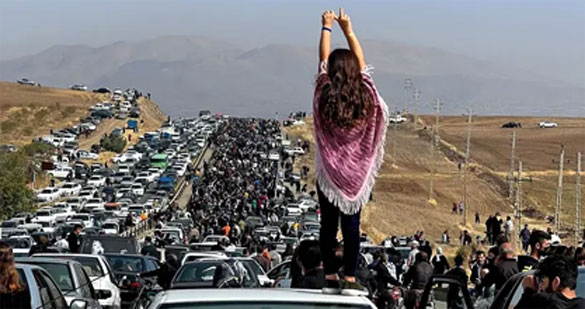
Three people across Iran
speak about how the protests have evolved and how they have changed daily life
in their city. Photograph: UGC/AFP/Getty Images
------
Clea Skopeliti
Fri 2 Dec 2022
Iran’s security forces have killed at least 448 people
since protests began more than two months ago, according to a human rights
group.
Iran Human Rights (IHR) said those killed include
including 60 children under the age of 18 and 29 women. The UN high
commissioner for human rights recently warned that “a fully fledged human
rights crisis” was taking place.
Three people across Iran speak about how the protests
have evolved and how they have changed daily life in their city.
‘In parts of Tehran, people chant nearly every night’
My area of Tehran was active the first two weeks, but
then a lot more police and basij [paramilitary volunteer militia] forces
started guarding the main streets and especially the main square.
So active protests turned into other forms, mainly
honking cars and creating traffic. That has subsided too. On occasions that are
widely agreed on, people turn out again.
In my area there’s a lot less chanting at night,
nearly nonexistent. But that’s rather an exception. Other parts of town that
I’ve visited , people chant nearly every night. The most common one is ‘death
to the dictator’.
Sometimes there are clashes at night. There are all
kinds of plainclothes basij [among the protesters] – it breaks trust in the
crowd.
I do not go out that much because I’m active online
and cleaning my devices of any troublesome content is too much of a hassle
every time. In my area, there’s the risk of being recognised in protests by a
basiji from your own neighbourhood. The dynamic is complicated.
There’s a lot of graffiti, they’re regularly painted
over and done again. I have done a few myself. They used to be the names of the
victims, mainly Mahsa Amini and Nika Shakarami. Sometimes it’s slogans like
“down with the dictator”. Very often “zan zendegi azadi” [women, life,
freedom].
People try to ignore the hijab law when they can where
they can. As far as I’ve seen it’s on the rise and as many as four out of 10
women on main streets don’t have their heads covered.
Many friends have said that it is extremely stressful,
but they try to keep doing it. The forces are ignoring it mainly because they
can’t afford to go after everyone. Some more courageous ones even pass the
forces without a hijab [in the central square].
Mohsen*, 38, works in marketing in Tehran
‘I see women unveiled daily now’
From the beginning there haven’t been as many protests
here, compared with other cities.
Things are not that different on the surface compared
with before everything started, but there are differences nonetheless. There
are way more guards in every square than I have ever seen before. They are
equipped mostly with batons and tasers, but sometimes they have guns. But there
is also a sense of defiance among people.
Now it is mostly civil disobedience, like unveiling
hijab, strikes, gatherings in university and chanting “death to the dictator”.
We had some violent days [during protests in mid-November]. A lot of people
have been arrested, including two of my closest friends.
People write anti-government slogans everywhere in
public. City officials try to clean them up as fast as possible, but they still
reappear. [On Tuesday] night, after the match and the defeat of Iran’s team by
the USA, people actually cheered in the streets and in their homes.
I see women [unveiled] daily now on the bus, on the
metro, even in the university. It is mostly young women and girls. Before,
there were almost none, at least not here. My region is very conservative. Most
people don’t react, but [there is] sometimes a bit of staring from older people
.
Last week my friend and I walked in front of the
police with no veil. It was terrifying, but we did it. After we walked away
from them, a girl and her friend ask me for a fist bump and then gave me candy.
A couple of old men next to the guards laughed and said “Mashallah” [What God
has willed]. I try to do it as often as I can. Sometimes I get too scared,
sometimes I feel more brave.
Families don’t support this action. They are either
scared for their lives or are religious and strict. My family is in the first
category. My father advises me daily to not get involved, but I do it anyway.
It feels natural – how have we lived all these years without doing this?
Without feeling this freedom that [so many] women have?
Right now, [protests in Tabriz] are declining, but
this has happened before – a decline, then an uproar. Maybe this time it will
be finished, but I really doubt that.
Farah*, 24, teacher in Tabriz, north-west Iran
‘Some are applying for studies abroad to escape the
country’
On 17 November, security forces came into the
university library and tried to drag out a student [who had been involved in
protests]. Afterwards, students gathered in the library to protest, saying they
don’t want intruders in the uni or guards attacking students. They chanted
“university library is our home, don’t let enemies in our home”. The university
threatened to suspend students, and some were actually suspended.
There are government plans to sentence students who
protest to a 10 year ban from leaving the country. Applying to university
abroad is not just an academic thing – it’s a way for students to escape when
some are not being allowed to leave the country.
The protests are up and [down] in Shiraz. In
mid-November, the protests were really strong here. My father saw [security
forces] break car windows using batons and threaten people; people were honking
their horns in protest.
Since then, protests here have abated a little. Truck
drivers are joining the strike in many provinces in Iran to say they won’t work
until the people are listened to, as a way of protest.
[Overall, protests] are still strong in Shiraz, but
they happen in different ways. For example, people are boycotting businesses or
shops that have been proved to support the regime. Some days, it’s all
happening out there on the streets. They’re trying to keep the protest going,
while trying to stay safe themselves.
Shirin*, 22, living in Shiraz, south-central Iran
*Names have been changed
Source: The Guardian
--------
Najira Noushad, Indian Woman Drives From Kerala To
Doha To Support Argentina And Lionel
December 02, 2022
Shyam A. Krishna
Meet Najira Noushad: homemaker, avid traveller,
blogger and YouTuber. That’s not all. She’s a huge football fan: an ardent
supporter of Argentina and Lionel Messi. Little wonder she’s in Qatar for the
World Cup.
Football fans who can afford match tickets and air
tickets are in Doha for the World Cup, which brings together the best
footballers. Some enthusiasts go to great lengths to attend matches. For
others, the journey to the host nation is part of the experience.
Two French fans pedalled 8,000km from Paris to Doha on
their cycles. A Saudi fan walked from Jeddah to watch the World Cup. There are
others like Najira, who opted to drive from the southern Indian state of
Kerala.
The Keralite drove around 3,000km from Kannur to Doha
to watch her favourite team. She brought along her five children for the drive
in an SUV, named Olu (she or girl in Malayalam language). With a vehicle
stocked with groceries, utensils, a stove and a bed, Najira has turned her
Mahindra Thar into a home on wheels.
The 33-year-old started her journey on October 15 with
Kerala minister Anthony Raju flagging her off in Kannur. Najira headed to
Mumbai via Coimbatore and caught a ship to Oman. She then drove through the UAE
and Saudi Arabia before entering Qatar.
The social media influencer has been documenting her
49-day trip and posting photos and videos on Instagram
(@naajinoushi_solo_momtraveller). In the UAE, she even hitched a ride on a
truck. Najira also found time to snap selfies at the Burj Khalifa and Museum of
the Future in Dubai.
The Qatari government, impressed by her passion for
football, waived off all charges and welcomed her at the Abu Samra border
between Saudi Arabia and Qatar. She’s become a media darling with television
stations and newspapers seeking interviews.
Najira is no stranger to the Gulf countries. She lives
in Oman and holds an Omani driving licence, valid in Gulf Cooperation Council
countries. So she’s familiar with the roads in the region.
“I live in Oman with my husband and children, but I
wanted to start this drive from my hometown of Thalaserry in Kannur. So I came
down to India,” Najira told The Hindu newspaper in India.
How did she catch the football bug? “My mother’s
sister [aunt] and brothers are crazy about it [football], and I remember them
shouting and clapping and shrieking in delight when their team won.” Their
enthusiasm rubbed off on Najira at age 14.
Football is not her only passion. Najira is an
intrepid traveller too. Last year, she drove around exploring India with a
friend, covering 13,000km from Kerala to Ladakh crossing 17 states and five
Union territories. In February, Najira hitch-hiked from Kuttanad in Kerala to
the Everest Base camp in Nepal. She says her 50-day solo trip was aimed at
highlighting the message: India is the safest country for a solo woman
traveller.
Najira’s Qatar road trip is also part of her efforts
to spread the message that it’s safe for women to travel anywhere in the world.
She hopes that her trips inspire other women to travel.
“If a woman like me — a homemaker, a wife and a mother
of five — can realise my dreams, any woman can chase her dreams confidently,”
the Keralite says, adding: “Sometimes kids only think of their fathers as role
models. I want my kids to say, ‘My mama is my role model.’”
Najira credits her husband Noushad for encouraging her
wanderlust. “He is my biggest support system, along with my mother,” she told
the Global Indian website. “He has always pushed me to do what makes me feel
happier, and travel tops the list. Even with my five kids in tow, I have never
hesitated to take the road.”
The Qatar World Cup 2022 brought two of Najira’s
passions together. She didn’t hesitate to hit the road to Doha. The prospect of
seeing Messi and Argentina was the catalyst. “I am a hardcore Argentina and
Lionel Messi fan. [I] really want to see my favourite team lifting the cup [in
Qatar], Najira says.
The World Cup final is on December 18. Najira will be
in Doha to discover whether her dream will come true.
Source: Gulf News
--------
Saudi Arabia Submits Bid To Host Asian Football
Confederation Women’s Asian Cup 2026
December 02, 2022
RIYADH: Saudi Arabia’s has submitted an official bid
to the Asian Football Confederation to host the AFC Women’s Asian Cup 2026.
President of the Saudi Arabian Football Federation
Yasser Al-Misehal said that hosting this tournament opens new horizons for
women's football in the Kingdom and the region.
The Saudi delegation submitting the bid included Saudi
national team assistant coach Dana Rajab, and Saudi national team and Al-Shabab
player Raghad Helmi.
Saudi Arabia is competing with Jordan, Australia, and
Uzbekistan to host the event. The AFC is scheduled to make the decision in
2023.
The AFC Women’s Asian Cup 2026 is expected to build on
the solid foundations of the tournament’s celebrated legacy.
Expanded from eight to 12 teams, not only was the AFC
Women’s Asian Cup India 2022 the biggest-ever edition in nearly two decades,
but it was also organized by the largest-ever women’s delegation.
Source: Arab News
https://www.arabnews.com/node/2209641/sport
--------
Emirati Women Convinced About Their Place In National
Life: German author Monica Mergiu
December 02, 2022
German author Monica Mergiu has sent “warm regards
from cold Germany” to Gulf Today. A writer who has penned innumerable words on
the UAE in books and articles, her volume Royals & Artists: Emirati Women
of the Golden Era, is part of the Women and Art collection of interviews, of some
of the “most important Arab women of our times,” she says. “I’m writing about
women on their journey to self-discovery. Not always self-confident but for
sure very much convinced about their role in family life, professional life and
social life.”
Eng. Azza Bin Sulaiman is an engineer and a
politician; in 2015, she was appointed member of the United Arab Emirates
Federal National Council (FNC). “Azza Bin Sulaiman invites the Emirati youth to
self- discovery, self-definition and intellectual freedom,” Mergiu says.
Wedad Al Kaabi is a Founder Member of The Arts Club
Dubai and the Capital Club Dubai. She is an interior designer who also designs
jewellery. She produces only limited editions jewellery, since she creates them
“just for the ones ready to understand our Emirati heritage and our own
Spirituality.”
Abu Dhabi born Sumayyah Al Suwaidi is of course a
well-known figure in UAE art circles. For Mergiu, Al Suwaidi’s art “reinvents
forms, colours, structure and personalities.” Dr. Huda Al Habib is a therapist
— a soul doctor, according to Mergiu, since Al Habib provides medical care for
the soul. Practicing in a “green” ambience, her office graced with plants and
flowers, the doctor emphasises that “health isn’t just about medicines,
medicaments or chemical treatment — it is about our ability to see where we
are, what we are facing.”
For her, clients are not patients but friends. She
uses ancient wisdom from books, bio and herbal products and relies on “natural
nurture” in her role as healer. Fatma Lootah is an Emirati artist based in
Verona, Italy. “After living all those years between Dubai and Verona,” Mergiu
says, “Fatma Lootah is nothing more and nothing less than an oriental with the
flavour of canzonetta and an Italian with the mystery of sand dunes … her
paintings charm precisely by this blend of Orient and the Occident …”
“I am a soul in search of light through Art,” says the
artist. “I try to describe the atmosphere of happiness despite the sad wars and
desperate moments of other nations.” Mergiu reproduces a poem by Lootah which
describes a woman as being “stubbornly patient as a palm tree/stubbornly
patient as a camel/travelling through the hills of life.”
Mariam Al Shemmari is an Emirati perfumer. “Meeting
Mariam is like being in the middle of a forest with millions of flavours,
fragrances and scents,” Mergiu exclaims. With Emirati inspirations in the heart
and European standards in her hands, Al Shemmari “deals with the scents and
sense of elegance”. Noura Al Noman is the first author of science fiction
literature from the UAE. “She writes SF,” says Mergiu, “which is anyway
absolutely unusual in the Arabic language.” However, Al Noman cautions that
though her fiction is written in Arabic, it is not exclusively “Arab”. “It
takes place on other planets where ethnicities and even religions are
unspecified.
“In fact, I had made sure there is no mention of
Earth, Arabs and Islam in my fiction, in an effort to avoid the debates which
could arise from the themes and contents.” Though she has many favourite writers,
she draws most from Anne MCaffrey. “The striking feature,” says Al Noman, “is
the diversity and multi-ethnic worlds she has created, and the harmony between
them all.” Rather like the UAE, isn’t it?
Hind Bin Naiser is the owner of the first Emirati
cosmetic brand: when the book was being written, Bin Naiser was on the cusp of
introducing her products to the European market.
Hana Alhai, according to Mergiu, is “a mixture of
ancient Egypt and modern Emirati” as a fashion designer. She owns the Pearl Haute
Couture salon in Dubai. It is filled with flowers, multi-coloured orchids,
perfumes with Oriental flavours and oils with mysterious names, brilliant
kaftans of silk, long dresses in a marvellous eventail form, golden coffee
tables with delicious Arabic sweets and traditional dates – they remind the
author of old, royal Alexandria, the Cairo of Naguib Mahfouz and Khan
el-Khalili, the famous bazaar and souq in the historic centre of Cairo,
established as a centre of trade in the Mamluk era. “What is marvellous is the
fact that all this happens in the middle of cosmopolitan Dubai!” says Mergiu.
Dr. Noora Al Marzooqi is an anchor, media presenter in
Dubai Media City, spokesperson in international events, a trained dentist and
Founder and Owner of Opera Art Production. If this CV was not long enough, here
is more: she is also involved in education and charity events. “A real
inspiration for many young girls and a visionary person, giving a sense of
purpose to the new Emirati generation,” Mergiu concludes.
Shaima Al Habsi, the book notes, is a successful life
coach, motivational speaker and an analyst specialised in Economy, Climate and
Energy. “Being a young woman with a beautiful career in so many different
fields makes Shaima the perfect example of the new generation of Emirati women
dedicated to their roots, origins and identity, walking the long journey to
self-definition,” Mergiu says. Royals & Artists is illustrated by the
photographs of Tunisian-French painter Raouf Meftah, who has been awarded by
UNESCO for his calligraphy.
Source: Gulf Today
--------
Afghan, Pakistani female entrepreneurs share
experiences at exhibition
Shahid Khan
December 02, 2022
PESHAWAR
- In a rare one-day workshop
and exhibition here on Thursday, Afghan women entrepreneurs and local female business
owners shared their experiences.
The event for women Afghan refugee entrepreneurs was
organised by the Sarhad Rural Support Programme (SRSP) and the Women’s Chamber
of Commerce and Industry (WCCI), with support from the UNHCR and the
Commissionerate for Afghan Refugees.
The event’s goal was to encourage collaboration
between Afghan refugee women entrepreneurs and local counterparts for long-term
livelihood development.
The programme was attended by UNHCR provincial head
Gayrat Ahmadshoev, Afghan refugees’ KP Commissioner Mohammad Abbas, WCCI
President Azra Jamshed, Bank of Khyber Managing Director Muhammad Ali
Gulfaraz, representatives of First Women Bank, KP Board of Investment and
Trade, WCCI executive body members, local communities, and Afghan refugees.
WCCI President Azra Jamshed spoke on the occasion,
expressing hope that such events would bridge the gap between host communities
and refugees, creating opportunities for sustainable livelihoods.
Mohammad Abbas, KP Commissioner for Afghan Refugees,
stated that societies can achieve the true essence of social and economic
development by allowing equal participation to women from all walks of life
and reducing social barriers that act as a glass ceiling.
Gayrat Ahmadshoev praised the WCCI’s role in promoting
women’s empowerment and encouraged such healthy events for the development of
Afghan refugee women, as they faced harsh realities of life and were in
desperate need of all stakeholders’ support.
During the event, the participants, particularly
Afghan refugee women entrepreneurs, were thoroughly educated on the
entrepreneurial mindset and business modelling, financial literacy, and the
significance of digital platforms in business expansion and development.
In addition to orientation, the women of successful
local entrepreneurship shared their experiences with Afghan refugee women.
Afghan women and local entrepreneurs displayed their handmade products on
various stalls, which included beautician-related items, artificial jewellery,
handicrafts, home textile products, and stoneworks.
All of the dignitaries praised the products. Syed
Aftab Ahmad, the SRSP programme manager-operations, thanked all participants,
who received shields and certificates later on.
Source: Nation Pakistan
--------
URL: https://newageislam.com/islam-women-feminism/hindu-elopes-muslim-man-love-jihad/d/128547
New Age Islam, Islam Online, Islamic Website, African Muslim News, Arab World News, South Asia News, Indian Muslim News, World Muslim News, Women in Islam, Islamic Feminism, Arab Women, Women In Arab, Islamophobia in America, Muslim Women in West, Islam Women and Feminism