
Censors Forced Iran’s Moderate Newspaper Ham-Mihan Offline Over Hijab Stock Image For Alleged Rape Case
New Age Islam News Bureau
29 October2025
· Censors Forced Iran’s Moderate Newspaper Ham-Mihan Offline Over Hijab Stock Image For Alleged Rape Case
· Tehran Women Defy Volunteer Hijab Enforcers
· ‘Pilgrimage’ Portrays Muslim Women With The Complexity They Deserve
· Iranian Women’s Handball Team Wins Historic First-Ever Asian Youth Games Gold
· Canada Reaffirms Support For Afghan Women And Girls At UN Meeting
· World Bank Hails UAE As Model For Empowerment Of Women, Youth
Compiled by New Age Islam News Bureau
URL: https://newageislam.com/islam-women-feminism/forced-iran-moderate-hijab-rape-case/d/137441
------
Censors forced Iran’s Moderate Newspaper Ham-Mihan Offline Over Hijab Stock Image For Alleged Rape Case
Maryam Sinaiee
OCTOBER 29, 2025
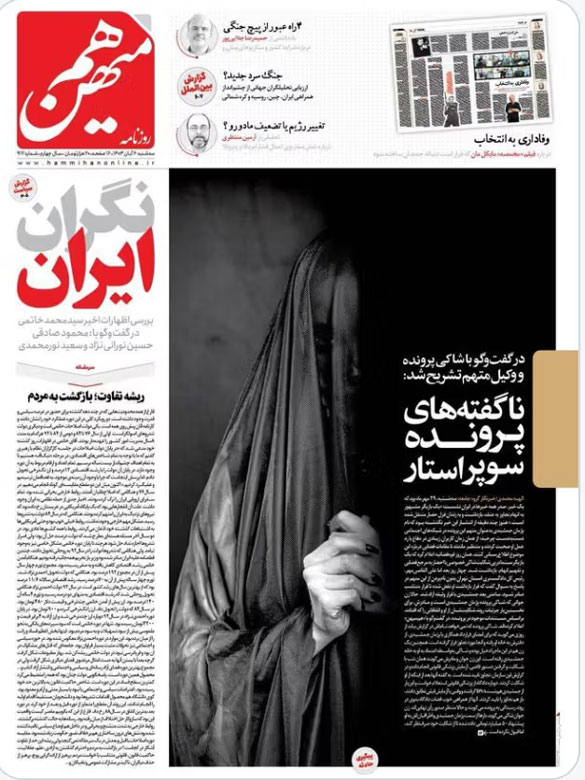
Censors forced Iran’s moderate newspaper Ham-Mihan offline on Tuesday after hardliners condemned its use of a photo of a veiled woman on its front page for a report about a controversial rape case.
Centering around the Islamic veil which conservatives view as a sacrosanct symbol of Iran's Islamic identity which they are empowered to force on society, the dispute exposes deepening cultural and political rifts inside the country.
The image, which was intended to represent the alleged victim symbolically, drew ire from conservative elements who accused the newspaper of allegedly insulting Islamic values and undermining the hijab.
State TV presenter Mohammad-Reza Shahbazi harshly criticized the choice, saying, “Virtuous and veiled women are pure from the filth you wallow in day and night, which sometimes reeks like this (rape case). Put up a picture of one of your own kind instead.”
Editor-in-chief Mohammad-Javad Rouh said the alleged victim did not wish to reveal her identity and that using an unveiled photo as a symbolic image was not possible under the Islamic Republic’s media restrictions.
Rouh rejected claims that the paper had targeted the hijab.
“We did not speak against the hijab, nor did we intend to create controversy,” Rouh said. He added that the newspaper had fulfilled its journalistic duty by interviewing both the complainant and the accused’s lawyer in what he called “a balanced, professional report.”
The hardline website Mashregh News claimed, citing an informed source, that Iran’s Press Supervisory Board had already issued three formal warnings to Ham-Mihan in recent months.
It alleged that one of the paper’s violations was serious enough to be referred to court and that “a judicial verdict is imminent," without elaborating.
Mashregh further accused the paper of intentionally publishing the rape case article by journalist Elaheh Mohammadi — who was imprisoned in 2022 for reporting on the death of Mahsa Amini — shortly before a potential suspension.
“The behavior of Ham-Mihan’s managers in assigning a project to a journalist with a history of arrest for security issues, whose past reporting triggered one of the country’s deepest crises, is now under review,” the outlet wrote.
Hardliners on the offensive
State-aligned outlets quickly turned the incident into a political storm. The official Mehr news agency said Ham-Mihan had been taken down for “violating professional ethics.” Tasnim, affiliated with the Revolutionary Guards, accused the paper of “a deliberate insult to the traditions of a large portion of Iranian women.”
Online, conservative commentators called the newspaper’s decision immoral.
Filmmaker Mikail Diani claimed it showed “malice and an effort to create social division,” while Fatemeh Raygani, a philosophy researcher, wrote on X that the report had “polluted the symbol of the black chador with a story of (alleged) sexual assault.”
Not the first time
The closure of Ham-Mihan underscores the precarious position of moderate media in Iran, where professional reporting on sensitive social issues can quickly provoke accusations of immorality or political subversion, leaving editors and reporters under intense scrutiny from authorities and the public alike.
Ham-Mihan, run by Gholamhossein Karbaschi — a senior member of the centrist Executives of Construction Party and a former Tehran mayor — was relaunched in July 2022 after previous suspensions.
It has faced closure twice before, in 1999 and 2008. Since its relaunch in 2022, it has drawn scrutiny for its coverage of gender and social issues.
Karbaschi told Eco Iran a few days ago that several of his reporters were summoned and threatened by Revolutionary Guards intelligence agents after publishing a piece on challenges facing female heads of households.
“What threat can a newspaper with a circulation of one or two thousand pose to the state?” he asked.
The dispute comes amid intensifying pressure on Iran’s press. According to the Defense of Free Information organization (DeFFI), at least 95 journalists and outlets faced legal or security action in the first half of 2025, with six reporters temporarily detained and collective prison sentences exceeding 22 years.
Some observers believe the main reason for the action taken against Ham-Mihan was reporting the alleged rape case itself.
Veteran reformist columnist Ahmad Zeidabadi wrote: “In a country where you can’t even report on a private criminal case, what need is there for newspapers at all? State TV and Kayhan (which is funded by the Supreme Leader’s office) are enough.”
Source: iranintl.com
https://www.iranintl.com/en/202510286927
------
Tehran Women Defy Volunteer Hijab Enforcers
OCTOBER 28, 2025
TARA ROSHANI
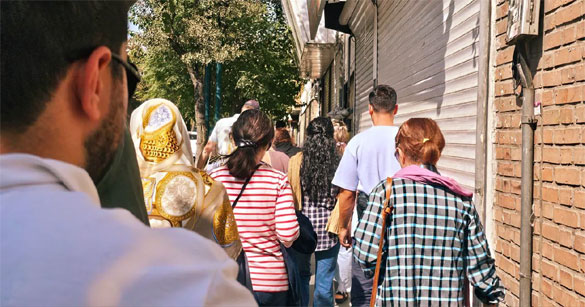
In October 2024, Iran’s Guardian Council approved a comprehensive Chastity and Hijab Law after multiple revisions
--------------
Two young women were on the stairs to the metro at Haft Tir Square this week when a pair of chador-clad women blocked their path.
“Ladies, put your head scarves on your heads,” one of the women demanded.
The young women, walking without a mandatory hijab, barely paused. “You’ve shown up again,” one replied before continuing into the station.
The brief encounter shows a new dynamic taking shape on Tehran’s streets, where volunteer hijab enforcers have begun confronting women who refuse to cover their hair – and where those women largely ignore them.
Farzaneh, who has been refusing to wear a headscarf for several months, said she and her mother encountered three chador-wearing women on Karim Khan Street recently.
“They said, ‘Ma’am, please put your scarves on,’” Farzaneh said. “My mother got angry and said, ‘Who are you to allow yourselves to stop people and give warnings?’”
The women identified themselves as ordinary citizens volunteering to fight what they called “corruption in society,” Farzaneh said.
Her mother’s response ended the conversation: “So our uncovered hair causes corruption, but the lavish wedding of Shamkhani’s daughter promotes society’s well-being?”
She was referring to a video that sparked controversy, showing scenes from a wedding ceremony held in March 2024 at Tehran’s upscale Espinas Palace Hotel.
Women danced without headscarves in mixed company at the wedding, where luxury dominated every frame.
The estimated cost ran into billions of tomans, all for the daughter of a man who had spent decades enforcing the same Islamic codes that guests flouted at his family celebration.
Ali Shamkhani, 70, currently serves as a political adviser to Supreme Leader Ali Khamenei and sits on the Expediency Discernment Council, one of Iran’s most powerful bodies.
One of the women shook her head and said, “I’m sorry you don’t fear God,” before walking away, according to Farzaneh.
The confrontations follow an announcement by Rouhollah Momennasab, secretary of Tehran Province’s Headquarters for the Propagation of Virtue and the Prevention of Vices, about forming a “Chastity and Hijab Situation Room.”
“With 80,000 trained forces across the province, a major transformation in implementing chastity and hijab policies will take place,” Momennasab said at a news conference.
He called on citizens to join a “people’s observers headquarters” to participate in the monitoring effort.
Momennasab said the situation room will track and analyze cultural and media activities in society, with enforcement strategies communicated to government agencies.
Ali, who works in a shop at Tajrish Square, said chador-wearing women have been circling the area for two or three days and approaching women without hijab.
“They’ve let their dogs loose again, but the people won’t back down,” he said. “Even among women who have head scarves around their necks, I’ve rarely seen anyone listen to them and put on a hijab.”
The number of women and girls traveling without a mandatory hijab in large cities has increased since June.
Now the volunteer enforcers have returned, using gentle language and friendly interaction - for now.
The chador-wearing women have appeared at major locations across the capital, including Valiasr Square, Vanak Square, Tajrish Square, Sanat Square, and Keshavarz Boulevard.
They approach women traveling without headscarves and request they cover their hair.
Mehrnaz, who works at a clothing store on Kar va Tejarat Street and received a hijab warning a few days ago, said “returning to the past is impossible.”
“I’ve been walking in the streets without a mandatory hijab for several months and using the metro and taxis and going to work,” she said. “I haven’t even faced a single bad encounter with men or insults or words that would constitute harassment, and I haven’t felt unsafe.”
She said the volunteer enforcers create the opposite effect of their stated goal.
“The presence of these women who consider themselves guardians of hijab and chastity and agents of peace and security brings us more feelings of anxiety, worry, and insecurity,” Mehrnaz said.
The volunteer enforcers, according to those who have encountered them, attempt to maintain friendly demeanors.
While President Masoud Pezeshkian blocked the implementation of a strict new hijab law last year, calling it “unenforceable,” enforcement continues selectively through existing regulations, creating an atmosphere of legal ambiguity that varies dramatically by region.
In October 2024, Iran’s Guardian Council approved a comprehensive Chastity and Hijab Law after multiple revisions.
The legislation imposed strict monitoring of dress for both women and men, with penalties ranging from fines to prison sentences of six months to five years for dress code violations.
But Pezeshkian, elected on a relatively moderate platform just months earlier, obtained a resolution from Iran’s Supreme National Security Council preventing the law’s implementation.
In June, Parliament Speaker Mohammad Bagher Ghalibaf confirmed in a public session that the council had ordered the law not to be enforced, responding to representatives who demanded its implementation.
The suspended provisions - Articles 48 through 50 - specifically prohibited women’s presence in public with “non-Islamic dress.”
Yet according to citizens’ reports and domestic media accounts, other parts of the hijab enforcement framework remain active through previous laws, directives, and administrative circulars.
The result is a patchwork system where enforcement depends heavily on location, with powerful local religious figures often wielding more influence than national government policy.
Residents of the capital say public spaces have changed over the past year, with women without headscarves now common across all neighborhoods - not just the traditionally liberal, affluent north.
Source: iranwire.com
https://iranwire.com/en/women/145889-impossible-to-return-to-the-past-tehran-women-defy-volunteer-hijab-enforcers/
------
‘Pilgrimage’ Portrays Muslim Women With The Complexity They Deserve
By Lily Janiak,
Oct 28, 2025
When Muslim women wear a head covering in much of American storytelling, it means they’re exotic yet ignorant, oppressed yet dangerous — an ethnic, cultural and religious other.
Achieving something more might sound like a low bar to clear. “Pilgrimage” banishes that bar to irrelevance, where it always should have been.
In Golden Thread Productions and Z Space’s show, which opened Monday, Oct. 27, five women — four relatives, one friend — make their faith’s sacred journey to Medina and Mecca. But that’s where their similarities end.
Maryam (Fatemeh Mehraban) is a multimillionaire CEO, while Sosan (Isabel Alamin) is a broke photographer. Fatima (Jeunée Simon) has the zeal of the recently converted, Noor (Nora el Samahy) is reigniting her faith after decades for mysterious reasons, and Nadia (Leda Rasooli) covers festering grudges with outward piety.
Humaira Ghilzai and Bridgette Dutta Portman’s script — which the companies are billing as the first world premiere co-written by an Afghan American woman in the United States — excels on multiple fronts. It mines cradle-forged power struggles with the kind of verisimilitude that seems bound to get scrambled with your own memories. (Where were these playwrights eavesdropping, you might wonder, when you squabbled with your mother about who deserves credit for your success, or your sister about her selfishness or self-inflicted misery?)
It also exudes care for the community it portrays. Ghilzai and Portman take their characters’ faith journeys seriously and with real depth while also granting them a certain lightness — “Resist patriarchy!” they all jokingly chant in a taxi. Spirituality is a spectrum, the show implies, with any entry or exit point valid.
But all these virtues only make the show’s shortcomings grate.
Directed by Michelle Talgarow, “Pilgrimage” is staged in the round in Z Space’s larger venue, a former cannery, which is way too big for the intimate story it’s trying to tell. Your enjoyment over the course of the play will likely directly correlate with whether the actors are close to you at any given moment. Often, they’re so ludicrously far away you might feel like you’re somehow not supposed to hear them. The high ceilings swallow sound, and not all members of the cast have the vocal horsepower to hurdle over that obstacle.
Other acting chops are uneven, too. El Samahy, in a mighty monologue of unburdening, strips away defense upon defense. It’s as if her character has traveled back in time to her younger self, raw and quivering during a time of war the younger women can’t imagine. But other performers are more wooden, reciting lines like they’re prerecorded and muting the impact of the script’s whopping second-act revelations.
If “Pilgrimage” ties up its manifold plot threads a bit too fastidiously, it also makes you leave the theater thinking about the women in your life — whom you’d trust with your darkest secrets, whom you could ask to join you on the journey of a lifetime or for care in your neediest hour.
Whether you’re Muslim, otherwise religious, agnostic or atheist, the play subtly posits another kind of religion we can all get behind: sisterhood.
Source: sfchronicle.com
https://www.sfchronicle.com/entertainment/article/pilgrimage-sf-muslim-review-21073934.php
------
Iranian women’s handball team wins historic first-ever Asian Youth Games gold
28 October 2025
Iranian girls’ handball team secured the championship title at the Asian Youth Games in Bahrain after recording their fifth consecutive victory, guaranteeing the first-ever gold medal in Iran’s handball history before the tournament’s conclusion.
The Iranian side, which had already defeated China, Uzbekistan, Kazakhstan, and Thailand, faced India in their fifth match at the Umm al-Hassam Hall in Manama on Tuesday.
With another strong performance, they claimed a 43–26 win, having led 23–13 at halftime.
The result placed them firmly at the top of the standings with 10 points, ensuring the gold medal regardless of the outcome of their final match against Hong Kong.
This marks the first-ever gold medal in Iran’s handball history at the Asian Games level, whether in youth or senior competitions.
Following the victory, Iran’s Foreign Minister Abbas Araghchi issued a message, extending congratulations to the “brave and champion girls” who achieved a “historic” victory while upholding their cultural and moral values.
He said the gold medal was the result of “hard work, perseverance, and admirable determination,” adding that it symbolizes the capability and merit of Iranian women.
He expressed hope that this continental success would pave the way for continued achievements by Iranian girls in various sports arenas, with the national flag always flying high.
Source: presstv.ir
https://www.presstv.ir/Detail/2025/10/28/757752/Iran-girls-handball-team-crowned-champions-at-Asian-Youth-Games
------
Canada reaffirms support for Afghan women and girls at UN meeting
By Siyar Sirat
28 October 2025
Canada has reiterated its firm support for the people of Afghanistan, particularly women and girls, during a high-level meeting of the Group of Friends of Afghanistan held at the United Nations.
In a statement posted on X on Tuesday, Canada’s Permanent Mission to the UN said it convened the meeting with the participation of Richard Bennett, the UN Special Rapporteur on the situation of human rights in Afghanistan. “We continue to call for sustained attention on Afghanistan and stand firm in our support for the people of Afghanistan, particularly women and girls,” the mission said.
The meeting took place as the humanitarian and human rights crisis in Afghanistan deepens under Taliban rule, with women and girls facing unprecedented restrictions on education, employment, and public life.
Speaking at a separate event on the sidelines of the UN General Assembly titled “The Taliban’s Misuse of Religion and Its Consequences for Afghanistan and Beyond,” Bennett warned that the Taliban’s extreme interpretation of religion poses a long-term threat to Afghan society, especially future generations.
Bennett, who has repeatedly warned of the deteriorating human rights situation in Afghanistan, has urged the international community to move beyond statements and take concrete action to support Afghan women and girls.
The Canadian mission’s renewed pledge comes amid growing concern that international focus on Afghanistan is fading, even as millions of Afghans—particularly women—continue to face restrictions and a collapsing economy.
Source: amu.tv
https://amu.tv/208052/
------
World Bank hails UAE as model for empowerment of women, youth
2025-10-29
DUBAI -- The World Bank has described the United Arab Emirates as a leading model in human development and in adopting policies that empower women and youth.
Fadia Saadah, Regional Director for Human Development in the Middle East and North Africa, Afghanistan and Pakistan Region at the World Bank, said the UAE has built an integrated model of work-life balance and women's workforce participation through labor law reforms and investments in early childhood development and childcare.
Speaking to the Emirates News Agency (WAM) following the release of the World Bank's new flagship report "Embracing and Shaping Change: Human Development for a Middle East & North Africa Region in Transition", Saadah said the UAE's 2022 labor law reforms have enabled part-time, temporary, remote, and shared work arrangements, expanding opportunities for women and youth.
In 2021, the country introduced enhanced parental leave provisions, which support work-life balance and women's workforce participation.
"The country's investments in early childhood development and affordable childcare are helping to empower women and equip youth with essential skills," she noted.
Highlighting how other MENA countries could benefit from the UAE's flexible labor mobility policies, Saadah pointed to the country's flexible labor mobility policies, which include adaptable visa options like the Golden and Green Visas for skilled professionals, investors, and freelancers, as well as job search and remote work visas.
She noted that the UAE also promotes labor protection through unemployment insurance, wage protection, and strengthened recruitment regulations. Adopting similar policies across the region, she said, would help attract and retain talent, support economic diversification and drive innovation.
According to the World Bank report, human capital in the MENA region has improved significantly in recent years, but further progress is needed to achieve inclusive and sustainable growth.
The report examines how three megatrends in particular - ageing populations, climate change, and technological change - are shaping the region's future, encouraging governments to continue to invest in "future-fit" human development policies.
Saadah said GCC countries may want to prioritise ageing and digitalisation, middle-income countries may focus on fiscal management, and lower-income or fragile countries should emphasise preserving human capital and institutions.
With continued commitment, she said, the MENA region is poised to transform emerging challenges into drivers of sustainable and inclusive growth, ensuring a brighter future for all.
Source: chinadaily.com.cn
https://global.chinadaily.com.cn/a/202510/29/WS69017579a310f735438b7886.html
-----
URL: https://newageislam.com/islam-women-feminism/forced-iran-moderate-hijab-rape-case/d/137441