
Burqa-Clad Hindu Woman Flying To Mumbai To Marry Muslim Man Held At UP Airport, Let Off By Court
New Age Islam News Bureau
31 March 2026
· Burqa-clad Hindu woman flying to Mumbai to marry Muslim man held at UP airport, let off by court
· 5 Films About Muslim Women Beyond the Mainstream
· AI Headshot Apps Removed Her Hijab. A Berkeley Law Researcher Wants to Know Why.
· Woman in hijab alleges racial profiling at Sen. Cory Booker event
· Malaysia’s Queen of Rock Ella to perform in Singapore as ‘Majlis Tertinggi Rockqueen’ tour arrives May 9
· Priyanka hits back at govt, says ‘don’t play politics over war’
· 8 years on, Mufti back in Assembly as guest, urges efforts to restore J&K legislature’s glory
· Syriac Women’s Union Easter Bazaar in Hasakah, Syria, showcases handmade traditions
Compiled by New Age Islam News Bureau
-----
Burqa-clad Hindu woman flying to Mumbai to marry Muslim man held at UP airport, let off by court
Mar 31, 2026
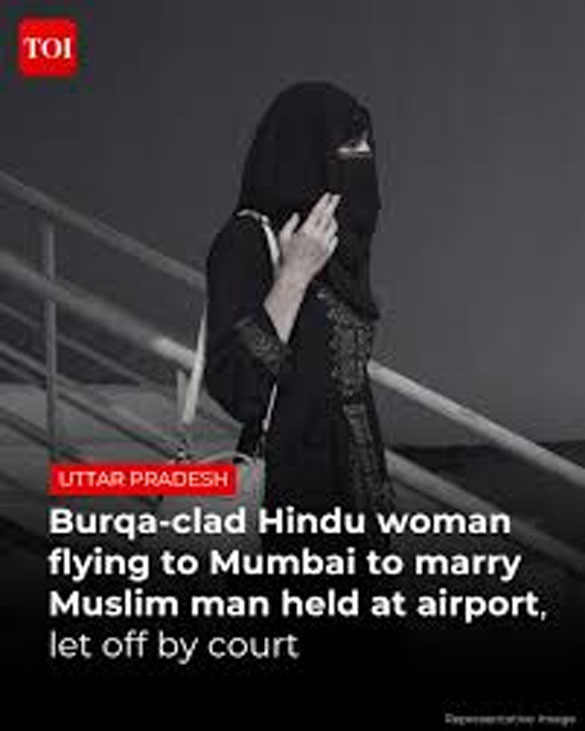
VARANASI: A 22-year-old burqa-clad Hindu woman was detained along with a Muslim youth at the Lal Bahadur Shastri International Airport in Varanasi on Sunday evening. The woman from Gopalganj in Bihar had to board a Mumbai flight with the youth.
When the documents were being checked before issuance of boarding passes, airline officials grew suspicious when they saw her in burqa while her Aadhaar identified her as a Hindu. After initial questioning, CISF handed her and the youth accompanying her to Phulpur police.
During a police investigation it came to light that the woman from Bihar's Gopalganj lives in Mumbai with her family. She fell in love with a Muslim youth in Mumbai. When her father came to know about it, he brought the girl from Mumbai to Gopalganj to marry her off to a youth of their caste.
However, the woman informed her lover about her family's decision who sent her Mumbai flight tickets and asked her to reach Mumbai with his friend. On Sunday, the girl reached Varanasi airport with the relative of her lover.
Phulpur police station in-charge Atul Singh on Monday said that credentials of the woman and the youth accompanying her were verified and no criminal record was found.
She was produced before a magistrate where she recorded her statement. The woman reiterated that she was going to Mumbai as he wanted to marry her lover. Since she is an adult, the magistrate allowed to go, said police.
Source: indiatimes.com
Please click the following URL to read the text of the original Story
https://timesofindia.indiatimes.com/city/varanasi/burqa-clad-hindu-woman-muslim-youth-held-at-airport/articleshowprint/129910153.cms
----
5 Films About Muslim Women Beyond the Mainstream
31.03.26
I’ve always loved films, and while I don’t believe you need to see yourself represented to relate to a character, there’s something genuinely joyful and quietly radical about seeing Muslim women exist on screen beyond stereotypes, not as passive subjects, symbols or case studies, but as people; central, complicated, funny, flawed, brave, or simply being themselves and living their lives unapologetically.
What makes the following films particularly powerful is their refusal to orient themselves around a white gaze. As the great Senegalese director Ousmane Sembene famously said, “Europe is not my centre.” These are not films made with a Western audience in mind. Though the directors in this list come from different parts of the world and tell vastly different stories, they are united by a shared resistance to explanation; a commitment to not diluting or flattening Muslim women for easy consumption. They fashion worlds where Muslim women desire, make mistakes and ultimately save themselves.
To me, centring powerful portrayals of Muslim women isn’t about chasing perfection; it’s about showing that we exist in complex, multifaceted forms, despite society persistently pushing us into a pre-designated box.
Too often, Muslim women in Western media are sidelined or defined solely by religion, framed as victims to be rescued or problems to solve. But our lives, personalities, and stories span far beyond that. When a film makes space for that fullness and portrays Muslim women’s lives with the rich texture that they deserve, the results are electric.
These stories do exist, if you just look outside the mainstream and surrender your fear of subtitles. Below I’ve listed some cinematic gems to savour, dissect and recommend to a friend.
‘Dhalinyaro,’ translating to youth in Somali, follows three young women on the cusp of adulthood, as their paths gradually pull them in vastly different directions. In her debut film exploring Somali girlhood, Lula Ali takes her camera to the sandy beaches of Djibouti and captures a moment suspended in time, where everything still feels possible.
Starring Amina Mohamed Ali, Tousmo Mouhoumed Mohamed, and Bilan Samir Moubus, the film conjures up images of lost teen years and a soft but fleeting innocence once cherished. These girls are allowed to be messy, proud, and defiant in the face of expectations placed upon them. The camera doesn’t judge; instead, Ali approaches their world with measured patience, attuned to the small rituals of self-expression. Secret romances. Sneaking out with friends. Clothes and hair scented with uunsi, carrying traces of home wherever you go.
Ali reminds us that true strength isn’t found in rebellion alone, but in the courage and thrill of carving out a space for yourself.
Ana Lily Amirpour’s feature debut doesn’t just introduce one of the coolest characters in modern cinema; it builds an entire world around her, as she rattles gender dynamics with slick style. She is not explicitly muslim, but her chador can be viewed as visual reclaiming of power, subverting stereotypes of muslim women as passive.
Sheila Vand is a magnetic presence as The Girl, a nocturnal drifter armed only with her skateboard and impenetrable gaze. Draped in a chador that billows like a cape, she is transformed into something other-worldly. The girl walking home alone isn’t in any danger; she is the danger, an avenging angel stalking dark alleyways to reclaim the night, offering a view into female rage that is both controlled and unrelenting.
It’s a conflicting piece of art that effortlessly folds genres together: part vampire western, part arthouse romance. Though set in an Iranian town, the film is drenched in American pop iconography, forming a space untethered from time or place. The Girl exists in a universe both mythic and modern, and she owns the story.
Sometimes the patriarchy feels like a waking nightmare you can’t escape. Predatory men stationed on every corner, dressed in sheep’s clothing, poised to take a piece of flesh. That’s the premise of Canadian Pakistani director Zarrar Khan’s ‘In Flames,’ which reframes horror not as the fear of the unknown, but as something rooted in the everyday threats women must navigate.
Our unyielding and perceptive lead is 25-year-old Maryam, played by Ramesha Nawa, a medical student. Following the death of her grandfather, she and her mother are left without a male guardian, rendering them vulnerable in Karachi, with no property rights of their own.
Khan blends the suffocating horrors of daily life as a woman with the supernatural, exposing how misogyny bleeds into every crevice of life, haunting not just dark alleyways, but brightly lit streets, homes and established institutions. It’s far more menacing than any traditional monster.
Maryam stares down the darkness, drawing strength from her connection with her mother to ward off the ghosts of past traumas. Their warm embrace provides much-needed support and protection.
Warsan Shire once wrote that there are locked rooms inside all women; sometimes the men come with keys, and sometimes they come with hammers.
Senegalese director Ousmane Sembene’s film is set in a small village in Burkina Faso, where FGM is still a common practice. At its centre is the imposing Colle, a woman of formidable presence. She steps forward and offers the young girls protection under moolade, a sacred spell that establishes a boundary no outsiders can cross. Marking her home and refusing to yield, she exposes a new and undeniable truth: the abuse can stop.
The men fear the women; this is evident in their scramble to maintain control amidst this small revolution. They confiscate radios, blame modernity for corrupting their wives and weaponise tradition and religion.
Colle dares to question and reject the status quo, using her power to forge a better future for the youth with an authority that can’t be ignored.
‘Yuni’ is a tender Indonesian coming-of-age story, written and directed by Kamila Andini. Arawinda Kirana is the mesmerising lead, playing a teenage girl living with the unbearable weight of having your future decided for you before you’ve had the chance to imagine it.
At school, control masquerades as morality. Mandatory virginity tests are imposed on girls, and music is banned on the grounds of religion. Yuni, only 16, busies herself with her studies, lingers with friends, and collects purple trinkets in an act of self-curation.
A girl of her age shouldn’t have to worry about much else, with her dreams of college only a whisper away. Yet she is inundated with marriage proposals by men triple her age, each one a threat to her freedom.
This stifling environment is carefully balanced by moments of pure teenage ‘rebellion’: discussing boys with friends, a first romantic experience, nights spent dancing alongside a free-spirited, divorced beautician who offers a glimpse into another world. Throughout it all, Yuni stands firm; she may not yet know what she wants from life – who does? – but she won’t succumb to a fate forced upon her.
Available to watch on Amazon Prime, Apple TV and Mubi.
Within these stories, we find that when the creatives behind the camera understand the weight and complexities of Muslim womanhood, that knowledge is felt on screen. Compared to Western cinema’s long tradition of narrowing us into symbols, often in an effort to explain away our perceived otherness, the difference is stark. In films like Dhalinyaro, A Girl Walks Home Alone at Night, In Flames, Moolade and Yuni, complexity isn’t granted but assumed.
While these films don’t announce themselves as radical, they are – in the tenderness, defiance, or dread they carry. They offer the profound relief of being seen without being reduced or defined. Perhaps what really matters isn’t being visible as Muslim women, but actually having agency to shape our own stories.
Source: amaliah.com
https://www.amaliah.com/post/81373/interesting-films-about-muslim-women
-------
AI Headshot Apps Removed Her Hijab. A Berkeley Law Researcher Wants to Know Why.
By Alex A.G. Shapiro
31.03.26
After testing more than 25 AI headshot generators, Berkeley Law J.S.D. candidate Mahwish Moazzam found that every one removed her hijab from the generated images, raising new questions about AI bias, religious expression, representation, and human dignity in algorithmic systems.
When Mahwish Moazzam uploaded a selfie to an AI headshot generator, she expected what the ads promised: a polished professional portrait.
Instead, the software removed her hijab — a visible expression of religious identity.
At first, she assumed it was a glitch.
She tried another app. The same thing happened.
Then another.
To see whether the issue was isolated or systemic, Moazzam uploaded selfies to more than 25 widely used AI headshot generators over the course of a year, including retesting several months later to see whether the results changed. Every one removed her hijab from the generated images. Only two apps produced mixed results, showing distorted or incomplete head coverings — “a piece of paper somewhere at the head,” she says.
The pattern raised a broader question: whether widely used AI image tools may be systematically altering visible expressions of religious identity.
“Some of the apps even prompted users to decide whether they wanted to keep accessories such as glasses,” Moazzam says. “None asked whether the hijab should remain.”
For Moazzam, a lawyer and legal scholar studying artificial intelligence and human rights, the experience pointed to a deeper issue. If AI systems can erase visible markers of religious identity, what does that mean for discrimination law, human dignity, and representation in digital spaces?
“Traditional anti-discrimination law was designed for identifiable human decision-makers,” Moazzam says. “Now we must ask how those laws apply when the decision-maker is an algorithm, where intent cannot easily be established and outcomes are difficult to explain.”
Her observations highlight a form of algorithmic bias that has received little attention, even as debates about AI discrimination have focused on facial recognition systems, hiring tools, and image generators. Despite the rapid spread of AI image tools, the removal of religious markers such as the hijab has rarely been examined as a potential issue of religious discrimination or identity distortion.
Because the apps are publicly available, Moazzam says other researchers and journalists could easily replicate the test to see how AI image systems handle visible markers of identity such as religious dress.
From Pakistan to Berkeley Law
The discovery emerged from Moazzam’s broader research on artificial intelligence and human rights at Berkeley Law, where she first arrived in 2019 to pursue an LL.M. degree with a specialization in international law.
Before coming to Berkeley, she spent many years teaching law in Pakistan, including courses in comparative constitutional law, tort law, and jurisprudence. Her work focused on human rights, constitutional governance, and questions about how law and state institutions respond to injustice in practice.
Moazzam was drawn to Berkeley Law for its strength in international law and its strong tradition of comparative and interdisciplinary legal scholarship addressing complex global issues. After completing the LL.M., she worked briefly at the Law Offices of Vernon C. Goins in Oakland before returning to Berkeley to pursue a J.S.D., the most advanced law degree offered by U.S. law schools and a path for scholars pursuing academic careers.
Her doctoral research examines how legal systems translate human rights commitments into meaningful protection in practice, using domestic violence legislation in Pakistan as a case study. More broadly, her work sits at the intersection of technology, human rights, and international law — areas Berkeley Law faculty have been examining for years — exploring how emerging technologies such as artificial intelligence pose new challenges for law and governance.
Faculty perspective
“Mahwish Moazzam’s research is a superb illustration of our institutional core values,” says Berkeley Law Professor Laurent Mayali, faculty director of the Robbins Collection Research Center. “It reflects a vision of what law is meant to do for people, particularly as new technologies and social media raise challenges to personal identity and individual rights.”
Professor Kathryn Abrams, Moazzam’s J.S.D. supervisor, says the research highlights how rapidly emerging technologies can raise new questions about identity, dignity, and equality. She adds that the project is typical of the curiosity, persistence, and insight that have fueled Mahwish’s path through her graduate work. “When Mahwish encounters a fact situation that surprises or puzzles her – be it a case, a political outcome, or an unexpected AI version of her own headshot – she follows the factual clues until she can begin to generate challenging conceptual hypotheses.”
“Mahwish Moazzam’s research asks all of us to wake up and understand how AI can affect human dignity and human rights,” adds Professor Eric Stover, co-faculty director of the Human Rights Center at Berkeley Law. “As Henry David Thoreau once wrote, ‘It is not what you look at that matters, it’s what you see.’”
Q&A with Mahwish Moazzam
What brought you to Berkeley Law?
My academic interests have long focused on the intersection of comparative constitutional law and human rights. While teaching law in Pakistan, I developed a strong interest in examining how law and state institutions respond to injustice in practice, and I wanted to explore these questions in a broader global and comparative context.
That interest is what brought me to Berkeley Law for my LL.M., where I specialized in international law. Berkeley has one of the strongest international law programs in the world. Also, its strong tradition of comparative and interdisciplinary legal scholarship made it an ideal place to pursue these questions.
My experience during the LL.M. was intellectually transformative. It made me realize that many of the questions I was asking about how legal systems translate human rights commitments into real protection required deeper research. I was also interested in how law adapts when new forms of harm challenge existing frameworks. The J.S.D. was the natural next step.
Berkeley gave me the institutional home, mentorship, and scholarly community to pursue that work seriously. As a first-generation university student from Pakistan, the path from LL.M. student to doctoral researcher at Berkeley is deeply meaningful to me.
What is the focus of your research on AI and human rights?
My broader research examines how legal institutions operate in practice and how legal systems allocate responsibility when new legal and technological challenges arise.
When we look at artificial intelligence, a key question emerges: who is responsible when AI systems generate outcomes that raise questions of discrimination and legal accountability? AI systems involve many actors: companies that create training datasets, developers who build models, platforms that deploy them, and end users who interact with them. Because so many actors are involved, responsibility becomes legally complex.
This becomes even more complicated internationally. A developer may be in California, the app may be distributed worldwide through an app store, and the person experiencing harm may be in another country. Understanding accountability in these cross-border situations is one of the major challenges for law and policy today.
What prompted your study of AI headshot applications?
It started very casually. I kept seeing advertisements on social media for AI headshot applications that turn casual photos and selfies into professional headshots. Out of curiosity, I tried one. The images looked very professional, but my hijab had disappeared. At first I thought it might be a glitch. But when the same thing happened across multiple apps, I began to suspect it reflected a deeper issue.
Over the course of about a year, I tested around 25 different AI headshot applications. Every one removed my hijab from the generated images. Some of the apps even asked whether users wanted to keep accessories like glasses. None asked whether the hijab should remain.
For Muslim women, the hijab is not simply a piece of clothing. It is a visible expression of religious identity and autonomy. If an AI system systematically removes it, the problem goes far beyond aesthetics. It raises serious concerns about identity distortion, religious discrimination, and the possibility that automated systems may quietly erase visible markers of identity in digital spaces without people realizing it.
Why should lawyers and policymakers care about this?
This research matters because it shows that AI systems can alter visible religious identity, reproduce discrimination at scale, and create accountability gaps that existing legal frameworks are not yet prepared to address.
First, it shows that AI can distort identity, not simply misidentify people or misclassify data. When a system removes a hijab, it alters how someone appears in a digital environment.
Second, it shows how AI systems can reproduce discrimination and exclusion in subtle ways. These systems learn from large datasets, and when certain identities are underrepresented in those datasets, the systems may quietly reproduce those biases in their outputs.
Third, it raises a serious accountability problem. If a tool removes a hijab, who is responsible? The developer, the company that built the application, the dataset provider, the platform distributing the app, or no one at all?
Finally, these harms are often transboundary. A system may be developed in one country, distributed globally through an app store, and used by someone in another country.
The question for law and policy
As AI image tools spread across social media and professional platforms, Moazzam believes the legal system will increasingly face questions like the one her experiment uncovered: what happens when algorithms quietly reshape visible expressions of identity.
“Every day we see new examples of AI harm,” she says. “The real question is whether our legal systems are ready to recognize those harms and respond to them.”
Source: berkeley.edu
https://www.law.berkeley.edu/article/ai-headshot-apps-remove-hijab-berkeley-law-researcher-wants-to-know-why/
------
Woman in hijab alleges racial profiling at Sen. Cory Booker event
By Rob DiRienzo
March 30, 2026
DECATUR, Ga. - A tense confrontation outside a Decatur church has led to allegations of racial profiling after a Stone Mountain woman wearing a hijab was barred from a high-profile event Friday.
Jawahir Sharwany, who is Muslim, says she was denied entry to the event despite having paid for a ticket.
Witnesses said Sharwany, who was wearing a hijab and a T-shirt critical of Israel, was singled out.
"I saw a woman very calmly, very peacefully standing in line, waiting to see the same thing I was seeing," Amy Paulder, a Decatur resident also in line, said. "And [then she was] stopped for no reason."
Paulder declined to go in and stood up for Sharwany.
What we know:
The event at the church on Friday was in promotion of Sen. Booker's new book.
Sen. Raphael Warnock was also there.
Sharwany said security approached her after she had screened her for weapons.
"This security officer, he approached me when I was in the line, and he said, you can't go in there," Sharwany said. "I'm not doing anything. Why aren't you letting me in there?"
Sharwanty was wearing a shirt that said: "Stop Arming Israel."
While she is a familiar face at many metro Atlanta protests, she said she was there to listen.
Paulder thinks that regardless of Sharwany's beliefs, she should have been allowed in.
"No one else had a hijab on. She was stopped. The police were called. I don't know whether I agree with her," Amy Paulder, an event attendee, said. "I don't agree with her on many of her causes. I did see something that I thought was fundamentally wrong."
What they're saying:
"I paid $60 to come in here and get my book signed," Sharwany is heard on cell phone video telling the guard.
"If she can't go in, then we won't go in," bystanders said.
While Sharwany says her ticket was refunded, she felt violated and humiliated by security and hopes this moment will start a conversation.
"He has no right," Sharwany said. "And he's standing in the front of the church, in front of the House of God. What makes you do this?"
The other side:
In the video, you can hear a Decatur police officer giving her an ultimatum.
"You remaining on this property is not legal," the officer in the video said. "And if you don't leave soon, I will have to trespass you."
A lieutenant with Decatur police confirmed they responded and said since everyone complied, no one was arrested and there was no further investigation.
Meanwhile, an aide for Booker's office said "admittance and security issues" were handled by the venue.
Neither the church nor the private security company has responded to our questions.
Booker's aide said the senator was unaware of the incident but supported everyone's right to free speech.
Spokespeople for Sen. Warnock, who was also in attendance, did not return multiple requests for comment.
Source: fox5atlanta.com
https://www.fox5atlanta.com/news/woman-hijab-alleges-racial-profiling-sen-cory-booker-event
----
Malaysia’s Queen of Rock Ella to perform in Singapore as ‘Majlis Tertinggi Rockqueen’ tour arrives May 9
30 Mar 2026
SINGAPORE, Mar 30 — Malaysian rock icon Ella will return to Singapore for a concert on May 9 at The Star Theatre.
CNA reported that the show is part of her ‘Majlis Tertinggi Rockqueen’ tour and marks her first Singapore performance since 2024.
The 59-year-old, whose full name is Nor Zila Aminuddin, has entertained audiences for more than three decades with hits such as Rama Rama, Pengemis Cinta and Puteri Kota.
Tickets are now on sale through Sistic, with prices ranging from S$69 to S$249 (RM215 to RM778) before booking fees.
VIP ticket holders will also receive access to a meet‑and‑greet session with the singer.
Source: malaymail.com
https://www.malaymail.com/news/singapore/2026/03/30/malaysias-queen-of-rock-ella-to-perform-in-singapore-as-majlis-tertinggi-rockqueen-tour-arrives-may-9-video/214458
-----
Priyanka hits back at govt, says ‘don’t play politics over war’
Preetha Nair
31 Mar 2026
NEW DELHI: Launching a counter attack against PM Narendra Modi’s remarks on Congress, party general secretary Priyanka Gandhi Vadra on Monday said it is not right to play politics over war.
Her remarks came a day after Modi accused the Congress of making “dangerous” remarks that could put Indians living in the Gulf at risk to gain political advantage. The Congress leader also asked what plan the government has to bring Indians stranded in the Gulf out of harm’s way.
Asked about the PM’s remarks, Priyanka Gandhi told reporters in the Parliament House complex, “Lives are in danger because bombs are raining from above. What is he doing about that? What is the plan for bringing people out of harm’s way? It is not right to do politics on these things, on war.”
NEW DELHI: Launching a counter attack against PM Narendra Modi’s remarks on Congress, party general secretary Priyanka Gandhi Vadra on Monday said it is not right to play politics over war.
Her remarks came a day after Modi accused the Congress of making “dangerous” remarks that could put Indians living in the Gulf at risk to gain political advantage. The Congress leader also asked what plan the government has to bring Indians stranded in the Gulf out of harm’s way.
Asked about the PM’s remarks, Priyanka Gandhi told reporters in the Parliament House complex, “Lives are in danger because bombs are raining from above. What is he doing about that? What is the plan for bringing people out of harm’s way? It is not right to do politics on these things, on war.”
Source: newindianexpress.com
https://www.newindianexpress.com/nation/2026/Mar/31/priyanka-hits-back-at-govt-says-dont-play-politics-over-war
-----
8 years on, Mufti back in Assembly as guest, urges efforts to restore J&K legislature’s glory
Muzaffar Raina
31.03.26
PDP president and former chief minister Mehbooba Mufti on Monday made an appearance in the Jammu and Kashmir Assembly as a guest, eight years after she was unseated by the BJP’s withdrawal of support, and called for united efforts to restore the institution’s glory.
The eight-year period is marked by the striking decline of perhaps the most powerful Assembly in the country, protected by Articles 370 and 35A, to arguably the weakest elected regional body.
“I visited the Assembly today and felt good. It especially reminded me of my father (Mufti Mohammad Sayeed) and how it was like then. Our Assembly is a very important institution. However, its status value and authority have, in one way or another, been diminished since 2019,” Mehbooba told reporters after leaving the Assembly.
Jammu and Kashmir lost its special status under Articles 370 and 35A in 2019 and was bifurcated into two Union Territories. After years of procrastinating, the Centre allowed Assembly elections in 2024 but its promise of restoring statehood remains a pipedream.
The elected chief minister’s powers pale in comparison to those of the lieutenant governor, a nominee of the Centre.
A grim-looking Mehbooba watched the Assembly proceedings from the Speaker’s gallery and remained present for some time during Question Hour. All four PDP MLAs were in attendance.
Mehbooba later said her party would support the efforts to rebuild the Assembly gradually. “The PDP will certainly play its role, but the ruling party (NC) also has a major responsibility,” she said. “I firmly believe that through collective efforts of both the government and the Opposition, the lost strength of the J&K Assembly can be restored.”
Targeting chief minister Omar Abdullah, Mehbooba said several bills introduced in the House did not necessarily require statehood. “They can be passed within the existing Union framework,” she said, referring to bills dealing with the creation of new divisions and districts and granting ownership rights to the poor living on small plots of land for many years.
Many in Kashmir accuse the PDP of paving the way for the state’s decline by bringing the BJP to power for the first time as its coalition partner.
In the 2014 elections, the party had sought votes as the only force that could take on a resurgent BJP. However, it sprung a surprise by joining hands with the same party to form the government. Mehbooba was unceremoniously removed as chief minister when the BJP withdrew its support in 2018.
When elections were declared in 2024, Mehbooba swore not to contest for a “powerless Assembly that could not pass a law” or whose chief minister could not withdraw an FIR. The party fought the elections independently, but clocked its lowest tally.
With Omar’s popularity taking a hit, Mehbooba has positioned herself as a strong opponent.
She said it was the government’s responsibility to fulfil its promises, especially on employment, reservation and regularisation.
Source: telegraphindia.com
https://www.telegraphindia.com/india/8-years-on-mehbooba-mufti-back-in-assembly-as-guest-urges-efforts-to-restore-jk-legislatures-glory-prnt/cid/2153907
------
Syriac Women’s Union Easter Bazaar in Hasakah, Syria, showcases handmade traditions
31/03/2026
HASAKAH, Syria — As Easter approaches, a series of exhibitions and bazaars have been held across cities in the Gozarto (Jazira) Canton featuring handmade products inspired by the holiday and its rich symbolism. Among these events was a bazaar organized by the Syriac Women’s Union (Huyodo d’Neshe Suryoye b’Suriya, HNSS) branch in Hasakah, Syria, hosted at the Beth Nahrain Academy for Young Women in the Al-Nasirah neighborhood.
In comments to SyriacPress, Aster Murad, head of HNSS Hasakah Branch, explained that the initiative aimed to support women and encourage their active participation alongside men in all areas of life. She emphasized that the bazaar reflects the ability of women to contribute to their households by producing and selling handmade goods from their homes. Murad also highlighted that the Union’s support extends to small-scale projects led by women from all communities, not only those of Syriac (Aramean–Assyrian–Chaldean) background.
The four-day bazaar brought together eight participants who presented a diverse range of products, including candles, plaster crafts, sweets, chocolate, embroidery, beverages, and handmade decorations inspired by Easter traditions. Among the most prominent symbols featured were brightly colored eggs, a well-known and cherished custom among Christian communities.
The event attracted a strong turnout, with visitors expressing admiration for the craftsmanship on display and actively supporting the exhibitors through their purchases. Participants, in turn, voiced their appreciation to the organizers, noting that the bazaar provided valuable exposure for their work, strengthened public engagement, and complemented their efforts to promote their products through social media.
Source: syriacpress.com
https://syriacpress.com/blog/2026/03/31/syriac-womens-union-easter-bazaar-in-hasakah-syria-showcases-handmade-traditions/
------