
Burqa Bans: More Countries Eye Restrictions On Muslims, As Europe, U.S. Turn Right On Immigration
New Age Islam News Bureau
30 October 2025
· Burqa Bans: More Countries Eye Restrictions On Muslims, As Europe, U.S. Turn Right On Immigration· Female Candidates In Southern Iraq Report Campaigning Difficulties
· Celebrated Therapist, Author Marisa Peer Urges UAE Women To Rewrite Their Inner Dialogue
· Indonesian Women Created A Political Voice Through Gendered Care Work
· Punjab Woman Recalls Ordeal In Iraq; 25 Punjabi Women Duped By Travel Agent Still Trapped
· Iranian Baha’i Woman Arrested To Serve 10-Year Prison Sentence
Compiled by New Age Islam News Bureau
URL: https://www.newageislam.com/islam-women-feminism/burqa-ban-europe-us/d/137452
------
Burqa Bans: More Countries Eye Restrictions On Muslims, As Europe, U.S. Turn Right On Immigration
30 October 2025
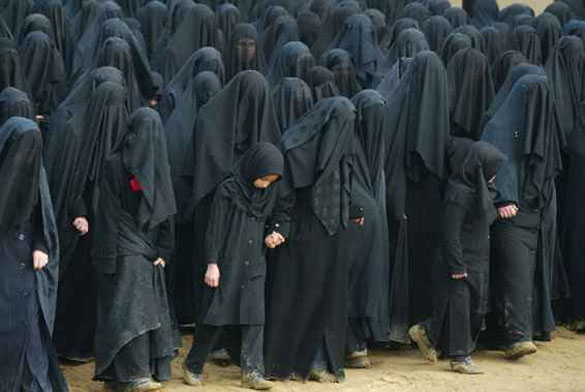
More than 20 countries already ban or restrict burqas, niqabs (full-body and face coverings) worn by some Muslim women.
More could be joining the list as Western countries and native populations turn to the right on immigration and post-pandemic migrations waves that saw heavy influxes from Africa, the Middle East, Latin America and South Asia into Europe and the U.S.
Portugal is looking to join the contingent passing a law earlier this month that imposes fines for women who wear face veils.
Portuguese President Marcelo Rebelo de Sousa still needs to approve the measure.
Italian Prime Minister Giorgia Meloni has also proposed a burqa and niqab ban.
"If you want to live in Italy, respect Italy, its culture, and its laws," Meloni said.
Earlier this year, Kazakhstan imposed a burqa ban.
A more expansive burqa ban has been put forward in Sweden. There is support on the right in the United Kingdom and Australia for burqa bans.
The pushes stems from native European populations' frustrations with and resistance to major migrations and immigration waves coming from Africa, the Middle East and South Asia since the coronavirus pandemic.
There have been significant migrations into Europe and the U.S. from poorer regions.
Some migrants are fleeing wars, violence and gangs. Others poverty and persecution. Some are coming for jobs and to escape dire circumstances. Others are bringing criminal backgrounds and continued criminal endeavors. Others end up on public assistance.
Europe has seen more migrations than the U.S. from Muslim countries (including former colonies).
Negative aspects of immigration (including illegal immigration) such as crime, drug and human trafficking and social strains have helped propel populist, anti-immigration candidates in the U.S., namely President Donald Trump, as well as European countries.
Some of the push for immigration restrictions and crackdowns and measures such as burqa bans stem from nativist and sometimes xenophobic sentiments toward immigrant groups, including Muslims.
Burqas (or burkas) are a full-body covering worn by some Muslim women. The face and eyes are also covered with with mesh type veil for the latter.
A niqab is a full-body covering but leaves the eyes open
The two Muslim garments are provide more covering than the hijab headscarf.
Burkas are required of women and girls who have reached puberty in Afghanistan.
The coverings are worn to abide Islamic rules for women to show modesty.
In Europe and other parts of the world, burqas, in particular, and niqabs are viewed as a misogynistic subjugation of women, Islamic extremism and resistance to broader Western societies.
France, Austria, Switzerland, Belgium, the Netherlands and Bulgaria have burka prohibitions in place. Some states in Germany also have restrictions.
There are also some restrictions on burkas and other Muslim headscarves for women in parts of Africa and Asia.
Some of the bans stem from advocates who say the Islamic headscarves and covering mandates and other gender-based rules subjugate women and girls.
They view burkhas in tandem with more conservative, traditional and perhaps more hardline Muslim households.
Critics of the bans say the prohibitions violate religious liberties and women’s personal choice of what they want to wear.
Afghanistan is the only country where women are girls who have reached puberty are required to wear burqas.
That came after Taliban’s return to power after two decades of U.S. invasion ans occupation after the 9/11 attacks.
Former President Joe Biden’s pullout from Afghanistan saw an immediate collapse of the U.S.-backed government and military and the return of the Islamist Taliban, which impose significant restrictions and rules on women and girls.
Source: wvnews.com
https://www.wvnews.com/news/around_the_web/states/burqa-bans-more-countries-eye-restrictions-on-muslims-as-europe-u-s-turn-right-on/article_f587d431-032c-5e7f-b3c2-40976e755dbe.html
———-
Female candidates in southern Iraq report campaigning difficulties
Oct. 29, 2025
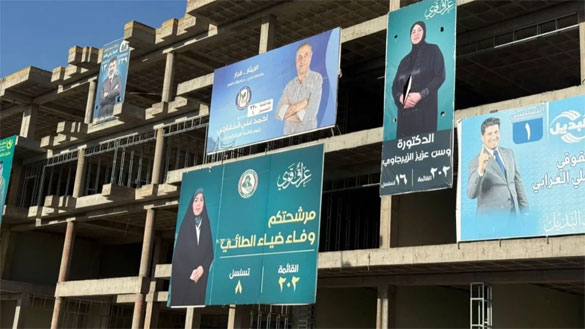
Posters of candidates for Iraq's upcoming parliamentary elections in Dhi Qar. Photo: The New Region
------------
ERBIL, Kurdistan Region of Iraq – Female candidates in Iraq’s southern Dhi Qar province have said it is difficult for them to campaign for the upcoming parliamentary elections, lamenting that their posters are being damaged and they are mocked.
Dhi Qar reserves 19 of the Iraqi parliament’s 329 seats, including a quota of at least five seats for women. In the province, 153 women have registered as candidates for the upcoming vote.
Haifa Amin, a candidate for the Civil Democratic Alliance, told The New Region that “political motives and discrimination against women” are among the main reasons for tearing down posters.
Dalal al-Rikabi, another candidate for the Reconstruction and Development Alliance, led by Prime Minister Mohammed Shia’ al-Sudani, also said her posters are being damaged.
“My campaign posters have also been destroyed or covered with others’ posters. This is because I am a popular candidate, and those who do these things are apparently harmed by my candidacy,” she told The New Region.
Razzaq Obaid, head of the Tammuz Organization for Social Development, told The New Region that the vandalism of female candidate posters is mostly related to mockery and harm, with women tending to only hang their posters in city centers where there are more CCTV cameras and traffic.
In many parts of conservative Iraq, female candidates are discouraged from public participation in campaigns that require visibility, media appearances, or engagement with voters. Some women avoid public campaigning altogether to avoid damaging their family’s reputation.
Shaima Battoush, a candidate for the Taqaddum Party in Kirkuk, led by former parliament speaker Mohammed al-Halbousi, only has her name and candidate and list numbers shown on her poster, with many of her posters featuring a picture of her husband instead.
According to Iraq’s electoral commission’s guidelines, anyone who tears down candidates' posters and damages them may be punished with a fine of between one to five million dinars (around $764 - $3,820) or imprisonment for one month to a year.
The United Nations has also provided several training programs to strengthen the role of women in the elections. However, election monitors lament that their campaigns are primarily focused on city centers, with a much weaker presence in districts and subdistricts.
Iraq is set to hold parliamentary elections on November 11. More than 7,750 candidates are competing for 329 seats under a proportional representation system, with penalties for electoral breaches ranging from 100,000 to 10 million Iraqi dinars.
Source: thenewregion.com
https://thenewregion.com/posts/3487
-------
Celebrated Therapist, Author Marisa Peer Urges UAE Women To Rewrite Their Inner Dialogue
29 Oct 2025
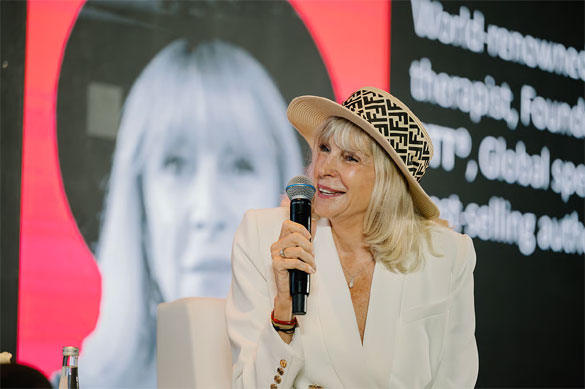
KT Photo: Neeraj Murali
----------
Urging women to reclaim their power by transforming how they think and speak to themselves, Marisa Peer spoke to a packed audience on Wednesday, about the barriers holding women back.
At Khaleej Times’ We the Women event in Dubai, the celebrated therapist, author, and global speaker highlighted that societal expectations, self-doubt, and perfectionism often limit potential, and called on women to embrace their flaws, strengthen self-belief, and inspire the next generation to aim higher.
The founder of Rapid Transformational Therapy (RTT) began her address by reflecting on how deeply ingrained gendered narratives shape girls from childhood. “We were talking about being enough,” she recalled. “I think we just don’t have enough books for girls saying you can do anything. My daughter was little, and I used to read her a story — Snow White married the handsome prince, Cinderella found the handsome prince — and I’d say, ‘Let’s change that.’ I’d say, ‘Well, thanks a lot, but I want to be a journalist. I’m going to film school now. I’ll have time to get married later.’”
Peer deliberated on how a different messaging is important — one that is empowering rather than confining. “All stories ever said to girls was: find the handsome prince, be at home washing the dishes with all these animals, and that’s your life. We should be saying to girls, you can do anything. You can be an astronaut, you can be a scientist,” she said.
As a mother and mentor, Peer emphasised the importance of starting early to instill ambition and confidence in young girls. “Don’t talk about their wedding or being a mother. Talk about being a bestselling writer, a phenomenal artist. We have to start early and say, you can do anything — you can be the prime minister, the president, you can be anything you like.”
Women and the burden of judgment
Peer explored how women often carry the weight of societal judgment in ways men do not. “80 per cent of women have imposter syndrome (a psychological phenomenon where individuals doubt their own abilities and accomplishments despite external evidence of success),” she said. “We get judged by what we look like. No one says to a man, ‘I saw you on TV, I loved your hair.’ We are still up against that. There’s even an expression — ‘what kind of mother did that person have to turn out like that?’ Well, what about what kind of father they had?”
She pointed out that women, being natural nurturers and multitaskers, tend to internalise pressure. “We think about others’ needs all the time. But the most important dialogue you will ever have in your whole life is the dialogue you have with yourself,” she stressed.
The power of self-talk
Encouraging women to take charge of their inner voice, Peer said, “Learn to say: I’m great, I’ve got this, I’m skilled, I’m doing something amazing. Don’t give that job to someone else — don’t ask, ‘What do you think of me? Am I okay?’”
She recalled stories of women who defied doubt and limitation, including American actress Elizabeth Taylor. “Someone told her she could be an actress but never a movie star. She said, ‘It’s not for you to tell me. I’ll show you.’ That’s what women need — an ‘I’ll show you’ attitude. You can’t let anyone tell you what you can or can’t do.”
For Peer, the foundation of change begins with five simple affirmations: “I’m enough, I matter, I’m significant, I’m worth it, I’m lovable — just the way I am.”
“When you change a thought — from ‘I’m not enough’ to ‘I am enough’ — everything changes,” she said. “You behave differently, you act differently, and life begins to shift in your favour.”
On perfection and embracing flaws
Peer also urged women to let go of the pursuit of perfection — a pressure that often leads to loneliness and unhappiness. “You want to be unhappy? The fastest way is trying to be perfect,” she said. “There is no perfection. People who are perfect are alone. The basis of all friendship is shared vulnerability.”
She introduced her concept of being “flawsome.” “I call it being flawsome” It’s a very forgiving place to be (in). Being perfect is lonely, unforgiving. We can have the most beautiful, flawed relationship. If you’re trying to be perfect you can never ever get there.”
Reframing beliefs and thoughts
A recurring theme in Peer’s talk was the power of beliefs. “We create our thoughts, and our thoughts create us. Since you make your beliefs and your beliefs make you — make better beliefs,” she said. “Life is changing so quickly. We must take responsibility for our beliefs, and if you don’t like them, change them.”
She reminded women that “the mind cannot hold conflicting beliefs” — one cannot think they are not enough and at the same time think they are amazing. “Every thought you think is a blueprint. So, say over and over again: I’ve got this. I’m smart, I’m capable, I’m lovable, I matter, affirm it and embody it.”
The only thing you can control
She then reflected on a thought-provoking reminder about control. “In a world where we try to control our weight, our home, and the traffic — the only thing you can really control is your thinking,” she said. “We can’t control the weather, or the world, but we can control our thoughts. And when you do, your life changes so dramatically.”
For Peer, happiness and success begin with mastering the mind. “Your mind’s job is to make your thoughts real. It doesn’t care if they’re good or bad — it just acts on what you tell it. So, tell it better things,” she said.
“Self-esteem is what I think of myself. Raising your self-worth, self-esteem, and self-belief is not anyone else’s job — it’s yours. The great news is, when you elevate yourself, the whole world joins you.”
Source: khaleejtimes.com
https://www.khaleejtimes.com/uae/marisa-peer-we-the-women-event-in-dubai
-------
Indonesian women created a political voice through gendered care work
October 29, 2025
In the early 20th century Dutch East Indies, colonial authorities set about instructing residents of Java and Sumatra on hygiene and nutrition.
“Literate women often noted that the ‘new scientific knowledge’ broadcast by the Dutch administration echoed indigenous practices, such as the advantages of eating unpolished rice, or religious mandates like the requirement for extended breastfeeding,” said Chiara Formichi, the H. Stanley Krusen Professor of World Religions in the College of Arts and Sciences. By medicalizing cleanliness and health, the Dutch marginalized women’s traditional influence and knowledge – but the women pushed back, Formichi writes in her new book, “Domestic Nationalism: Muslim Women, Health, and Modernity in Indonesia.”
Resisting the boundaries imposed on them by the colonial and postcolonial state, Indonesian women created a public voice for themselves, sharing their ideas in vernacular magazines, news and lifestyle media and advertisements. In ”Domestic Nationalism,” published Oct. 28 by Stanford University Press, Formichi argues that during the 1920s to 1950s, Indonesian women’s domestic activities contributed to nation-building as a political project.
The College of Arts and Sciences spoke with Formichi about the book.
Source: cornell.edu
https://news.cornell.edu/stories/2025/10/indonesian-women-created-political-voice-through-gendered-care-work
------
Punjab Woman Recalls Ordeal In Iraq; 25 Punjabi Women Duped By Travel Agent Still Trapped
Oct 29, 2025
"One day, they beat me until the stick broke," recalls a 29-year-old woman from Punjab, describing the horrifying abuse she allegedly faced in Iraq where she was forced to work as a domestic servant after a travel agent lured her with a promise of a tailoring job.
The woman, who hails from Moga district, was able to return to India last month after she approached Rajya Sabha member Balbir Singh Seechewal for help. She claimed that around 20 to 25 Punjabi women are still trapped in Iraq.
The woman claimed she was duped by a travel agent from Jagraon who had promised a tailoring job abroad. "The travel agent had promised a tailoring job, weekly holidays and permission to use a mobile phone to contact her family, but the reality was completely opposite," she said.
Narrating her ordeal, the woman said she left for Iraq on January 8, 2024. After she reached Iraq, she was "forced" to work as a domestic servant.
She claimed that the employer tried to assault her, but when she resisted and recorded a video as evidence, she was brutally beaten at the "behest" of the travel agent and his wife. "One day, they beat me until the stick broke," she said.
The continuous abuse and violence took a toll on her mental health, leaving her in deep depression for months.
Finally, on August 10, 2025, she reached out to Seechewal, who is also a noted environmentalist, through social media for help. He intervened in the matter and, as a result, she returned safely to Punjab on September 28.
Even after returning, she "remained in shock for an entire month". She said she could never forget the horrific days she spent in Iraq.
She claimed the travel agent has created a web of deceit in rural areas, luring poor girls abroad with false promises of "good jobs".
The woman visited Sultanpur Lodhi on Tuesday to thank Seechewal for his help in bringing her back safely.
Seechewal called the woman a symbol of courage who fought for her rights, as he also urged other trapped girls to gather courage and raise their voices.
He warned that such human trafficking networks have dangerously expanded across rural areas, pushing poor girls into a living hell abroad.
The Rajya Sabha member also appealed to the government to take immediate action against such rackets operating under the guise of foreign employment.
He said that every girl who has returned so far has confirmed that many others are still trapped there, a clear indication of how widespread and organised this racket has become.
"This is not just the story of one girl," Seechewal said, "but of all those Indian daughters who are falling prey to the false promises of agents and suffering unimaginable abuse in Gulf countries."
Meanwhile, a police official said they will approach the complainant to get details about the unauthorised agent for taking strict action against him.
Source: indiatimes.com
https://economictimes.indiatimes.com/nri/latest-updates/duped-by-travel-agent-punjab-woman-recalls-ordeal-in-iraq/articleshow/124896983.cms?from=mdr
------
Iranian Baha’i Woman Arrested to Serve 10-Year Prison Sentence
OCTOBER 29, 2025
Iranian security forces have arrested Baha’i citizen Rouya Sabet at her sister's home in Shiraz and transferred her to Adelabad Prison to begin serving her sentence.
Branch 1 of the Shiraz Revolutionary Court had previously sentenced Sabet to 10 years in prison for “cooperation and communication with citizens and institutions of the Israeli government,” ten years for “forming and managing a group with the intent to act against national security,” and five years for “sectarian propaganda activities contrary to Islamic law.”
The court also banned her from leaving the country for two years, ordered the cancellation of her passport, deprived her of social rights for five years, and prohibited her from using social media.
Branch 37 of the Fars Province Court of Appeals later upheld the verdict.
Under Article 134 of Iran's Islamic Penal Code, only the harshest sentence - in this case, ten years in prison - is enforceable.
Sabet is married and has lived in the United Arab Emirates for 23 years. She traveled to Shiraz last year to visit and care for her elderly and ailing parents, but was arrested by Intelligence Ministry agents because of her religious beliefs.
She was released after five months on bail.
According to her husband, authorities lifted her travel ban and returned her passport last month.
However, when she attempted to fly back to the UAE to visit her family, airport officials confiscated her passport and informed her that she was once again banned from leaving the country.
Baha’is in Iran continue to face systematic persecution, including restrictions on education, employment, and the practice of their faith.
They are frequently accused of espionage or actions against the government, though the Baha’i International Community maintains that no evidence has ever been presented to support these claims.
Over the past two years, Iranian authorities have intensified their crackdown on the Baha’i community - imprisoning dozens on baseless charges, denying them access to higher education and employment, and confiscating or destroying their property.
In its latest annual report, Human Rights Watch described the systematic suppression and denial of basic rights to Baha’is in Iran as a crime against humanity.
Source: iranwire.com
https://iranwire.com/en/bahais-of-iran/145904-iranian-bahai-woman-arrested-to-serve-10-year-prison-sentence/
------
URL: https://www.newageislam.com/islam-women-feminism/burqa-ban-europe-us/d/137452