
Abu Bakr al-Baghdadi’s Widow, Asma Mohammed, Also Known as Umm Hudaifa, Sentenced to Death in Iraq
New Age Islam News Bureau
11 July 2024
·
Abu Bakr al-Baghdadi’s Widow, Asma Mohammed,
Also Known as Umm Hudaifa, Sentenced to Death in Iraq
·
Justice AaliaNeelum Sworn In As First Woman
Chief Justice Of Lahore High Court
·
In Male-Dominated Iranian Politics,Azar
Mansouri, A Woman Has Emerged as A Kingmaker
·
Qatar’s UN Envoy, SheikhaAlya Ahmed
Al-Thani,Wants Other Arab Women to Join Her in Diplomacy
·
'Sharia Was Used to Deny Alimony': Bharatiya
Muslim Mahila Andolan
·
Nigerian Defence Academy Honours First Female
Nigerian Army General, Late Maj.-Gen. Aderonke Kale
·
Mehbooba Mufti’s Daughter, Iltija Mufti, Among
Apple Users in 98 Countries to Receive Alert On ‘Mercenary Spyware’
·
What Are Arab American Women Supposed to Do
This November?
·
How Bangladesh’s Traffickers Are Targeting Rohingya
Women at Refugee Camp
·
Nigerian Reps Pass Bill to Increase Women’s
Representation
Compiled by New Age Islam News Bureau
URL:
Abu Bakr
al-Baghdadi’s Widow, Asma Mohammed, Also Known as Umm Hudaifa, Sentenced to
Death in Iraq
By David
Gritten,
BBC
News, 11 July 2024
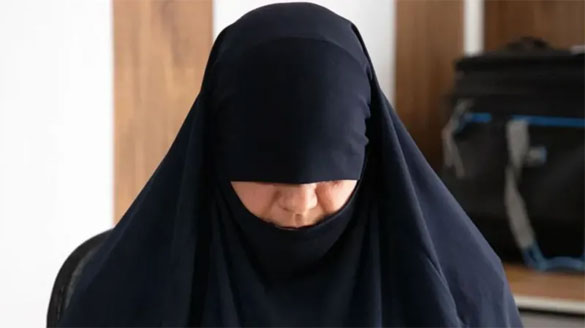 Asma
Mohammed, also known as Umm Hudaifa, told the BBC she was not involved in IS
atrocities
Asma
Mohammed, also known as Umm Hudaifa, told the BBC she was not involved in IS
atrocities
------------------
The
first wife of the late leader of the jihadist group Islamic State (IS), Abu
Bakr al-Baghdadi, has been sentenced to death by a court in Iraq, the country’s
judiciary says.
Karkh
Criminal Court convicted the woman of “working with the extremist organisation
and detaining Yazidi women”, according to the Supreme Judicial Council.
An
interior ministry official identified her as Asma Mohammed, also known as Umm
Hudaifa.
There
was no comment from her lawyer, but in a recent interview with the BBC she
denied involvement in IS’s atrocities or its kidnapping and enslavement of
Yazidi women.
She was
married to Baghdadi while he oversaw the group’s brutal rule over large parts
of Iraq and neighbouring Syria which were home to almost eight million people.
In 2019,
months after the group’s military defeat in the region, US forces raided the
place where Baghdadi was hiding in north-west Syria with some members of his
family. Baghdadi detonated an explosive vest when cornered in a tunnel, killing
himself and two children, while two of his four wives were killed in a
shootout.
Umm
Hudaifa was not there because she had been detained in southern Turkey in 2018
while living there under a false name. She was extradited to Iraq in February
this year and remanded in custody while authorities investigated her for
terrorism-related crimes.
UN
investigators say they have clear and convincing evidence that IS committed
genocide and numerous other international crimes against the Yazidi religious
minority, whose members were given the ultimatum to convert or die.
Thousands
of Yazidis were killed, while thousands more were enslaved, with women and
children abducted from their families and subjected to brutal abuses, including
serial rape and other sexual violence, they found.
The UN
investigators also say IS committed war crimes, including murder and torture
during the massacre of about 1,700 unarmed, predominantly Shia Muslim cadets
and personnel from Iraq’s Camp Speicher military base in 2014.
When
asked by the BBC about such atrocities, Umm Hudaifa said she had challenged her
husband about having “the blood of those innocent people” on his hands.
She also
said she was “felt ashamed” and was “very sorry” about what happened to Yazidi
women and children, at least nine of whom were allegedly bought to her homes as
slaves.
Yazidis
who were abducted and raped by members of IS have filed a civil lawsuit in Iraq
accusing Umm Hudaifa of colluding in the kidnapping and sexual enslavement of
girls and women. She denied the accusations.
Iraqi
courts have handed down hundreds of death sentences and life prison terms to
men and women convicted of “membership of a terrorist organisation” in recent
years.
Human
rights groups have said the charge is too broad and vaguely worded, and that
the trials have often been rushed and based on confessions often obtained under
torture.
Source: bbc.com
https://www.bbc.com/news/articles/c51y78nl13jo
--------
Justice
AaliaNeelum Sworn In As First Woman Chief Justice Of Lahore High Court
July 11,
2024
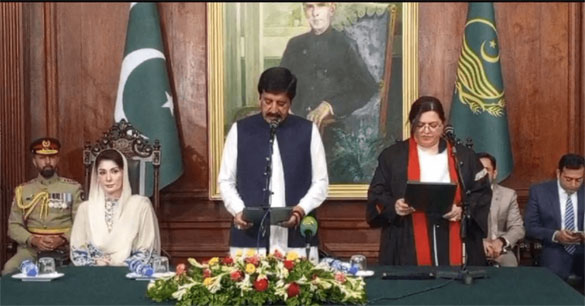 Punjab
Governor Sardar Salim Haider Khan administers the oath of office to Justice
Aalia Neelum at the Governor’s House in Lahore on Thursday, July 11, 2024 —
Screengrab via video from LHC press office
Punjab
Governor Sardar Salim Haider Khan administers the oath of office to Justice
Aalia Neelum at the Governor’s House in Lahore on Thursday, July 11, 2024 —
Screengrab via video from LHC press office
----------------
Justice
AaliaNeelum on Thursday was sworn in as the Lahore High Court’s (LHC) chief
justice at the Governor’s House, becoming the first woman to be elevated to the
court’s top position.
Her
oath-taking ceremony occurred a day after President Asif Ali Zardari approved
her appointment. Last week, the Judicial Commission of Pakistan (JCP), headed
by Chief Justice of Pakistan Qazi Faez Isa, greenlighted Justice Neelum’s
elevation after considering the nominations of three judges for the position of
LHC chief justice, including acting Chief Justice Shujaat Ali Khan and Justice
Ali BaqarNajafi.
Punjab
Governor Sardar Saleem Haider Khan administered the oath of office to her. At
the same time, several other LHC judges – including Lahore High Court Judge
Justice Ali BaqarNajafi, Justice Abid Aziz Sheikh, Justice Syed Shahbaz Rizvi,
and Justice Shams Mehmood Mirza, among others – participated in the ceremony.
Punjab
Chief Minister Maryam Nawaz, Law Minister Azam Nazeer Tarar, and the
inspector-general of Punjab were also in attendance.
The
office of LHC chief justice became vacant after the elevation of Justice Malik
Shahzad Ahmad Khan to the Supreme Court on June 7, following which Justice
Shujaat Ali Khan was appointed as acting LHC chief justice.
Justice
Neelum stood third in the seniority list of judges of the LHC. During the June
7 meeting, the JCP had decided to consider her nomination for the office of the
LHC chief justice.
Born on
November 12, 1966, Justice Neelum earned her LLB degree from the University of
Punjab in 1995 and was enrolled as an advocate in 1996. She was later enrolled
as an advocate of the Supreme Court in 2008 and elevated to the LHC in 2013
before being sworn in as a permanent judge on March 16, 2015.
As a
judge, Justice Neelum has given 203 exemplary judgments and was also the first
woman administrative judge of anti-terrorism courts across the province.
She was
instrumental in setting up separate courts to hear cases of gender-based
violence, playing a major role in the preparation of standard operating
procedures for recording evidence and statements during trials in e-courts
across Punjab.
In
recent years, Pakistan has seen the elevation of women judges to top court
positions. In a trailblazing milestone, Justice SyedaTahiraSafdar became the
first woman to hold the position of chief justice of the Balochistan High Court
in 2018, following the retirement of Justice Mohammad Noor Muskanzai.
This was
followed by another historic achievement when Justice Ayesha A. Malik became
the first woman judge to be appointed to the Supreme Court in 2021.
Source: dawn.com
https://www.dawn.com/news/1845172/justice-aalia-neelum-sworn-in-as-first-woman-chief-justice-of-lhc
--------
In
Male-Dominated Iranian Politics,Azar Mansouri, A Woman Has Emerged As A
Kingmaker
11 July,
2024
In the
lead-up to the just-concluded presidential election in Iran, Azar Mansouri held
a news conference to make one thing clear: the Iranian Reformist Front, an
umbrella of reformist parties she has headed since last year, will partake in the
vote only if its candidates are allowed to run.
It was a
clear message to the Guardian Council, a candidate-vetting body whose members
owe their loyalty to the nation’s supreme leader, Ayatollah Ali Khamenei. Ms
Mansouri was effectively telling the Council that if it disqualifies its
candidates, the IRF will sit out the elections, further reducing the legitimacy
of the vote.
This
decision amounted to a departure from 2013 and 2017, when the IRF backed the
non-reformist, but centrist, president Hassan Rouhani. And so, it was a daring
move from a political movement that has spent the past few years in the
wilderness. But it was a call that was borne of frustration.
None of
the IRF’s candidates were allowed to run in the previous presidential election,
in 2021, or in the 2020 and 2024 parliamentary elections. The Guardian
Council’s decision to keep reformists out angered many Iranians who sat out
those elections, dragging the voter turnout to below 50 per cent.
When
hardliner president Ebrahim Raisi died in a helicopter crash last May,
elections had to be hastily organised. It gave Ms Mansouri the opportunity to
issue an ultimatum to the establishment. Her gamble worked.
While
two of the three candidates it backed were disqualified, Dr Masoud Pezeshkian
was given the green light. The IRF threw all its weight behind his candidacy
and collected endorsements of key reformist grandees, such as former president
Mohammad Khatami, on his behalf. The rest is history, as Dr Pezeshkian went on
to win last weekend.
The
President-elect’s campaign featured many high-profile centrist figures,
including the “Two Javads” – Mohammad JavadZarif and Mohammad Javad Azari
Jahromi, both former ministers in Mr Rouhani’s cabinet. But perhaps no other
politician had as key a role to play in Dr Pezeshkian’s nomination, and
eventual victory, than Ms Mansouri.
A rare
female voice in a male-dominated political class, Ms Mansouri built much of her
political career in the era of reformists. She is not known to make
barnstorming speeches or hold key administrative positions, but she has a
reputation for hard bargaining behind closed doors.
Her
career dates back to the movement’s rise in the late 1990s. Born in 1964 in
Shahre Rey, near Tehran, she has a master’s degree in history. A court order
put a stop to her PhD programme, coming at the cost for her political work. And
yet much credit goes to her for keeping the reformist movement relevant in
Iran’s political scene.
Ms
Mansouri advised Mr Khatami and helped him organise his successful presidential
campaign in 1997. Two years later, she was elected to Varamin’s city council,
where she served until 2003. She was also active in one of the main reformist
political parties, eventually becoming its deputy leader.
But the
hardliner Mahmoud Ahmadinejad’s rise to the presidency in 2005 didn’t augur
well for her or the movement she represented, as the judiciary shut down a
number of reformist parties and jailed several of its politicians. Ms Mansouri
was herself sentenced to three years in 2009.
She
continued her political work upon her release, serving as part of the
leadership of another reformist party. But even as she was allowed to carry out
her work during the Rouhani years, she was unable to run in most elections or
even organise. In 2020, for instance, she sought to run for Parliament but was
denied.
Her
disqualification came as no surprise, especially following her vociferous
denouncement of the repression of popular protests that broke out in November
2019. These demonstrations, sparked by a fuel price hike, called for the
rejection of the regime.
Even as
many in the Rouhani administration kept mum while hundreds were killed by the
security forces, Ms Mansouri was one of several leaders to condemn the
repression. She was just as assertive during the Women, Life, Freedom protests
that broke out in 2022 after the death in custody of a young woman for
allegedly not veiling properly.
Ms
Mansouri has had to walk a tightrope throughout her political career, but she
has shown great acumen to survive in the competitive world of politics.
In a
society that has long moved past the regime’s set of ideologies, she still
heads a party that pledges support to the late Ayatollah Ruhollah Khomeini, the
man who founded the republic. While she never endorsed any calls to change the
regime, and always pledged non-violence, she also repeatedly condemned the
repression of protesters.
Two
years ago, she was sentenced to a year in prison and was handed a two-year ban
from social work over her support for the 2019 and 2022 protesters. Yet her
determination to keep at arm’s length those seeking to overthrow the regime and
channel some of the dissenting voices have put her in a unique position. This possibly
explains why she was invited to meetings held by regime officials in an
acknowledgment of the domestic opposition. (It’s worth noting here that Ms
Mansouri quit these meetings after one protester was executed.)
She
recently also denounced Israel’s “genocide” in Gaza. But rather than calling
for the destruction of Israel, which is the regime’s stated intention, she
sought a way to “stop this aggression and occupation is recognition of an
independent Palestinian state”.
Ever
since she was elected leader of her party in 2021, a rare achievement for a
woman, and then leader of the IRF, Ms Mansouri has maintained the upper hand in
the reformist camp. Her stand against those reformists who “believe that we
should take part in the elections under any conditions” has been well
appreciated, as has her insistence that “society shouldn’t believe we will
accept any indignity just to have a hand in power”.
Even
after Dr Pezeshkian’s victory, she has pledged to continue working on the
causes close to her heart. “We will continue our demands,” she said. “We, the
forces demanding change, have come out with all our power, despite all of our
limitations.”
Ms
Mansouri’s influence in Iranian politics can be best illustrated by a phone
call she received from interim President Mohammad Mokhber, who sought to
assuage her concerns about any electoral irregularities. It is this level of
influence that could well secure her a position in Dr Pezeshkian’s cabinet –
perhaps even as a vice president.
Whatever
role she gets in the new government, if she does, there is little doubt that
her voice will be well and truly heard.
Source: thenationalnews.com
https://www.thenationalnews.com/opinion/comment/2024/07/11/iran-president-masoud-pezeshkian-azar-mansouri/
--------
Qatar’s
UN Envoy, SheikhaAlya Ahmed Al-Thani,Wants Other Arab Women to Join Her in
Diplomacy
July 10,
2024
SheikhaAlya
Ahmed Al-Thani is the first woman ambassador for Qatar at the United Nations.
Now that she’s reached that milestone, she wants company — other Mideast women
to join her diplomatic world. Her father, Sheikh Ahmed bin Saif Al- Thani, was
not only a minister of state for Qatar, a Gulf oil country, but also served as
ambassador to Britain, Sweden and Norway. She said that watching him speak at
the UN General Assembly when she was a child shaped her career path.
“It’s a
personal struggle that if I fail it will discourage others from joining or will
discourage the idea of having more women,” Al-Thani told PassBlue during a
recent interview in her office at the Qatari mission in New York City. “I think
that is one personal struggle for me because it is very important to me that
this succeeds and that others succeed.”
Al-Thani,
who is in her 40s, has been working in Qatar’s diplomatic corps for about a
decade and a half. One of her goals is to keep the door open for as many other
Arab women to choose such a career. Before coming to New York City, she was
Qatar’s permanent representative to the UN in Geneva. Another Qatari woman sits
in her old office, a progression that Al-Thani said underscores Qatar’s
dedication toward advancing its women.
Yet,
women’s rights in Qatar are significantly restricted with laws limiting their
autonomy despite constitutional guarantees of equal rights. A Human Rights
Watch report highlighted that women of all ages need permission from a male
relative to marry, study abroad on government scholarships, work in many
government jobs and travel outside the country. An Amnesty International report
in 2023 noted that Qatari women are inadequately protected against domestic
violence. Al-Thani told PassBlue that the male guardianship system has changed
and that Qatar now has more respect for women.
The
ambassador may have a different view of the reality of most Qatari women and
others in the Mideast. She was born into a royal family, the lineage of Sheikh
Jassim bin Mohammed Al-Thani, who founded Qatar and was emir from 1878 to 1913.
The Al-Thanis, from the Tamimi tribe, are Qatar’s ruling family (though the
ambassador said her immediate family is not in the ruling branch) and have led
the economic and political affairs of the country since its creation in 1971,
when it also joined the UN.
The
country’s prime minister, foreign affairs minister, interior minister, culture
minister, commerce and industry minister are all Al-Thanis. The extended family
numbers in the tens of thousands and make up the majority of Qatari citizens.
Two members of the family were listed on the 2024 Forbes billionaires list with
a cumulative wealth of $3.5 billion.
Yet, the
ambassador is modest and reserved but friendly. Interviewed in her wood-paneled
office at the Qatari mission, she works at a large desk in a quiet, orderly
space with deep, leather chairs as a large-screen TV broadcasts news (on mute)
in Arabic. She earned her bachelor’s degree in economics from Qatar University
and a master’s in international studies and diplomacy from the School of
Oriental and African Studies (SOAS), in London.
Al-Thani
talked in early July about her diplomacy work, her country’s attitudes toward
women’s rights and its mediation role in the Gaza war — a difficult subject to
broach with her. The interview has been edited and condensed for clarity and is
part of PassBlue’s series on small states and multilateralism at the UN. The
definition of “small states” is primarily based on a country’s population
(using the World Bank list or Forum of Small States) and other factors like
global warming and economic vulnerabilities.
Qatar
has a population of 2.7 million, and although it is hardly needy financially,
it relies on the UN multilateral system to carry out some of its global
ambitions, such as promoting the Sustainable Development Goals, while trying to
steer clear of politics, the ambassador suggested. Yet, Qatar is advocating for
Palestine’s full membership in the UN. — DAMILOLA BANJO
Al-Thani:
I joined in October 2013 as the representative of Qatar to the UN here in New
York. Previously, I headed our mission in Geneva for two years. Women are still
looked at as a minority in the composition of the UN community, but the numbers
have grown. We are now 47 female ambassadors [out of 193], and I’m happy to be
among the very few within the Arab region. Hopefully, we will have more female
representation from the region. Qatar is a country that is very progressive
when it comes to the role of women. We have three ministries headed by women in
key ministries, which are health, education and social development. Several
women are leading important positions in every aspect of the political and
civil life in Qatar. Actually, I’m the first female appointment to assume the
position of a diplomat and the ambassador and the diplomatic corps, starting
more than 15 years ago. Today, the composition of the foreign service in Qatar
is 30 percent female, serving in the capital or abroad. We need to show our
example when it comes to gender parity and empowerment of women. So I dedicate
a lot of my time to doing that here in New York City.
PassBlue:
You are the first woman ambassador for Qatar. What does that feel like?
Al-Thani:
It’s incredible, it’s inspiring. It has opened the door. The government has
always been very progressive and provided the opportunity. It was women who
were hesitant to join the diplomatic corps for many reasons. We had a very good
role model in our country: Her Highness SheikhaMoza bint Nasser. She’s the UN
secretary-general’s Sustainable Development Goal advocate for education; she
has served in that capacity for years. I’ve had the privilege of working with
her at the beginning of my career. That set the tone. We come from a very
conservative society culturally, but with a progressive government that
encouraged others to join. I’m privileged to have the honor to be the first
female ambassador, but I’m eager to see more. You don’t want to be alone.
PassBlue:
Qatar has a guardianship system that requires a woman to seek male relatives’
approval to study abroad on government scholarships or to work in many
government jobs. Did you have to go through that process? How did you achieve
this feat?
Al-Thani:
First of all, it is not how you explain it. Women and women’s roles are very
well respected in the government. Look at our education figures, it is in favor
of women more than men. We have more women educated, more women in higher
education and more women teaching in the academic area. We have more women in
many ministries, whether in commerce, education or health. We look at [women]
as half of the society, and without them, we can’t progress because
demographically, we need women to engage in civil life and political life and
in commerce and banking and the private sector.
Whenever
you meet women from Qatar, you get the sense of how strong they are and how
decisive they are about the future and their opportunities, but family comes
first. So, work-family balance is something that the government has always
worked on to make sure that mothers and women with families and with family
responsibilities are not denied the right to work if they want to, but they are
provided with the opportunity to have the work-family balance.
PasssBlue:
As of May 2024, women held 25 percent of permanent representative posts at the
UN New York City, per the Inter-Parliamentary Union. How can that number grow?
Al-Thani:
I think it’s really important that member states continue to encourage and
press [fellow countries] to present female candidates for this position. This
is something Qatar believes in. New York and Geneva are represented by female
ambassadors from Qatar. This says a lot about how much the government trusts women
to handle tough jobs, especially in multilateral positions.
PassBlue:
What are your efforts in promoting Qatar, a small state, at the UN? How do you
optimize multilateralism at the UN as a small country?
Al-Thani:
We try our best to contribute to the international community through our work
here. There is a lot of substantive work that takes place and negotiating
outcomes. I had the privilege of facilitating several important resolutions,
namely the UN 75th political declaration in 2020 with Sweden. I also had the
privilege last year to co-facilitate the political declaration at the SDG
[Sustainable Develop Goals] summit with the ambassador of Ireland. All these
opportunities showcase how small states are contributing intensively by using
our leverage to reach agreements, build bridges and build consensus approaches,
especially in this geopolitical scene we live in today.
We are
here to serve not only our national interest but also because we believe in the
relevance of the United Nations. Qatar has always been a strong supporter of
the UN, and we need to continue to protect multilateralism in the face of those
difficulties and the complexity of situations today. The UN is needed more than
ever to protect the world from the scourge of war, from humanitarian
situations, from the destruction of education. Education is an important
objective for our foreign policy. We know through education we can fight
terrorism and extremism.
PassBlue:
Qatar may be small in population, but it
is in the big league economically. How do you encourage small countries that do
not have Qatar’s resources to engage the multilateral system to benefit their
country individually and collectively?
Al-Thani:
We need to continue to build partnerships, we need to support each other. We
are small countries, but we are blessed with the resources and we are
supporting countries who do not have the privileges and the resources we do.
Qatar is working with countries in Asia, Africa and every part of the world. We
believe in genuine cooperation that doesn’t have a political agenda. We want to
lift up countries. This is why we have hosted the UN Conference on the Least
Developed Countries [LDC]. We have a commitment for the next eight years, which
is called the Doha Program of Action. It has five key deliverables. We will
announce the implementation of two key deliverables, on food security and on
building resilience. We have allocated funds for [the deliverables] of over $60
million for LDCs. We need to help each other. I think this is the essence of
the Summit of the Future [in September]. We need to revive the financing of the
development agenda.
PassBlue:
How else can Qatar help other small states lacking the financial power of your
country?
Al-Thani:
I think by meeting our commitments. We are approaching 2030. Last year, the SDG
summit was an opportunity for us to renew our commitments. We shouldn’t preach,
we should do what we have committed to do. I think the key aspect is financing
the SDG agenda. Qatar has continued to do that. We set goals for ourselves
through our bilateral development assistance to our multilateral development
assistance, to which we contribute over $90 million annually between core
contributions to the UN and voluntary contributions and beyond. We had a major
commitment in 2018, to commit $500 million up to 2030 to support the UN. We are
focusing on innovative approaches with the UN Development Program through the
SDG accelerator labs operating in over 70 countries.
PassBlue:
Let’s talk about Gaza. What is the status of the latest negotiations being led
by Qatar, Egypt and the United States to broker a ceasefire between Hamas and
Israel? What role do you personally play?
Al-Thani:
Gaza takes me to our role in mediation and conflict resolution. Qatar has
invested a lot in this area. Throughout the years, we’ve been involved in
discussions that have led to solutions, and specifically in Gaza, we have
always played an important role in reaching several ceasefires in the past
wars. But this war is more devastating. The Palestinian people in Gaza have
suffered Israeli bombardment. Qatar, throughout these months, has committed
together with Egypt and the United States to try to find solutions to reach a
ceasefire. In November last year, Qatar, through its mediation, was able to achieve
the humanitarian pause that helped release 109 Israeli hostages. The efforts
have never stopped. We have had highs and lows because of the complexity of the
situation. We need to see an end to this war, we need to have a ceasefire, and
we need to commit to the Security Council resolutions that have called for a
ceasefire.
PassBlue:
What’s Qatar doing to encourage Palestinian membership in the UN?
Al-Thani:
We have worked closely with the Palestinians and the Arab group to make sure we
continue to call for the two-state solution. As you know, the process of
Palestine requesting admission to the UN has started; a resolution was
presented in the Security Council. Unfortunately, it was vetoed [by the US].
But that resolution went to the General Assembly and it was adopted. We keep
saying that the situation we are faced with today in Gaza did not start on
October 7. It is a situation that has continued for the last 75 years because
of decades of occupation and illegal settlements in the West Bank. If you look
at the outcome of the resolution in the Security Council — 12 countries were in
favor of Palestine’s request, two countries abstained [Switzerland and Britain]
and one country vetoed. Nobody disagreed with the importance of a two-state
solution, including those who have not supported it. What is important is to
continue the momentum. We are very close with the Palestinians to see when will
be the time to go back to the Security Council.
PassBlue:
There are reports that some Hamas leaders are sheltering in Qatar. Is your
country not worried about sheltering members of what is considered a terrorist
group, particularly in light of the Oct. 7 attack?
Al-Thani:
Just to be clear, Qatar hosts the political office of Hamas. We are engaged in
negotiations with the parties, including the political office. We are finding
ways to solve the situation. We cannot do that without the key parties, Israel and Hamas.
Source: passblue.com
https://www.passblue.com/2024/07/10/qatars-un-envoy-wants-other-arab-women-to-join-her-in-diplomacy/
--------
'Sharia
Was Used to Deny Alimony': Bharatiya Muslim Mahila Andolan
July 11,
2024
Founder
of the Bharatiya Muslim Mahila Andolan, social activist ZakiaSoman has waged
many a legal battle against the orthodox Muslim clergy seeking equality for
Muslim women in social, economic and religious affairs.
Soman,
who fought against the practice of triple Talaq and is also a vocal proponent
of the Uniform Civil Code discusses the Supreme Court verdict of July 10, 2024
delivered by the two-judge bench of Justices B V Nagarathna and Augustne George
Masih that ruled that divorced Muslim women can seek maintenance from their
husbands under Section 125 of the Criminal Procedure Code.
"So
far, we have been told that we will not give you (legal justice) because Sharia
doesn't require us to give (justice to) you (divorced women). They (the
orthodox Muslims in India) have used the name of Sharia to deny Muslim women
alimony rights. That is now being rendered immaterial," Soman tells
Prasanna D Zore/Rediff.com.
How do
you look at the Supreme Court's verdict on alimony to be given to divorced
Muslim women?
It's a
very welcome judgment; it's completely progressive. Ideally, there should not
have been any need for the judgment because (Section) 125 of the CrPC (Criminal
Procedure Code) applies to everybody, to all women.
Unfortunately,
at the time of Shah Bano, this thing (the application of Section 125 of the
CrPC applies to everybody, to all women) got reversed and that law was brought
in 1986 specifically for Muslim women (In 1985 the Supreme Court, citing the
provisions of Section 125 of the CrPC, ruled in favour of Shah Bano, a divorced
Muslim woman, who had filed a suit against her husband Mohammed Ahmed Khan, for
maintenance leading to a huge uproar among the Muslim men, who took out huge
protests against this judgment and forced the then Rajiv Gandhi government to
enact the Muslim Women (Protection of Rights on Divorce) Act 1986, which
overturned the Supreme Court's 1985 verdict.
The
Congress government headed by Rajiv Gandhi, which took over soon after the
assassination of prime minister Indira Gandhi on October 31, 1984, had won a
brute majority of 404 seats in a 514-member House and rode roughshod over the
Opposition while passing the Muslim Women (Protection of Rights on Divorce) Act
1986).
Then
(after this 1986 law was enacted) Muslim women were meant to claim alimony
under that 1986 law. This judgment (granting the right to alimony to Muslim
women under Section 125 of the CrPC) will open the doors for many more women to
seek alimony after divorce.
Will
this judgment take effect in retrospect? Will those women who have been
divorced as per Sharia law before the Supreme Court's verdict on July 10, 2024,
would also be eligible for seeking maintenance and alimony from their husbands?
It (the
Supreme Court's July 10 verdict) says that maintenance is a right, not a
charity, and it transcends boundaries of religion and whatever.
Time
also? Will this new ruling take effect from the date of judgement or will it
also be applicable in retrospect?
No, it's
never retrospective normally. So it has to be now onwards (after July 10,
2024). Even otherwise, some women have been going and filing (for maintenance
right) under (Section) 125.
The
overall understanding is from now onwards, women will be able to go (seek
maintenance rights) under this (Supreme Court verdict of July 10, 2024).
Do you
see any political or social opposition to this ruling from the conservatives
among the Muslim clerics in India?
Today,
the (Muslim) conservatives are not so relevant. For all they want, they can
keep opposing. But then, now not many people (among the common Muslims) listen
to them.
Like
earlier, when Shah Bano happened in 1985-1986, they (the conservatives among
the Muslim clergy as well as the laity) were the ones who were dominant. But
particularly in the last 20 years, you know, post the Internet world and post
the knowledge and information technology (boom), people have stopped relying so
much on the clerics.
What so
changed between the enactment of the Muslim Women (Protection of Rights on
Divorce) Act, 1986 and 2024 that Muslims in general -- not necessarily women,
even men -- have stopped looking at the orthodox clergy...
... as
the sole repositories of all matters of the Islamic faith?
Yes.
What led to this change?
The
awareness among Muslims in general that these people (the orthodox Muslim
clerics and their followers among the Muslims) have not been useful to the
community, that they have not done anything substantial.
They've
only rigged up all the emotive issues plus the general awareness and general
education about women's equality and rights of women has increased creating a
sense of awakening among Muslims.
The
women themselves have become very vocal and demanding about their rights.
Are
Muslim women of the view that the Islamic clergy in India have been
interpreting Islam and Sharia in a very orthodox way?
Yes. And
that was abundantly proved at the time of abolition of triple talaq.
Their
first response (of orthodox Muslim clerics in India) was to say that they
opposed our petition saying that it was un-Islamic. That we are going against
Islam.
We
proved that it's very much they who are going against Islam because triple
talaq has no mention in the Quran and nowhere in the other Muslim countries are
divorces decreed thus.
We
demonstrated that they are the ones who are against Islam, not the women (who
were seeking the abolition of triple talaq).
Is there
a general awakening among the Muslim women as well as men that the clergy is
not interpreting the Sharia in a progressive way?
In the
course of my work, the impression I get is many more people today are aware
that the clergy is not competent, not committed to any reform or any change in
society. That general consciousness is there.
What
does Section 124 of the CrPC generally deal with and what is the importance of
this section in the context of SC's judgment today?
It talks
about maintenance post-divorce. It talks about maintenance irrespective of
gender. In this two-bench judgement, Justice Nagarathna highlighted that she is
not talking about any particular community or any particular religion.
She said
that in general Indian men (irrespective of their religion) need to recognise
the fact how much, if they are married, their wives sacrifice in building a
life together.
Just
because they are not able to go out of the home and work doesn't mean that they
are not contributing to the well-being of the family. They are equally
contributing by their unpaid care and work that they are doing not just for the
husband, for the children, for the in laws, but for all family members.
So if
the husband was to go out and work and if he was to hire professional help for
all this, it would perhaps cost him half his salary, isn't it?
Let's
not overlook the factor of commitment and love and affection with which the
wife does all this, which any amount of professional help cannot replace. That
seems to be the tone and tenor of Justice Nagarathna, and it's a very
progressive, very gender friendly ruling.
Could
you underline the importance of section 125 of the CrPC in the context of this
judgment?
Under
Section 125 of the CrPC, any and all divorced women are entitled to maintenance
(after being divorced by their husbands). Normally, it (the alimony amount) is
interpreted as per the economic and social status of the family of the husband.
Not just the wife, even the children are entitled (for maintenance) under
Section 125, even old parents are entitled.
It's
(Section 125 deals with) like right to live with dignity for non-earning
members of family. The earning member is sort of bound to provide them with
maintenance.
Justice
Nagarathna, while pronouncing the judgment, said that 'We are hereby dismissing
the criminal appeal with the major conclusion that section 125 would be
applicable to all women. Would all women also include women who are not married
and are in a live-in relationship?
That
includes women in live-in relationships (also). That also includes family
members, such as daughters, such as a widower, widow aunts, a widow mother. It
includes all people in your family who are part of the family, who are
contributing to the family, but are not in a position to earn for themselves.
So they too should be entitled to a dignified living, and that can happen only
if they are given maintenance.
It's a
very gender-just and progressive stance that Justice Nagarathna has taken,
which is really amazing.
Why is
this judgment being hailed as a landmark judgment? What are its far reaching
consequences for Muslim women seeking alimony after divorce?
Since
there are no codified Muslim family laws this judgment has opened the door for
Muslim women to get legal justice in divorce and alimony matters.
Legal
justice outside the purview of the Sharia?
Of
course, because it (legal justice) has been so far denied. It has been denied
in the name of Sharia.
Who has
seen what Sharia is? Who knows what actual Sharia is? So far, we have been told
that we will not give you (legal justice) because Sharia doesn't require us to
give (justice to) you (divorced women).
They
(the orthodox Muslims in India) have used the name of Sharia to deny Muslim
women alimony rights. That is now being rendered immaterial. She can claim, she
can go to court and claim (maintenance after divorce) under (Section) 125.
From
today, a divorced Muslim women seeking alimony can go to any Indian court and
seek alimony citing the Supreme Court's ruling of July 10, 2024?
Source: rediff.com
https://www.rediff.com/news/interview/zakia-soman-sharia-was-used-to-deny-alimony/20240711.htm
--------
Nigerian
Defence AcademyHonours First Female Nigerian Army General, Late Maj.-Gen.
Aderonke Kale
10-07-24
The
Nigerian Defence Academy (NDA), on Tuesday unveiled the monument of the first
female general in the Nigerian Army, late Maj.-Gen. Aderonke Kale.
The
Commandant of NDA, Maj.-Gen. John Ochai, said the academy would continue to
prioritise gender equality.
The News
Agency of Nigeria (NAN), reports that a lecture was held in honour of Kale at
the academy’s auditorium in Afaka, Kaduna State.
Ochai
said the Armed Forces of Nigeria have a plethora of set skills that women can
equally participate even in combat operations.
He
assured that the academy would continue to guarantee equality and inclusiveness
to all Nigerians, irrespective of gender, race or religion.
Cross
section of cadets of NDA during a lecture in honour of the first female
Maj.-Gen. in the Nigerian Army, late Maj-Gen Aderonke Kale, on Tuesday in
Kaduna.
Also
speaking, Maj.-Gen. AbimbolaAmusu, who was the second female general in the
Nigerian Army, described Kale as a trailblazer who broke the jinx against all
odds.
Amusu
advised female cadets and officers to remain committed, resolute and leverage
on the available opportunities and training for their career progression.
High
point of the event was a lecture presentation by Navy Capt. FeyisaraSolebo,
entiled: “Impact of Traditional Roles on
Women’s Participation in the Armed Forces: Exploring Gender Stereotypes and
Cultural Barriers”.
NAN
reports that monument of the Kale was unveiled in her memory at the female
cadets’ lines of academy.
Kale was
the first female Nigerian to attain the rank of a Major General in the army,
and the pioneer female Medical Corps Commander in the Nigerian Army.
Source: nannews.ng
https://nannews.ng/2024/07/10/nda-honours-first-female-nigerian-army-general/
--------
Mehbooba
Mufti’s Daughter, Iltija Mufti, Among Apple Users in 98 Countries to Receive
Alert On ‘Mercenary Spyware’
The
Pegasus controversy had broken following media reports of alleged illegal use
of the software to tap the phones of some activists, journalists and
politicians. Subsequently, several petitions were filed in the Supreme Court
seeking an inquiry into the charges.
July 11,
2024
Iltija
Mufti, the daughter of former Jammu and Kashmir Chief Minister Mehbooba Mufti,
Wednesday said she had received an Apple threat notification saying her iPhone
could have been attacked by “mercenary spyware”, such as the NSO Group’s
Pegasus.
“Got an
Apple alert that my phone’s been hacked by Pegasus which GOI has admittedly
procured & weaponised to harass critics & political opponents…” Iltija
Mufti said in a post on social media platform X.
“I have
not received such an alert before, never to my knowledge,” she told The Indian
Express.
“I know
GOI, especially BJP’s top brass, has a history of intimidating rivals and
silencing dissenters and opponents by hacking into their phones. Snooping around
on women is a new low. I’m shocked they’ve attempted to hack into my phone to
intercept my personal information,” she alleged.
Apart
from Mufti, Pushparaj Deshpande, founder of the Delhi-based Samruddha Bharat
Foundation also claimed to have received a similar notification from Apple. The
foundation works with stakeholders including the INDIA bloc parties.
Deshpande,
who says he also represents Congress as a spokesperson in TV debates, told The
Indian Express: “I am assuming this is an escalation of what my organisation
has been facing for a while. If this is sanctioned by state actors, this is a
structural assault on all progressives safeguarding India’s soul.”
A source
aware of Apple’s threat notifications said that the alerts were sent as part of
the company’s quarterly update process, and users in 98 countries, including
India, received them. The number of Indian iPhone users who may have been
affected is unclear.
Apple
did not respond to a request for comment.
It is
also unclear when exactly the attack may have taken place since Apple sends
these alerts every quarter. It is possible that some people’s iPhones may have
been affected for several months before they learn about it at the end of a
quarter from Apple. The company has not attributed the recent wave of attacks
to any entity.
In
April, Apple had updated its threat notification policy, which was seen by many
as a dilution of its earlier policy. A key change Apple had then made was
removing language which said a user’s iPhone may have been targeted by a
“potential state-sponsored spyware attack”, and attributing attacks to
“mercenary spyware”.
Last
October, the company had sent threat notifications to Opposition leaders across
parties — from Congress’s Shashi Tharoor to AAP’s Raghav Chadha to TMC’s Mahua
Moitra — warning of a “potential state-sponsored spyware attack” on their
iPhones.
The
notifications sent to Mufti and Deshpande reflect the changed “mercenary
spyware” threat. “Apple detected that you are being targeted by a mercenary
spyware attack that is trying to remotely compromise the iPhone associated with
your Apple ID… This attack is likely targeting you specifically because of who
you are or what you do. Although it’s never possible to achieve absolute
certainty when detecting such attacks, Apple has high confidence in this
warning — please take it seriously,” reads the notification email that Apple
sends to impacted users.
“Mercenary
spyware attacks, such as those using Pegasus from the NSO Group, are
exceptionally rare and vastly more sophisticated than regular cybercriminal
activity or consumer malware. These attacks cost millions of dollars and are
individually deployed against a very small number of people, but the targeting
is ongoing and global,” said the notification.
Apple
started sending these threat notifications in 2021, and since then individuals
in 150 countries have received them. When it had sent the notification last
year, at least 20 Indians with iPhones had received them.
Investigations
into similar issues in the past haven’t yielded much. In 2021, the Supreme
Court had formed a committee of technical experts to look into allegations of
unauthorised surveillance using the Pegasus software developed by Israeli firm
NSO Group.
The
Pegasus controversy had broken following media reports of alleged illegal use
of the software to tap the phones of some activists, journalists and
politicians. Subsequently, several petitions were filed in the Supreme Court
seeking an inquiry into the charges.
Source: indianexpress.com
https://indianexpress.com/article/india/phone-hacked-pegasus-pdp-chief-mehbooba-muftis-daughter-9444864/
--------
What Are
Arab American Women Supposed to Do This November?
JULY 10,
2024
It was
the ice cream that broke Reina Sultan. In February, when she saw a clip of
President Joe Biden nonchalantly telling reporters he hoped to see a cease-fire
in Gaza by the end of the weekend, a Van Leeuwen cone in his hand, her heart
sank. Israel’s war on Gaza following the attacks by Hamas on October 7 had been
raging for four months at that point, and the International Court of Justice
had recently ordered the country to take action to prevent a genocide. “I wake
up thinking about it,” the Brooklyn-based journalist says of the war. “I go to
sleep thinking about it.” That image of Biden has replayed in Sultan’s head in
the roughly 19 weekends since as a symbol of how seriously U.S. politicians
take Israel’s bombing campaign, in which the death toll has passed 37,000,
including 15,000 children. “I’ve been forced to witness babies that look like
my cousins without their heads attached to their bodies,” Sultan says, “and
there’s not a peep” from the president. “I expect nothing from him,” she adds.
I spoke
with nearly a dozen Arab American women across the country over the past five
months who tell me they’re fed up with the lack of progress they’ve seen from
their elected officials on brokering a cease-fire. “I’m one of those people who
calls my congressman every day,” says Amira, a 28-year-old Palestinian American
from Columbus, Ohio. “We feel very strongly that the people in our government
have severely failed us.” Not only do these women feel betrayed by their
political leaders, but they’re also facing blowback for expressing that
feeling. “I had a conversation with a colleague at work who was like, ‘You have
to vote for Biden. If we don’t have Biden, we have Trump,’” Layla, a British
Iraqi educator in New York, tells me. Diana Jarrar, a Palestinian Syrian
entrepreneur in Los Angeles, says that some of her non-Palestinian friends have
suggested she’ll be letting Trump win if she doesn’t vote this year. “I don’t
care. I’m sorry if that seems unpatriotic,” she says. “It’s really unpatriotic
to be enabling a genocide halfway across the world.”
I’ve
been watching the “Could Arab American and Muslim voters cost Biden the 2024
election?” discourse unfold this year with a pit in my stomach. A troubling
political atmosphere triggers memories from my post-9/11 upbringing: While
young people and swing-state voters are also bailing on their support for
Biden, some liberals seem primed to scapegoat Arab Americans should Trump win
in November. I feel it when I see media figures respond to a columnist’s tweet
about his Arab relatives abstaining from voting with “They won’t be happy when
Trump puts them in camps.” I feel it when I hear Representative Alexandria
Ocasio-Cortez say she’d tell Arab Americans reluctant to vote for the
Democratic nominee that she’d rather organize under a Biden administration than
a Trump one, prefacing that she wouldn’t want to lecture Palestinian Americans
on how to vote. The message these Democrats and the pundits who support them
are sending is that the way to prove my community members care about upholding
democracy is through discarding whatever feelings they may have about the
president and his administration’s handling of the crisis, even if they’ve lost
relatives in Gaza, and voting for Biden anyway.
Did you
notice that the president didn’t say the word Palestinian at all during the
presidential debate last month? I did. And when Trump did, he used it as a
slur. When Biden did speak about the war, he noted that the U.S. is “the
biggest producer of support for Israel anywhere in the world.” (Indeed, the
U.S. government has continued advancing billion-dollar arms sales to Israel
despite a coalition of lawyers urging Biden to halt these transfers.) Sultan,
who is Lebanese American, worries that Biden is sending the message that
“starving and bombing Palestinians is totally fine” by not focusing attention
on those killed in the Israeli offensive. For her part, Jarrar feels that the
administration hasn’t done enough to address Islamophobia at home. “The moment
I start alluding to being Palestinian, Arab, or Muslim, people get
uncomfortable,” she says. Several suspected hate crimes against Palestinian
Americans in recent months — the stabbing death of a 6-year-old, the shooting
of three college students wearing keffiyehs, and the attempted drowning of a
3-year-old girl — have put the community on edge. Layla Elabed, a 34-year-old
Palestinian American in Michigan, sees this apprehension manifesting in her
hometown. “There’s a lot of fear here, being in Dearborn as an Arab American
and feeling like we’re sitting ducks,” she says. “Our community has received
threats.”
As
Amani, a 24-year-old Egyptian American from the Detroit area, puts it when
picking between Biden or Trump, “Gun to my head? I would let the gun go off.”
Biden’s
handling of antiwar and pro-Palestinian protesters on college campuses earlier
this year also rankled the women I spoke with. Yasmeen Kadouh, a Lebanese
American community activist in Michigan, knew the organizers of the Columbia
University protests. “When police broke up the encampment and arrested the
students, it hit close to home,” she says. Layla, the educator from New York,
says law-enforcement officers roughed up those she knew who were involved in
student protests. “The police crackdown was one of the most horrific,
antidemocratic things I’ve ever seen in my life,” she says. While Biden defended
protesters’ right to free speech, he also described the demonstrations as
disorderly and antisemitic; many protest organizers — including Jewish students
— and extremism experts have rebuked these claims. (For his part, Trump called
the protesters “raging lunatics” and said the NYPD raiding Columbia’s campus
was a “beautiful thing to watch.”) “I can’t believe students protesting a
genocide on campuses where they pay tens of thousands of dollars every year to
attend would be assaulted and arrested with the full backing of all of our
leaders,” Layla says. “It really brings into focus why the Palestinians have
struggled to the extent they’ve struggled for the last 76 years. Every system
is set up to work against them and to vilify them and anyone standing up for
them.”
Women
like me are left to puzzle through a complicated question: How should we vote?
Biden garnered nearly 60 percent of the Arab American vote in 2020, helping him
narrowly win swing states like Michigan. But according to a recent poll from
the Arab American Institute, Biden is losing the community with only 18 percent
planning to vote for him versus 32 percent planning to vote for Trump. (It’s
important to note that even among Democrats generally, only 42 percent were
pleased with the nominee before the disastrous debate.) While the president has
telegraphed that he’s displeased with Israel’s actions, Biden has remained
steadfast in his public support of Prime Minister Benjamin Netanyahu. “When we
marched in D.C., we said, ‘We will remember in November,’” says Amira, who
protested in the nation’s capital last year alongside thousands of others
calling for a permanent cease-fire. “And we meant it.”
Elabed
is the campaign manager for Listen to Michigan, an antiwar movement that aimed
to put pressure on Biden by asking Democrats to vote “uncommitted” in primaries
earlier this year. She finds it “incompetent and irresponsible” when
Establishment Democrats, like Michigan governor Gretchen Whitmer, who said it
was a “mistake” for party leaders to support the movement, argue that
criticizing Biden could help Trump topple him. “We’re asking Biden and his
administration to do something before the November elections,” she says. “He’s
in a place of power, not Donald Trump. He sits in one of the most powerful
seats globally to actually make change — to save lives in Gaza.”
As
Democratic congresswoman RashidaTlaib’s younger sister, Elabed “felt we had a
direct line with President Joe Biden through Rashida, through the times he met
our mother; he met me.” It had been a proud moment for her to see the president
greet their mother, who wore a traditional Palestinian thobe, at the White
House. Now, though, she says, “To feel like there is no empathy there feels
very, very hard. We’re talking about human beings — with folks that have a
personal connection to the West Bank and to Gaza.”
For the
women I spoke with, the war is not some abstract, political discomfort but a
real danger to their relatives both in Gaza and across the Middle East.
ReemElkhaldi, a Palestinian American attorney in Orlando, Florida, has
volunteered as a ballot-counter in the past and believed she was helping
protect democracy when she voted for Biden in 2020. But since the Israeli
offensive began, several of the 36-year-old’s relatives have been killed in
Gaza, and she feels as though the “veil” of democracy in the United States has
been lifted. “Our rights are dying,” she says. “I try not to hurt people and
hold up my end of the social contract. I’m not going to actively support
something I know oppresses somebody else.” Kadouh also took part in
get-out-the-vote organizing for Biden in 2020 and used her podcast, Dearborn
Girl, to encourage her community to get behind the Democratic nominee in that
election. “We thought he was somebody that would do the right thing,” she says.
But now, she feels as if “he’s put our community to the side.” Kadouh has
family in southern Lebanon whose villages “are being bombed as we speak” by
Israel. “They want our votes but not our voices,” she tells me.
We’re
asking Biden and his administration to do something before the November
elections. He’s in a place of power, not Donald Trump.
None of
the women I spoke with plan on voting for the Democratic nominee this fall. “I
campaigned hard for Obama. I campaigned for Bernie Sanders. I begrudgingly
voted for Hillary and voted for Biden,” Noor Zufari, a Palestinian Syrian event
planner in Tampa, says. “I just can’t do it anymore. It feels traitorous to
Palestinians and the global South.” While these women are not thrilled about
the prospect of another Trump presidency, they see little difference between
him calling for a “total and complete shutdown” of Muslims entering the United
States and Biden helping fund the war in Gaza. “It’s deciding between the known
sin of what Biden is doing and the unknown sin of what Trump could do,” says
Jarrar. Or as Amani, a 24-year-old Egyptian American from the Detroit area,
puts it when picking between Biden or Trump, “Gun to my head? I would let the
gun go off.”
As these
women turn away from the Democratic nominee, some are seeking out a third-party
candidate they feel they can cast a ballot for with a clean conscience. “I
think maybe I have become a single-issue voter” in regard to Gaza, Layla tells
me. She’s not yet sure what she’ll do on Election Day. Kadouh plans to vote for
either Cornel West, who has been critical of Biden’s approach in Gaza, or Jill
Stein. Several others noted they have a favorable opinion of Stein in part
because of her stance on Palestine and her criticism of Netanyahu. “She herself
is a Jewish medical doctor, and I respect her knowing the repercussions she
could face,” Jarrar says. “I’ll still vote because I can. It’s my last-ditch
effort and the only actionable step I can take, symbolically speaking.”
Sultan
plans on abstaining from voting in the presidential election altogether. “I
couldn’t even imagine the guilt I would feel writing Joe Biden’s name down,”
she says. Although she acknowledges “the immense danger we would be facing” if
Trump is reelected, Elkhaldi is also considering not voting. “At some point, we
have to put our foot down with Democrats who keep presenting a shitty
candidate,” she says. Elkhaldi has thought about temporarily leaving the
country instead. “I remember four years ago on Election Day how supercharged
people were emotionally,” she says, recalling getting into an argument with
other voters about who to cast their ballots for. This year, “already people
have been extra hostile since October,” and she worries that wearing a hijab
puts a target on her back. “I’m no longer going to continue like this is normal
and pretend we are the upholders of freedom,” she says. “It was a really nice
dream. It just wasn’t true.”
Source: thecut.com
https://www.thecut.com/article/arab-american-women-2024-election.html
--------
How
Bangladesh’s traffickers are targeting Rohingya women at refugee camp
July 09,
2024
DHAKA: A
rising number of Rohingya women in Bangladesh are being targeted by human
traffickers who offer them an escape from deteriorating conditions in the
world’s largest refugee camp.
Nearly 1
million Rohingya people are living in squalid conditions in Bangladesh’s Cox’s
Bazar, which Amnesty International described as “inhumane” last year. Refugees
are not allowed to leave the fenced area and are trapped inside with limited
food, water and electricity.
Thousands
have been trying to flee the overcrowded Bangladeshi camp in recent years,
hoping to seek a better life elsewhere, often with the help of human
trafficking networks.
“Human
trafficking is undoubtedly a problem here. From the government’s side, we are
trying to combat this,” Mohammed Mizanur Rahman, Bangladesh’s refugee relief
and repatriation commissioner, told Arab News on Tuesday.
“Women
and children are being trafficked in many cases, and this is derived from
absolute frustration and penniless situations.”
Some 569
Rohingya — out of almost 4,500 — died or went missing in 2023 while trying to
relocate to another country through deadly sea crossings, often on rickety
boats, the highest figure in nine years, according to data from the UN Refugee
Agency.
Many are
taken to Malaysia and Indonesia, with Jakarta blaming human traffickers for the
increasing number of Rohingya entering the country by boat late last year.
Rahman
said that many women take the perilous sea journeys “with the aim of getting
married to a Rohingya man” who may have relocated to a country in Southeast Asia.
He said:
“Most of the Rohingya living in Malaysia are male. They get married to Rohingya
girls living in the camps through (contact by) mobile phones. Later, the male
sends money to bring the wife to Malaysia.”
In such
cases, the Rohingya involved would “make contact with the human traffickers” to
circumvent their lack of legal documents to travel.
Rahman
added: “In this process, sometimes they become successful, and sometimes they
end up in abusive situations. Sometimes they die by drowning at sea.”
The
predominantly Muslim Rohingya people — referred to by the UN as the “world’s
most persecuted minority” — have faced decades of persecution in Myanmar.
More
than 730,000 Rohingya fled to neighboring Bangladesh in 2017 after a brutal
crackdown by the Myanmar military, which the UN said amounted to genocide.
The
Rohingya in Bangladesh have faced restrictions on movement and work in the
years since, forcing them into being idle amid growing uncertainties over their
future, dwindling international aid and languishing attempts for a dignified
repatriation.
Dhaka-based
migration expert Asif Munir told Arab News: “There’s no permanent solution in
sight in the camp-life situation; this has created frustration among the camp
population.
“The
Rohingya population is vulnerable and also densely populated. In terms of the
network of traffickers, they can move more freely and sort of exploit the women
who are already in a vulnerable condition within the camps.”
Even the
presence of law enforcement officers is not enough to keep up with the Rohingya
population, Munir said, as authorities also have to deal with security
incidents involving armed groups within and around the refugee camp.
For many
Rohingya women, life in Cox’s Bazar is layered with challenges. Many of them
have been exploited by local Bangladeshi men with promises of marriage, or
lured into commercial sex work.
Munir
added: “In a way, they feel at least that if they are somehow able to go to
Malaysia, they would have a better life, even if it’s not very legal.
“Traffickers
and smugglers are ready to provide the service in exchange for money. And for
the women who feel that they’re backed up against a wall, this is an option.”
Source: arabnews.com
https://www.arabnews.com/node/2546436/world
--------
Nigerian
Reps Pass Bill to Increase Women’s Representation
JULY 10,
2024
Aconstitutional
amendment bill aimed at enhancing women’s representation in parliament through
the introduction of special seats has passed its second reading in the House of
Representatives.
On
Tuesday, lawmakers were divided on the bill.
While
some fully supported it, others called for a more critical review, highlighting
the constitutional provision that cautions against enacting discriminatory
laws.
The bill
had previously failed during the constitution amendment process in the 9th
assembly when it was voted down by parliament.
Source:
newscentral.africa
https://newscentral.africa/nigerian-reps-pass-bill-to-increase-womens-representation/
--------
URL: https://newageislam.com/islam-women-feminism/abu-bakr-al-baghdadi-asma-mohammed-iraq/d/132680