
A Kashmiri Pandit Woman’s Marriage To A Muslim Is Threatening Peace In Pulwama
New Age Islam News Bureau
01 August 2025
· A Kashmiri Pandit Woman’s Marriage To A Muslim Is Threatening Peace In Pulwama
· Empowering Muslim Women Vital For Inclusive Growth: Indian Minister
· Taliban To Face People’s Tribunal In Spain Over Abuses Against Afghan Women
· Muslim Women Send Rakhis To PM Modi Over Op Sindoor Feat
· Pakistan Fails To End Inherent Violence Against Women Among Tribes
· "Gordian Knot" in Iran-Azerbaijan Relations: How "Husseinioun" Now Uses Women
Compiled by New Age Islam News Bureau
URL: https://newageislam.com/islam-women-feminism/kashmiri-pandit-woman-marriage-muslim-pulwama/d/136374
-----
A Kashmiri Pandit woman’s marriage to a Muslim is threatening peace in Pulwama
‘We are requesting the government and authorities to bring in an anti-conversion bill,’ said Ashwani Sadhu, who is leading the campaign. He is mobilising Kashmiri Pandits to ‘bring the girl back’.
Sagrika Kissu
01 August, 2025
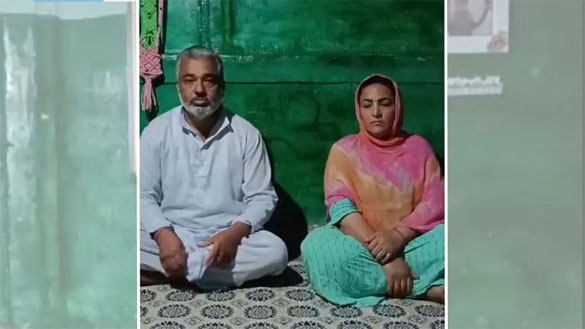
Parents of Fatima Mir (Niha Raina) have posted a video seeking religious leaders' intervention to bring their daughter back | Photo: X/@KPSSamiti
----------
New Delhi: A Kashmiri Pandit woman’s social media announcement that she has converted to Islam, changed her name, and married a Muslim man, is threatening the fragile peace between the two communities in Pulwama and the rest of the Valley.
Now, Kashmiri Pandits are rallying behind her parents, who have posted a video online claiming she was “lured” and “brainwashed”, and are asking religious leaders to intervene.
“If there is Kashmiriyat, where is it?” said the woman’s father in the video.
It all began on 23 July, when Niha Raina from Pulwama, who is now Fatima Mir, posted a 17-second video on Facebook announcing her conversion to Islam. With her head covered in a dupatta, she said the decision was entirely her own.
“I had always liked this [Islam] religion. I was never forced to convert,” Fatima said in the clip. After her parents’ public appeal, she posted another video on Facebook, saying she is happily married to her Muslim boyfriend and goes by her new name, Fatima Mir. She reminded viewers that she is an adult who can make her own decisions.
The incident has reignited long-standing communal anxieties in the Valley, with members of the minority Kashmiri Pandit community demanding the introduction of an anti-conversion law. For the older generation, it is a reminder of the 1960s, when one Parmeshwari Handoo married her co-worker Ghulam Rasool Kanth. At the time, it sparked massive protests by the Pandit community.
Now, rumblings of discontent are taking root again, magnified by social media posts. This love story can potentially change the fraught dynamics between Kashmiri Pandit and Muslim communities, said a senior politician who did not want to be named.
“It’s a very sensitive matter. We are trying our best to see what can be done so that the minorities don’t feel hurt,” said Waheed Para, Pulwama MLA.
Within the Kashmiri Pandit community, the woman has a small section of reluctant supporters who agree that she is free to make her own decisions, but are unhappy that she has converted. For the most part, however, members are knocking on the doors of local politicians and police.
“We are requesting the government and authorities to bring in an anti-conversion bill,” said Ashwani Sadhu, a 43-year-old businessman based in Chandigarh. He is mobilising members to ‘bring the woman back’.
“A section of Kashmiri Pandits stayed back in Kashmir 35 years ago. Why? So that their daughters would grow up and get converted? This incident has triggered a real sense of threat to our community,” said Sadhu.
In 2021, a Sikh girl converted to Islam and married a Muslim man. It became a flashpoint in the Valley, with the Sikh community forcefully bringing her back as she was a minor. She was forced to marry a Sikh man, but ultimately eloped with her Muslim lover.
“Part of the anxiety is about the majority and minority in a democracy. The women are seen as someone who will carry their progeny, while the larger anxiety is that if women keep converting, Hindus will become a minority,” said a senior sociologist at a university in Delhi.
‘I am 30, can make own decisions’
Fatima Mir and Sajad Mir lived in Looswani village in Pahalgam. Sajad was Fatima (Niha)’s neighbour. According to a police official, the two had been in a relationship for over seven years. When news of their marriage broke two weeks ago, the Kashmiri Pandit community mobilised.
A WhatsApp group, with over two dozen Kashmiri Pandits, was formed with a single agenda: to bring ‘Niha’ back.
They met the woman’s family members and are now preparing to launch protests across Jammu and Kashmir.
“For us, this is a case of love jihad,” said Ashwani Sadhu, who is leading the campaign. “We spoke to the family. They told us Mir would often visit their home and called Niha his sister. It never crossed their minds that the two were in a relationship.”
Sadhu alleged that Mir was already married and that Niha is his second wife. “They didn’t have a legitimate marriage—only under Islamic law, for which the girl had to convert first. How can this be a conversion of her own will?” he said.
Fatima and Sajad have approached the district court for protection and are currently staying at a shelter home in Kashmir. According to Sadhu, the police are not allowing the woman’s family to meet her, and the matter has reached the Jammu and Kashmir High Court.
“We will do whatever it takes,” said another Kashmiri Pandit from the WhatsApp group. “We will bring our girl back.”
Hours after her parents’ video surfaced online, Fatima uploaded a second, longer video from a new Facebook account.
“Why is everyone reacting in a manner as if we have committed a crime? Please let us stay alive,” she said in the video. “I’m 30 years old, not a minor. I have the right to make my own decisions. We’ve been married for three months. My parents never had an issue—until now. I am happily married to Sajad Ahmad Mir, and I am his wife, Fatima Mir.”
The video of the family members pleading for justice has been widely shared by the Pandit community members on Facebook, Instagram, and X.
“Just imagine for a moment. If the numbers flip, 80 percent Muslims and 20 percent Hindus. Will your ‘Secular India’ still exist?” read a comment under the video.
But the matter doesn’t end there. The incident has prompted Sadhu and others to begin monitoring other Kashmiri Pandit women living in and outside Kashmir.
“Right now, we have information about at least half a dozen Kashmiri Pandit women who are in relationships with Muslim men,” he said. “We can’t let this happen.”
Source: theprint.in
https://theprint.in/feature/kashmiri-pandit-woman-marriage-muslim-pulwama/2710035/
.......
Empowering Muslim women vital for inclusive growth: Kiren Rijiju
Aug 01, 2025

Empowering Muslim women vital for inclusive growth: Kiren Rijiju
------------
New Delhi, Union Minister for Minority Affairs and Parliamentary Affairs Kiren Rijiju on Friday said empowering Muslim women with knowledge of their rights is critical towards inclusive development.
He was speaking at a national consultation organised by the National Commission for Women on the theme "Rights of Muslim Women in India".
"Empowering Muslim women with awareness of their rights is not just a social commitment but a necessity for inclusive growth," Rijiju said during his inaugural address.
"When women become economically independent, they also become socially powerful. Economic empowerment automatically leads to social empowerment," he said.
The day-long consultation brought together lawyers, academics, sociologists, women's rights activists, policymakers and representatives from civil society across India to discuss the legal, economic and social rights of Muslim women.
Rijiju also assured participants that he would take forward the key recommendations that emerged from the consultation.
"I will personally contribute to advancing the outcomes of this consultation so that the voices heard here translate into meaningful change," he said.
NCW Chairperson Vijay Rahatkar said the Commission is consistently working to safeguard the rights and welfare of Muslim women.
"This consultation is not just an event; it is a platform to amplify voices that have long remained unheard," she said.
"No woman - irrespective of her background - should be denied justice, dignity, and human rights," she said.
She stressed that legal reforms must be accompanied by shifts in societal thinking.
"When we talk about Muslim women's rights, merely opening law books is not enough. We must also address the evolving societal landscape, where balancing tradition and progress is crucial," she said.
On the occasion, Rijiju also released Naya Daur, a special publication by the NCW compiling information on Muslim women's rights, legal provisions, and welfare schemes.
The consultation featured four thematic technical sessions. The first focused on assessing the effectiveness of government schemes aimed at the socio-economic empowerment of Muslim women.
The second session examined provisions in the Wakf Act, 2025, with speakers calling for greater transparency and women's representation in Wakf boards.
The third session explored legal challenges related to maintenance, child custody, and property rights under Muslim personal law, while the final session addressed marriage and divorce rights of Muslim women, highlighting the need to ensure dignity and justice from a constitutional lens.
The NCW said the consultation aimed to bring Muslim women's voices into the policy discourse and ensure equal rights and opportunities for them in Indian society.
This article was generated from an automated news agency feed without modifications to text.
.........
Taliban To Face People’s Tribunal In Spain Over Abuses Against Afghan Women
01/08/2025
Four Afghan civil society organisations announced on Thursday the launch of the People’s Tribunal for Afghan Women, an independent forum aimed at examining the Taliban’s systemic oppression and institutionalised violence against women since returning to power in 2021.
The hearings will be held in Madrid from 8 to 10 October in collaboration with the Permanent Peoples’ Tribunal, and will include participation from international judges, prosecutors and subject-matter experts. Organisers say the tribunal seeks to hold the Taliban morally and politically accountable, even though it lacks legal enforcement powers.
In a joint statement, the organisers said, that by holding the People’s Tribunal for Afghan Women, Afghan civil society and women’s rights groups are opening another avenue for justice and accountability for Taliban crimes.
The tribunal aims to document widespread human rights violations and provide evidence that may support future international legal action. Although it cannot issue arrest warrants, its findings will be submitted to international courts such as the International Criminal Court (ICC), which has already initiated preliminary investigations into Taliban crimes, including gender-based persecution.
Civil society organisations behind the initiative stressed that while arrest warrants for Taliban leaders are significant, they are not sufficient on their own. The tribunal, they said, underscores the urgent need for a comprehensive, victim-centred approach to transitional justice in Afghanistan.
Concerns Over International Normalisation of Taliban Rule
The announcement comes amid growing concern about the international community’s shifting posture toward the Taliban. Russia recently became the first permanent member of the United Nations Security Council to recognise the Taliban government. China and several regional powers have also deepened engagement with the group. While many European countries continue to condemn human rights violations in Afghanistan, some have maintained “technical contact” with the Taliban, particularly in the context of deporting Afghan asylum seekers.
The organisers of the tribunal warned that such engagement risks legitimising the Taliban despite their continued oppression of women.
Shaharzad Akbar, head of the Rawadari organisation and one of the tribunal’s organisers, told Afghanistan International that the initiative aims to counter the growing trend of political normalisation. “This tribunal is an Afghan-led effort to begin an independent justice process, rather than waiting for international institutions to act,” she said.
Akbar noted that as the fourth anniversary of the Taliban’s return to power approaches, Afghanistan has fallen off the global agenda, raising fears that the ongoing crisis, particularly for women, could be ignored.
She added that the tribunal will serve as a platform for Afghan women to directly participate in justice processes, share their personal testimonies, and amplify the voices of victims of war and gender-based violence.
Formal Accusations and Global Participation
Four Afghan prosecutors with experience in international justice and gender-based violence have been appointed to draft formal indictments. A joint team of Afghan and international experts is collecting documentation and evidence against the Taliban.
The hearings will be public and livestreamed, with an international judicial panel presiding. A final verdict is expected to be issued in December.
The Permanent Peoples’ Tribunal, a co-organiser of the event, is a Rome-based independent body that has previously convened hearings around the world on major human rights violations, including crimes against humanity, war crimes and genocide.
Other civil society organisations involved in organising the tribunal include Rawadari, the Afghanistan Human Rights and Democracy Organisation, and the Human Rights Defenders Forum.
https://www.afintl.com/en/202508015983
......
Muslim women send rakhis to PM Modi over Op Sindoor feat
Jul 31, 2025
Varanasi: While opposition parties continue to criticise Prime Minister Narendra Modi over Operation Sindoor, Muslim women in his parliamentary constituency of Varanasi have expressed their support by sending rakhis to him, hailing the mission as a symbol of national pride and women's dignity.
Under the joint auspices of the Muslim Mahila Foundation and Vishal Bharat Sansthan, a large number of Muslim women gathered at Subhash Bhavan in Lamhi to sing songs for Modi to the beat of dholak.
They crafted rakhis, decorated with traditional tikki, sitara, gota, kiran, and featuring the Operation Sindoor logo. Some rakhis featured images of Prime Minister Modi, and will be tied among the women themselves on the occasion of Raksha Bandhan. Hindu women also participated in the event, displaying sindoor as a mark of cultural solidarity.
Nazneen Ansari, president of the Muslim Mahila Foundation, said, "Through Operation Sindoor, Modi Ji brought Pakistan to its knees and gave a lesson to those who dare to disrupt the sindoor of our sisters and daughters. Sindoor is not just a cosmetic, but a symbol of India's great tradition and dignity." She added that opposing the operation equated to disrespecting Indian values and "helping Pakistan," calling it an "act of treason.
Archana Bharatwanshi, general secretary of Vishal Bharat Sansthan, echoed similar sentiments, saying, "Modi Ji upheld the nation's honour. Those who disrespected sindoor were shown their place. We've been sending rakhis to Modi Ji since 2011."
Najma Parveen, who has completed a doctorate on Prime Minister Modi, described Operation Sindoor as a historic achievement.
"It's a proud moment for India. Just like his step to abolish triple talaq, this operation is another move towards empowering Muslim women with dignity," she said.
-----
Pakistan fails to end inherent violence against women among tribes
By Uzma Khatoon
In recent weeks, a heartbreaking video from Balochistan shocked millions across South Asia. A young woman named Bano Satkzai was seen walking with confidence in bright red clothes, adjusting her shawl. She looked calm and fearless. In the Brahui language, she said, “Only shooting is allowed, nothing else.” This was followed by gunfire, and she fell. Another man named Ihsan Samalani, badly injured, was also shot again. Even Bano’s body was not spared. In the background, someone pleaded, saying, “Stop it,” but the bullets did not stop. Both of them were murdered in the name of family honour.
They had fallen in love and possibly married or planned to marry. Just for choosing their life partner, they were hunted, kidnapped, and then shot. They were not criminals. Their only "crime" was love. This heartless killing happened near Quetta in an area called Degari, just before the Eid festival. Bano did not run. She did not beg for her life. She seemed to know her fate was already decided.
After the video went viral, 11 people were arrested, including Bano’s brother and a local tribal elder. According to journalist Murtaza Zahri and Jalila Haider, Bano was shot seven times and Ihsan nine times. The family members are silent about the killings. In such cases, truth is often buried under the burden of tribal customs; people are too afraid to speak up. Many people in Balochistan and other tribal areas still follow strict tribal codes based on old pride, revenge, and control. These customs are so powerful that even the courts and police are afraid to act. Men in these areas believe their honour is tied to women's actions. If a woman dares to talk to a man, choose her partner, or even post a picture on social media, she is considered a disgrace. The punishment comes fast and final—death.
Sadly, this is not an isolated event. Honour killings have become far too common in Pakistan. According to the Human Rights Commission of Pakistan, over 1,200 women were killed in the name of honor between 2021 and 2023. In 2024, more than 400 women were murdered for similar reasons. Sindh province reported over 300 cases. Shockingly, some victims were even from the Hindu community. The problem is not religion—it is tribal culture.
What’s happening in Pakistan is not Islamic justice. It is tribal justice. These tribal ideas—like Pukhtunwali among Pukhtun tribes—are older than Islam itself. They existed before the Prophet Muhammad brought the message of Islam to the people. Earlier in ancient Arab society, baby girls were buried alive because they were seen as a shame to the family. When Prophet Muhammad received the message of Allah, one of the first things he did was ban this cruel practice. He taught that daughters are a blessing and promised Paradise to people who raise their daughters with love and care. He said, “Whoever has three daughters and treats them well will enter Paradise because of them.” That is Islam. That is the message of Allah. But the murder of Bano and Ihsan is the message of tribal pride and ignorance. No matter what people call it, it is not Islam.
In Islam, marriage is a sacred contract. It must happen with the free will and consent of both the man and the woman. The Quran says clearly: “Do not mistreat them, and do not prevent them from marrying their husbands when they agree between themselves in a lawful manner” (Quran 2:232). The Prophet also said, “There is no marriage without the consent of the woman.” Therefore, if a woman chooses her husband, Islam allows it. There is no dishonor in love or marriage. All these killings and violence done in the name of Islam are lies. They are part of an old tribal culture that turns women into property and honor into violence.
This problem is not limited to Pakistan. In Yemen, Iran, Afghanistan, and even parts of Iraq, honor killings happen among Muslim communities. But Islam does not allow them. Islam teaches mercy, love, equality, and justice. The Quran says, “Do not kill the soul which Allah has made sacred.” So how can people kill someone and then say it is in the name of God? It is hypocrisy. The real message of Islam has been hidden behind the dirty politics of tribal leaders, corrupt clerics, and greedy landlords.
In Pakistan, many poor and rural families are still ruled by tribal elders known as sardars, maliks, or waderas. These men act as judges, police, and executioners. Across the country, illegal village courts—called jirgas or panchayats—make decisions about marriage, land, and women. These men often decide that a young girl must be killed or married off to end a family feud. A practice called ‘Vani’ allows little girls to be given to the enemy tribe as punishment. Another cruel tradition is ‘Marriage to the Quran,’ where a girl is told she is married to the holy book and must never marry a man. Her family's goal is only to protect land and property. This is not faith—it is slavery.
While Pakistan was created as a country for Muslims, it has failed to protect the rights of Muslim women. Its Constitution speaks about equality, but in real life, women face violence, humiliation, and death—even from their own families. A woman using social media or walking alone may be insulted or attacked. Even the police do not help. Laws made to protect women are ignored. Many religious leaders are interested more in power than justice. They preach modesty to women but remain silent when women are killed. Some even justify these killings to protect culture.
Islam never gave men the right to control women. The Quran uses the word "qawwam" to describe a man’s role—not as a master, but a protector and caretaker. A man is responsible for the emotional and financial well-being of the women in his family. This does not mean he owns them. A woman is free to choose her life, career, education, and husband. The Prophet Muhammad (peace be upon him) never beat his wives. He asked people to treat their women kindly and gave examples through his actions. When his daughter Fatimah entered the room, he stood up for her. This is how Islam honors women.
Yet in today’s Pakistan, these lessons are forgotten. Most women are taught to obey, not to choose. They are not allowed to finish school in many villages. Educated girls are seen as "dangerous" because they ask questions. Sadly, even in urban areas, women are harassed at work or threatened on social media. Many journalists, doctors, and politicians face abuse, not because they did something wrong, but because they are women with a voice.
At the same time, Pakistani men are told from childhood that their job is to protect family honor. Even if they are poor, unemployed, or struggling, society tells them they are the boss. This pressure makes some frustrated men act violently, especially when they feel powerless in other areas. Some are even misled in the name of religion and join extremist groups. They are promised Paradise if they die in “honour” or “jihad,” but Islam clearly says killing another human being without just cause is a great sin.
Many women in Pakistan live in fear. Graveyards are full of nameless women, killed in the name of religion but buried in silence. Their stories never reach the public. Their killers are often family members. Even if arrested, they are usually forgiven under Islamic loopholes and walk free. The justice system is weak, and the culture favors the criminal if he is male and powerful.
Now look at Muslim women in India. While India certainly has challenges, Muslim women here have more rights and freedom than most of their sisters in Pakistan. They can choose who to marry, go to schools and colleges, become doctors, judges, officers, and even Members of Parliament, and they are protected by law and courts. There are honor crimes in India, too—but such cases face public outrage and legal action. In India, a Muslim woman can file a police complaint, go to court, get media support, and live safely if she takes a stand. In Pakistan, speaking up is dangerous.
While Pakistan punishes women for falling in love, in India, Muslim women enjoy greater freedom and dignity, supported by the strong framework of the Indian Constitution. Fundamental rights like equality, personal liberty, and protection against discrimination apply equally to them. A powerful example was seen during the triple talaq debate, where the Indian Supreme Court declared instant divorce unconstitutional. This landmark decision reinforced that Muslim women are individual persons with full constitutional rights—not property of their husbands. Parliament followed with a law making instant triple talaq a criminal offense, further securing justice for these women.
In India, constitutional remedies like writs under Articles 32 and 226 empower women to directly approach the courts when their rights are violated. This is known as the “writ of the State”—a system where law stands above tradition. While Pakistan silences its women with bullets and traditions, India gives them a voice in courts, classrooms, and even Parliament. The key difference is not just religion, but the presence of justice, equality, and constitutional protection that treats every woman—not just as someone's daughter or wife—but as a complete human being in her own right.
It is time we stop hiding the truth. What is happening in Balochistan, Sindh, and Khyber Pakhtunkhwa is not Islam. It is tribalism, sexism, and a dark form of cultural violence wearing a religious mask. Islam cannot be blamed for these murders. The Prophet banned honor killing 1,400 years ago. But people in Pakistan have made a new religion—what we might call "Mullah kadeen," full of power, control, and fear. It is not Allah’s religion, which is based on liberty, respect, and equality.
No society can move forward while half its population is wounded, silenced, or dead. The world must call out the crimes in Pakistan. The government must take action. The courts must punish killers. And the people must understand that honor is not in killing. Honor is in kindness, in letting your daughter choose her future, in letting your sister live with dignity, in respecting your wife’s voice. The honor that demands blood is not honour—it is cowardice.
Dr.Uzma Khatoon has taught in the Department of Islamic Studies at Aligarh Muslim University.
.....
"Gordian Knot" in Iran-Azerbaijan Relations: How "Husseinioun" Now Uses Women
01/08/2025
Despite periodic serious tensions between neighboring Azerbaijan and Iran, which profess the same branch of Islam, after the meeting of Azerbaijan's President Ilham Aliyev with the now-deceased President of Iran Seyyed Ebrahim Raisi on May 19, 2024, at the bridge over the Araz River, a rapid turn toward softening relations began.
As reported by BAKU.WS with reference to Oxu.Az, nevertheless, there exists an organization called "Husseiniun," consisting of Azerbaijanis who fled to Iran to avoid punishment for various crimes. This group has long been used by Iranian intelligence services for ideological subversion and information-propaganda work against Azerbaijan.
One of the main stated goals of this organization, directly aimed at changing the constitutional order of Azerbaijan, is to implement an "Islamic revolution" in the country following the Iranian model, to promote Iranian policy under the guise of Shiism, and to create a Sharia state based on this policy.
Despite the fact that numerous criminal acts of this group, led by Tohid Ibrahimbeyli, a native of the Lankaran district, including organizing armed actions against the state in Azerbaijan, have been fully proven, and they have been officially placed on an international wanted list, the Iranian side still avoids extraditing them to Azerbaijan under various pretexts.
Although in April 2023 they were temporarily detained by the Iranian Ministry of Information, Intelligence and Security (ETTELAAT), according to widespread information, they were released precisely due to the open intervention of the Islamic Revolutionary Guard Corps (IRGC) and still reside in Iran under an unknown status.
The Iranian side claims that "Husseiniun" is a humanitarian public organization created by Azerbaijani students studying in Iran themselves and has no connections with the Iranian state. However, the activation or retreat of "Husseiniun" in accordance with the pace of tension in Azerbaijani-Iranian relations, the special protection of their leaders under the control of the IRGC, the creation of all conditions for conducting Iranian propaganda under the guise of Shiism, as well as numerous irrefutable evidence of their subversive activities in Azerbaijan clearly show that this organization is openly supported and managed by the Iranian state.
In the wake of the provocation in Bibiheybat: "Husseiniun" is now pushing women to the forefront!
Since most representatives of the network they are trying to create in Azerbaijan are periodically exposed and eliminated by law enforcement agencies, recently "Husseiniun" has resorted to a new tactic: using religious women!
Just recently, on July 6, 2025, during the Ashura ceremony at the Bibiheybat mosque, a group of women in niqabs led by Shahla Yadulla gizi Farajova suddenly raised flags with religious slogans, trying to create an artificial confrontation with the Azerbaijani police, record it on video, and spread it on social networks. "Husseiniun" was also behind this attempt.
https://baku.ws/en/politics/gordian-knot-in-iran-azerbaijan-relations-how-husseinioun-now-uses-women
----
URL: https://newageislam.com/islam-women-feminism/kashmiri-pandit-woman-marriage-muslim-pulwama/d/136374
New Age Islam, Islam Online, Islamic Website, African Muslim News, Arab World News, South Asia News, Indian Muslim News, World Muslim News, Women in Islam, Islamic Feminism, Arab Women, Women In Arab, Islamophobia in America, Muslim Women in West, Islam Women and Feminism