
What is Talaq-e-Hasan, Muslim Divorce Form Being Challenged In Supreme Court of India
New Age Islam News Bureau
12 August 2025
• What is Talaq-e-Hasan, Muslim Divorce Form Being Challenged In Supreme Court of India
• “Minta Devi 124 Not Out”: According To The Election Commission Data Minta Devi Is A First-Time Voter In Bihar
• Kothamangalam woman suicide case: Police arrest boyfriend over rape; BJP alleges ‘love jihad’
• Female mayors join women’s protest urging end to war; march planned today near Nahal Oz
• Four years on, here’s what total exclusion of women in Afghanistan looks like
• UNICEF Marks International Youth Day with Skills Training for 200 Girls in Herat
• Lingering Fatigue, Dizziness, Weakness: The Anemia Crisis Is Striking Urban Women
Compiled by New Age Islam News Bureau
-----
What is Talaq-e-Hasan, Muslim Divorce Form Being Challenged In Supreme Court of India
12 August 2025
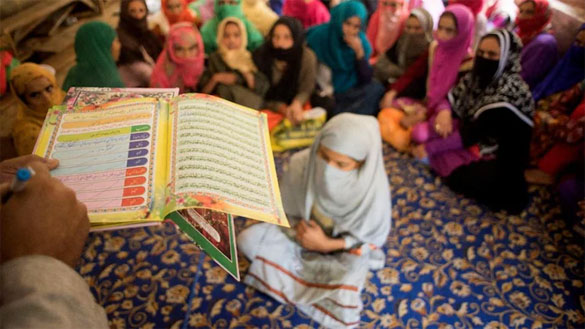
Talaq-e-Hasan is a form of triple talaq under Talaq-ul-Sunnat in which a Muslim man can divorce his wife in three months. (Photo: File)
-----------
Eight years after the ban on instant triple Talaq or Talaq-e-Biddat, the Supreme Court is examining Talaq-e-Hasan on a plea by a Muslim woman. The apex court has sought views from rights bodies before deciding on its constitutionality. This is more about Talaq-e-Hasan, which allows Muslim men to divorce.
Eight years after the Supreme Court outlawed instantaneous triple talaq or Talaq-e-Biddat, it is now examining the validity of Talaq-e-Hasan, another form of triple talaq in which a Muslim man can divorce his wife by saying "talaq" once a month for three months.
The petitioner, Ghaziabad-based journalist Benazeer Heena, argued in 2022 that the practice is "discriminatory" since only men can exercise it, and sought a declaration that it is unconstitutional as arbitrary and violative of Articles 14, 15, 21, and 25 of the Constitution.
In her plea, Heena also alleged that the unilateral talaq process causes "gross affront to the dignity of women" and undermines their right to equality and to life with dignity.
The Supreme Court has now asked the National Human Rights Commission (NHRC), National Commission for Women (NCW), and the National Commission for Protection of Child Rights (NCPCR) to provide their opinions on Talaq-e-Hasan.
A bench of Justices Surya Kant and Joymalya Bagchi is hearing nine petitions related to the issue. The matter has been listed for November, according to Live Law.
HOW TALAQ-E-HASAN IS DIFFERENT FROM OTHER DIVORCE FORMS UNDER SHARIA
Talaq-e-Hasan is one of the two subtypes of Talaq-ul-Sunnat. The other type of divorce under Talaq-ul-Sunnat is Talaq-e-Ahsan.
While the now-outlawed instant triple talaq was supposed to have been pronounced by a Muslim man upon his wife if he spelled out the word 'talaq' (meaning divorce) three times in one instance and in one sitting, Talaq-ul-Sunnat is supposed to give time for such decisions.
Talaq-ul-Sunnat means divorce "according to Sunnah" – the method approved by Prophet Muhammad. In Islam, it is considered the proper, thoughtful way to divorce, giving time for reflection and reconciliation.
In Talaq-e-Hasan, the husband pronounces "talaq" once during a period when the wife is not menstruating (tuhr).
After this first pronouncement, there is a waiting period until her next menstrual cycle. If reconciliation happens during this time, the divorce process stops.
If the couple does not reconcile, the husband repeats the talaq in the second menstrual cycle, and again in the third cycle if separation is still desired.
After the third pronouncement, the divorce under Talaq-e-Hasan becomes final and irrevocable.
TELANGANA HC UPHELD MUSLIM WOMEN'S RIGHT TO KHULA
The Talaq-e-Biddat or instantaneous Triple Talaq was declared unconstitutional by the Supreme Court in 2017 in the Shayara Bano vs Union of India case.
After the verdict, the Muslim Women (Protection of Rights on Marriage) Act, 2019, outlawed the practice, criminalising it with penalties, including imprisonment, to protect Muslim women’s rights.
While Talaq-e-Ahsan and Talaq-e-Hasan are exclusively initiated by men, Mubarat can be initiated by either spouse but requires mutual consent.
Khula is the only form of divorce exclusively initiated by women among the four types of divorce in a Muslim marriage.
Holding a Muslim woman's right to unilateral divorce through the Khula form of divorce under the Muslim Personal Law as absolute, the Telangana High Court in its June 25 judgment reignited conversations on marital equality and personal laws. A bench of Justices Moushumi Bhattacharya and BR Madhusudhan Rao delivered the landmark verdict in 'Mohammed Arif Ali vs Smt Afsarunnisa and Another' case.
The High Court heard a husband's appeal against a family court order upholding his wife's Khula granted by the Sada-e-Haq Sharai Council. Married in 2012, the wife alleged assault in 2017 and left home. After the husband denied her Khula, the council attempted reconciliation but issued a Khulanama in 2020. He argued the council lacked authority, but the court ruled a woman's right to Khula is independent of her husband's consent and needs no judicial decree unless contested.
While Khula is the only form of divorce that can be initiated unilaterally by a Muslim woman, Talaq-e-Hasan is part of Talaq-ul-Sunnat and provides time for the decision, unlike the now-banned instant triple talaq.
------
“Minta Devi 124 Not Out”: according to the Election Commission data Minta Devi is a first-time voter in Bihar
Our Bureau/ 12.08.25
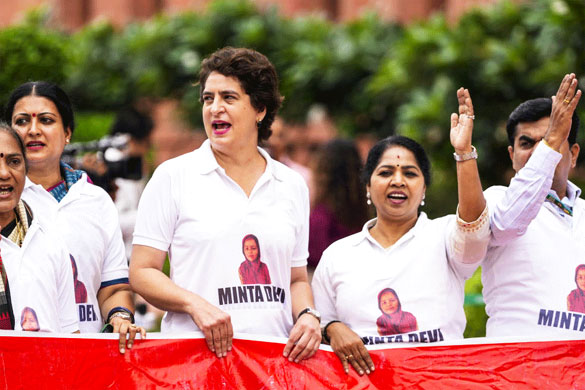
Congress MP Priyanka Gandhi Vadra and other INDIA bloc members seen wearing T-shirts featuring the name Minta Devi, a voter allegedly listed as 124 years old in the Election Commission's voter list, during their protest over the issues of 'poll fraud' and Special Intensive Revision of electoral rolls, at the Monsoon session of Parliament, in New Delhi, Tuesday, Aug. 12, 2025.
PTI
-------------
The Opposition INDIA bloc MPs on Tuesday staged a protest at the Parliament complex with white T-shirts bearing the slogan “Minta Devi 124 Not Out.”
Who is Minta Devi?
Minta Devi, according to the Election Commission data cited by Leader of the Opposition in the Lok Sabha Rahul Gandhi, is a 124-year-old first-time voter registered in Bihar’s Daraundha Assembly seat under Siwan Lok Sabha at the Kanya Utkramit Madhya Vidyalaya in Arjaanipur.
Minta Devi’s name surfaced soon after the Election Commission completed its special intensive revision (SIR) of the electoral rolls in the poll-bound state amid Rahul’s presentation of what he calls evidence on voter list manipulation and fraud.
“We proudly nominate Minta Devi for the Guinness World Record: the youngest looking oldest human in India – courtesy the several miracles of ECI,” wrote Congress leader Pawan Khera on his X (formerly Twitter) handle.
In May this year, the BBC reported Ethel Caterham, who lives in a care home at Surrey’s Lightwater, as the oldest living person after the death of Brazilian nun Sister Inah Canaborro Lucas. She was 116.
Caterham will be celebrating her 116th birthday on August 21. Minta Devi’s date of birth is listed as July 15, 1900.
“The Election Commission has done a great service to humankind. They discovered the oldest living human, Minta Devi, whose age is listed as 124 years in the Bihar SIR. The mega voter fraud done by the EC can never be allowed. INDIA will keep protesting until it is stopped,” said Congress MP K.C. Venugopal.
The Opposition’s T-shirt protest came a day after the many parliamentarians were stopped from marching to the Election Commission of India’s office at Nirvachan Sadan in Delhi.
“This isn’t just a clerical error- it’s proof of mega voter fraud. INDIA will keep protesting until this is stopped,” said Congress MP Manickam Tagore.
At the Parliament protest asked about Minta Devi, Rahul replied: “Picture abhi baaki hai (There is more to come).”
NDTV reporters, however, claimed to have traced Minta Devi in Bihar and said she had incorrectly written 1900 instead of 1990 as year of birth in her form. There was no clarification, however, on how such errors creep into a draft roll after an exercise meant to clean up the voters’; lists.
https://www.telegraphindia.com/india/minta-devi-124-not-out-the-story-behind-oppositions-sir-protest-t-shirts-in-parliament/cid/2117623
-----
Kothamangalam Woman Suicide Case: Police Arrest Boyfriend Over Rape; BJP Alleges ‘Love Jihad’
KOCHI: Police on Monday arrested the boyfriend of the 23-year-old woman who died by suicide in Kothamangalam, on charges of rape under the pretext of marriage, abetment of suicide and assault. The case has sparked a political controversy, with BJP leaders alleging that the woman was the victim of a ‘love jihad’-linked religious conversion attempt.
The deceased, Sona Eldhose, a resident of Puthupady in Kothamangalam and a TTC student at an institute in Muvattupuzha, was found dead at her residence around 2 pm on Saturday. She was alone at the time.
Ramees, 24, a native of Alangad in Aluva and a temporary employee at the Cochin International Airport in Nedumbassery, was first taken into preventive custody, and was later formally arrested under multiple sections of the Bharatiya Nyaya Sanhita (BNS) for abetment of suicide, rape under the pretext of marriage, wrongful confinement, and voluntarily causing hurt. Police said his father and mother have also been booked and will be taken into custody for questioning.
The Ernakulam rural police said a suicide note recovered from Sona’s house says she was pressured by Ramees and his father to convert to their faith, and that she was assaulted over it.
“We have obtained evidence from their WhatsApp chats indicating that Ramees assaulted Sona. The messages also reveal that when Sona expressed her intention to end her life, Ramees encouraged her to do so,” an officer said.
The note, described by the investigators as a turning point in the case, begins: “I don’t want to live a life where I have to endure such betrayal.”
Her death not isolated incident: BJP
Sona wrote that she had forgiven Ramees after his arrest in an immoral trafficking case, but alleged he repeatedly proved he never truly loved her. She accused him of forcing her to convert to his religion despite her sacrifices.
The note also claims that his family told her they had arranged a car to take her to Ponnani for religious conversion, and that marriage would take place only two months after the conversion. There was no other option, they had asserted, the note says. His parents, sisters, and friends allegedly supported the plan.
BJP national executive committee member P K Krishnadas, who visited Sona’s family at Karukadam with other party leaders, said her death was not an isolated incident.
“Across Kerala, religious extremists lure girls pretending love, convert those who agree and use them for extremist activities. This is happening on a large scale, yet both the government and the Opposition try to pass it off as an isolated case,” he alleged.
Police said the probe, led by Ernakulam district police chief M Hemalatha, is progressing, and Ramees’ family members are likely to be made co-accused. They also revealed that Ramees had previously been booked in around seven narcotics-related cases.
.....
Female Mayors Join Women’s Protest Urging End To War; March Planned Today Near Nahal Oz
By Sue Surkes
Aug 12, 2025
Several female mayors join the women’s and mothers’ protest in southern Israel, which began Sunday, which is calling for an end to the Gaza war and the return of all Israeli hostages.
They are Michal Uziyahu of the Eshkol Regional Authority near the Gaza border, Shlomit Shichor Reichman of the Jezreel Valley Regional Council in the north, and, from the center of the country, Rotem Yadlin of the Gezer Regional Authority, Galit Shaul of the Emek Hefer Regional Council, and Keren Green of the local council in Kadima-Zoran.
Later today, a march is planned to a site memorializing female soldiers killed at the Nahal Oz army base on October 7, 2023, when Hamas terrorists overran the base. Among those who have said they will join are Eran Etzion, a former head of policy planning at the Foreign Ministry and former deputy head of the National Security Council in the Prime Minister’s Office; former education minister Yuli Tamir; and a retired judge, Sarah Habib.
....
Four Years On, Here’s What Total Exclusion Of Women In Afghanistan Looks Like
Aug 12, 2025
Four years after Taliban fighters retook the capital Kabul on 15 August 2021, gender equality agency UN Women is warning that the situation for women and girls in Afghanistan is increasingly untenable.
And without urgent action, this untenable reality will become normalised and women and girls will be fully excluded.
“The Taliban is closer than ever to achieving its vision of a society that completely erases women from public life,” UN women said in a press release on Monday.
UN Women’s warning came just as the UN Assistance Mission in Afghanistan (UNAMA) released its latest report on the human rights situation between May and June, detailing harshening enforcement of regulations against women and death threats against female humanitarians.
A society which is against them
The edicts which the Taliban have passed restricting women and girls’ rights interact together to create an inescapable cycle which relegates women to private spaces and increases their vulnerability.
In most cases, including for humanitarian workers, women are not allowed to move freely in public without being accompanied by a mahram, or a male guardian.
In its report, UNAMA noted a change in the enforcement of mahram requirements, with the de facto Taliban authorities instructing private businesses and health clinics to refuse services to all women who were not accompanied by a mahram.
In certain regions, the authorities have also begun to strictly enforce hijab regulations, including by requiring women to wear a chador, a full body covering. In Herat, if they were not doing so, women are being banned from public spaces.
Out of opportunities
In addition to impeding women's movements in public spaces, the Taliban has also banned women and girls from secondary and higher education.
Taken together, these two edicts have profound ramifications at all levels of society. Now, not only is it functionally impossible for women to receive educational degrees, it is also unduly difficult for them to get jobs and enter into training programmes.
As a result, over 78 per cent of Afghan women are not in education, employment or training.
This means that almost half of the work force is not contributing to the economy in measurable ways, a huge problem for a country whose economy has been devastated by sanctions and climate shocks.
UNAMA’s report noted that the de facto authorities continue to affirm that Islam permits women to work – even as other edicts seem to discourage it.
An unhealthy cycle
But it’s not just the economy which is suffering. In some cases, these edicts can literally be a matter of life or death.
“The results are devastating. Women are living shorter, less healthy lives,” the UN agency said.
Take healthcare for instance. If women are not allowed to enter higher education, they cannot become doctors. And if women are banned from receiving treatment from male doctors – which they are in certain regions – they cannot expect to live healthy lives.
UN Women estimates that impediments to receiving healthcare for women in Afghanistan will increase maternal mortality by 50 per cent by 2026.
Child marriage is also becoming more common, and women are increasingly subjected to violence, inside and outside of their homes. In some cases, de facto authorities were the ones involved in or enforcing forced marriages.
Solidarity in Afghanistan
It is not just in public that women’s voices are being excluded – 62 per cent of women feel that they cannot even influence decisions at home. This comes amidst a curtailing of expression rights more generally, with many private media outlets closing and social media accounts being monitored, according to the UNAMA report.
UN Women emphasises that despite having little to hope for, Afghan women remain resilient. They continue to look for moments of solidarity and hope for a different future.
In May, some women working for the UN were subjected to explicit death threats in relation to their work, but they continue to deliver lifesaving and life-building services.
One woman whose grassroots leadership organization lost all of its funding in 2022 continues to work to support women in smaller ways.
“I will continue to stand strong as a woman, supporting other Afghan women. I go to remote areas and collect [women’s] stories, listen to their problems and this gives them hope. I try my best and that also gives me hope,” she said.
A dangerous precedent
In total, since 2021, almost 100 edicts which restrict how women and girls move through society have been instituted and enforced. In four years, not a single one has been overturned.
Susan Ferguson, UN Women’s representative in Afghanistan, said that this lack of progress must be understood beyond the Afghan context.
“This is not only about the rights – and futures – of Afghan women and girls. It’s about what we stand for as a global community,” Ms. Ferguson said.
“If we allow Afghan women and girls to be silenced, we send a message that the rights of women and girls everywhere are disposable. And that’s an immensely dangerous precedent.”
https://news.un.org/en/story/2025/08/1165622
.....
UNICEF Marks International Youth Day with Skills Training for 200 Girls in Herat
12/08/2025
On International Youth Day, the United Nations Children’s Fund (UNICEF) announced a vocational training initiative in Herat province for 200 girls who have been deprived of formal education.
According to a UNICEF report released on Tuesday, August 12, the participants are aged between 15 and 25 and represent some of the most disadvantaged youth in Afghanistan.
The six-month program, organized in partnership with Japan, will provide training in sewing and carpet weaving, equipping the girls with practical skills to support their livelihoods and independence.
UNICEF highlighted that since the Taliban’s ban on girls’ education, more than one million girls have been unable to attend school, creating one of the world’s most severe education crises.
International Youth Day, observed annually on August 12, aims to promote youth rights and opportunities worldwide. This year, it comes as millions of Afghan youth face restricted education, high unemployment, and limited personal freedoms.
The program offers a rare opportunity for Afghan girls to gain employable skills despite ongoing restrictions, while also underscoring the importance of sustained global support for youth empowerment in conflict-affected areas.
Observers say such initiatives are vital for preserving hope and opportunity for Afghanistan’s younger generation, helping them navigate a future shaped by political instability and social limitations.
.....
Lingering Fatigue, Dizziness, Weakness: The Anemia Crisis Is Striking Urban Women
Aug 12, 2025
Anaemia is increasingly affecting urban women in India, as a result of changing diets and lifestyles and the rise of processed convenient foods.
For decades, anemia, a condition where the body lacks enough healthy red blood cells to carry oxygen, was seen as a rural health problem in India, linked to poor diets, limited healthcare, and heavy manual labour in villages. But today, with changing lifestyles, dietary shifts, and other risk factors on the rise in cities, urban women are increasingly facing the same challenge.
......
New Age Islam, Islam Online, Islamic Website, African Muslim News, Arab World News, South Asia News, Indian Muslim News, World Muslim News, Women in Islam, Islamic Feminism, Arab Women, Women In Arab, Islamophobia in America, Muslim Women in West, Islam Women and Feminism