
'Al-Ayyala' Dance At Midnight: Donald Trump Getting Hair-Flipping Welcome by Women In UAE
New Age Islam News Bureau
17 May 2025
· 'Al-Ayyala' Dance At Midnight: Donald Trump Getting Hair-Flipping Welcome by Women In UAE
· Mina Bahmani Detained in Iran Prison Without Legal Process for Nearly a Year
· FatemehSepehri: Imprisoned Dissident’s Health Crisis Reaches Critical Stage
· 'I Will Die Like a Woman, Free': Mother Defies the Islamic Republic After DaughterMaryam’s Death
· Woman Shot Dead After Rejecting Marriage Proposal In Western Iran
· Tehran Authorities Close Children’s Music Show Over 'Religious Concerns'
· Muslim Women’s Coalition Networking Brunch Features Gardening Expert Linda Wolk
· Macron Opposes Hijab Use In Sport
Compiled by New Age Islam News Bureau
URL: https://newageislam.com/islam-women-feminism/al-ayyala-dance-hair-flipping-women-uae/d/135560
-----
'Al-Ayyala' Dance At Midnight: Donald Trump Getting Hair-Flipping Welcome by Women In UAE
May 16th 2025
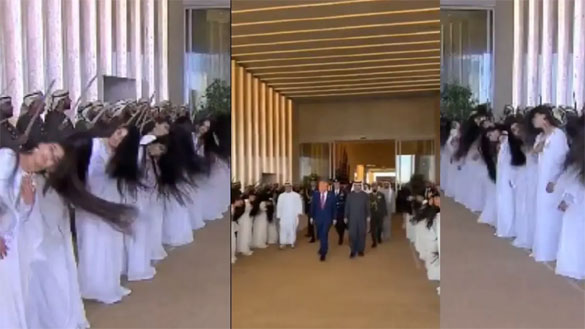
Don't Do 'Al-Ayyala' At Midnight: Netizens Hilariously React To Donald Trump Getting Hair-Flipping Welcome by Women In UAE | Image: X
--------------
Washington: US President Donald Trump, who is currently on a visit to the United Arab Emirates (UAE) for strengthening bilateral ties, received a rather unusual welcome that has left the internet in splits. While walking alongside the UAE President Sheikh Mohamed bin Zayed Al Nahyan, Trump was greeted with a traditional Emirati dance, where a line of women in white clothes flipped their hair in unison — something that many netizens found surprising, hilarious, and even spooky.
What Was the Dance?
This dance is called Al-Ayyala, a traditional folk performance common in the UAE and Oman. It is usually performed during national celebrations, weddings, and cultural festivals. The dance is a symbol of national pride and unity, re-enacting scenes of battle through synchronized movement.
In the dance, men carry swords or bamboo sticks and move in coordinated steps, while women — dressed in traditional long robes — stand in front and flip their hair from side to side to the beat of the music. This unique visual caught many people off guard.
Netizens Call It ‘Scary’
The dramatic performance went viral on social media, especially due to the women’s synchronized hair-flipping, which many found amusing or creepy. Several users shared funny reactions online.
One user wrote, “This can’t be true. Looks like a bunch of ghosts scaring Trump. He’s too old to handle this!”
Another commented, “You’re wrong. These women are drying their hair after a shower.”
A third user added, “This is one scary way to welcome someone. Something like this happens near ghost-hunting places or ‘conversion factories’ in India!”
A fourth simply wrote, “That’s scary, actually.”
And a fifth called it, “A ghostly welcome?!”
Cultural Significance
Despite the jokes and memes, the Al-Ayyala dance is an important part of Emirati heritage. It reflects the country’s history, values, and pride. The performance, though new to many outsiders like Trump and internet users, is considered an honourable welcome by locals.
Source: republicworld.com
https://www.republicworld.com/world-news/trump-in-uae-netizens-hilariously-react-to-donald-trump-getting-hair-flipping-welcome-by-women-in-uae
---------
Mina Bahmani Detained in Iran Prison Without Legal Process for Nearly a Year
MAY 16, 2025
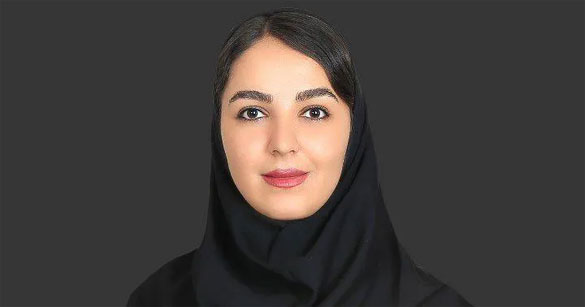
Mina Bahmani remains in Sepidar Prison in Ahvaz without access to basic prisoner rights after nearly a year in detention
-----------
Mina Bahmani remains in Sepidar Prison in Ahvaz without access to basic prisoner rights after nearly a year in detention.
Bahmani, from southern Izeh, was arrested on July 14, 2024. She faces charges of involvement in the alleged killing of a police officer, but no formal legal proceedings have begun in her case.
She is a relative of Hadi Bahmani, a 17-year-old killed by security forces during the 2021 Khuzestan protests.
Her family had remained silent about her situation until recently.
Security agencies have blocked volunteer lawyers from representing Bahmani, effectively denying her legal counsel.
The Dadban media outlet reports that concerns are growing about her detention conditions, health status, and the lack of transparency in her case.
Source: iranwire.com
https://iranwire.com/en/women/141251-woman-detained-in-iran-prison-without-legal-process-for-nearly-a-year/
----------
FatemehSepehri: Imprisoned Dissident’s Health Crisis Reaches Critical Stage
MAY 16, 2025
ROGHAYEH REZAEI
FatemehSepehri, a 61-year-old political prisoner with a heart condition, was rushed to Shariati Hospital in northeastern Mashhad on May 11 with dangerously low blood pressure.
Despite her critical condition, authorities returned her to Vakilabad Prison after just one night. Three days later, on May 14, she was again hospitalized with severe chest pain and heart palpitations.
For months, Sepehri and two other female political prisoners have been confined in a small cell in Mashhad’s notorious prison. Deprived of fresh air, adequate medical care, and even the most basic human rights, they call themselves “the forgotten ones.”
This is not the first health crisis for Sepehri, who underwent open-heart surgery in October 2023.
Yet prison authorities have repeatedly denied her medical leave, forcing her to return to the harsh confines of Ward 5 in Vakilabad Prison even when doctors advised continued hospitalization.
“Unfortunately, despite all our efforts to get her leave so she could pursue her treatment, they have not agreed,” her brother, Asghar Sepehri told IranWire.
Sepehri was imprisoned for signing the “Statement of 14,” a letter released in August 2019 by 14 activists calling on Supreme Leader Ali Khamenei to resign. They criticized the Islamic Republic for failing to meet the needs of the Iranian people.
Sepehri has paid a heavy price for her political dissent. Since 2019, she has faced repeated imprisonment, with her latest arrest on September 21, 2022, just days after nationwide protests broke out over the death of Mahsa Amini in the custody of the morality police.
The Islamic Republic’s judicial system has opened multiple cases against her. In one case, she and her brother Mohammad Hossein Sepehri were each sentenced to three years and nine months for publishing a letter from inside prison.
In another case, she faces charges of “cooperation with hostile states,” “assembly and collusion,” “insulting the leadership,” and “propaganda against the Islamic Republic.”
With the consolidation of sentences under Article 134 of the Islamic Penal Code, Sepehri must serve 10 years.
Sepehri shares Ward 5 with two other female political prisoners: FarzanehGharehhasanlo and Zahra Kohnehkar. All three women are subjected to extraordinary restrictions that go beyond the Islamic Republic’s standard prison conditions.
“In Ward 5, conditions are very dire and inhumane. Lack of light and ventilation torments these women,” said a source familiar with the prison conditions who spoke to IranWire. “It’s actually a killing ground, and there is concern that the Islamic Republic intends to take the lives of these prisoners.”
For the past seven months, prison authorities have kept the ward’s door permanently locked, preventing the women from accessing outdoor exercise areas or even from making purchases from the prison shop.
“Before that, when the ward door was open, they could go out for shopping and outdoor exercise,” Asghar Sepehri explained. “So it seems there is no security issue, and it’s clear they want to put pressure [on them].”
The conditions are so extreme that FarzanehGharehhasanlo compared them to “Nazi forced labor camps” in an audio recording leaked from the prison.
After the release of this recording, Gharehhasanlo was further punished with the loss of phone call privileges, visiting rights, and even the ability to purchase bottled water.
The women must submit written requests for even the most basic needs, a process designed to humiliate them, according to Asghar Sepehri. Each request must be accompanied by signatures and fingerprints.
In a message published on X by her brother Ali, FatemehSepehri described the process: “One of the most hateful things we are forced to do in prison is writing requests that must be accompanied by signatures and fingerprints, even for the most basic human rights. For every worthless demand, a humiliating petition must be written.”
As an act of defiance, Sepehri once included a reference to last month’s devastating explosion in an Iranian port in her request form.
She wrote, “I, FatemehSepehri, given that the import and storage of solid fuel for intercontinental missiles does not require any permission, kindly request that you allow a ten-minute phone call inside the prison.”
She wrote this just one day before being rushed to the hospital.
Sepehri’s cellmate, FarzanehGharehhasanlo, was arrested in September 2022 during a memorial gathering for Hadis Najafi, a young woman killed during the nationwide protests.
Gharehhasanlo was detained alongside her husband, Hamid Gharehhasanlo, a physician who was initially sentenced to death in connection with the death of a Basij militia member at the same memorial event.
After international outcry, Gharehhasanlo’s sentence was reduced to 15 years of exile imprisonment, while Farzaneh received 5 years of exile imprisonment.
The third prisoner, Zahra Kohnehkar, wrote under the pseudonym “Sepand Azar” on social media before her arrest on charges related to an alleged bombing on February 11, 2024, the anniversary of the Islamic Revolution.
In an interview with Voice of America’s Persian service, Kohnehkar described the psychological torture of their confinement.
She said, “They put us under so much psychological pressure that I want to bang my head against the wall. I can say Mashhad’s cemetery has more living people than Mashhad’s prison.”
It was Kohnehkar who first referred to herself and her cellmates as “the forgotten ones,” explaining, “They have closed the door on us. Many times, because of poor health, we’ve called out, and no one has responded.
“The prison water is in terrible condition and cannot be used. Many times we needed water, and they didn’t open the door for hours.”
The treatment of Sepehri follows a documented pattern of medical negligence toward political prisoners in Iran, particularly those associated with opposition to the Supreme Leader.
In October 2023, less than a few weeks after her open-heart surgery, Sepehri was transferred to Qaem Hospital in Mashhad with severe headaches and chest pain.
It happened after she had been rearrested and returned to Vakilabad Prison just one day after being discharged from the hospital following her heart operation.
According to her lawyer, KhosrowAlikurdi, Sepehri was punished for a video she made from the hospital in which she spoke about the end of the Islamic Republic in connection with the Hamas terror attacks against Israel that began in October 2023.
Alikurdi told IranWire that the video had acted like “petrol on fire,” and despite her inability to tolerate imprisonment due to her medical condition, she was sent back to prison.
Since her return to Vakilabad, Sepehri’s health has continued to deteriorate. Her recent hospitalization with dangerously low blood pressure and subsequent emergency readmission with chest pains shows a serious decline.
Despite the harsh conditions and deteriorating health, Sepehri has continued to resist in whatever ways she can.
For months, she has refused to use her right to phone calls in protest against the closed ward door, forcing family members to visit the prison in person if they wish to communicate with her.
Her brothers have become her voice to the outside world, sharing her messages on social media and speaking to the press about her condition.
The source who described Ward 5 as a “killing ground” expressed desperation about the situation.
They said, “How long does Vakilabad Prison want to continue this deplorable situation? For 7 months, they have closed the door on them, and they don’t see light. They are not allowed outdoor exercise. How long can one endure these inhumane conditions?”
The source added, “The Islamic Republic intends to take their lives, and no move is seen to reduce the pressure on them… Before something happens to them and, God forbid, someone loses their life in that ward, something must be done.”
Iranian authorities call all three women “pro-monarchy political prisoners,” a label that is especially negative in the Islamic Republic.
While all political prisoners face harsh treatment, women often face additional forms of discrimination and abuse.
Asghar Sepehri, who lives in America, relies on family members in Iran for updates about his sister’s condition.
He said, “What I heard from the family was that her condition worsened on Sunday, to the extent that the prison clinic said she needed to be transferred to the hospital.”
He added, “But she was only at Shariati Hospital for one night… she had heart palpitations, and the situation is concerning. After that one night, they took her back to prison, and so far they have not agreed to her leave.”
Source: iranwire.com
https://iranwire.com/en/features/141253-fatemeh-sepehri-imprisoned-dissidents-health-crisis-reaches-critical-stage/
--------
'I Will Die Like a Woman, Free': Mother Defies the Islamic Republic After DaughterMaryam’s Death
MAY 16, 2025
AIDA GHAJAR
It was night in Tehran.
Maryam, 22, said goodnight to her mother and went to her room. After eight years of surveillance and threats, living under state control had come to feel normal.
That night, as she fell asleep, her heart, heavy from years of watching her mother’s persecution, quietly stopped.
The daughter of activist EnsiehAbdolhosseini became another casualty in the Islamic Republic’s war on dissent. She was not executed or imprisoned but broken by the slow, relentless pressure that wore down her body and spirit.
One year and seven months after burying her daughter, Abdolhosseini has once again been summoned to the Shahid Moghaddas Security Prosecutor’s Office in Tehran.
The authorities now seek to imprison her for writing poems critical of the Islamic Republic. Her options: prison or being labeled “mentally ill.”
She refuses to back down. “I won’t ask for a pardon,” she says. “The Islamic Republic should ask forgiveness from me and all mothers.”
It began on a cold December day. The protests that erupted across Iran in 2017 posed a serious challenge to the Islamic Republic. Citizens took to the streets in response to economic hardship, corruption, and political repression.
Among them was EnsiehAbdolhosseini, an educated woman and CEO of a private company. Like thousands of others, she was exercising what should have been her basic right to peaceful protest.
The Islamic Republic's response was swift and brutal. Security forces identified her during the demonstrations and soon after, raided her home. It was sixteen-year-old Maryam who opened the door to armed agents.
The scene that followed haunted the teenager for the rest of her short life: her mother, still in her nightgown, being forcibly taken from their home.
But the agents took more than Ensieh that day. They seized her personal belongings and writings, including a notebook filled with her poetry and prose. That notebook would later become the prosecution’s primary evidence against her.
Within its pages, she had written about the massacre of political prisoners in the 1980s under orders from Ruhollah Khomeini. She questioned how the Supreme Leader had concealed both the truth and the graves of the executed.
For that, she was charged with “insulting the Supreme Leader.” In another entry, she referred to agents of the Islamic Republic as “religious shopkeepers,” leading to an additional charge of “propaganda against the Islamic Republic.”
When Ensieh appeared before Judge Mohammad Moghiseh for trial, who was gunned down earlier this year, the absurdity of Iran’s justice system was laid bare.
“You called me a religious shopkeeper,” he said before sentencing her to three years in prison on the two charges.
For Ensieh, who “had never even set foot in the detention centers of the morality police,” the transition to life within the notorious walls of Evin Prison was a jarring shock.
Meanwhile, her teenage daughter Maryam began a grim routine familiar to many families of political prisoners in Iran: standing in visitation lines, coordinating bail efforts, and negotiating with authorities who had taken her mother.
After a month, Ensieh was released on bail. For a brief moment, mother and daughter believed they might escape the state’s shadow.
They attempted to leave Iran together, but police intercepted them at the airport. Without prior notification of a verdict, Ensieh was rearrested in 2018 and sent back to Evin Prison to serve her sentence.
Maryam was sent home alone.
The following eight months were marked by resistance and retaliation. Ensieh went on a hunger strike to protest her condition. In response, authorities transferred her to Qarchak Prison, placing her among women charged with murder and drug trafficking.
After ten days of this punitive transfer, guards returned her to Evin with a mocking question: “Did you have a good time?”
The cruelty didn’t end there. In 2018, under orders from Ali Chaharmahali, then-head of Evin Prison, Ensieh was transferred to the psychiatric ward of Tehran’s Loghman Hospital and chained to a bed.
According to her, she “was not even allowed to go to the yard for fresh air” and remained in the psychiatric ward for ten days, guarded by two male officers stationed outside her door.
For years, many political prisoners, both men and women, have been subjected to similar treatment: transferred to psychiatric facilities, chained to beds, and given unspecified medications and injections.
It is a systematic attempt to break prisoners psychologically and discredit their sanity - a form of torture disguised as medical care.
Eventually, Ensieh was released on bail. However, freedom from prison did not mean freedom from surveillance. A case officer known by the alias “Salehi” maintained what Ensieh described as “a heavy security shadow” over her family.
Salehi repeatedly told family members she was kept under surveillance so that the case might be closed if she refrained from further activism. This indefinite limbo - neither fully free nor imprisoned - created an ongoing atmosphere of fear and uncertainty.
“An open case is worse than long-term imprisonment or execution,” Ensieh explains. “With execution, you die once. With an open case, you are executed every day.”
For eight years, that shadow followed Ensieh and Maryam. They were banned from leaving the country. Their movements and communications were likely monitored.
Ensieh described herself as “a prisoner in this homeland. Even outside prison, after eight months, I remained a prisoner.”
The surveillance and harassment extended to their entire family. Maryam could neither flee Iran nor withstand the daily psychological toll. Their lives, according to Ensieh, were “under control and security surveillance," resembling anything but a normal life.
And the heaviest price was paid by Maryam.
At sixteen, she opened the door to armed agents who dragged her mother away. She was thrust into Iran’s complex legal system, trying to free her mother. For eight years, she lived under watch and threat.
Maryam, described as “a girl with a height of 174 centimeters and eyes as bright as life,” gradually "lost the luster of youth from her eyes."
After her death, her classmates told Ensieh that they witnessed Maryam's struggles. Maryam had shared her suffering with them, saying the Islamic Republic was hurting her mother and that they were not free.
Despite this burden, Maryam completed her studies in accounting. She often asked her mother when the case would be closed, hoping they could “leave this place of suffering, seek their destiny in a new country, and free themselves from interrogator Salehi’s constant presence in their lives.”
That day never came.
One night, after saying goodnight to her mother and going to bed, “her heart could no longer bear it, and her life’s pulse stopped.” Maryam was 24.
Ensieh and Maryam had, in many ways, "grown up together." Ensieh was only 21 when she gave birth to her. Later, her family shared a chilling memory: after Ensieh’s first arrest, when security agents violently took her away, Maryam’s eyes “saw only white light for two days.”
Maryam’s death turned Ensieh’s grief into steely defiance. “At Maryam’s grave, I told everyone I would bury my child in eternal soil myself,” she recounts. “The pain of laying her face into the earth will stay with me forever. Maryam was my red line.”
Instead of breaking her, the loss hardened her resolve. “I told myself, ‘Ensieh, get up. What did you learn in Evin?’ I no longer have anything to lose. I will not allow anyone who comes along to bully me."
After burying her daughter, Ensieh returned to work and then went directly to the Intelligence Office, where she publicly accused Salehi of responsibility for Maryam’s death.
Now, eight years after her initial arrest and following the loss of her child, Ensieh has been summoned to serve her sentence.
The five-day deadline for the summons expired on May 15. Authorities suggested she could avoid prison by visiting the Medical Examiner’s Office and obtaining a "certificate of mental illness," which could then be used to apply for a pardon.
Ensieh’s response is unequivocal: “The Islamic Republic wants to label us mentally ill, to assassinate our character. If I were a criminal, why didn’t you come after me eight years ago? I ask no forgiveness from this system.”
“When my child was alive, and I was her joy, I compromised a little for her sake so she wouldn't be harmed. But now that she’s gone, and they come after me again with complete impudence, I will not compromise.”
To accept such terms, she says, would be “to trample on the blood of those killed in the fight for Iran’s freedom.”
Her decision is made: “I will not walk into the Evin Prosecutor’s Office. You’ll have to come take me.”
Ensieh sees her story as part of a larger pattern: mothers who have lost children to state violence in Iran, from the mass executions of the 1980s to the present day.
“It’s as if all the energy of those young people has become courage in the mothers.”
These mothers often become fearless advocates - perhaps, as Ensieh says, because “Is there anything worse than the death of a child? I will not let the Islamic Republic enjoy my wailing.”
“They say, ‘Hit the son, and the father bends.’ But I show that I did not bend with Maryam,” Ensieh declares, refusing to follow the state’s script of fear and submission in the face of overwhelming force and tragedy.
“I paid the price. My child paid the price,” she says. “The Islamic Republic reopened my case after my daughter, who endured depression and suffered all these years, died of a cardiac arrest in her sleep.”
Throughout her ordeal, Ensieh has drawn a sharp line between religious belief and the political use of religion by the Islamic Republic.
“I bow to no one except my own God,” she says. “He is the God of Maryam, Ensieh, and all political prisoners.”
As she faces reimprisonment, Ensieh chooses to speak out. “She has decided not to remain silent, to place the cost of her lost life, Maryam’s death, and her imprisonment on the shoulders of the Islamic Republic, and to retell the story of her suffering.”
“I also told Salehi: Even if I die, I will die like a woman, free.”
In a system built to strip people of their humanity and agency, EnsiehAbdolhosseini insists on retaining both. She rejects the false choice between imprisonment and being declared "mentally ill." She refuses to ask forgiveness from those who destroyed her family.
Instead, she demands accountability.
“It is not I who should request a pardon,” she says. “The Islamic Republic should ask for forgiveness - from me and from all of us.”
Source: iranwire.com
https://iranwire.com/en/special-features/141236-i-will-die-like-a-woman-free-mother-defies-the-islamic-republic-after-daughters-death/
----------
Woman Shot Dead After Rejecting Marriage Proposal in Western Iran
MAY 16, 2025
A 40-year-old woman was fatally shot in western Kermanshah after rejecting a marriage proposal.
Samira Nourbakhsh was killed by the man whose marriage proposal she had rejected.
Nourbakhsh, mother of a 21-year-old daughter and a 17-year-old son, had recently decided to remarry after years of raising her children alone.
Sources close to the victim said the 32-year-old man first seemed kind and respectful. But over time, Nourbakhsh noticed worrying signs, like sudden anger and verbal abuse.
She eventually learned that he had a history of failed marriages and was undergoing psychiatric treatment.
After she rejected his proposal, the man threatened to kill her. On the evening of May 3, he confronted Nourbakhsh as she returned from her sister’s home and shot her before fleeing the scene.
Several incidents of violence against women have been reported across Iran since March.
Official bodies in Iran do not release accurate statistics on femicides, although such incidents are reported in the Iranian newspapers.
According to Etemad newspaper, 78 women were murdered by relatives or family members between March and September last year.
In 2023, Shargh newspaper reported that at least 165 women were killed by male family members between 2021 and 2023. Of those, 27 were murdered in the first three months of 2023 alone, with “honor killings” cited as a primary motive.
These figures reflect only reported cases. The actual number of femicides is likely much higher.
Source: iranwire.com
https://iranwire.com/en/women/141246-woman-shot-dead-after-rejecting-marriage-proposal-in-western-iran/
---------
Tehran Authorities Close Children’s Music Show Over 'Religious Concerns'
MAY 16, 2025
Officials of the Islamic Republic shut down a children’s music show in Tehran for “disregarding religious principles.”
Security personnel from the hosting venue carried out the closure.
It took place at the Institute for the Institute for the Intellectual Development of Children and Young Adults, though the institute’s director claimed they only provided the space while another organization managed the content.
Human rights groups reported 536 business closures in Iran last year for various violations, including operating during Ramadan and hijab violations.
Source: iranwire.com
https://iranwire.com/en/news/141243-tehran-authorities-close-childrens-music-show-over-religious-concerns/
---------
MUSLIM WOMEN’S COALITION NETWORKING BRUNCH FEATURES GARDENING EXPERT LINDA WOLK
May 16, 2025
Muslim Women’s Coalition’s Garden Club coordinator Linda Wolk of Milwaukee has deep roots. Her background in gardening began in infancy as the daughter of owners of a florist shop. From a Polish Catholic family, her ties with MWC go back decades to one of the Islamic Society of Milwaukee’s early interfaith dinners. Wolk’s study of languages, faiths and business has been practically lifelong.
Wolk now shares her energy, talents and diverse interests with others through her volunteer work for MWC. She teaches popular classes to adults and youth on how to tend a garden and participates in various MWC initiatives, earning the organization’s 2023 Volunteer of the Year Award.
The educator and gardener will share spring gardening tips at MWC’s May Networking Brunch in her talk: Soil Savvy: Preparing your garden for a successful planting season. The brunch will take place from 10 a.m. – 12 p.m., Friday, May 30, at the Islamic Resource Center, 5235 S. 27th St., Greenfield.
Brunch from Taqwa’s Bakery and Restaurant will be served. The fee is $15. Register here and pay at the door (cash or credit only).
Wisconsin Muslim Journal recently interviewed the avid learner, gardener and teacher about how she cultivates her own growth as well as her gardeners. Here are the highlights:
How did you get interested in gardening?
My parents owned a flower shop and a couple of greenhouses for 65 years. I was nearly born there.
My father started a flower shop when he was 19 years old, around 1950. He was only open for two years when he got sent to Korea. His parents took care of things while he was gone.
My mother lived across the alley from them. So, the ladies in the neighborhood would say, “Oh, we know Donnie. He’s such a nice young man. You should write to him. She did and the rest is history. When he got back from the Korean War, he went right back to running the flower shop.
Did you work in the flower shop?
I helped. I am their only child. Like I tell the ladies in the garden club, my parents dragged me to every park, every garden. My entire life has been spent in parks, gardens, arboretums, nature preserves, forests—because they loved it, that’s what our family did.
Sometimes as a teenager, I’d think, “God, why am I here?” But now that I’m older, I appreciate all the things I learned from them.
My father had a collection of 300 to 400 biology and horticultural books, not the how-to grow plants type but the scientific kind. That’s another reason I know a lot about plants. I don’t think I read all 400, but I did read a lot of them.
Did the flower shop close?
In 2015, my mother had a stroke. My dad and I were helping her find healthcare and rehab. My dad was already 70. Dad and I knew it would be very difficult for us to run the flower shop so we made the difficult decision to close it. That was 2016. Sixty-six years. It was a long run.
How did your childhood experiences in the flower shop impact your life?
I always kept those interests and they led me to others. When I took trips through my undergrad program or later when my husband and I took trips, I always checked out the gardens.
What really interested me was the flower shops. Where I was in the world, I’d walk into them and start talking with the owners about how they did things. It was a cool connection, having the flower business in common. We’d talk about how we made brides’ bouquets, handling customers, funeral flowers.
Early on, I realized how international the flower business is. All our flowers at the shop came from a bunch of different countries.
I decided to do a bachelor of arts in business administration at Alverno and focus on international business. I figured that is where the world is going and whatever you do these days is international.
While there, I did several short-term study abroad programs—to China, Paraguay, Argentina, Brazil. I did a Chinese language immersion in China for a semester, as well as classes at Alverno.
I went to the Great Mosque of Xi’an. We got to spend the whole day there and I’m not even Muslim! It was such a big honor.
What is your connection to Milwaukee’s Muslim Community?
Our flower shop was located on Milwaukee’s South Side, not far from the Islamic Society of Milwaukee’s center and mosque. When I was a little girl, we took a trip with our grade school and visited there.
As an adult, I was involved a lot at my Catholic church. After 9/11, there was animosity in the U.S. from many towards Muslims. The ISM had an interfaith dinner and invited the interfaith community. Our pastor friend, my husband and I went. It was the first time for any of us to interact personally with Muslims.
When a Muslim-Catholic Women’s Coalition formed, I joined and wow! One month we’d focus on a Christian or Catholic topic and the next month a Muslim topic, back and forth. I’ve known Janan (Najeeb, founder of MWC) and InshirahFarhoud (an early MWC board member) for 25 years.
When that group folded, the Muslim women created their own Milwaukee Muslim Women’s Coalition. Since I had gotten to know them, I joined them. I got my library card from the IRC (Islamic Resource Center), joined the MWC Book Club and supported as many things as I possibly could over the years.
Tell us about your work with MWC’s garden clubs.
In 2022, when MWC was looking for someone to start the Youth Garden Club, I volunteered. We started a garden club for adults this year. I like to make them fun. In both, they learn about planting, about how to plant and what can happen and how to fix problems.
I also include biology, a little botany, ecology, conservation, environmentalism. I want to give them an appreciation that comes from knowing things like trees give us oxygen and we couldn’t live without them.
What will you share at the networking brunch?
Since it is the end of May and gardening season has started, we will focus on how to get started with the right soil. When you go to gardening centers these days there may be 20 different kinds of soil.
I often say, “All soil is not created equal.” How do you choose the right soil for what you want to do? How do you know what soil you have and what amendments it needs? How can you make it better without adding a whole lot of chemicals?
Source: wisconsinmuslimjournal.org
https://wisconsinmuslimjournal.org/muslim-womens-coalition-networking-brunch-features-gardening-expert-linda-wolk/
----------
Macron opposes hijab use in sport
16 May 2025
The French president said he was not in favour of allowing the Islamic veil during competition when asked about the hot-button topic this week on national television while lawmakers, social leaders and the affected governing bodies ponder its pros and cons.
In his appearance for a broader discussion on France's political affairs, Emmanuel Macron addressed the controversial issue, which has gained traction as a national debate subject following the passing of a specific legislative initiative intended to ban the display of religious symbols in both amateur and professional competitions in February. "I am in favour of the Olympic Charter, which prohibits the wearing of any religious symbols during competitions", the president stated in an interview on broadcaster TF1 Info, while advocating for "equality between men and women".
The place of religious symbols in French sport has become a recurring theme, with the latest resurgence propelled by this year’s legislative push from Senator Michel Savin, whose draft proposal passed the Senate vote with 210 ballots in favour and 81 against. At present, regulations vary considerably across disciplines and French sports federations operate with a significant degree of autonomy, leading to a fragmented landscape of inconsistent rules: Football, the country's most popular sport, enforces a ban on the hijab as do basketball, volleyball and rugby while others, including athletics and handball, allow it. The fate of the bill will determine whether this patchwork of policies endures or is replaced by a single binding national standard for all.
When asked Tuesday about the wearing of religious symbols such as the Islamic veil, Macron clearly expressed his opposition for in-competition scenarios, although he did clarify that he did not mind them for getting to and from venues or for sporting activities outside competitions, leaving the regulation up to the specific sporting federations to decide in such a case. "In (sports) facilities, for training and initiation, pragmatism is needed and our law does not prevent it (the wearing of religious symbols)," the president explained.
The nation's strict secularist model already bars public servants, teachers, students, and athletes representing France abroad from displaying visible religious symbols—whether Christian crosses, Jewish kippahs, Sikh turbans, or Islamic headscarves. The proposed law now seeks to extend this suspension to all domestic sports competitions.
While Macron mentioned the Olympic charter that states that "no kind of political, religious or racial demonstration or propaganda is permitted in any Olympic venue, site or other location" when defending his stance, he failed to detail quite an important caveat, as the International Olympic Committee also considers the veil to be "a cultural object rather than a religious one", therefore authorising its wearing at the Olympic Games. "As far as the practice of sport is concerned, I think that it is up to the federations to decide. I will make a distinction between sporting activities in infrastructures and competitions," the president simply stated.
Besides addressing his TF1 interviewer's questions, Macron was also indirectly challenged on the subject by weightlifter Sylvie Eberana, national amateur champion in her category in 2024. A Muslim who wears a headscarf, she said she feared she would no longer be able to compete. Her story has been widely covered by both international and national media, with her 4 March interview for StreetPress particularly resonating across social platforms.
The most ardent supporters of the bill claim it will counter an "Islamist invasion" in a country scarred by jihadist attacks. Yet a 2022 Interior Ministry report found "no structural or even significant radicalisation trend" in French sports.
While the debate heats up, compatriot Teddy Riner, who won gold in Judo at the Paris 2024 Summer Games, considered the topic a "waste of time" and said that it was better to "think [about] equality" rather than "picking on one and the same religion", Agence France-Presse reported, while highlighting that Interior Minister Bruno Retailleau expressed his "radical disagreement" with the five-time Olympic champion and stressed that the government needed "to ban the veil from sporting events in order to preserve sport as a sanctuary." After clearing the Senate’s filter, the draft law is due to go before the National Assembly soon.
In the leadup to the vote, hardline backers of the ban like Retailleau have described the hijab as "a symbol of submission." On the other side and well beyond France's borders, United Nations experts and Amnesty International labelled such regulations as "disproportionate and discriminatory." It is difficult to estimate how many athletes would be excluded if the new law is passed, although the impact is already beginning to be felt, according to some testimonies from Muslim civic leaders.
Source: insidethegames.biz
https://www.insidethegames.biz/articles/1153411/macron-opposes-hijab-use-in-sport
----------
URL: https://newageislam.com/islam-women-feminism/al-ayyala-dance-hair-flipping-women-uae/d/135560