
“We Don’t Have A Choice”, Says, Mother Of A 14-Year-Old Pakistan Girl Named Zunaira On Her Marriage To A Man Twice Her Age
New Age Islam News Bureau
21 September 2025
• “We Don’t Have A Choice”, Says, Mother Of A 14-Year-Old Pakistan Girl Named Zunaira On Her Marriage To A Man Twice Her Age
• Ithra Spotlights Arab Women Artists With Landmark Exhibition
• Six Baha’i Women In Iran Facing Imminent Imprisonment
• Sephora Announced As New Team Sponsor For Al-Nassr Women’s Football Squad
Compiled by New Age Islam News Bureau
URL: https://newageislam.com/islam-women-feminism/mother-pakistan-girl-marriage-man-twice/d/136918
-----
“We Don’t Have A Choice”, Says, Mother Of A 14-Year-Old Pakistan Girl Named Zunaira On Her Marriage To A Man Twice Her Age
MahparaZulqadar
21 September 2025
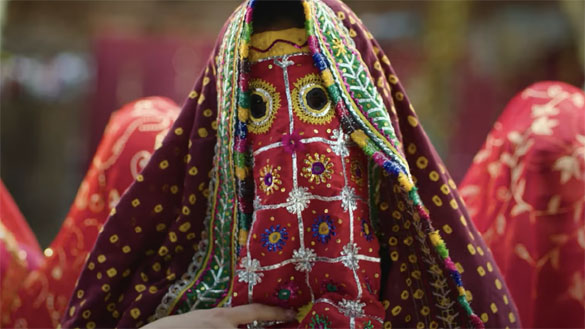
Screenshot via YouTube video of UNICEF Pakistan. Fair use.
-----------
In the dusty village of Behal, District Layyah in South Punjab, Pakistan, a 14-year-old girl named Zunaira shared her story in an interview conducted in June 2025. She dreamed of becoming a science teacher, but that dream was cut short when her family arranged for her to marry a man twice her age. Her mother wept quietly but told her gently, “We don’t have a choice.”
Zunaira’s story is far from unique; it is a recurring heartbreak. Across Pakistan, laws promise protection. In practice, however, weak enforcement, social pressure, and the lack of reliable age documentation mean these laws remain stronger on paper than in rural courtyards.
In May 2025, the Parliament of Pakistan passed the Child Marriage Restraint Bill, setting the legal marriage age at 18 for all genders. The law introduced penalties of fines and imprisonment for those who arrange or solemnize underage marriages and empowered local authorities to halt such unions before they take place.
However, the political parties’ role in this regard has remained divided. Following the Islamabad Child Marriage Restraint Law’s approval, the Pakistan Peoples Party (PPP) celebrated the milestone. In contrast, Jamiat Ulema-e-Islam–Fazl (JUI-F) vehemently opposed the law. Maulana Fazlur Rehman declared the legislation “contrary to, and trampling, the Quran and Sunnah,” announcing nationwide protest rallies to “create awareness” of what he perceived as threats to Islamic identity.
The first legal attempt to curb child marriage in the Indian subcontinent was the Child Marriage Restraint Act of 1929, which set the minimum age at 14 for girls and 18 for boys. After independence, Pakistan retained this law with minor amendments. In 1961, the Muslim Family Laws Ordinance reinforced restrictions, but enforcement remained weak. Later, after the passage of the 18th Amendment in 2010 and subsequent devolution of powers, the provinces introduced their own laws. Sindh raised the minimum age for girls to 18 in 2013, while Punjab, Khyber Pakhtunkhwa, and Balochistan still largely follow the minimum age for girls at 16.
UNICEF reports that 29 percent of Pakistani girls are married before the age of 18, and 4 percent before 15. Save the Children has also documented a troubling correlation with climate disasters, as Pakistan witnessed an 18 percent surge in child marriages after the devastating 2022 floods.
The toll is measured in futures lost, health shattered, and rights denied. Girls who marry before 18 are 60 percent more likely to drop out of school, says UNESCO. In many rural districts, barely 13 percent of girls remain enrolled by grade 10. Once married, the school uniform is replaced by household duties, textbooks by cooking pots, and playgrounds by the confines of a courtyard.
The risks don’t end there. World Health Organization (WHO) data shows girls under 18 are 2–5 times more likely to die from pregnancy-related causes than women in their 20s. In South Punjab’s underserved districts, early pregnancy is among the top killers of young mothers.
Many of these girls enter marriage without even the most basic reproductive health knowledge. According to a study by Real Medicine Foundation in 2017, 79 percent of Pakistani adolescent women lack menstrual health education, leaving them vulnerable to stigma, infections, and lifelong health complications.
According to the 2024 SDG Gender Index, Pakistan ranks 137 out of 139 countries, with one of the lowest scores for gender equality. Behind closed doors, marriage at a young age often leads to violence. UNFPA mentioned that one in three child brides in South Asia faces domestic or sexual abuse. Isolated from friends, stripped of legal recourse, and dependent on their husbands’ families, these girls live in silence.
Pakistan is among the top countries most affected by climate change. Recurring floods and other disasters — both natural and man-made — are accelerating the problem of early marriage. After the severe floods of 2022, economic desperation pushed families in parts of Sindh to marry off their daughters at younger ages. Media and NGO reports describe how child marriages, sometimes arranged in exchange for money or reduced dowries, became a survival strategy for households that had lost their homes, crops, and livelihoods. This led to a surge in unions involving girls between 14 and 17 years old.
Even when laws exist, enforcement often falters, particularly in the absence of proof of age. According to UNICEF, only 42 percent of Pakistani children under five have an official birth certificate. Without documentation, a 14-year-old can be declared “18” with a simple verbal assurance, rendering legal protections meaningless. Even when documents exist, the tradition of conducting marriages without civil registration, often referred to as sharinikah in Pakistan, has allowed child marriages to be validated outside the state’s oversight.
In April 2025, during an interview in Bhakkar district of Punjab, Pakistan, a father named Qamar Ahmed reflected on marrying off his eldest daughter at 17:
“She wasn’t ready… She suffered. I won’t repeat it. My younger daughter will finish school. No marriage talks until she’s ready emotionally and financially.”
In May 2025, during a school visit in Layyah district, a government schoolteacher recounted how one of her brightest students suddenly stopped attending class. The girl’s family was preparing her for marriage. Instead of confrontation, the teacher visited the home, brought along a female health worker, and convinced the parents to delay the wedding until the girl finished the year. That small delay gave her a window of hope.
In a Friday sermon delivered in a mosque near Layyah city, Imam Ali Noor confronted harmful traditions: “Islam doesn’t support forced or early marriage. Nikah without consent is invalid. Education is a right of every individual.”
These moments are fragile, like small lamps flickering in the wind. But they prove that change doesn’t always come through sweeping reforms; it can start in classrooms, in sermons, in kitchen conversations.
Still, for every marriage delayed, dozens go ahead in silence. The truth is, Pakistan’s laws are changing faster than its communities. Without consistent enforcement, universal birth registration, honest conversations about reproductive health, and targeted economic support for vulnerable families, the gap between policy and practice will only grow.
A critical step in preventing child marriage is the establishment of a universal, digital birth registration system. In May 2025, the National Database and Registration Authority (NADRA) launched a digital birth and death registration system at hospitals nationwide to modernize and streamline record-keeping. A move that, if extended to marriage registration, could block underage unions.
Oversight of nikah registrars has also gained judicial backing. In 2024, the Lahore High Court ruled that “registrars who breach guidelines to curb child marriage will face legal action.” At the community level, non-profit PODA’s registrar training program urged clerics to “refuse nikah solemnization for anyone under 18 without official documents.” This is one of the important steps to curb the menace of child marriages.
Economic incentives can help keep girls in school and delay marriage. The Ehsaas Secondary Education Conditional Cash Transfer program, for instance, provides higher stipends for girls’ continued schooling, a model that could be expanded to Grade 12 to directly link financial support with education. This model offers a financial pathway to reduce dropout rates which indirectly result in child marriages.
Education also has a preventive role. Advocacy groups working on curriculum reform argue that “adolescents cannot be protected from harmful practices unless they are equipped with age-appropriate health and rights education.” Integrating reproductive health awareness in schools is increasingly seen as a long-term safeguard against child marriage.
The civil society in Pakistan has been at the forefront of campaigning to end child marriage, often filling the gaps left by weak legal enforcement.
Child marriage is not a “tradition” to be preserved, it is a systemic failure. A failure of protection, of education, and of accountability. Girls should not need to be rescued; they should grow up with the rights, the resources, and the freedom to decide their own futures. Until that day, Zunaira’s story will keep repeating itself in the villages of South Punjab, and each repetition will be a reminder that there is more work to be done.
Source: Globalvoices.Org
-----
Ithra spotlights Arab women artists with landmark exhibition
21/09/2025
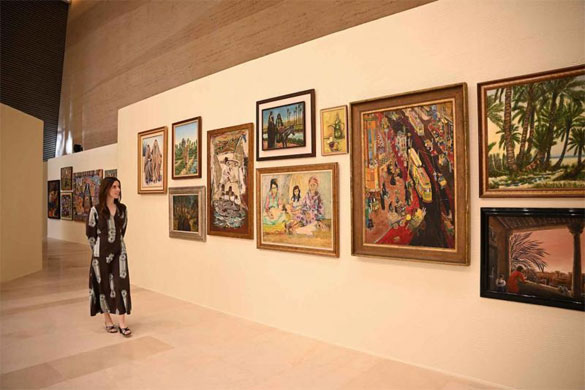
Artworks on display as part of the “Horizon in Their Hands” exhibition at the Ithra Museum in Dhahran, Saudi Arabia.
------------
Fifty pioneering women artists from across the Arab world are being celebrated in a major new exhibition at the Ithra Museum in Dhahran, Saudi Arabia, highlighting their overlooked role in shaping modern Arab art between the 1960s and 1980s.
The show, “Horizon in Their Hands: Women Artists from the Arab World (1960s–1980s),” opened on Thursday and runs until February 14, 2026. It is staged in partnership with Sharjah’s Barjeel Art Foundation and curated by Rémi Homs.
Bringing together works in painting, sculpture, ceramics, tapestry, glass and mixed media, the exhibition seeks to redraw the history of Arab modernism by placing women at its centre.
Among the highlights are a 1953 oil on canvas, “Ezba,” by Egyptian revolutionary artist InjiEfflatoun, Moroccan painter ChaibiaTalal’s exuberant “Août” (1969) and Palestinian ceramicist Vera Tamari’s “Palestinian Women at Work” (1979). Saudi pioneers also feature prominently, including the late SafeyaBinzagr, the first woman to stage a solo exhibition in the kingdom and MounirahMosly, known for her work with palm fibre and copper.
“Featuring the work of 50 seminal figures, this exhibition revisits the contributions of women who challenged the very definition of art,” Homs said.
“The works examine how they engaged with the boundaries between art and craft, turning this intersection into fertile ground for critical reflection. What defines fine art? Where does the line fall between utilitarian and often gendered forms of craft and individual artistic expression? And how can materiality itself become a vehicle for cultural and political commentary?” he added.
The show spans multiple generations, from early modernists such as Egyptian painter Zeinab Abd el-Hamid and Tunisian artist Safia Farhat to later voices including Bahraini painter Mariam al-Fakhro and Kuwaiti artist Suad al-Essa.
Farah Abushullaih, head of the Ithra Museum, said the exhibition was part of the institution’s mission to amplify under-represented narratives in Arab art. “Through this collaboration, we are not only preserving legacies but also inspiring dialogue between past, present and future,” she said.
For Ithra, a flagship Saudi cultural centre backed by Aramco, the exhibition reinforces its position as a hub for cultural dialogue and creativity in the Gulf. For Barjeel, founded by Emirati collector Sultan Sooud Al Qassemi, it is the latest in a series of international collaborations designed to bring modern and contemporary Arab art to global audiences.
While many of the artists worked in times of political upheaval, their pieces also highlight resilience, innovation and a willingness to experiment with both material and meaning. Whether through vibrant canvases, feminist-inflected craft, or explorations of memory and identity, the works on show tell the story of a region undergoing profound cultural transformation.
“Horizon in Their Hands” offers visitors a rare opportunity to see these narratives unfold side by side, in an exhibition that looks set to become a reference point in the rewriting of modern Arab art history.
Source: Thearabweekly.com
https://thearabweekly.com/ithra-spotlights-arab-women-artists-landmark-exhibition
-----
Six Baha’i women in Iran facing imminent imprisonment
September 20, 2025
Six Baha’i women in Hamadan, western Iran, who have been sentenced to a combined total of 39 years in prison, are facing imminent imprisonment. They were charged and sentenced for their belief in the Baha’i Faith.
The six women are ZarrindokhtAhadzadeh, FaridehAyyoubi, Noura Ayyoubi, NedaMohebbi, JalehRezaie, and Atefeh Zahedi. Two of the women, Atefeh and Neda, have children from as young as five years old.
The arrests follow a joint statement by 18 United Nations experts who raised the alarm at the “systematic targeting of Baha’i women,” flagging the “increase” in these human rights violations and denouncing the “arrests, summoning for interrogation, enforced disappearance, raids on homes, confiscation of personal belongings, limitations on freedom of movement and prolonged consecutive deprivations of liberty.” The experts said Baha’i women in Iran face disproportionate targeting and intersectional discrimination—both as members of the largest non-Muslim religious minority in Iran and as women.
The new sentences come just as the latest report of the UN Secretary General, Antonio Gueterres, the highest-ranking official within the UN, who condemned the Iranian government’s discrimination of Baha’is including discrimination against Baha’i women.
The outrageous and excessive prison sentences—handed down on ludicrous charges such as “membership in the Baha’i community”, reflects an intensifying campaign of persecution.
“Women in Iran hold the key to helping the country become a flourishing nation,” said SiminFahandej, Representative of the Baha’i International Community to the United Nations in Geneva. “But instead of nurturing and empowering its women, the Iranian government puts them in jail and persecutes them, in this case not only as women, but also as Baha’is.”
“Baha’i women in Iran face multiple forms of discrimination. These six women in Hamadan, with children and families, are going to spend years in jail only for their beliefs. The Iranian Government should be held accountable for this gross prejudice and cruelty,” Ms. Fahandej added.
The six Baha’i women were first arrested in November 2023, held in solitary confinement for 31 days, which runs counter to international law, and forced to endure prolonged interrogations without access to lawyers or their families. Guilty verdicts and sentences were handed down in April 2024—after which the women appealed the verdicts.
Lawyers for the women filed appeals—but these were rejected during August hearings of Branch 11 of the Hamadan Court of Appeals. The court rejected every objection to the verdicts and original sentences. And in its final ruling, the court dismissed defence arguments presented by the women and their lawyers, going so far as to order the destruction of Bahá’í religious literature owned by the women.
And these sentences follow news published last month of a shocking series of “confiscations by text message” in Isfahan, central Iran, in which a body controlled by Supreme Leader Ali Khamenei invoked and misused an Iranian constitutional provision to seize the total assets of more than 20 Baha’i families.
Baha’is in Iran are subjected to arbitrary arrests and detentions, physical and psychological abuse, enforced disappearance, forced business closures, property confiscation and destruction, including cemeteries, house raids, and hate speech by officials, clergy and state media.
A 2024 publication by the Baha’i International Community, The Baha’i Question: Persecution and Resilience in Iran, documents the 46-year history of these human rights violations.
Earlier this year, the UN Fact-Finding Mission also reported about the disproportionate targeting(link is external) of Bahá’í women since the 2022 uprising, while in 2024 former Iran Special Rapporteur Javaid Rehman concluded that the persecution has been carried out with “genocidal intent.”
Human Rights Watch has determined the persecution amounts to the “crime against humanity of persecution” and the Boroumand Foundation documented “multifaceted violence” against Baha’is in Iran ranging from imprisonment and dispossession to social exclusion.
Source: Iranpresswatch.Org
https://iranpresswatch.org/post/25581/six-bahai-women-in-iran-facing-imminent-imprisonment/
-----
Sephora announced as new team sponsor for Al-Nassr women’s football squad
Arab News
September 20, 2025
DUBAI: Global retailer Sephora was announced as the official sponsor for Al-Nassr women’s football team via Instagram on Friday.
Al-Nassr are the reigning champions of the first Saudi Women’s Super Cup, defeating Al-Ahli 2-0 on Sept. 8.
Source: Www.arabnews.com
https://www.arabnews.com/node/2616057/sport
-----
URL: https://newageislam.com/islam-women-feminism/mother-pakistan-girl-marriage-man-twice/d/136918