
Iranian Women Are Almost Everywhere With Their Brown, Black, Blonde And Grey Locks At Tehran’s Vali-e Asr Street
New Age Islam News Bureau
28 November 2025
· Iranian Women Are Almost Everywhere With Their Brown, Black, Blonde And Grey Locks At Tehran’s Vali-e Asr Street
· Hijabs, Hymns & Headmistresses: The New Religious Telenovela Streaming Live in Ghana
· Iranian Official Says Government Working To Bring Back Female Artists
· UN Women: Violence Against Women In Afghanistan Is On The Rise
· Qatar: States Urged To Ensure Access To Justice For Women And Girls With Disabilities
· Iranian Appeals Court Upholds Prison Sentence for 63-Year-Old Baha'i Woman, Nahid Behruzi
Compiled by New Age Islam News Bureau
URL: https://newageislam.com/islam-women-feminism/iranian-women-tehran-vali-e-asr/d/137807
-------
Iranian Women Are Almost Everywhere With Their Brown, Black, Blonde And Grey Locks At Tehran’s Vali-e Asr Street
Nov 28, 2025
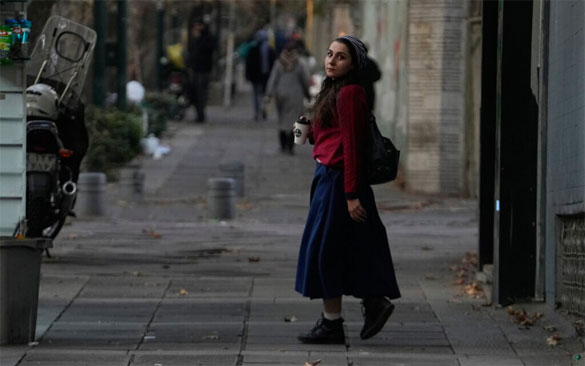
A woman holds her drink as she walks on a sidewalk in northern Tehran, Iran, November 20, 2025. (AP Photo/Vahid Salemi)
------------
TEHRAN, Iran (AP) — As you enter Iran’s capital, it starts with only occasional glimpses — a passenger in a car speeding by or a pedestrian trying to leapfrog through Tehran’s notorious traffic.
But as you reach the cooler heights of Tehran’s northern neighbourhoods along the city’s sycamore-lined Vali-e Asr Street, they are almost everywhere, women with their brown, black, blonde and grey locks.
More and more, Iranian women choose to forgo the country’s mandatory headscarf, or hijab.
It was something unthinkable just a few years ago in the Islamic Republic, whose conservative Shiite clerics and hardline politicians long pushed for strict enforcement of laws requiring women to cover their hair.
But the 2022 death of Mahsa Amini and the nationwide protests that followed enraged women of all ages and views in a way few other issues have since the country’s 1979 Islamic Revolution.
“When I moved to Iran in 1999, letting a single strand of hair show would immediately prompt someone to tell me to tuck it back under my headscarf out of fear of the morality police taking me away,” said Holly Dagres, a senior fellow at the Washington Institute for Near East Policy. “To see where Iran is today feels unimaginable: Women and girls openly defying mandatory hijab.”
“Authorities are overwhelmed by the sheer numbers across the country and worry that if they crack down — at a delicate time marked by power blackouts, water shortages, and a rotten economy — they could spur Iranians to return to the streets,” she said.
First trip to Iran in years
I received a three-day visa from the government to attend a summit addressed by Iranian Foreign Minister Abbas Araghchi as tensions remain high over Tehran’s nuclear program.
Access to reporting beyond the summit was limited, but the trip gave me my first look on the ground in Iran since my last visits in 2018 and 2019.
In those intervening years, I had watched from abroad in Dubai, United Arab Emirates, in my role overseeing the Associated Press’s coverage of Iran and the Gulf Arab states as Iran was roiled by protests over the economy and Amini’s death, the coronavirus pandemic and a 12-day war with Israel in June.
For the past 46 years, Iran’s rulers have imposed the hijab rule. At the strictest times, the police and the Basij, the all-volunteer force of the paramilitary Revolutionary Guard, kept a close eye on women in the streets to ensure compliance.
Whenever the atmosphere felt laxer, many women pushed their scarves further and further back on their heads — small challenges to the government as to how much hair you could get away with showing. But they rarely dared to remove it.
More women choosing to go without the hijab
Working remotely with my AP colleagues in Iran, I knew from their reporting, photographs and video footage from the streets on even unrelated assignments that women had begun to drop the hijab completely.
But I didn’t fully understand the scale of that refusal until I saw it myself.
Around Tajrish Square, at the foot of Tehran’s Alborz Mountains, one group of young girls who are required to wear the hijab to school immediately removed them after leaving in the afternoon. They darted between cars, idling through traffic, laughing and carrying art projects.
Women of all ages went uncovered at the Tajrish Bazaar and walking past the blue-tile domes of the Imamzadeh Saleh shrine.
Two police officers on the street talked among themselves as the women passed by unremarked.
At the luxury Espinas Palace Hotel, multiple women with their hair uncovered walked past the signs reading, “Please observe the Islamic hijab,” with the black-and-white outline of a woman in hijab.
A foreign diplomat’s wife attended a dinner for the summit without one. An Iranian woman in attendance briefly put one over her head while in discussion with a hotel staff member, then let it fall fully to her shoulders a moment later.
Those sights were in northern Tehran, an affluent area that is generally more liberal.
But even in a more conservative southern district, an uncovered woman walked quickly down the street among others in the all-encompassing black chador.
“All of my life I had to wear hijab, at school, at university, everywhere in public,” one Iranian woman who recently emigrated to Canada told me after I returned to Dubai, speaking on condition of anonymity for fear of reprisal. “I always tried to follow the rules but it made me feel a lack of confidence… because I wore the hijab and I didn’t believe in that.”
Signs of the war with Israel in June could be seen too. I saw one apartment building, its top-floor apartment still in ruins from an Israeli strike.
Dissatisfaction simmers under the surface
Hardliners within Iran’s theocracy repeatedly have called for increased enforcement of the hijab laws. Iran’s reformist President Masoud Pezeshkian has pushed to halt that, saying in September in an interview with NBC News that “human beings have a right to choose.”
Iran’s 86-year-old supreme leader, Ayatollah Ali Khamenei, has so far left the hijab issue alone after this year’s war, which also saw the United States bomb Iranian nuclear enrichment sites.
Also on hold is any change to Iran’s government-subsidized gasoline prices, among the cheapest in the world, despite increasing economic pressure on the country as its rial currency trades at over 1 million to USD$1.
The reason likely rests in the widespread dissatisfaction of Iran’s people with its theocracy at the moment. Previous government actions on both issues led to nationwide protests and security force crackdowns that killed hundreds and saw thousands detained.
In recent days, Pezeshkian’s social affairs adviser Mohammad-Javad Javadi-Yeganeh acknowledged data from an unpublished survey by the state-linked Iranian Students Polling Agency.
The polling reportedly suggested widespread discontent with the government, something not previously acknowledged by officials who have repeatedly contended that the country came together during the 12-day war. Fear of another war breaking out permeates conversations across Tehran.
“When we visit provinces, we see in surveys that people are discontent about the administration,” Pezeshkian recently said, without directly acknowledging the polling. “We are answerable since we cannot provide services to people.”
The polling tracks with widespread voter discontent and a low turnout during last year’s initial presidential vote.
“Years of economic hardship, inflation, currency volatility, unemployment and public frustration over environmental and social challenges have sharply eroded trust in institutions,” the Washington-based National Iranian American Council said in an analysis about the reported polling data.
Yet the worry of a renewed government crackdown persists for a population exhausted by the grind of international sanctions and the widespread fear that another war with Israel will come.
“Sometimes that fear is with me,” the Iranian woman living in Canada said. “Sometimes when I’m behind the wheel, I try to find my headscarf on my head. That fear is still with me.”
Source: timesofisrael.com
https://www.timesofisrael.com/with-irans-regime-wary-of-widespread-dissent-tehran-women-let-their-hair-down/
------
Hijabs, Hymns & Headmistresses: The New Religious Telenovela Streaming Live in Ghana
27 November 2025
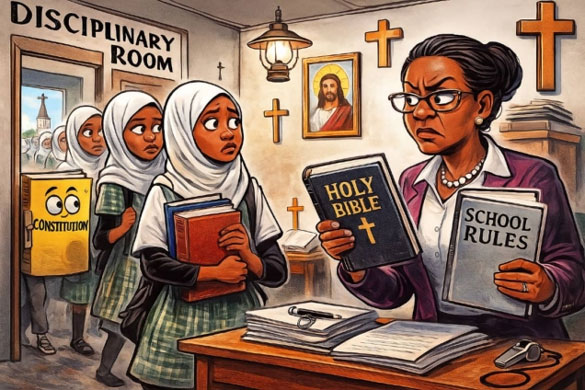
Ghana, that tranquil republic known for peace, tolerance, and occasional hypertension, has awakened to a curious spectacle: our senior high schools have quietly transformed themselves into religious battlegrounds. While the rest of the world debates artificial intelligence, climate change, and the cost of sending humans to Mars, Ghana is debating the cost of allowing a Muslim girl to wear her hijab while conjugating French verbs. In some of our schools, even blinking in the direction of your own religion now requires exeat.
Take Wesley Girls High School, for instance—a school so famous that even its dining hall has pedigree. Once upon a serene morning, the school reportedly reminded its Muslim students that the path to “excellent character formation” included compulsory attendance at Christian services. Not just optional fellowship ooo—compulsory, as if Jesus Himself had sent a memo to the headmistress instructing her to ensure all daughters of Abraham report for devotion by 4:30am sharp, hymnbook in hand. Fasting? That too raised suspicion. A girl skipping breakfast for Ramadan was interrogated like she was trying to smuggle contraband faith across the dining hall.
In the midst of this, the Constitution arrived at the school gate—late, confused, and without exeat. Article 21, that gentle old prefect of religious freedom, attempted to enter the assembly hall, only to be told by the school authorities that unless it could prove it was in the original 1876 Methodist blueprint, it had no business interfering with discipline. Ghana’s Constitution is a day student after all; school doctrine is the permanent boarder.
Then arrived the Minister of Education, breathing edicts and warnings with the enthusiasm of a prophet descending from Mordechai Hill. His statements—issued with biblical urgency—sounded less like policy and more like the Ten Commandments receiving a budget revision. He seemed determined to prevent a full-scale religious uprising, though his pronouncements carried the unmistakable tone of a man tired of refereeing spiritual tug-of-war matches between parents, pastors, imams, and alumni groups who behave like UN observers in school uniform.
And just when the dust seemed ready to settle, the Supreme Court entered the classroom like a no-nonsense headmaster. They summoned the school’s Board of Governors to answer for these allegations. The Board, suddenly shy, shuffled forward like Form One students who had been caught climbing the school wall to buy waakye during prep time. Meanwhile, the Constitution—still standing in the corridor—peeped inside and whispered, “Ei, so you people really don’t rate me?”
Parents too have taken the matter personally. The National Council of PTAs, usually quiet except when they are announcing levies, has suddenly discovered its voice. They warned about “religious bias” in schools, speaking with the righteous indignation of parents who haven’t attended a meeting in five years but now feel spiritually obligated to defend the republic’s moral fabric. They want unity, harmony, peace—everything except contributing their ward’s unpaid PTA dues.
Mission schools, to be fair, are proud institutions with noble pasts, built on foundations of love, tolerance, and evangelism. But somewhere along the line, “love thy neighbor” has been replaced with “love thy neighbor, but only if she joins morning devotion.” One wonders: if Jesus Himself appeared at Wesley Girls today wearing His traditional Middle Eastern robe, would He be allowed to wear His traditional robes?
Through all this, the students have become accidental hostages in a holy Cold War. Muslim girls navigate their faith the way undercover agents exchange secret codes. Christian girls observe the tension with the ambience of referees at a match nobody wants to officiate. Teachers, exhausted from supervising morning worship, afternoon prep, and evening prayer, sigh heavily and mutter, “This one dier, only God can mark it.”
The tragedy hiding behind all this comedy is that Ghana’s religious harmony—the thing we boast about during Independence Day speeches and international conferences—is being kneaded into confusion at the dining tables of our senior high schools. On the surface, we play the tolerant nation; underneath, some of our schools are quietly running denominational immigration checkpoints.
Yet the solution is not complicated. Let mission schools preserve their values, their hymns, their mottos, and their heritage—but they cannot turn themselves into compulsory conversion centers. Faith is a personal journey. Education is a public right. When the two collide, common sense—not crusade—should lead.
And so, may Ghana find its way back to the peaceful coexistence we proudly sing about. May every student worship without fear. May the Constitution finally find a seat in the assembly hall without being asked, “Who invited you?”
And above all, may common sense, that endangered species in our public life, descend upon us with the speed and urgency of a headmistress closing the school gate at 8am.
About the Author:
Jimmy Aglah is the creator of the Republic of Uncommon Sense, a writer known for his sharp, humorous commentary on Ghanaian life, governance, and the everyday madness we all pretend to understand. He is also the author of Once Upon a Time in Ghana and The Price of Gold: The Fight for Sikakrom’s Soul.
Source: myjoyonline.com
https://www.myjoyonline.com/hijabs-hymns-headmistresses-the-new-religious-telenovela-streaming-live-from-shs/
------
Iranian Official Says Government Working to Bring Back Female Artists
NOVEMBER 27, 2025
Iran’s vice president for women and family affairs said Wednesday that the government is working to reintegrate female artists into cultural and artistic fields.
Zahra Behrouz-Azar said the government is trying to strengthen women’s participation in decision-making and improve their status across sectors through policy-making and support initiatives.
Addressing the status of blacklisted female actors inside Iran, as well as the possibility of artists returning from abroad, Behrouz-Azar said, “From the beginning, we have been working with the Ministry of Guidance to resolve this issue.
“The Ministry of Guidance is handling this matter professionally. The return to work for both women and men is happening not only in acting but also in music and other fields.”
On Iranians abroad, she added, “Our view is that Iran is the homeland of all these dear ones, and the country needs the capacities of all Iranians outside the country. There may have been communication disruptions in the past, but this path is now open.”
According to Behrouz-Azar, the Foreign Ministry has formed a working group on the president's orders and is developing a system to facilitate the return process.
“This will be announced soon, and people will be able to come back with confidence, whether to visit family or for pilgrimage,” she said.
Her statements come as many citizens have faced security pressures or judicial actions after returning to Iran.
Source: iranwire.com
https://iranwire.com/en/news/146592-iranian-official-says-government-working-to-bring-back-female-artists/
-----
UN Women: Violence Against Women in Afghanistan Is on the Rise
Nov 28, 2025
The UN Women has announced that the level of violence against women in Afghanistan is rapidly increasing and that millions of women and girls urgently need support and protection.
In a report released on Thursday, November 27, 2025, the organization said that in less than two years, the number of women and girls facing serious risk has increased by 40 percent.
UN Women added that the reduction in financial assistance has forced the organization to scale back its vital services to combat gender-based violence in Afghanistan.
The United Nations has also stated that approximately 14 million women currently require support services.
According to the report, women-led local organizations in Afghanistan have lost about one-fifth of their funding.
UN Women said that with the collapse of previous support systems following the Taliban takeover, millions of women now have nowhere to turn, and access to vital services has been severely restricted.
Source: 8am.media
https://8am.media/eng/un-women-violence-against-women-in-afghanistan-is-on-the-rise/
------
Qatar: States urged to ensure access to justice for women and girls with disabilities
27 Nov 2025
The session, titled “Redefining Justice Now-Ending Disability-Based Exclusion”, focused on significant and ongoing barriers women and girls with disabilities face in accessing justice across the world, with drawing on examples from Kenya, Nepal, Malaysia and Finland. Participants called for legal reforms to ensure that women and girls disabilities, and in particular women and girls with intellectual and/or psychosocial disabilities, can exercise and enjoy their human rights guaranteed in the Convention on the Rights of Persons with Disabilities (CRPD) and, in particular, the rights to: access to justice (Article 12), legal capacity (Article 13) and liberty and security of person (Article 14).
Concluding the session, ICJ Legal Adviser Karuna Parajuli noted,
“The 2025 Qatar Summit has provided a timely platform to advance justice and reaffirm our collective responsibility to ensure that no one is left behind. It has provided a platform to advocate for justice systems to be more inclusive and effective, for example, through training of justice actors, the provision for procedural accommodations and the elimination of all forms of institutionalization in line with international human rights standards, including CRPD”.
Describing the barriers faced by women with disabilities in accessing justice in Malaysia, Ms. Beatrice Leong, an autistic self-advocate explained:
“I was only diagnosed as autistic in adulthood… The diagnostic frameworks we inherited are male, Western, and medicalized, failing to recognize women and girls who mask, adapt, and are punished for being misunderstood”.
Dr. Heba Hagrass, UN Special Rapporteur on the Rights of Persons with Disabilities, emphasized that, from the perspective of her mandate:
“Women and girls with disabilities continue to face barriers to justice due to gender and ableism-based stereotypes, and a lack of accessible infrastructure and sign-language interpreters”.
She therefore called for States to ensure inclusive legal frameworks and support systems for women and girls with disabilities because this is crucial in the protection of their human rights:
“Access to justice is not a single right, it is the gateway to all other rights. Without it, equality remains theoretical”.
Delivering a keynote speech, Her Excellency Sanni Grahn-Laasonen, Minister of Social Security of Finland, reaffirmed Finland’s commitment to tackle the various forms of discrimination faced by women and girls with disabilities and to advance their rights.
The panel discussion also included presentations by Ms. Esther Caroline Mkamori (United Disabled Persons of Kenya), Advocate Sabin Shrestha (Forum for Women, Law and Development) and Muhammad Ali Hasnain (United for Global Mental Health).
The following recommendations stemming from the discussions include that States take measures to:
Source: icj.org
https://www.icj.org/qatar-states-urged-to-ensure-access-to-justice-for-women-and-girls-with-disabilities/
------
Iranian Appeals Court Upholds Prison Sentence for 63-Year-Old Baha'i Woman, Nahid Behruzi
NOVEMBER 27, 2025
An appeals court in Alborz province has upheld a three-year prison sentence for Nahid Behruzi, a 63-year-old Baha'i citizen, after reducing the original sentence issued by a lower court.
Branch 4 of the Revolutionary Court in Karaj had previously sentenced Behruzi to five years in prison and 10 years of deprivation of social rights, along with the confiscation of electronic devices, religious books, and other personal belongings.
She was charged under Article 500 of the Islamic Penal Code with “deviant educational or propaganda activity contrary to Islamic law.”
The appeals court upheld the other punishments without modification.
Behruzi was arrested on July 29, 2024, in an underpass at the Karaj metro station by security forces who did not present a judicial warrant.
Relatives say the arrest involved physical violence that caused bruising and a nosebleed.
She was released from Kachouei Prison after 65 days in detention on bail.
Behruzi’s conviction is part of a growing pattern of security and judicial actions targeting Baha'i followers in Iran.
In recent months, dozens of Baha'i citizens have been arrested or sentenced to prison across the country.
Source: iranwire.com
https://iranwire.com/en/bahais-of-iran/146591-iranian-appeals-court-upholds-prison-sentence-for-63-year-old-bahai-woman/
-------
URL: https://newageislam.com/islam-women-feminism/iranian-women-tehran-vali-e-asr/d/137807