
AIMPLB Tells Supreme Court Women Can Enter Mosques But Cannot Demand Equal Access
New Age Islam News Bureau
25 April 2026
· AIMPLB Tells Supreme Court Women Can Enter Mosques But Cannot Demand Equal Access
· CAIR-NY Calls for Hate Crime Probe into Assault on Muslim Woman Near LIU Brooklyn
· Taliban Restrictions Haunt Afghan Women Outside Afghanistan
· Pakistani state attempting to "desensitise" society through routine abductions of Baloch women, rights group alleges
· Youth must play role as agents of change, says Dr Wan Azizah
· Kiwi track women overcome adversity to claim Malaysia World Cup win
· IDS calls for more capable women leaders
Compiled by New Age Islam News Bureau
-------
AIMPLB Tells Supreme Court Women Can Enter Mosques But Cannot Demand Equal Access
April 25, 2026
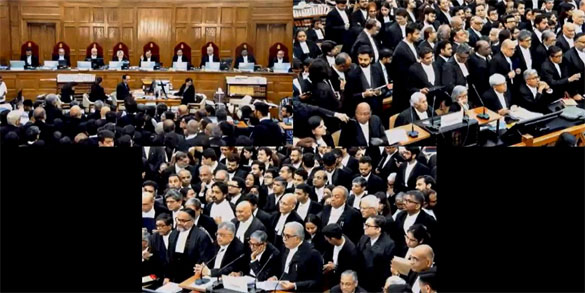
Representational image: A nine-judge constitution bench hears a case related to the Sabarimala temple, Supreme Court, April 9, 2026. (@SupremeCourtofIndia-1950/YT via PTI Photo)
--------
New Delhi: The All India Muslim Personal Law Board (AIMPLB) told the Supreme Court on Friday (April 24) that while Muslim women are not barred from entering mosques, they cannot insist on access through the main entrance or demand removal of any barrier that separates worshippers by gender within a mosque.
These arguments were put forward by the AIMPLB counsel, Senior Advocate M.R. Shamshad, before a nine-judge Constitution Bench headed by Chief Justice of India Surya Kant. The AIMPLB is a private body formed to articulate positions on Muslim personal law.
A report in the Indian Express said that in response to CJI Kant’s question, “For factual clarity, are women allowed to enter the mosque?” Shamshad responded, “There is no quarrel among the religious denominations in Muslims that women can enter mosques. And that too for prayer, but there is certain discipline that has to be followed.”
He said women’s right to enter mosques for prayer is subject to “established religious discipline and practices”.
Shamshad opposed a ruling directing mosques to allow the entry of women from any of its entrances. He also opposed any order revoking the norm of a physical barrier separating worshippers by gender. He said that while men are obligated to offer congregational prayers in mosques, women are not under such a requirement – it was up to them if they wished to participate in those gatherings.
Women may pray at home while receiving equivalent spiritual merit, he said.
Justice Ahsanuddin Amanullah observed that the gender distinction between obligations for congregational prayers in mosques existed but was historically linked to social roles, including childcare responsibilities that fell on women. He noted that such practices have been governed by tradition since the time of the Prophet.
“You should elaborate for everybody’s consumption that right from the beginning, there is also no dispute (that women can enter), that it started from the holy Prophet himself,” Justice Amanullah said. Justice Nagarathna also asked, as per a report in LiveLaw: “So, it is not mandated for them [women] to attend a congregation?”
Agreeing, the counsel said, “Yes, my lords. The Prophet himself said, don’t stop women coming to the mosque. There is clarity on this. And many of those who have recorded the hadith in many volumes have recorded this narration that the Prophet instructed that don’t stop women coming to the mosque.”
Justice Amanullah asked Shamshad to explain why it is not mandatory for women to attend mosques for prayers. “Give the reason also. The reason was if everybody goes from the house, who will look after the children. If she has the time, the capacity, she can also go, but then the crux comes”, where she will stand, he said.
On the question of unrestricted access to mosques, Shamshad pointed out that the petitioners were equating the musallah (place of prayer) with the structure of Hindu temples, where a sanctum sanctorum exists. He said this was an incorrect understanding.
“If the religion believes that there is no sanctum sanctorum inside the mosque, then nobody can insist that ‘I have to stand at a particular place’ or ‘I have to be first to lead the namaz’.”
Why this hearing
The court is currently hearing a batch of petitions that raise constitutional questions arising from the September 2018 Sabarimala judgment. A number of petition have been “clubbed”, including a PIL filed in March 2019 by a Pune-based couple, Yasmeen Zuber Ahmad and her husband Zuber Ahmad Nazir Ahmad Peerzade. This petition, related to Muslim women’s access to mosques, makes specific pleas that substantially rely on the Sabarimala ruling.
The background to this PIL, as per leg news site Supreme Court Observer, was the petitioners’ written request to the Mohmidiya Jama Masjid in Pune to allow women entry to offer prayers. After the request was denied at multiple levels, Yasmeen approached the Supreme Court seeking relief under the writ of Mandamus and citing Articles 14, 15, 21, 25 and 29 of the constitution. The writ is a court order directing a public authority to perform a duty it is legally required to perform.
Yasmeen’s petition argues that any fatwa (opinion based on the sayings of Prophet Mohammad) preventing Muslim women from entering mosques to pray must be set aside.
It further demands a legal ruling that women must be allowed to offer prayers inside mosques, enter through any of its doors and have access to the musallah. It seeks permission for women to pray without being separated by a barrier from male congregants. It also seeks a ruling that women can attend regular congregations in mosques as well as special prayers on Fridays, Eid and so on.
Why Sabarimala matters to this case
In 2018, the Supreme Court struck down as exclusionary the restriction on women of menstruating age from the Sabarimala temple’s sanctum sanctorum. It held that religious customs cannot override constitutional rights. Following this judgment, numerous petitioners approached the court, challenging religious customs while citing the constitutional bar on gender-based discrimination.
One such petition is the Pune couple’s PIL, admitted by the Supreme Court as an independent case in March 2019 but taken up later along with other matters. The court had at the time issued notices to the Union government, the Sunni Waqf Board and the AIMPLB. Legal proceedings had started in the case.
In November 2019 a five-judge Supreme Court bench hearing the Sabarimala review petitions had referred the matter to a larger bench and directed similar matters be heard together. A nine-judge bench was constituted to hear these matters, starting in February 2020. It is this bench, consisting of Justices B.V. Nagarathna, M.M. Sundresh, Ahsanuddin Amanullah, Aravind Kumar, Augustine George Masih, Prasanna B Varale, R Mahadevan and Joymalya Bagchi, led by the CJI, that heard the AIMPLB on Friday.
Barrier between worshippers?
While Shamshad’s argument has drawn attention, the original petitioners’ PIL had also emphasised that Islam does not oppose women entering mosques to pray. That is why this petition stands out – it has sought a specific ruling from a constitutional court for mosques to allow women in (not just the Pune-based Mohmidiya Jama Masjid) to pray – although the entry of women is not barred by Islamic law.
The PIL argues that despite no theological restriction, social norms deter women from participating in congregational prayers. “…socially, Indian women are not encouraged to regularly pray at mosques even if they do have separate enclosures,” the petition says.
It says that even in the mosques where women are allowed, there are separate entrances and enclosures for worship for men and women. “There should not be any gender discrimination and allow Muslim women to pray in all,” the petition says, while highlighting that the segregation desired during prayer was not in sync with social realities.
It also says that while women are allowed to enter mosques that have a separate space for them, “most mosques in India do not” have such spaces at all, and some mosque managements refuse to create them, effectively creating a gender-based exclusion.
Previous hearings related to the PIL
These very questions were also raised in 2020 in the Supreme Court during a hearing in the PIL. At the time, on the primary question of whether women are permitted to pray in a mosque, the AIMPLB had said there was no such religious restriction. Those arguments were in direct reference to the Pune case, which had not been clubbed with other matters.
“The present respondent has taken [the] stand, as per Islamic texts, that entry of woman into mosque for namaz is permitted. Any other fatwa to this effect may be ignored,” the AIMPLB had then said.
“However, on the sanctity of fatwa, it is submitted that it is an opinion based upon religious texts, doctrine and their interpretation and has no statutory force,” AIMPLB had said. It also said, “Upon having received the opinion, it is for the follower of Islam, who seeks [a] fatwa, either to accept the same or not.”
AIMPLB had also noted that courts could not restrain individuals from seeking a fatwa, “as the same shall directly hit the right and freedom of religious belief of an individual”.
These arguments were in the AIMPLB’s written responses to the Pune PIL petitioners in court. It had argued that the petition was inviting the court to “interpret religious beliefs and religious practices”, and not just raising matters of statutory laws that govern the management of Islamic religious sites.
This distinction, the body had argued, was relevant because the court could not interpret religious norms as it would infringe on the right to freedom of religion.
“Hence, the respondent is of its firm view that the averments/ pleadings in relation to Articles 14, 15, 21, 25 and 29 of the Constitution of India cannot be considered and looked into for the prayers as claimed in the present petition,” AIMPLB had said.
The Pune petitioners’ case
The PIL filed by the petitioners asserted that the Quran casts the same religious duty on males and females, and that “women are not subject to less religious duties or obligations”, just as the spiritual rewards were the same for them. It submitted that according to historical sources, Prophet Muhammad had encouraged women to actively participate in mosque congregations and prayers.
It argued that in recent times, women were not being allowed inside mosques in a few countries, especially in India and neighbouring countries. “Otherwise, in most of the other countries, women are allowed in mosques”, including the sacred mosques in Mecca, without segregation as the norm.
It submitted that mosques receiving state funds cannot make segregation and discrimination amongst entry of people inside mosque based on sex and gender, and cited the Directive Principles of State Policy. The petitioners said that Article 44 encourages the Indian state to “secure a uniform civil code for all citizens by eliminating discrepancies between various personal laws currently in force in the country”.
Wider ambit of hearings
LiveLaw reports that Shamshad argued that courts have misapplied the “Essential Religious Practice” (ERP) doctrine to Islam by judging practices based on whether they appear “mandatory” or not. He said Islam has a detailed internal system distinguishing between what is forbidden, obligatory and recommended – which courts often fail to take into account.
This is relevant to the current matter because the nine-judge bench is considering a wider set of questions including:
Can courts decide what is an “essential religious practice” (ERP)?
How should Articles 14 (equality) and 25 (freedom of religion) be balanced?
What is the scope of judicial review in religious matters?
While the arguments in the Pune case are based on equality, (and directive principles), they implicitly rely on the court’s power to assess and intervene in religious practices – a power that flows from the ERP doctrine. Shamshad pointed out that courts have relied on readings of the Quran and flawed translations of Hadith, leading to incorrect conclusions about what is “essential” to Islam. As a result, several Islamic practices have failed the ERP test.
To explain this, Shamshad said, “Here is a petition [Pune PIL] which says that for a Muslim women, mosque is essential. And I have a judgment, which says mosque is not [an] essential [religious practice] in Islam.” He was referring to the 1994 Ismail Farooqui judgement, in which the Supreme Court ruled that since namaz could be offered “even in the open”, mosques were “non-essential” to Islamic practice.
Friday was the eighth day of the hearings in the Sabarimala reference case. The matter will resume for hearings next week.
Source: thewire.in
https://thewire.in/law/aimplb-tells-supreme-court-women-can-enter-mosques-but-cannot-demand-equal-access
------
CAIR-NY Calls for Hate Crime Probe into Assault on Muslim Woman Near LIU Brooklyn
April 24, 2026
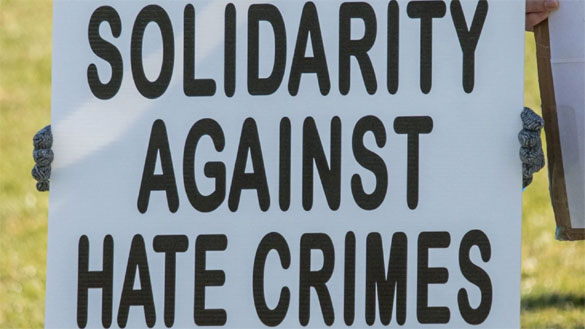
The New York chapter of the Council on American-Islamic Relations (CAIR-NY), a chapter of the nation’s largest Muslim civil rights and advocacy organization, today strongly condemned the assault of a Muslim woman wearing hijab near LIU Brooklyn and is calling on law enforcement authorities to launch a hate crime investigation and to swiftly identify and hold the perpetrator accountable.
The victim told CAIR-NY that at approximately 9:30 a.m., while she was walking near the Long Island University and DeKalb Avenue subway station, visibly identifiable as Muslim and wearing a hijab, she was approached by an unidentified man wearing a red hoodie and punched in the cheek. The assailant then reportedly attacked an Asian woman before walking away from the scene. The victim has reported the incident to the NYPD.
Given the rise in anti-Muslim bigotry nationwide, CAIR-NY is urging authorities to investigate whether bias may have been a motivating factor in this incident.
In a statement, CAIR-NY Executive Director Afaf Nasher said:
“This brazen assault in broad daylight is deeply alarming and unacceptable. No one should have to fear being attacked in public spaces. We urge law enforcement to launch a hate crime investigation and act swiftly to identify and apprehend the individual responsible and ensure full accountability. We also remind community members to remain vigilant.”
She noted that in March, CAIR released its latest report “The Right to Be Different” documenting a record high in anti-Muslim incidents.
CAIR-NY reiterated its call for a thorough investigation and emphasized the importance of ensuring the safety of all community members in public spaces.
CAIR-NY’s mission is to protect civil rights, enhance understanding of Islam, promote justice, and empower American Muslims.
La misión de CAIR-NY es proteger las libertades civiles, mejorar la comprensión del Islam, promover la justicia, y empoderar a los musulmanes en los Estados Unidos.
Subscribe to CAIR-NY’s Email List
You can help contribute to CAIR’s work of defending civil rights and empowering American Muslims across the country by making a one-time contribution or becoming a monthly donor. Supporters like you make CAIR’s advocacy work possible and defeating Islamophobia an achievable goal. Click here to donate to CAIR.
Source: cair.com
https://www.cair.com/press_releases/cair-ny-calls-for-hate-crime-probe-into-assault-on-muslim-woman-near-liu-brooklyn/
-------
Taliban Restrictions Haunt Afghan Women Outside Afghanistan
April 24, 2026
While corresponding with a local journalist in Afghanistan around a recent report I had authored, I received a shocking request: “Can we please have a video clip on your new report—not from you, but from a man from Human Rights Watch?”
I reread the message in anger. Although I was the report’s author as Human Rights Watch’s Afghanistan researcher, the outlet wanted a male colleague to speak in my place. Sadly, the reason behind the request is something many Afghan women around the world experience on a daily basis.
I eventually learned the media outlet had been instructed by the Taliban’s Ministry for the Propagation of Virtue and the Prevention of Vice (PVPV) that any Afghan woman, no matter where she lives, must appear in a full hijab with her face covered when speaking on air.
Rather than being treated as an expert on the country, I had been, like all women in Afghanistan, reduced to that identity alone and therefore could only speak in the media under conditions set by the Taliban. The implication was clear: being a woman from Afghanistan was enough to justify silencing me, even outside the country.
Nearly five years after the Taliban’s takeover of Afghanistan, little if any meaningful freedom of expression survives inside the country, particularly for women. Afghan women are barred from education beyond sixth grade and face severe restrictions in employment and erasure from public life. In some provinces, female journalists cannot work and women's voices are banned from radio and TV.
This incident is also an example of how far the Taliban’s reach extends. Their system of repression does not stop at Afghanistan’s borders as they attempt to control and silence Afghan women abroad through demands that media outlets enforce their abusive rules on those who speak out and challenge Taliban abuses.
As an Afghan woman and Human Rights Watch researcher, I will not comply with the Taliban’s restrictive rules. But its repressive instructions to media outlets have serious implications for Afghan women’s right to freedom of expression, both inside and outside the country. Afghan women should not have to submit to discriminatory rules to exercise a right to speak publicly. Wherever we are, our voices matter.
Source: hrw.org
https://www.hrw.org/news/2026/04/24/taliban-restrictions-haunt-afghan-women-outside-afghanistan
------
Pakistani state attempting to "desensitise" society through routine abductions of Baloch women, rights group alleges
April 25, 2026
Balochistan [Pakistan], April 25 (ANI): The Baloch Students Organization (BSO-Azad) has accused the Pakistani state of deliberately attempting to normalise the enforced disappearance of Baloch women, describing it as a calculated strategy to erode the social fabric of Baloch society, as reported by The Balochistan Post. According to The Balochistan Post, speaking on behalf of the group, central spokesperson Sholan Baloch stated that Baloch society is historically grounded in strong moral and ethical traditions, shaped by resistance to injustice, commitment to equality, and deep respect for women. According to him, these values have long defined the identity and dignity of the Baloch people. He alleged that since what he described as Pakistan's "occupation" of Balochistan in 1948, state authorities have pursued policies aimed at exploiting the region while simultaneously attempting to dismantle its cultural and social structures. These efforts, he claimed, have included suppressing local language, traditions, and identity to consolidate control. The spokesperson further stated that enforced disappearances, once sporadic, have now become routine.He warned that a new and troubling phase is emerging, in which the disappearance of women is being increasingly normalised. He cited reports of house raids, violations of private spaces, and instances where families are collectively punished. According to his claims, nearly two dozen Baloch women have allegedly been forcibly disappeared this year from areas including Quetta, Karachi, Khuzdar, Kech, and Awaran. Some of these women, he alleged, are being held in undisclosed detention centres under harsh conditions, while others face intimidation and media narratives aimed at discrediting the movement. Drawing parallels with past events, he accused the Pakistani state of previously engaging in similar actions during the Bangladesh conflict, alleging a pattern of human rights violations, as highlighted by The Balochistan Post. He argued that such practices are now being repeated in Balochistan, targeting women through harassment, threats, and disappearances. Calling these acts grave violations of human rights and ethical norms, Sholan Baloch asserted that such measures are intended to weaken and desensitise Baloch society. However, he maintained that these efforts would ultimately fail, emphasising that a people with a deep-rooted history of resistance cannot be subdued through force, as reported by The Balochistan Post. (ANI)
Source: aninews.in
https://www.aninews.in/news/world/asia/pakistani-state-attempting-to-desensitise-society-through-routine-abductions-of-baloch-women-rights-group-alleges20260425131953/
------
Youth must play role as agents of change, says Dr Wan Azizah
25 Apr 2026
Youth in Malaysia must act as agents of change to drive holistic and sustainable national development, says Bandar Tun Razak MP Datuk Seri Dr Wan Azizah Wan Ismail.
KUALA LUMPUR: Youth in the country must play a role as agents of change capable of bringing positive values to society, to ensure holistic and sustainable national development.
Bandar Tun Razak Member of Parliament Datuk Seri Dr Wan Azizah Wan Ismail said that to achieve this goal, young people must build a strong sense of identity and develop critical thinking skills to prepare themselves for future challenges.
“Youth must continuously strive to enhance their capabilities in various fields,” she said when speaking at the Federal Territories Youth 2026 get-together, attended by 160 youth leaders and activists from Kuala Lumpur, Putrajaya and Labuan today.
Dr Wan Azizah, who is also the wife of the Prime Minister, urged the group to make full use of existing development platforms to build strategic cooperation that directly benefits the community.
“Use these opportunities to build networks, exchange views and plan strategic collaborations that can benefit the community. Active participation in organisations and development programmes not only enhances leadership skills but also shapes a well-balanced and competitive personality,” she said.
At the event, Dr Wan Azizah also officiated the ‘Penggerak Belia Wilayah Persekutuan’ programme in conjunction with the Federal Territories-level Youth Day celebration.
Source: thesun.my
https://thesun.my/news/malaysia-news/youth-must-play-role-as-agents-of-change-says-dr-wan-azizah/
------
Kiwi track women overcome adversity to claim Malaysia World Cup win
April 25, 2026
An under-strength New Zealand’s women’s team pursuit combination overcame the odds to claim their second gold medal in two weeks at the UCI Track World Cup in Malaysia.
With key rider Ally Wollaston having returned to her professional road racing duties in Europe, the team were further challenged with emerging star Prudence Fowler coping with ill-health which forced a change of tactics.
Fowler moved to the unaccustomed role of starting, and having led for the first few laps, she pulled off, with the remaining three riders – Bryony Botha, Samantha Donnelly and Emily Shearman -negotiating the final 12 laps of the 4000m journey.
It did not prevent New Zealand topping qualifiers in 4:16.917 and winning their first-round clash against the Netherlands, recording the fastest time of 4:10.857 to move into the gold medal clash.
They had a tight battle against China in the final with the teams equal at 1000m, and the kiwis holding the slimmest of margins over the next 2000m before powering clear over the final kilometre to win by nearly two seconds.
The combination was fastest at 1:08 for the first kilometre before reeling off three further kilos in 1:01 in an impressive ride.
“We had to be quite adaptable with Pru (Fowler) not feeling super-good throughout the first part of the week,” said Botha.
“We changed our strategy with Pru doing the first three or four laps of the TP, and the rest of us taking it from there. It went well considering Pru is not our usual first-wheel starter, and we did not have Ally with us either. With only four riders, we had to make do with what we had in the situation.
“We were actually quite surprised. We went into it with no expectations on ourselves and just wanted to do a ride that we were proud of – and I think we can definitely be proud.”
The men’s team pursuit had mixed fortunes, with the gold medallists from Hong Kong last week again topping qualifiers in 3:51.722 ahead of China and Italy.
However, the kiwi quartet of Marshall Erwood, George Jackson, Daniel Morton, Tom Sexton were upset by France in the first round to be edged out of medal contention.
In a close battle, the kiwis were marginally ahead at the 3000m mark but could not match the French combination over the final 1000m and were only fifth fastest to miss out on a medal ride.
Earlier Keegan Hornblow was pipped for a medal in the exciting elimination race, edged out in the sprint for the podium with the big field whittled down to four riders.
Tomorrow Hornblow returns to compete in the four-race omnium with Botha and Fowler combining in the two-rider madison and Sam Dakin competing in the men’s sprint.
The third round of the UCI Track World Cup is being staged at the impressive Nilai Velodrome Nasional in Malaysia.
Source: cyclingnewzealand.nz
https://www.cyclingnewzealand.nz/blog/post/163736/kiwi-track-women-overcome-adversity-to-claim-malaysia-world-cup-win/
------
IDS calls for more capable women leaders
April 25, 2026
KOTA KINABALU: Chairwoman of the Sabah Institute of Development Studies (IDS), Datuk Seri Azizah Mohd Dun, has urged efforts to strengthen women’s leadership in Sabah, noting that their representation remains low.
Backed by IDS research data, she stressed the need to not only increase the number of women leaders but to ensure they are qualified, capable and credible.
Speaking at a women’s leadership empowerment workshop, Azizah said strong leaders must communicate clearly, be well-prepared and understand the issues they represent.
The GRS woman's chief She added that training programmes such as public speaking, group work and presentations help build these qualities.
She also highlighted experience, accountability and continuous learning as key traits, urging women leaders to keep up with rapidly evolving issues.
The workshop involved 35 participants from GRS women’s wings across Kota Kinabalu, Putatan, Penampang and Sepanggar.
Source: dailyexpress.com.my
https://www.dailyexpress.com.my/news/280263/ids-calls-for-more-capable-women-leaders/
-----