
Razia Sajjad Zaheer, A Woman Who Gave A Voice to The Marginalised Through Her Stories

By Afroz Khan, New Age Islam
7 January 2026
Razia Sajjad Zaheer (1918–1979), a pioneering progressive Urdu writer and translator, vividly portrayed the struggles of marginalised women in acclaimed stories like "Namak" and "Neech". Married to communist leader Sajjad Zaheer, she balanced family duties with literature, earning awards for feminist works and translations.
Key points:
· Progressive Urdu writer (1918–1979) known for social realism and feminist themes.
· Portrayed struggles of marginalised women in stories like "Namak", "Neech", and "Andhera".
· Married to communist leader Sajjad Zaheer; balanced family duties with writing.
· Notable works include collections "Zard Gulab" and translations of Brecht and Anand.
· Received awards like Soviet Land Nehru Award; under-recognised pioneering voice.
…
“Anything that draws us toward passivity, inaction, and ignorance, we dismiss as reactionary. Anything that awakens a critical spirit in us… that helps us work, organise ourselves, and bring about change, we consider progressive.”
Razia Sajjad Zaheer
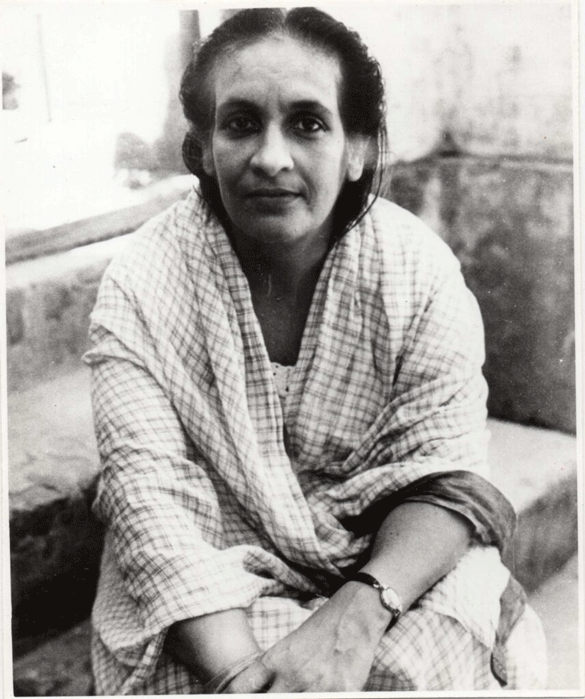
Razia Sajjad Zaheer was born on October 15, 1918, in Ajmer, Rajasthan. Her father was the principal of Ajmer's Islamia High School. Razia's family belonged to an enlightened and progressive family, which is why she received a higher education. After marriage, she received an M.A. degree in Urdu from Allahabad University.
Razia Sajjad Zaheer had a passion for writing since childhood. She began writing Urdu stories at the age of only nine. As a child, she submitted her stories to prestigious magazines like Phool, Tahzeeb-e-Niswan, and Ismat under the pen name Dilshad.
It is said that finding the right life partner can bring out their talent and brilliance, but finding the wrong one can ruin both their talent and life.
Razia Sajjad Zaheer proved fortunate in finding a life partner. She was married to the renowned Urdu writer and communist leader Sajjad Zaheer. However, shortly after their marriage, when Sajjad Zaheer was imprisoned for his revolutionary activities, Razia Sajjad Zaheer single-handedly shouldered the responsibilities of the family and fulfilled them admirably.
For some time, Razia Sajjad Zaheer stopped writing due to the responsibility of her family and children, but this pause was short-lived. Her husband, Sajjad Zaheer, encouraged her to write again, and in 1953, her first significant independent work, "Sar-e-Shaam," was published.
In 1954, her works "Kaante" (novel) and "Nehru Ka Bhatija" (children's literature) were published.
One of her most popular stories is "Namak," part of her short story collection "Zard Gulab."
The story "Namak" beautifully depicts the pain of the India-Pakistan partition, displacement, and the human emotions that persist across borders. Currently, this story is also part of the Hindi curriculum for Class 12 (Aaroha Part 2) in India.
The beauty of Razia Sajjad Zaheer's writing is that her main characters are ordinary and poor people. Razia Sajjad Zaheer has very seriously portrayed the struggles, mental conflicts, and social status of women in her works.
Among her major stories centred
On women, "Neech" is a story that exposes the dual discrimination of caste and gender. Its main character, Shamli, is a lower caste woman who challenges the hypocrisy and patriarchal thinking of society.
Another of her works, "Andhera," depicts the inner fear and insecurity of a woman travelling alone on a train at night. It is a poignant portrayal of a woman's psychological state in a patriarchal society.
Another of her stories focused on women and their struggles is "Meri Apahij Bua," about a woman who strives to live with self-respect despite physical disabilities and social neglect.
"Allah De Banda Le," also the title of a collection of stories, gives voice to the lives of ordinary Muslim women, their suppressed emotions, and the social pressures they face.
A large portion of Razia Sajjad Zaheer's works express the unspoken pain of middle-class and marginalised
Women, which they are unable to express openly in society.
Razia Sajjad Zaheer translated Bertolt Brecht's famous work 'Life of Galileo' into Urdu.
In 1962, she translated Mulk Raj Anand's work 'Saat saal'.
She also translated Siyaramsharan Gupta's novel 'Nari' into Urdu under the title 'Aurat', which was published by the Sahitya Akademi.
In 1966, she was awarded the Soviet Land Nehru Award for her translation work. In 1972, she was honoured with the Uttar Pradesh Urdu Academy Award.
She was awarded the All India Writers' Association Award for her effective portrayal of women's empowerment and women's issues in literature.
Her writing and contributions to literature have not received the recognition they deserve. She was a progressive and feminist writer. Appreciating her writing, Dr. Sharib Rudolvi said,
"Razia Sajjad Zaheer first lives her stories herself, and then puts them down on paper.”
Her works, particularly 'Namak' and 'Zard Gulab' are still considered excellent examples of social realism and human sensitivity.
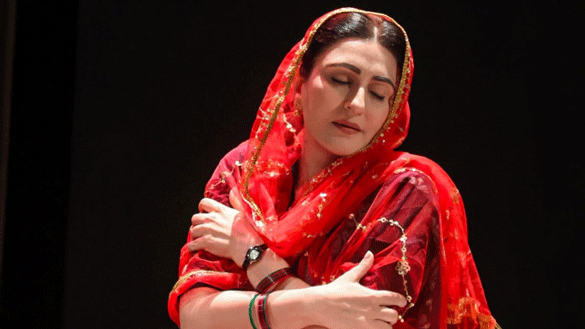
Her daughter, Nadira Babbar, has paid a heartfelt tribute to her mother by bringing her challenging life as a mother, wife, and writer to the stage through the play titled 1938: A Love Story.
Razia Sajjad Zaheer passed away in Delhi on 18 December 1979, due to a heart attack. She was buried in the VIP graveyard at Jamia Millia Islamia in Delhi.
…
Afroz Khan is a teacher by profession who writes on women, politics, communal harmony, and Islam. She holds a master’s degree in Education.
URL: https://newageislam.com/islam-women-feminism/razia-sajjad-zaheer-voice-of-manginalised/d/138337
New Age Islam, Islam Online, Islamic Website, African Muslim News, Arab World News, South Asia News, Indian Muslim News, World Muslim News, Women in Islam, Islamic Feminism, Arab Women, Women In Arab, Islamophobia in America, Muslim Women in West, Islam Women and Feminism