
Video Showing Iranian Police Sexually Assaulting a Female Protester Sparks Outrage
New Age Islam News Bureau
15 October 2022
• Omani Innovator Somaya Bint Saeed Al Siyabiya First
Arab Woman to Win First Place in the Stars of Science Programme
• Taliban Ban Women from Many Subjects, Like
Journalism, in University
• Malaysian Activist Fahmi Reza Zarin Discharged Over
‘Obscene Posting’ About Liquor Ban
• Tehran Billboard of Famous Women in Hijab Changed a
Day After Going Up
• Marriage Laws In MENA Region Put Women At Increased
Risk Of Child Marriage And Domestic Violence
Compiled by New
Age Islam News Bureau
URL: https://newageislam.com/islam-women-feminism/iranian-police-sexually-assaulting-female/d/128187
--------
Video Showing Iranian Police Sexually Assaulting a
Female Protester Sparks Outrage
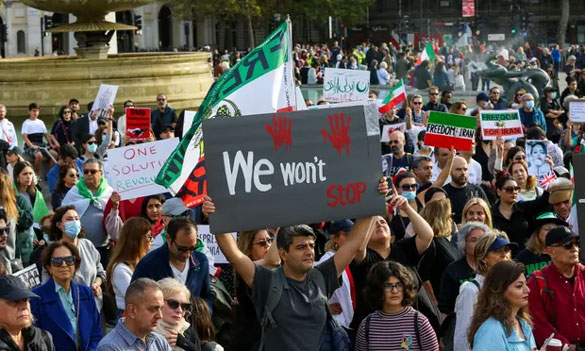
Protests in Iran over
Mahsa Amini's death in police custody. Photograph:( Twitter )
------
October 15, 2022
DUBAI: Video footage showing Iranian police officers
sexually assaulting a female protester as they attempt to arrest her has
sparked outrage on social media.
The video, which was verified as genuine by the BBC,
shows officers in protective gear and helmets surrounding a woman on a busy
road. One of them grabs her by the neck and leads her to a group of fellow
officers.
As she is being forced toward an officer on a
motorbike, another officer approaches her from behind and inappropriately
touches her. The woman then crouches and a female voice behind the camera can
be heard saying: “They are pulling her hair.”
The protester, whose head does not appear to be
covered by a hijab, then stands up and runs from the police. The same female
voice then says: “Look at him (the officer), he is laughing.”
According to the BBC, the incident took place on
Wednesday in Tehran’s Argentina Square. As the footage spread on social media,
users called for the resignation of the police chief responsible for the
officers.
According to Iran’s Islamic Republic News Agency,
Tehran’s Police Public Relations office said the incident is being
investigated. The police statement did not comment on the scenes shown in the
video but said that enemies are “using psychological warfare” to cause “public
anxiety and incite violence.”
In an interview with the Fars News Agency, which is
run by Iran’s Islamic Revolutionary Guard Corps, a police official denied the
girl had been assaulted. “Such encounters are inevitable in riot scenes,” he
said, according to London-based TV channel Iran International.
Last month, the US imposed sanctions on Iran’s
so-called morality police and senior security officials “who have engaged in
serious human rights abuses.” It followed the death in police custody on Sept.
16 of Mahsa Amini, a 22-year-old Iranian woman who had been arrested on Sept.
13 for not following strict rules on head coverings.
Her death sparked ongoing protests across the country
and there have been reports of brutal attacks by security forces on women
during crackdowns on protesters. Many people have taken to social media to
share their experiences and express their anger, fear and sorrow.
The video below, for example, obtained by Iran
International, shows police dragging a woman into a police van as she screams.
The UN has called on Iranian authorities “to fully
respect the rights to freedom of opinion, expression, peaceful assembly and
association, as a state party to the International Covenant on Civil and
Political Rights.” It condemned Amini’s death and said “Iran must repeal all
legislation and policies that discriminate on the grounds of sex and gender, in
line with international human rights standards.”
Source: Arab News
https://www.arabnews.com/node/2181366/media
--------
Omani Innovator Somaya Bint Saeed Al Siyabiya First
Arab Woman to Win First Place in the Stars of Science Programme
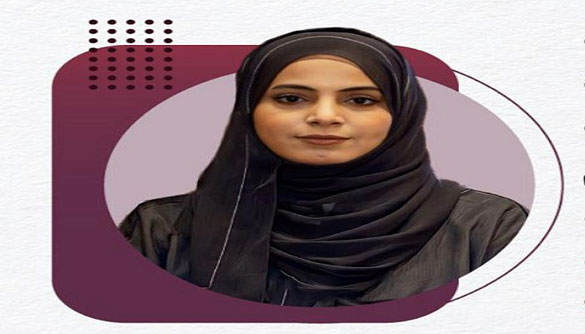
Omani Innovator Sumaya bint Said Al Siyabi
------
15/October/2022
Muscat: Omani Innovator Somaya bint Saeed Al Siyabiya
won the first place as the first Arab woman in the Stars of Science programme.
A statement issued online by Oman News Agency (ONA)
said: ”The Omani innovator Shamiya bint Saeed Al-Siyabiya won the first place
as the first Arab woman in the Science Stars Programme for her scientific
innovation in the environmental field 'Bio-analysis of microplastics in a new
way of biological and nanotechnology'."
Through the various stages of the programme, the Omani
innovator was able to overcome several challenges and won the votes of the
programme jury several times, to be able to progress through the stages and
reach the final stage despite the multiple cases of exclusion of the
participants.
Source: Times Of Oman
--------
Taliban Ban Women from Many Subjects, Like Journalism,
in University
By Hafizullah Maroof
14 Oct 2022
"I went to the entrance exam with lots of hope.
But when I saw the selection paper, I couldn't find my favourite subject,"
says a tearful Fatima.
The 19-year-old is a student from Laghman province in
eastern Afghanistan. The BBC is not using her real name for her safety.
Fatima's dreams of pursuing a career in journalism
have been put in jeopardy because of a new order by the country's Taliban
rulers.
A year after banning most teenage girls from attending
school, the Taliban are imposing sweeping restrictions on which courses women
can enrol in at public universities.
"I dreamed of being a journalist. I wanted to
work on radio and TV. I want to fight for women's rights," Fatima told the
BBC.
She did not get to complete her final year at school
as girls were banned from high school by the Taliban after they seized power in
August 2021.
The militant group have said the correct "Islamic
environment" needs to be created for older girls to be allowed back into
schools, but more than a year after they returned to power this still has not
happened in most provinces, with reports suggesting hardliners in the group remain
opposed to it.
But the Taliban did make the decision that girls who
were in the last year of school could also sit university entrance exams.
Fatima's excitement was short-lived however.
The Taliban concession came with limitations on the
subjects’ women, but not men, could choose.
For instance, at Nangarhar University where Fatima
hoped to study journalism, in the province neighbouring hers, girls are now
given the right to choose from only seven of 13 faculties. Women are not
permitted to take subjects like journalism, agriculture, veterinary medicine,
engineering or economics.
"All their hopes are gone now," says Fatima,
of the girls who would have pursued studies in these areas if they'd passed the
entrance exam.
She and the other female students were given the
option of taking a test in subjects such as nursing, midwifery or literature,
which are among the courses on offer at the seven faculties open to them at
Nangarhar.
University professors who supervised the entrance
examination there confirmed to the BBC that boys would be allowed to choose any
subject they want.
"The selection paper was not given to us in
advance. When we - a group of about 10 girls - saw the paper and couldn't find
the faculties we wanted, we all broke down in tears," Fatima recounted.
The choice for female students can vary from
university to university, and depending on which part of the country you're in,
the BBC has found. Women are allowed to take medicine and nursing in all
provinces, as well as teacher training and Islamic studies.
But veterinary science, engineering, economics and
agriculture appear off-limits to women nationwide, while opportunities to study
journalism are extremely limited.
It has been a tough journey for Fatima and her
friends. Since schools were shut to them, they have had to prepare for
university entrance at home. Fatima organised group studies with other girls.
"In our area there are no opportunities to take
tuition classes. They were all closed."
Officials expect 100,000 students (including 30,000
women) to take university entrance exams in Afghanistan this year.
The academic year starts either in March or August,
and it usually takes two to three months for entrance exam results to be
announced. Now, with the Taliban back in power, nobody is sure when the results
will be released.
Male and female students have been taking the exams
separately - in line with Taliban rules on segregating students by gender - for
example boys in the morning, girls in the afternoon or by using screens in exam
halls. In some provinces where the candidate numbers were high, entrance exams
were held over two or three days.
Activists say the number of female students applying
for university will fall dramatically in the coming years, unless the Taliban
reopen secondary schools to girls from grades 6 to 12.
In Laghman province last year nearly 1,200 girls took
the test while this year the number had fallen to just 182 girls.
Taliban officials are downplaying the restrictions.
Abdul Qadir Khamush, who heads the examinations
division in the Ministry of Higher Education, says girls can choose their
favourite subject, with the exception of just three or four.
"We need to provide separate classes for women.
In some areas the number of female candidates are low. So we are not allowing
women to apply for certain courses."
Officials are yet to reveal the number of university
places on offer this year.
Afghanistan's education sector was badly affected
after the Taliban takeover and there has been an exodus of trained academics
after the withdrawal of US-led forces last year.
The country's economy has been largely dependent on
foreign aid in recent decades, but aid agencies have partly - and in some cases
fully - withdrawn support to the education sector after the Taliban refused to
allow girls into all secondary schools.
Many of the teaching staff who remain go unpaid for
months.
Taliban restrictions on which subjects girls can study
are not always uniformly applied across the country, the BBC has discovered.
For instance, in Kabul University, girls are still allowed on some courses in
the journalism faculty.
But Fatima cannot circumvent the rules by applying to
universities in places as far away as the capital. The Taliban have divided the
country into a number of zones and girls are not allowed to study outside them,
in what amounts to another very serious restriction based on sex.
"I can only study what they offer me. I have no
option," says Fatima, but she has not quite given up on her dream.
"If the government changes its policy next year,
I will choose journalism."
But if that doesn't happen, she and other girls like
her will have no option other than to study what the Taliban let them if they
want to go to university.
For the tens of thousands of teenage girls currently
being denied a secondary education - even that choice may not be open in
future.
Source: BBC
https://www.bbc.com/news/world-asia-63219895
--------
Malaysian Activist Fahmi Reza Zarin Discharged Over
‘Obscene Posting’ About Liquor Ban
October 14, 2022
KUALA LUMPUR: Graphic designer and activist Fahmi Reza
Zarin, better known as Fahmi Reza, was discharged by the sessions court today
of making an allegedly obscene posting on social media about a ban on liquor
sales.
Judge Nor Hasniah Ab Razak said the charges were
“flawed and unfounded”, and allowed an initial objection to the charges by
Fahmi’s lawyer, N Yohendra, Bernama reported.
She granted Fahmi a discharge not amounting to an
acquittal.
The preliminary objection had been filed on Aug 30 on
the grounds that the charge did not contain sufficient details, was flawed and
contradicted the requirements of the Criminal Procedure Code.
Fahmi had pleaded not guilty on Feb 17 to knowingly
making and initiating the transmission of an obscene posting on Facebook about
a liquor ban on June 1 last year.
Fahmi was charged under the Communications and
Multimedia Act 1998. The charge carries a maximum fine of RM50,000 or up to a
year’s jail or both, with a further fine of RM1,000 for each day the offence
continues after conviction.
Source: Free Malaysia Today
The prosecution was led by deputy public prosecutor
Najihah Farhana Che Awang.
--------
Tehran billboard of famous women in hijab changed a
day after going up
October 14, 2022
TEHRAN: A photomontage of dozens of renowned Iranian
women all observing hijab disappeared from a Tehran billboard Friday within 24
hours of going up, after drawing criticism amid protests over Mahsa Amini’s
death.
Iran has been gripped by a month of protests since
Amini died after being arrested by the morality police in Tehran for allegedly
violating the country’s strict dress code for women.
The street violence has led to dozens of deaths, mostly
of protestors but also members of the security forces, and hundreds have been
arrested.
The original billboard appeared early Thursday on
Valiasr Square, in downtown Tehran, bearing a photomontage of an array of
celebrities around the slogan “The women of my homeland, Iran”.
Among them were athletes, political figures and
scientists such as late mathematician Maryam Mirzakhani, early 20th century
revolutionary figure Bibi Maryam Bakhtiari and poet Parvin E’tesami.
But on Friday morning, the photomontage was replaced
by a white background, although the new version retained the slogan.
Fars news agency said the move came after some of
those featured had asked for their pictures to be removed, citing a “lack of
coordination” with them.
Others criticised the billboard for featuring women
who had removed their headscarves during the recent protests, it added.
Award-winning Iranian actress Fatemeh Motamed-Arya
demanded her picture be removed in an emotional video that went viral on social
media.
“I am Mahsa’s mother, I am Sarina’s mother, I am the
mother of all the children who are killed in this land, I am the mother of all
Iran, not a woman in the land of killers,” Motamed-Arya said.
She appeared in the video without a hijab headscarf,
seemingly in a vehicle as it passed Valiasr Square.
The billboard was raised by Owj Arts and Media
Organization, known for pro-revolutionary films and cultural production.
The decision to remove the pictures was taken after
“controversies and reactions”, the organisation said in a statement carried by
state news agency IRNA.
The billboard on Valiasr Square often features
symbolic murals related to religious, social and political themes.
Source: Gulf News
--------
Marriage
laws in MENA region put women at increased risk of child marriage and domestic
violence
October
14, 2022
A
new policy briefing by the NGO, Equality Now, on how marriage laws in the MENA
region and around the world discriminate against women and girls reveals how
failure to reform means they are at increased risk of human rights violations,
such as child marriage and domestic violence.
In
Egypt, 62 per cent of men and 49 per cent of women agree with the practice of
honour killing. According to the World Bank, at least 35 per cent of women in
the MENA region have experienced some form of violence by an intimate partner
at some stage in their life.
"As
shocking as this figure is, it is likely to be an under-estimate, as
gender-based violence frequently goes unreported due to obstacles such as
social stigma, victim-blaming and concerns that the case will not be dealt with
effectively by the State," Dima Dabbous, Equality Now's regional
representative in the Middle East and North African region told MEMO.
"In
the wake of the COVID-19 pandemic and the resulting economic fallout, cases of
domestic violence, child and forced marriages surged in the region, as they did
globally, with women and girls from poorer communities and refugee families in
conflict areas especially impacted."
Almost
30 years ago, in a conference hall in Beijing, world leaders pledged to remove
existing unfair laws and make legal equality a reality. But these goals,
promised at the 4th UN Conference on Women, are not only far from being
realised, Equality Now's briefing says, but they are getting worse.
"Advances
in the MENA have been slow and inconsistent," says Dima. "Worryingly,
in recent years, there has been a backsliding on women's rights in some
countries. Governments have been reluctant to address or prioritise reform, and
countries such as Iran and Saudi Arabia have been actively targeting and
punishing women's rights activists."
In
Lebanon, the father has all parental authority, apart from breastfeeding and,
if a woman remarries, she loses custody of her children. Under Algeria's Family
Code, a woman requires the permission of a male marriage guardian, whilst in
Israel, under the Marriage and Divorce Law, the divorce relies solely on the
will of the husband.
Three
decades since that conference, these discriminatory laws are not being removed
because there is a lack of political will, says Dima. "This is fuelled, in
part, by those in power seeking to preserve the status quo and maintain support
from conservative constituencies that do not support women's empowerment."
"Attempts
to reform family laws can be risky, even dangerous, in some MENA
countries," she continues, "especially where authoritarian
governments treat peacefully campaigning for women's rights as a crime
punishable by social and economic sanctions, imprisonment, torture and even
death."
Last
year, leading Egyptian women's rights activist, Amal Fathy, was sentenced to a
year in prison after she criticised the government's failure to protect women
from sexual harassment. In 2016 Egyptian lawyer and feminist Azza Soliman was
arrested, her assets frozen and a travel ban put in place. Azza has now been
cleared of charges against her in a terror court, but is still banned from
travelling.
Also
in 2021, prominent Saudi women's rights activist, Loujain Al-Hathloul, was
released from prison after three years in detention where she was tortured.
Despite being released, Loujain was banned from travelling.
Whilst
laws strengthening legal rights for women and girls have been introduced in the
region, other strategies need to also be put in place, which generate public
support to make sure they are accepted and implemented, says Dima.
"Achieving
systematic, lasting change requires shifting negative attitudes and behaviour
towards women and girls. For example, in Egypt child marriage is forbidden by
law and denounced by the religious Al-Azhar authority, yet it remains widely
practiced and culturally accepted."
And,
whilst the Egyptian government has increased the number of women appointed to
government positions and criminalised denying women their inheritance, they have,
at the same time, continued to squeeze free speech.
There
are restrictions on civil society, including a law which prohibits NGOs from
disclosing the results of field research without government approval, threatens
fines of up to one million Egyptian pounds for receiving funds without
government approval and prohibits cooperation with foreign organisations and
experts.
Beyond
the MENA region, there is almost no country in the world which has eradicated
sex discriminatory laws, says Dima. By 2022, only 12 countries achieved full
legal equality, according to the World Bank.
"Sex
discriminatory marital status laws make gender equality impossible. Until women
and girls have legal equality, there will continue to be the proliferation of
harmful practices such as child marriage and forced marriage, and sexual and gender-based
violence."
"One
major area of reform in personal status laws that states in the [MENA] region
must undertake is to make their nationality and citizenship laws gender-equal,
so that women have the same rights as men to transfer nationality to their
children and spouses, and acquire or change it," Dima adds later.
"This will improve women's lives, as well as their families, and bring
countries into compliance with international law, which requires gender
equality in nationality rights."
Source:
Middle East Monitor
--------
URL: https://newageislam.com/islam-women-feminism/iranian-police-sexually-assaulting-female/d/128187
New Age Islam, Islam Online, Islamic Website, African Muslim News, Arab World News, South Asia News, Indian Muslim News, World Muslim News, Women in Islam, Islamic Feminism, Arab Women, Women In Arab, Islamophobia in America, Muslim Women in West, Islam Women and Feminism