
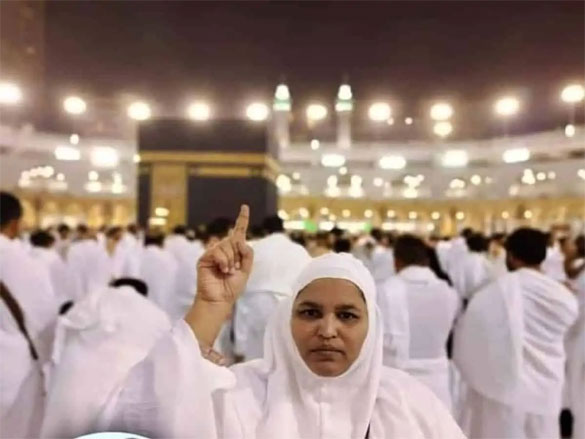
Tamil Motivational Speaker Sabarimala Jayakanthan Converts To Islam After Reading Quran And Named Herself Fatima Sabarimala at Holy Kabah
New
Age Islam News Bureau
25 April 2022
 •
An Unspoken Abuse: Time To End Female Genital Mutilation In Pakistan
•
An Unspoken Abuse: Time To End Female Genital Mutilation In Pakistan
•
Ramadan: Muslim Women Charged To Focus On Ibadah
•
Family Of British Woman Accused Of Ordering Husband's Murder In Pakistan Launch
Petition To UK Government
•
Khyber Economic Corridor Project Speakers For Economic And Social Empowerment
Of Women
•
Egypt Launches 6 Initiatives To Empower Women: Minister
Compiled
by New Age Islam News Bureau
--------
Tamil
Motivational Speaker Sabarimala Jayakanthan Converts To Islam After Reading
Quran And Named Herself Fatima Sabarimala at Holy Kabah
Syed
Ali Mujtaba
24th
April 2022
Tamil
motivational speaker and teacher Sabarimala Jayakanthan has taken oath holding
the holy cloth of Kabah, to announce that she has converted to Islam and named
herself Fatima Sabarimala at Holy Kabah.
Fatima
on her first visit to Makkah said, “I asked myself why there is so much hatred
against Muslims in the world? I started reading the Quran as a neutral person.
Then I came to know the truth. Now I love Islam more than myself.”
“Its
a great privilege and honor to be a Muslim,” said the teacher, requesting
Muslims to introduce Quran to everyone.
“You
people have wonderful amazing ‘Book’, why are you hiding it in your homes. The
world must Read this,” she reportedly said in Makkah.
Background
of Fatima Sabarimala
Sabarimala
was born on December 26, 1982 in Madurai, to Alagharsamy and Kalaiyarasi. She
married to Jayakanthan and have a son named Jayacholan.
Sabarimala
did her education at Dindigul, Tamil Nadu, and joined Elleri School near
Kattumannargudi in Cuddalore district as a school teacher in 2002. She quit her
job as a government school teacher saying the nation is more important than her
job.
Sabarimala
is at the forefront of bringing a single education system across India. She
says there is no need for the NEET exam and argues, “How NEET could be
equitable for all when there is no common education system in India.
She
went on a hunger strike against the ‘NEET exam and insisted that it should be
scrapped till there is a common education system is implemented in India.
This
public figure of Tamil Nadu is involved in community service since 2002. She
has been fighting for educational equality and the protection of girls’ and
women’s rights. She started an organization called “Vision 2040” in 2017 in
Tamil Nadu. The goal of this organization is the protection of girl children
and bringing a single education system.
Sabrimala
is fighting against violence against girls and women in society. She has met
about six lakh girls in rural areas across Tamil Nadu to raise awareness about
the protection of girl children. She has written a book on girl child
protection and has distributed it to 5000 school girls. She arranged one lakh
rupees for the family of Rithanyasree, a girl, who died in a sexual abuse case
in Coimbatore.
Motivational
speaker
As
a motivational speaker, Sabarimala has been on more than two thousand stages.
She has been a panel speaker on more than 200 platforms and moderated several
TV programs on Vander TV, News7 TV, Jaya TV, etc. She says, her speeches are
not for business but for social change.
Her
current mission is to turn government school students into public speakers. She
has prepared thousands of students for the stage speeches. She continues to
turn students into speakers and conducts workshops across Tamil Nadu at
schools, festivals, and literary venues where she makes students speak on
stage.
Sabarimala
has started a campaign with the slogan “No Return to Home.” She promises that she
will send the women standing in the kitchen to the assembly. She has also
formed a political party the “Women’s Liberation Party” (WLP) with feminist
motives.
Women
are seen as child-bearing toys, and kitchen machines, and the Women’s
Liberation Party would break these stereotypes and change the status of women
in Tamil Nadu, says Fatima Sabarimala a.k.a Sabarimala.
Syed
Ali Mujtaba is a journalist based in Chennai. He can be contacted at
syedalimujtaba2007@gmail.com
Source:Siasat
Daily
--------
An
unspoken abuse: Time to end female genital mutilation in Pakistan
Uswah
Zahid
Apr
25 2022
Very
few talk about it. Even fewer report on it. Even today, many young girls face
this abuse in Pakistan.
The
United Nations has classified “female genital mutilation” (FGM) or cutting as
an “extreme form of violence against girls” and a violation of their rights.
FGM
is now known to cause irreparable damage to a body and inflicts lifelong
emotional trauma.
Yet,
the inhumane practice continues in Pakistan behind closed doors, for cultural
and religious reasons. And there is no law as of now in the country banning the
cruel act.
What
is female genital mutilation?
The
procedure involves “partial or total removal of external female genitalia or
other injury to the female genital organs for non-medical reasons,” explains
the World Health Organisation (WHO).
Communities
in Pakistan, which carry out this physically invasive practice, insist that it
prevents girls from zina (adultery) and masturbation, as it curbs their sexual
urges, which could lead to illicit relations between a man and woman.
The
procedure of FGM, locally known as female khatna (circumcision), can be
performed in four different ways.
“Clitoridectomy”
involves partial or total removal of the external part of the glans clitoral or
the prepuce (clitoral hood). While “excision” includes the partial or total
removal of the glans clitoral or labia minora.
Another
way to carry out this practice is “infibulation”, where the vaginal opening is
narrowed by cutting or repositioning the labia minora or labia majora. This is
done through stitching, but a small opening is left for urine and menstrual
blood.
Other
ways of this harmful procedure include pricking, piercing, incising, scraping
and cauterization.
Which
type of FGM is commonly practiced in Pakistan?
There
are communities in the country that regularly perform type 1, therefore
“clitoridectomy”, on girls as young as seven-years-old.
As
per one study by the non-government organisation in Karachi, Sahiyo, an
estimated 80% of women within the Dawoodi Bohra community have undergone female
genital cutting.
“They
[these communities] refer to the practice as Khafz,” notes a research paper by
Habib University titled “FGM and Sexual Functioning: Insights from the Maasai
and Bohra Community”. For the paper, the researcher studied the close-knit
community of Dawoodi Bohra Muslims in Karachi, and the Maasai community in
Kenya, East Africa.
Khafz
involves shortening the clitoral hood or removing the tip of the clitoris. The
procedure is performed without anaesthesia on pre-pubescent girls by a
traditional circumciser, the paper states.
These
traditional circumcisers are women, who have no medical background and little
regard for hygiene.
The
practice is also carried out secretly, to prevent people from finding out or to
avoid any trouble from law enforcement agencies.
A
woman, who was forced to go through FGM at the age of seven, spoke to Geo.tv on
the condition of anonymity and said that her community in Karachi justified the
brutal practice by comparing it to male circumcision.
“They
tell us it is done to ‘purify’ girls and to limit their sexual urges,” she
said.
However,
another woman, who had also undergone the procedure, defended the practice:
“This stops us from sinning as adultery is considered a very serious sin in
Islam,” she said, on the condition of not being identified.
How
does FGM affect physical and mental health?
According
to the World Health Organisation, young girls who suffer female genital
mutilation are later at the risk of shock, severe pain, bleeding, haemorrhage,
infection, injury to surrounding tissues, shock, and even death.
Other
long-term complications include urinary, vaginal and menstrual problems as well
sexual problems, and issues with childbirth.
“Girls
have to bear a lot of pain during this process as well as after it is carried
out,” said a woman, who had gone through FGM, “Many girls face loss of blood
for a very long time after it is done.”
Another
woman said that she is more vulnerable after FGM to urinary tract infections as
“it is the clitoral hood that protects the vagina from germs and that is cut
out,” she added.
Dr
Pushpa Kumari, a gynaecologist in Karachi, told Geo.tv, that women who are cut
often face issues with their menses “including pain and difficulty in passing menstrual
blood which leads to infections and cysts,” she said.
The
doctor further explained that girls who go through his procedure later have to
opt for a cesarean section to deliver a baby.
FGM
is also associated with long-term psychological problems including depression,
anxiety, stress, post-traumatic stress disorder and low self-esteem.
One
of the women Geo.tv spoke to in Karachi, who had gone through this process,
said it was a traumatic experience for her and felt like a breach of her
privacy and boundary.
She
added that it led to her developing trust and intimacy issues later on with her
partner.
FGM
deeply affects the self-esteem of young girls, explained the Karachi-based
psychologist Dr Mariah Noor.
“Women
who have undergone FGM stop thinking of themselves as an individual since their
bodily freedom is taken away from them,” Dr Noor said.
Source:GeoTV
https://www.geo.tv/latest/413481-an-unspoken-abuse-time-to-end-female-genital-mutilation-in-pakistan
--------
Ramadan: Muslim Women Charged To Focus On Ibadah
Apr
25 2022
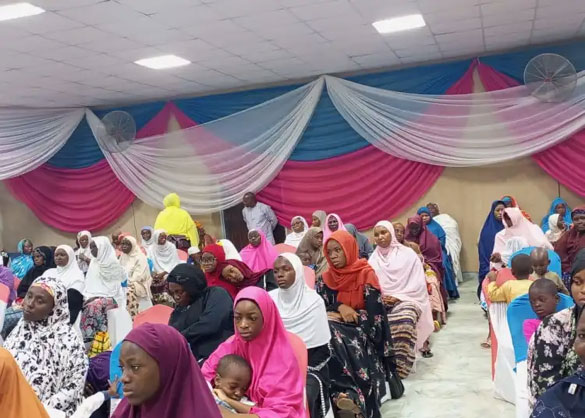 Muslim
women have been charged to focus more on their Ibadah, Remembrance of Almighty
Allah in this Holy month,(Ramadan), and not only on cooking.
Muslim
women have been charged to focus more on their Ibadah, Remembrance of Almighty
Allah in this Holy month,(Ramadan), and not only on cooking.
An
Islamic scholar, Mallema Amina Sani Idris made the call in Abuja at a Ramadan
series Lecture organise by women wings of Alhabibiyya society, the
titled”Family, Ramadan, and Women”, said a lot of rewards come from cooking in
the months of Ramadan but that shouldn’t stop them from doing some of the
necessary things in this Ramadan.
According
to her (Amina) “Cooking is not bad but they should also put more efforts in
their Ibadah, during the cooking they can observe Qur’an recitation,
Remembrance of Allah, and some other things that can purify their fasting
because, we have many problems in our society today, but with the help of
Almighty Allah, things would be better
“Begging
generally is prohibited in Islam. The menace of our people flooding the street
begging is very annoying, instead of begging why can’t they look for something
good and start doing it.
While
speaking on the series lectures, she said the lecture is taking place every
Saturday, and thank God for the turnout every week is encouraging and our
society is getting much better with the help of this program.
“When
you want to look at the society, Prophet Muhammed SAW said, you should look at
the women and I believe that the way they are answering our call, practicing
what they have been learning from here every week, is quite impressive,” she
said
Also,
Guest lecturer, UstaziaHaleemah Sani explained that there is a need to change
our perception concerning upbringing because we are seeing the consequences in
our society.
The
whole things become sprayed of evils things in our society, obnoxious scenes,
indecent dressing, morality is fading in our society, and this is as a result
of killings, kidnapping we are facing today.
Mothers
have to do upbringing from the beginning and if it fails, you are going to
breed a child that is a failure as a mother, what she also gives her children
is what she has learned from the parents.
Breeding
a good child has nothing to with religion because everybody in the society has
their culture, and the culture is morality and is no longer there today. It has
been overtaken by evils, money and others.
We
have to call on the parents to revisit the way they are training their children
right now, especially the elites who don’t want anyone to talk to their
children.
In
his remarks, National Chief Imam Al-habibiyah, Imam Faud Adeyemi said sincerity
is what can keep you going You will get better. I don’t want to say how
Al-habibiyah has changed the face of an Islamic organization in Nigeria today.
He
said,” Is good for women to pursue their career but it would be more good if
they are always at home taking care of their children.”
Source:Leadership
Nigeria
https://leadership.ng/ramadan-muslim-women-charged-to-focus-on-ibadah/
--------
Family of British woman accused of ordering husband's murder in Pakistan launch
petition to UK government
Ellen
Manning
April
24, 2022
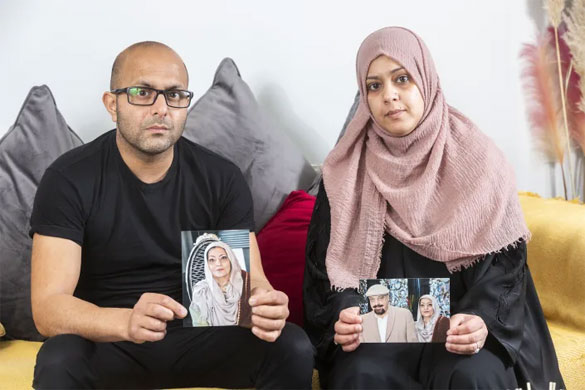 Saima
Bashir, 38, and brother Sajid Bashir, 40, face the possibility of their mum
Yasmin Kausar, 62, having the death penalty after she was accused of ordering
the murder of her husband in Pakistan. (SWNS)
Saima
Bashir, 38, and brother Sajid Bashir, 40, face the possibility of their mum
Yasmin Kausar, 62, having the death penalty after she was accused of ordering
the murder of her husband in Pakistan. (SWNS)
--------
The
family of a British mother who is facing the death penalty in Pakistan after
being accused of ordering her husband's murder have launched a campaign to
clear her name.
Yasmin
Kausar, 62, is accused of ordering her young lover to murder her husband and
dispose of his body in a burning car so they could start a new life together.
She
was arrested alongside two others - Abdul Waheed, 22, who she is accused of
having a relationship with, and Abdul Idrees, 24.
Police
believe Kausar's husband Mohammad Farooq, 65, from Headingley, Leeds, was
strangled at the family's Pakistan home.
His
charred body was found in a burnt-out car at a rubbish dump in Morgah, near
Islamabad, 27 miles away on 1 April.
His
widow was detained on 4 April by police in Rawalpindi, who released a statement
to local media saying they had 'solved’ the murder.
But
Kausar's daughter Saima Bashir, 38, has branded the allegations
"nonsense", and said her mother had been framed.
The
family have now launched a petition calling for the British government to
contact authorities in Pakistan and ensure that Kausar's human rights are being
protected.
Speaking
from her home in Leeds, West Yorkshire, Saima Bashir said: "My mum is 100
per cent innocent. She was married to my stepdad for 23 years, they had a
loving relationship.
“They
were like soulmates, they were best friends. There’s no way my mum would have
done this."
Bashir,
who is undergoing treatment for cancer herself, said she feared for the safety
of her mother, who has Type 2 diabetes, in the prison where she is being held
on remand ahead of a court appearance.
She
claimed she has been beaten and tortured and had her medication withheld when
she was first arrested, adding: "They’ve arrested my mum and on the second
day, they’ve tried to interrogate mum to make her confess that she’s killed
him.
"She’s
been subjected to mental and physical abuse since her arrest. It’s very scary,
she faces the death penalty, but she’s probably close to death as it is.
"On
Thursday, my uncle in Pakistan made contact with her and he said she’s lost a
lot of weight and she’s very weak."
She
said claims that her mother stood to gain financially from the death of her
husband were "rubbish", and claimed the police's allegations didn't
"add up".
"It
must be the quickest a murder has ever been solved in history," she said.
"It just doesn’t add up.
"We
just want justice for Mr Farooq and we want justice for my mum. We can’t get
justice for one without the other.
"We
want them to solve the murder and we want our mum home safe."
Bradford
West MP Naz Shah has also written to the Prime Minister of Pakistan to raise
concerns about the case.
Source:NewsYahoo
https://news.yahoo.com/family-british-woman-husband-murder-pakistan-petition-181411214.html
--------
Khyber
Economic Corridor Project Speakers For Economic And Social Empowerment Of Women
25
Apr, 2022
PESHAWAR:
Speakers at a training workshop held under auspices of Khyber Economic Corridor
Project, stressed the need for economic and social empowerment of women so that
they can play their due role in development of the country.
Women
are an important part of the society, who have contributed a lot toward
economic development of the country by working with male colleagues and men
counterparts/ bosses, side by side said the participants/ keynote speakers
during a training workshop organised by Khyber Economic Corridor here on
Sunday.
The
training session was aimed at adopting a comprehensive strategy for promoting
economic and trade activities in areas adjacent to Khyber Pass.
Businesswomen
attached with various trade and businesses apprised the organisers of the
workshop about hurdles and difficulties, which they face in promotion of their
products and other related issues.
On
the occasion, Khyber Economic Corridor Project Director Imran Zahoor, Project
Consultant ShenaazKabadiya and Kashif Gul comprehensively briefed the
participants about this important project.
The
session was attended by FPCCI regional coordinator Sartaj Ahmad Khan, the Bank
of Khyber representative Asadur Rehman, representative of Aurat Foundation
Shabina Ayaz, Saima, Women Chambers presidents, office bearers and
businesswomen in a large number.
During
the workshop, the participants were informed that it is important to formulate
a vibrant strategy for development of Khyber belt, economic improvement of
people, especially to make women economically self-resilient to play their
pivotal role in the country’s progress in a befitting manner.
Sartaj
Ahmad while speaking on the occasion emphasised that if all provincial relevant
departments work together that would open avenues of progress in Khyber
Pakhtunkhwa.
In
his recommendation, Ahmad said it is a dire need of hour to provide congenial
and conducive environment for women to do businesses and play their important
role in economic development of KP and rest of the country.
We
can achieve economic development goals and progress by strengthening and
enhancing the technical skills of FPCCI and its subsidiary chambers, trade
bodies, especially women chambers, the FPCCI regional coordinator stressed.
Sartaj
Ahmad said the training session should be conducted for those women who want to
come in the practical field and play their role in the economic development of
the country. He said FPCCI is an institution which is providing services for
economic uplift projects by giving high importance to nation building and
progress.
Source:Brecorder
https://www.brecorder.com/news/40169234
--------
Egypt
launches 6 initiatives to empower women: Minister
23
Apr 2022
CAIRO
- 23 April 2022: Minister of Local Development Major General Mahmoud Shaarawy,
received an achievement report from the central equal opportunities unit in the
ministry on the public and sub-opportunity units in the governorates, totalling
(277) units on the work strategy to integrate women’s issues into the
comprehensive and sustainable development process in the governorates.
This
comes in light of the interest of the Ministry of Development Local women’s
role in the renaissance of societies and their ability to bring about positive
change in all aspects of social, political and economic life, and in
implementation of the mandates of the political leadership to empower women,
raise their efficiency and build their capabilities.
Major
General Mahmoud Shaarawy stated that 6 initiatives were launched in all
governorates targeting the participation of women on a large scale in all
political, social and cultural sectors. In the field of protection and
combating violence against women, it carried out 238 awareness seminars aimed
at combating all forms of violence against women, harassment and bullying,
benefiting 17,376 beneficiaries. In addition, 249 awareness seminars were held
aiming at raising awareness of the health, social and psychological risks of
FGM, benefiting 7,323 beneficiaries. Also, 30 awareness seminars were carried
out aimed at eliminating the phenomenon of early marriage and the negative
damages resulting from it, benefiting 1,400 beneficiaries.
Shaarawy
also pointed to the importance of the development goals achieved by the
"You Are Productive" initiative, where 50 workshops were implemented
to train women in a variety of handicrafts, including (carpets - handicrafts -
clothes - sewing - housekeeping) for the benefit of 977 beneficiaries and 5
workshops to train 50 women workers.
Shaarawy
added that, in light of the directives of the equal opportunities units in the
governorates to raise awareness and pay attention to women's public health and
the importance of education, the "Caring for Women's Public Health"
and "Egyptian Village Without Illiteracy" initiatives were launched,
where the first carried out 31 medical convoys in the field of reproductive
health and various other specialties. For 3206 beneficiaries, 26 campaigns for
early detection of breast cancer were organized, benefiting 922 women, in
addition to organizing 22 awareness seminars on the importance of the Corona
vaccine, benefiting 1780 beneficiaries. As for the “Egyptian Village Without
Illiteracy” initiative, 6 classes were implemented to eradicate 196 women
Organizing 16 seminars on dropping out of education for 505 female
beneficiaries.
Major
General Shaarawy drew attention to the great interest of the Equal
Opportunities Units in capacity-building and awareness-raising, as 4 workshops
were organized to introduce digital transformation to benefit 196 women, in
addition to implementing 8 training courses for capacity-building in various fields
such as (technological literacy - civil service law - Time management -
effective communication - the concept of financial inclusion), in addition to
holding 19 seminars to raise awareness and introduce the most important
societal issues (national identity and belonging - human rights strategy and
women's empowerment axis - memories of the October War - the importance of
water rationalization - the rights of the elderly under the title "Give
Back" “), and 11 awareness seminars on the dangers of addiction in
cooperation with the Addiction Control and Treatment Fund. The Equal
Opportunities Unit in the Ministry implemented a training program to build the
capacities of heads of equal opportunities units and empower them to integrate
women’s issues into the comprehensive and sustainable development process in
the governorates for 28 beneficiaries with advanced training content.
Major
General Shaarawy stressed the ministry’s interest in empowering women and
placing them in decision-making centers in the governorates. The “Executive
Women Executive Workforce in Localities” program will be implemented, and the
program is concerned with building the capacities of female workers in the
offices of all governorates to qualify them to occupy leadership positions in the
local administration.
The
program aims to build women’s capacities in an effort to increase their
representation in leadership positions in localities, while developing their
skills to make them pioneers in community work.
Major
General Shaarawy added that the ministry's interest in women working in
localities was evident in the launch of the "A Day in a Village"
initiative, where 12 seminars were organized aimed at introducing equal
opportunities units at the level of centers and villages and the services.
Source:
Egypt Today
https://www.egypttoday.com/Article/1/115201/Egypt-launches-6-initiatives-to-empower-women-Minister
--------