
Syrian Girls Play Soccer In Raqqa Among Ghosts Of Islamic State
New Age
Islam News Bureau
24 May 2023
• Syrian Girls Play Soccer In Raqqa Among Ghosts Of
Islamic State
• Parisa Haidari, The Afghan Woman’s 3,100-Mile Journey
To Safety
• Joanne O’Fee, Whitehaven Woman Denies Shouting Racist
Language To Mosque-Goers
• Female Speakers Inspire Audience At Forbes Middle East
Women’s Summit
• Why AIMPLB Is Responsible For Low Educational Levels
Of Pasmanda Muslim Women’
Compiled by New Age Islam News Bureau
URL: https://newageislam.com/islam-women-feminism/syrian-soccer-raqqa-islamic-ghosts/d/129843
------
Syrian Girls
Play Soccer In Raqqa Among Ghosts Of Islamic State
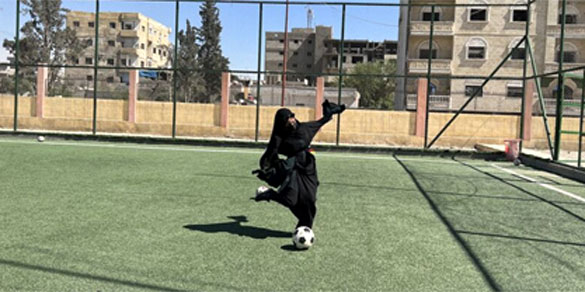
Sewsan
Hemadah, a 22-year-old martial arts teacher, playing soccer in Raqqa on April
25, 2023. (Amberin Zaman/Al-Monitor)
------
May 23, 2023
RAQQA, Syria —
In Raqqa, the erstwhile capital of the Islamic State (IS), a slim woman
shrouded in black squints through the slits of her veil, dribbles a soccer ball
then sends it into the net with a firm kick. Elsewhere across the sun-soaked
pitch, young girls warm up, some covered and others not, whooping and joking as
boys on an adjacent field look on. Aged between 10 and 14, they are members of
Raqqa’s first-ever girls’ soccer team. Exuberance permeates the air.
The scene is
nothing short of “revolutionary,” asserted Abdurrazaq Al Ahmed Slash, president
of the city’s junior soccer league, smiling proudly as he gestured toward the
girls. “We are changing the mentality here,” he told Al-Monitor. “It’s slow,
but it’s happening.”
Less than six
years ago, when IS still reigned over Raqqa, nobody dared to watch soccer let
alone play it in the open. In Mosul, the caliphate’s other major outpost in
neighboring Iraq, 13 teenage boys who defied the rule, watching an Asian Cup
match between Jordan and Iraq, were rounded up and publicly executed by a
firing squad. At Raqqa’s “black” soccer stadium, thus named because of its dark
stone structure, public beheadings touted as family entertainment were the only
“sports” on display. Beneath the stadium, in locker rooms converted into
torture chambers, an untold number died.
Life was
hardest on women and girls. They were permitted to move in public only if
accompanied by males and wearing double-layered veils, loose chadors and
gloves. The garments had to be black. Girls as young as 4 and 5 were not exempt
from the dress code. Those who disobeyed were brutalized by IS religious police
known as the Hisbah and slapped with heavy fines.
K-pop and
Ronaldo
What would the
Hisbah have made of 13-year-old midfielder Rama, who told Al-Monitor, “I don’t
want to get married or have a family.” Or Mahanna, a bubbly 14-year-old who,
like all of the girls here, wants to become a professional soccer player. She
“loves” the Portuguese soccer legend Cristiano Ronaldo, wants to learn English and
listens to K-pop. “I am from Raqqa. I don’t want to think about such a
question,” said Ahmed Abeid, who coaches the girls.
The girls' team
was formally established in June 2022. As word spread, a growing number of
girls signed up, some 32 in total, Abeid told Al-Monitor. Most are Arabs. It
wasn’t until the start of this year that the twin pitches, funded by a private
Norwegian initiative, were completed and the girls began to play.
The Oslo-based
board of the Norwegian initiative told Al-Monitor in an emailed statement that
the results of the project were “absolutely overwhelming” and the response
“much bigger than we had hoped for,” with grants flowing from “dozens of
football clubs and trade unions.” The aim is “first and foremost to enable
these children to experience joy and a feeling of being safe,” the board said.
It’s also about
reversing Raqqa’s bloody image. “We wanted to do this project so people would
look at us in a different way, to create life for the girls after so much
darkness,” Abeid said.
How did the
girls’ parents feel about a male coach? “The parents are totally fine with
this. They trust me,” Abeid explained.
He was planning
to take them to play another girls’ team in Qamishli, the administrative
capital on the Turkish border. “But we don’t have enough money to pay for the
trip,” Abeid lamented.
Abeid has had
to fish into his own meager savings to buy soccer balls and uniforms for the
girls.
Nowrouz
Mohamed, who came to watch her two daughters play, said, “I am very happy that
my girls are playing football.” “Before there was no life in Raqqa, only
death,” she told Al-Monitor.
Like many here,
Abeid credits the Kurdish-led autonomous administration that has been governing
Raqqa and other former IS strongholds in north and east Syria for creating an
environment in which to execute such plans. The fledgling body, operating under
US military protection, is ideologically inspired by Abdullah Ocalan, the
imprisoned Kurdish leader. Ocalan founded the outlawed Kurdistan Workers Party
and led its armed campaign against the Turkish state from his sanctuary in
Syria until he was forced out and captured by Turkish forces in Kenya in 1999.
JinJiyan Azadi
Ocalan’s
radical brand of feminism has seen women share power in government and lead
some of the most effective battles against IS. Their courage earned sympathy
and admiration across the globe. “JinJiyan Azadi,” Kurdish for “Women, Life,
Freedom,” became the rallying cry of millions of Iranian women who rose up last
year following the death in police custody of Kurdish woman Mahsa Amini. The
slogan was coined by the Ocalan-led movement.
“Empowering
women is one of the main pillars of our democratic project,” said Fawza Yusuf,
a top Syrian Kurdish official who met Ocalan in Syria and says she was deeply influenced
by his ideas. “We are trying to promote women at every level of society,” Yusuf
told Al-Monitor.
Many of those
ideas do not sit well in Arab-majority areas where religious conservatism runs
strong. The malaise is palpable in Deirez-Zor where tribal codes surrounding
female “honor” remain stubbornly rooted and IS still finds recruits.
In Raqqa too,
the battle for hearts and minds is far from won. The scars of war are
everywhere. Buildings cratered by coalition airstrikes line potholed streets.
Drinking water and electricity are a luxury despite a steady flow of aid from
the United States and other international donors. The city recently suffered a
cholera outbreak along with other towns in the US-protected zone.
The region’s
majority Arab population chafes at what the International Crisis Group called
the Kurdish-led administration’s “overbearing” ways and its alleged promotion
of Kurdish cadres over others. The enormous gulf separating those who earn
dollar salaries working for Western-funded organizations and the rest who
struggle to put bread on the table adds to the tensions.
The Norwegian
donors who have funded separate pitches in the Kurdish-majority town of Kobane
emphasize that they have no political agenda. “It is a completely neutral
project when it comes to politics. Joy to children — that’s it,” the board
stressed.
Queried about
the girls’ team, a tailor at the local bazaar aired disgust. “What do you think
when a girl is following a ball,” he sneered before striding away. However, a
clutch of boy apprentices took a different view. “It’s OK for girls to play
football,” said Aboud, 15. “Why not?” another piped in.
“Families are
not always happy about the changes, but society simply has no bandwidth to
‘control’ women as they used to,” explained Hassan Hassan, founder and
editor-in-chief of the Washington-based New Lines magazine, who is from Raqqa.
“It’s surprising how stuff that used to cause violence and trouble is now
tolerated, with women making their own decisions, traveling without family
consent, eloping with people they want to marry and so on,” Hassan told
Al-Monitor. “These are a big deal in a conservative tribal society that
emphasizes honor and chastity, as they define it.”
Amid a sea of
adversity, including Turkey’s unremitting attacks against civilian
infrastructure, northeast Syria remains the least oppressive and most stable
and Western-oriented part of Syria today.
Ahmed Sayyir
runs a sports store in central Raqqa where he sells soccer balls, uniforms and
various other goods he imports from Turkey, China and the United Arab Emirates.
During IS rule, the shop remained open but business was down to a trickle.
Sayyir would sell balls to fighters who played soccer within the confines of
their compounds but never outdoors. “They forced me to grow a beard and pay
taxes. Every day we experienced violence,” he recalled.
“Life is good
now, except for public services,” Sayyir told Al-Monitor. As for girls playing
soccer, “Society has accepted the idea,” Sayyir observed.
Back at the
soccer pitch, SewsanHemadah, the black-swathed goal scorer, is here to
chaperone her 15-year-old sister Sulaf who plays on the team. Hemadah, 22,
teaches martial arts to care for her mother and seven siblings. “My father
died, so I am now the breadwinner,” she explained. The family, ethnic Arabs
from Raqqa, had moved to Damascus when IS took over. The secular culture
aggressively promoted by the Assad regime allowed the young woman to acquire
her sporting skills. They returned to Raqqa a year ago.
“It's better
than under Bashar [al-Assad] here. We are all freer now. I earn more money,”
Hemadah told Al-Monitor. “And it’s good my sister plays football,” she added.
“Like our mama says, it’s better than doing bad things.”
Source: al-monitor.com
https://www.al-monitor.com/originals/2023/05/syrian-girls-play-soccer-among-ghosts-islamic-state
--------
Parisa Haidari,
The Afghan Woman’s 3,100-Mile Journey To Safety
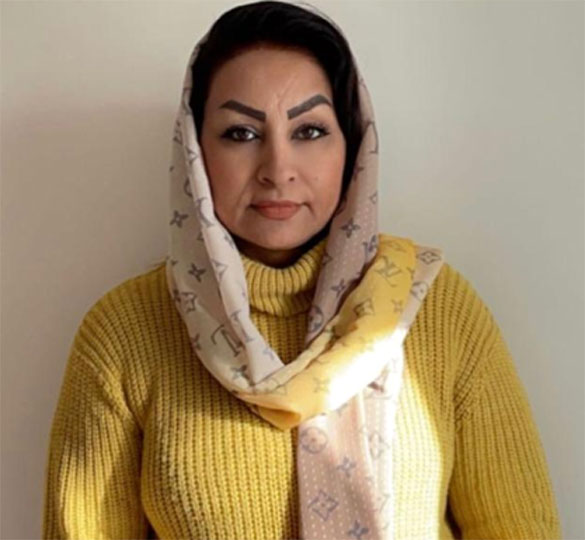
Parisa
Haidari
----
23 May 202
Parisa Haidari
is taking classes with her daughter to become a certified nail technician. They
hope to open a nail salon in Italy, which could also serve as a cultural center
for Muslim women, who, like her, have had to flee Afghanistan, leaving their
homes and careers behind.
Before Haidari
ended up in Italy, she had been a journalist in Kabul. In some ways she has
come full circle. She started out as a beautician back in 2005 while she
finished university.
After getting a
degree in literature, she started working as a cultural and social host for
Farda TV/Radio, where she invited important figures on the show to talk about
cultural matters, such as the growing feminist movement in Afghanistan.
But women’s
rights was not something the general public embraced. Haidari said that after
U.S. special forces killed Osama Bin Laden in Pakistan in 2011, she began to
hear stories about coworkers targeted for being journalists, specifically those
who were women.
“Being a
journalist and a woman working in social media was dangerous, many colleagues
were threatened or killed,” Haidari said. “I did not feel safe doing this job,
so that’s the reason why I decided to quit.”
Empowering
women in Afghanistan
After seven
years as a journalist, Haidari left her job and began working in an orphanage,
where she taught young girls cosmetology skills, including hair-cutting and
makeup application, in appreciation of the job that got her through university.
Years later,
Haidari got a job at NoveOnlus, an Italian NGO aimed at bringing peace and
justice to the world, as well as creating more jobs for women.
Her job was to
drive a pink shuttle, a van that picked women up at their houses and dropped
them off at work.
This empowered
the women of Kabul and kept them safe. Many women were not permitted to go more
than 20 meters from their house without a male relation. The pink shuttle
allowed women to go back and forth to work easily.
On 10 August
2021, the Biden administration in Washington announced it would pull American
troops out of Afghanistan, and a mere five days later, the Taliban regained
control of the capital city of Kabul.
Fleeing Kabul
to be free of Taliban rule
Shortly after,
Haidari, her husband and her youngest daughter, with the help of NoveOnlus,
caught a flight out of Kabul and came to Florence, where they caught a bus to
Arezzo and finally to Viterbo. Their oldest son had moved to Germany many years
earlier, while their second oldest daughter had married and moved to Iran.
“This wasn’t an
organized trip, we left Afghanistan immediately, we hadn’t prepared ourselves
at all,” Haidari said. “We hadn’t thought of this before at all, and when we
came to Italy we met different people, religion, language, culture, food.
Everything was new for us. So at the beginning it was difficult, but little by
little we are learning to adapt to our new lives.”
Haidari
attributes much of the help that they received to
AssociazioneRicreativaCulturaleItaliana (ARCI), a national Italian nonprofit
organization that works to provide financial and physical aid to immigrants and
refugees in Italy.
According to
the Italian National Institute of Statistics, there are currently about 14,000
Afghan refugees living in Italy. Of this group, only 15% are women.
One expert, who
works at ARCI, explained that this low percentage suggests that Afghanistan is
not allowing women who lack husbands or who emancipated themselves to leave the
country. “We have a lot of women in our project who ask to be reunited with
their sisters or daughters but there is no solution for them now,” the expert
said, speaking on condition that their name not be used. “There are no
‘humanitarian channels’ agreed with the current government of Afghanistan.”
The struggle
for the rights of women under traditional Islam
Haidari’s
earliest childhood memories take place in Iran, the bordering country that her
family moved to from Afghanistan shortly after she was born. She is the oldest
of 10 siblings, split between one father and two mothers.
Haidari doesn’t
remember much of her early childhood, except the constant presence of war and
instability in Afghanistan.
These conditions
only worsened. Merely five years after she was born, the president of
Afghanistan was killed and Nur Mohammed Taraki, leader of the People’s
Democratic Party of Afghanistan, took over Afghanistan as the new leader.
During his
reign, Taraki restricted women’s rights and established traditional Islamic
values. According to the United Nations High Commissioner for Refugees (UNHCR),
since 1982 about 2.8 million Afghan people have fled to neighboring Pakistan
and Iran in order to escape the ongoing chaos in Afghanistan.
After
graduating high school in Iran, Haidari studied literature at a local
university for two years until her family found her a husband, whom she met
once before getting married. She was not even 20 years old on her wedding day,
and had her first son a year later. Due to the birth of her son, she had to
drop out of university, much to her dismay.
“I wanted to
study, but when I got married I couldn’t continue my studies anymore, so I gave
up,” Haidari said.
The Taliban
reemerges.
In 1995, the
Taliban rose to power in Afghanistan with the promise of peace, causing even
more chaos and war in the country. Not long after, however, 9/11 happened, and
the United States became suspicious that Osama Bin Laden, who was behind the
attack, was hiding in Afghanistan. This led to United States occupancy in
Afghanistan, which drove the Taliban out of power.
Shortly after
this, Haidari moved to Afghanistan, full of hope for peace and equal rights for
women in this war-torn country.
Now, Haidari is
using the help of ARCI to open a nail salon that will double as a cultural
center for Muslim women, particularly Afghan women, in the Viterbo province.
“We want to open up this cultural center with the help of ARCI. We want to do
it for women, for Muslim women and above all for Afghan women,” she said.
Haidari would
like the women of Afghanistan to know that they are beautiful and strong, and
that they can do anything just like, if not better than men can. She wants the
world to know that Afghan women can do anything that they put their minds to.
“I have this
message for the Afghan women: I am sure that we can find a solution, and one
day we will pass all of this war, all of these things that are happening in
Afghanistan,” Haidari said. “I hope that this situation soon ends in
Afghanistan, and that we can get back the rights that we had before.”
According to
the UNHCR, about 200,000 Afghan women fled the country in August 2021. Millions
more remain, unable to escape.
Source: news-decoder.com
https://news-decoder.com/one-afghan-womans-3100-mile-journey-to-safety/
--------
Joanne O’Fee, Whitehaven
Woman Denies Shouting Racist Language To Mosque-Goers
By Lucy
Jenkinson
24-05-23
A WOMAN has
appeared in court accused of shouting racist language at people going to a local
mosque.
Joanne O’Fee,
54, pleaded not guilty to a charge of religiously aggravated intentional
harassment, alarm, or distress, when she appeared at Workington Magistartes’
Court.
The offence is
alleged to have taken place on September 9 near the defendant's address on
College Street in Whitehaven.
O’Fee will
appear at Carlisle Crown Court for a plea and trial preparation hearing on June
19.
She was granted
unconditional bail.
Source: newsandstar.co.uk
https://www.newsandstar.co.uk/news/23539826.whitehaven-woman-denies-shouting-racist-language-mosque-goers/
--------
Female speakers
inspire audience at Forbes Middle East Women’s Summit
May 23, 2023
RIYADH: The
Forbes Middle East Women’s Summit, being held for the first time in Riyadh, has
set the stage alight with dozens of inspirational speakers from diverse
backgrounds and industries.
On Monday, the
second day of the event, hundreds of delegates listened to presentations from
women involved in sectors such as technology, healthcare, fashion and beauty,
and travel and tourism.
A panel
discussion on championing representation in beauty featured Somali American
activist and fashion model, Halima Aden, alongside Kayali Fragrances founder,
Mona Kattan.
Session
moderator and UN Development Program goodwill ambassador, Muna Abu Sulayman,
said: “We have two women straddling a multitude of cultures and identities with
millions of followers whose lives played across multiple social media
platforms, yet each in her own way, deconstructed traditional power structures
and rose to a place of power ownership and created her own seat at the table.”
Aden walked
away from the fashion world at the height of her fame, sharing her own internal
struggles in making the decision. She later returned to entertainment and
fashion on her own terms and feeling stronger than ever.
IMG, one of the
biggest modeling agencies in the world, welcomed her terms before signing a
contract, supporting her with a hijab clause and a female chaperone for her
travels abroad.
“I think the
interesting part that I should mention is that fashion actually came to me, I
did not go seeking it. So that is powerful because the ball is in my court, and
early on in my career, IMG let me bring a suitcase full of my own hijabs from
back home, they were very accommodating,” Aden said.
She was born
and raised in Kakuma, one of the largest refugee camps in the world, and when
aged seven, moved with her family to the US.
When the
coronavirus pandemic hit, she took a three-year break from modelling.
Aden told Arab
News: “Some of the obstacles I had in my career was just the fact that I had no
one to look up to before me, so pioneering a new way is not easy and is very
tough.”
She constantly
questioned that the path she was paving for Arab women who chose to wear a
hijab was the right one.
“I have a whole
community to represent, and the beautiful thing of being the first is seeing
the second, the third, the many today embracing the standards I am setting,”
she said.
Kattan, a
former investment banker, co-founded one of the biggest global beauty
companies, Huda Beauty, with her sisters, in 2018.
She noted that
social media had helped kickstart the business and that their entire journey
was self-funded.
“If we had
created the brand 20 years ago, I don’t think we would have had the resources
to necessarily make it happen so fast. Building an online community was super
integral to our business because we started with a mere $6,000 in resources,”
she said.
She grew up in
the US before moving to the UAE, and pointed out that drawing on her culture,
roots, and background had been a key driver to success.
“My Kayali
perfume brand itself was inspired by the Middle East and its culture. I think
if I hadn’t moved to Dubai, I would never have started this business which was
inspired by the way Arabs use perfume,” she added.
Kattan said
that every scent was attached to an emotion or memory which perfumes unravel.
Aden said she
had been inspired by the Kattan sisters when they first started their YouTube
channel. “We always had strong women from our region who were doing amazing
things even early on,” she added.
Abu Sulayman
told Arab News: “The Forbes Middle East Women’s Summit is a great networking
opportunity between industry leaders who are speaking very candidly about their
own journey, leadership, and work, and also the young managers and young women
who are interested in breaking through.
“So, it’s an
amazing opportunity for both to come together and help each other.”
Source: arabnews.com
https://www.arabnews.com/node/2308751/saudi-arabia
--------
Why AIMPLB is
responsible for low educational levels of Pasmanda Muslim women’
Roshan Ara and
Imanuddin
24-05-23
It’s no
exaggeration to say that the All India Muslim Personal Law Board is an
organization that is mostly responsible for the pathetic condition of Pasmanda
Muslim women. The organisation supports the eligibility for marriage at the age
of 15. By the way, AIMPLB is a non-governmental organization and its stated
object is the protection of Sharia law. This organization has opposed every
reform in Muslim society ever since it was founded in 1972 during the reign of
Indira Gandhi. Even though it describes itself as a non-political organization,
AIMPLB is a social and political organization of Muslim elite Ashraafs.
The younger
generation may not know about Shah Bano.
Shah Bano was a
Muslim woman from Indore, Madhya Pradesh who won a case against her husband who
had denied her alimony of Rs 200 after he divorced her at the age of 62.
Her advocate
husband Muhammad Ahmad Khan left her to fend alone with five children way back
in 1978. Khan was initially living with Shah Bano and his other wife for years.
After the divorce, he promised to pay her an alimony of Rs 200 per month, but
he soon stopped paying it to her.
Shah Bano
approached the Supreme Court against her husband’s arbitrary withdrawal of
alimony and won the case. A big section of Muslim society, including the
AIMPLB, was dead against the judgment. They said it’s against the Sharia law.
The AIMPLB launched a major movement across the country against the award of
alimony granted to Shah Bano Begum. The Congress government led by Rajiv Gandhi
bowed to the powerful Ashraaf-led movement against the judgment and with its
brute majority in the Lok Sabha, passed a law reversing the judgment of the
Supreme Court.
The incident
sums up the attitude of the AIMPLB towards social reform in Muslim society.
Also, it reflected the Congress party’s appeasement of the Ashraafs as the
hallmark of its attitude towards Muslims. Congress thus strangled the
reformists in Muslim society and ended the scope of any further reforms. Congress had given precedence to the Ashraafs
over the welfare of Muslims.
The age limit
of marriage is considered 15 years according to Muslim law. The law takes its
origins from this: "The guardian of a boy or girl below the age of 15
years can contract marriage with such an adult, but in this case, it is also
necessary that the adult is less than seven years old. Do not be." Amir Ali says that "In the two schools
of Hanafi and Shia, in the case of men and women, the presumption of majority
is taken on attaining the age of 15 years, provided that majority is proved.
There should be no evidence that it has been obtained before. In the case of
Shia women, the age of adulthood coincides with menstruation, and in the
absence of direct evidence, it has been hypothesized that menstruation begins
between the ages of 9 and 10. In the Shia case Sadiq Ali Khan v. Jaikishori,
the learned Justice of the Privy Council held that "majority in the case
of a girl child is attained at the age of nine years."
According to
Solicitor General Tushar Mehta, most of the girls get married at the age of 14,
15, or 16. At present, the Supreme Court has agreed to consider the petition of
the National Commission for Protection of Child Rights (NCPCR), against the
order of the Punjab and Haryana High Court that justified that a girl can get
married at the age of 15 according to Muslim law.
Despite the
Indian Constitution granting equality, the majority of the Muslims and
Pasmanda, follow Shariat laws in the matter of marriage.
After
independence, under the influence of the progressive movement across India, the
Ashraaf community among Muslims began to fear that the backward castes of
Muslim society might challenge their supremacy. The community took the initiative
to implement the rules for the benefit of Ashraaf in the name of Shari'a. It’s
said that if you want to weaken a society, break its backbone. Women are the
foundation of society; the Ashraaf started efforts to keep women in bondage.
In a Pasmanda family,
a girl from her birth till she gets married, is brought up in a way that she
starts thinking and behaving like a woman early in her life. Even as a child,
she is mentally a woman. Due to the poor economic condition of Pasmanda men and
social pressure, her father gets her married off early even if she has to leave
her school. Although under the influence of the Hindus, the Pasmanda society
has, of late, started opting for educating their girls even up to higher levels
before getting them married, the speed of change is slow. Today, education is expensive and the poor
Pasmanda cannot even afford it, and that too contributes to lower educational
levels among them.
A Pasmanda girl
touches her 15 years pass rather quickly. When she is between the age of 1 to 5
years old, she barely starts recognizing people in her family. By then she
starts going to school and when she reaches class 10 and she has acquired some
knowledge about society and the world she suddenly is asked to shoulder the
responsibility of a wife, mother, and homemaker. (The Sachar Committee Report
elaborates on it) The schools are not the place for them any longer. When the
Pasmanda girls see her classmates - Hindu men and women, doctors, engineers,
scientists, lawyers, and teachers, she
struggles to hide her latent dream of becoming an IAS.
Here is a post
from AIMPLB against perceived attempts of the government to change the
marriageable age of women:
Her premature
marriage amounts not only to the murder of her dream but the beginning of a phase
of her life that no woman desires to have ideally so soon! The progressive
Muslims are never tired of praising their do not get tired of praising tenet
that in Islam marriage is a contract.
What does
Hadith say about marriage?
“Marriage is a
legal process, by which union between a man and a woman and the generation and
adoption of children is completely legal and valid.” This makes it clear that
the goal of marriage is procreation. Even if the girl gathers a little courage
to say no to this bondage, she cannot do it.
Her husband’s house, that of her father, and the rules of the Shariat
set by the powerful Ashraaf, all are against her will She accepts her life
reluctantly.
When she
returns to her matrimonial home and finds her Hindu classmates attending school
and coaching for their careers she can't help but feel sad about her life. One
can understand the questions that pop up in her mind upon seeing her
classmates. The question of getting a job and becoming financially self-reliant
doesn’t arise in this situation. In this era of modernity, she cannot stand
anywhere in front of the women of Hindu society.
Within a few
years, she produces children. In Indian society, the responsibility of bringing
up children is that of a woman. For Pasmanda women, motherhood is all the more
challenging as they yet still bodily and mentally in a state of immaturity. If
it’s a girl child, the young mother feels depressed and as such raising
children in this condition is cumbersome. Why are Muslim women (of whom the
majority are Pasmanda) have the highest incidence of mental illness? This
should be a subject of research.
The status of a
woman has a detrimental effect on the Pasmanda children. It’s a universal fact
that Mothers have the biggest role in building the personality of their
children. It’s because children are emotionally more attached to their mothers
than their fathers. The frequent needs of children and the behavior of parents
towards them are the basic blocks that create their personality. Children of
immature mothers are often brought up unusually. As a result, Pasmanda inherits
a weak body and personality.
How does child
marriage work in Ashraf's favor?
If we consider
this as child marriage (although Ashraaf does not agree with it) then from a
sociological point of view this practice goes in favour of elite Muslims.
Pasmanda women's early marriage and childbirth limit her social and economic
activities. He gets so attached to her household that he is not able to
participate in any political or social activity. This makes the Pasmanda
community socio-economically weak. To keep them in this state, the Ashraaf
can’t have a more potent weapon than child marriage. This weapon has been
perpetuated in the name of Shariah.
Ashraaf
intellectuals do not even realize how child marriage is harming the majority of
Muslims - Pasmanda. At times, there is
talk of women's freedom, or stopping child marriage, but there is no discussion
on the Ashraafs occupying all the positions in the Muslim Personal Law Board of
India, that perpetuates and imposes these customs. Why is the AIMPLB always
full of Ashraaf members? Are the Shari'ah laws explained by this organization
under the rules of the Quran?
People say that
only a woman can understand the pain of a woman. Given this, a separate All
India Muslim Women Personal Law Board has also been formed exclusively for
women. Does this organization run a program of social reform for the Pasmanda
women? No. Unfortunately, even this institution is also reserved for Ashraaf
women who work to make Pasmanda women into homemakers with limited capabilities
that too in the name of the Qur'an. This organization distributes booklets to
spread the books that promote Ashraaf’s ideas. The Dalit or the OBC Muslim
women are not included in this organization. This organization of women runs
completely under the control of Ashraaf men. It was established in 2015.
However, In October 2022, it was dissolved due to the controversial rhetoric of
its members.
Unfortunately,
even those who call themselves secular, socialist, and leftist, never speak up
for Ashraaf women as they advocate women's freedom and rights. They keep mum on
the Ashraaf feudal character of the AIMPLB
and never question its functioning in the interests of Ashraaf community
which is 10 percent of the Indian Muslims’ population. They raise questions
only on two issues: triple talaq and communalism. They revel in the fantasy of a woman in Urdu
poetry and ghazals. Many progressice Ashraaf like lyricist Sahir Ludhianvi,
Karratul Ain Haider, Ismat Chughtai, Manto, Javed Akhtar, Kaifi Azmi, Arifa
Khanum Sherwani, jurist Faizan Mustafa, historian Irfan Habib, JNU's
ShahelaRashed are well-known persons but they too never raise their voice
against the feudal-medieval-casteist character of the AIMPLB.
Source: awazthevoice.in
https://www.awazthevoice.in/women-news/why-aimplb-is-responsible-for-low-educational-levels-of-pasmanda-muslim-women-21614.html
--------
URL: https://newageislam.com/islam-women-feminism/syrian-soccer-raqqa-islamic-ghosts/d/129843